

Introduction
[T]he people have the right and duty to participate individually and collectively in the planning and implementation of their health care.
There is now widespread acceptance, in political and policy declarations, that the individual citizen should be at the heart of the health system (OECD Health Ministerial Meeting, 2017; World Health Organization, 2016; World Health Organization Regional Office for Europe, 2015). A person-focused approach has been advocated on political, ethical and instrumental grounds and is believed to benefit service users, health professionals and the health system more broadly (Reference DieterichDieterich, 2007; Reference DugganDuggan et al., 2006; Reference Richards, Coulter and WicksRichards, Coulter & Wicks, 2015). However, and in contrast to the political and policy emphasis placed upon ‘person focus’, there is continuing debate about its actual meaning in the health care context vis-à-vis concepts such as ‘patient-centred’, ‘user-centred’, ‘family-centred’ or ‘people-centred’ care, or indeed ‘personalized’ health care, as well as the strategies that are available and effective to promote and implement ‘person focus’. There is no single definition of related concepts, and there are different views on the extent to which patient- or person-centredness:
constitutes one of the several dimensions of delivering ‘good quality care’, along with effectiveness, safety, efficiency or equity, among others (Institute of Medicine, 2001; Reference KlassenKlassen et al., 2010);
represents a component of the broader idea of engaging patients and their carers in their health and health care (Reference MittlerMittler et al., 2013); or
forms a complex strategy to innovate and implement long-lasting change in the way services in the health sectors are being delivered, involving multiple changes at multiple levels (World Health Organization, 2016).
The discussion around person-centredness is further complicated by more general concepts of empowerment and participation. Frequently used interchangeably (Reference ConsortiumEMPATHiE Consortium, 2014; Reference SchollScholl et al., 2014), the terms ‘empowerment’ and ‘participation’ have themselves defied a commonly agreed definition or framework. For example, Reference BravoBravo et al. (2015), in a scoping review of patient empowerment, identified widely varying definitions. These ranged from those that viewed empowerment to be grounded in the principles of autonomy and self-determination and those that interpreted it as a transformative process that patients go through as they gain control of their health and health care, to those that simply viewed empowerment as an intervention aimed at promoting patient self-management. Similarly, participation and involvement have been described in different ways (Reference Conklin, Morris and NolteConklin, Morris & Nolte, 2010; Reference Wait and NolteWait & Nolte, 2006). A 2014 review of reviews of consumer and community engagement described a distinct, while overlapping, set of concepts related to involvement, which included shared decision-making, self-management, community-based health promotion, participation in research, collaboration in research design and conduct, and peer support, among others (Reference Sarrami-ForoushaniSarrami-Foroushani et al., 2014).
Common to all these concepts is what Reference MittlerMittler et al. (2013) have referred to as the ‘philosophical argument’ (or ethical argument) and the ‘performance-based argument’ (or instrumental argument). The former stresses that individuals should have more say in their care as a principle: user involvement has a value in itself irrespective of its possible impact on quality of care or health. The performance-based argument expects that removing obstacles to service user involvement, such as a lack of information or motivation, will lead to an informed service user who behaves in ways which will ultimately improve the quality of their care and their health. It assumes that informed service users will select high-quality providers or help design a person-centred care plan to follow, which in turn may help enhance provider and service performance and contain care costs. If these instrumental purposes are not fulfilled, user involvement can, according to the performance-based argument, be challenged.
While intuitively, and indeed conceptually appealing, available evidence to support the premise that person-focused care and related concepts will lead to improved performance remains patchy. In brief, and as will be developed further in this book, there is good evidence at the individual user level for some aspects to be positively associated with selected measures. Examples include shared decision-making in the clinical encounter, which was shown to enhance knowledge and patients taking a more active role in decision-making (Reference SchiøtzStacey et al., 2017). Further evidence also points to the potential for interventions related to shared decision-making to contribute to reducing health inequalities (Reference DurandDurand et al., 2014). Similarly, self-management support can improve selected health outcomes among people with chronic disease, including health-related quality of life and healthy behaviours (Reference FranekFranek, 2013). Conversely, the evidence of the impact of patient and public engagement in health care decision-making more broadly remains difficult to establish (Reference GroeneGroene et al., 2014; Reference MockfordMockford et al., 2012), although, in line with the philosophical argument above, it has been argued that involving the public in the health care policy process can be seen to be a value in its own right (Reference Conklin, Morris and NolteConklin, Morris & Nolte, 2010).
Against this background of growing policy interest and a patchy evidence base, it seems timely to revisit the idea of person-centredness, set it in a broader context and review the available evidence on strategies and interventions more coherently. Specifically, there is a need to take a systems approach to better understand and clarify the use and usefulness of strategies seeking to give individuals, their families and communities a greater role in the health system. This takes greater urgency against concerns that lack of clarity about what person-centred care and related concepts really mean can “produce efforts that are superficial and unconvincing” (Reference Epstein and StreetEpstein & Street, 2011, p. 101), and which can, ultimately, undermine the legitimacy of a public health care system (Reference FloodFlood, 2015). Policy-makers seeking to improve the position of individuals, their families and communities in the health system, based on philosophical or performance-based arguments or both, are thus faced with two major policy questions to ensure person-centredness is systematically considered in decision-making:
how to characterize and organize the range of approaches and strategies that are available; and
what types of interventions and strategies are effective to strengthen person-centredness in different health system contexts.
This book aims to respond to these two policy concerns by exploring ‘person-centred’ care and its realization at the different tiers within health systems. In doing so, the study considers the various concepts that have been discussed under the headings of ‘centredness’ and ‘involvement’ and how these play out at the different levels of the system. This stretches from the broad collective population level to the individual patient level in a clinical setting, capturing strategies and policies that share the common aim of placing individuals, their families and communities at the centre and enabling them to play a more central and directing role in their own care as well as in shaping the system that serves them.
In this chapter, we first set out the challenges that a greater person-focus is expected to address. We then describe the framework that has guided this work and our methodological approach. We conclude with a brief outline of the book and who should read it.
What is the problem policy-makers want ‘person-centredness’ to address?
Globally, health systems are facing numerous challenges. While there have been significant advances in people’s health and life expectancy in Europe and elsewhere, relative improvements have been unequal among and within countries and there remain considerable challenges across regions (GBD 2016 DALYs and HALE Collaborators, 2017). Key challenges include the rising burden of chronic health problems and of multimorbidity, along with growing consumer expectations and technological advances against a backdrop of increasing financial constraints, creating a pressing need for the efficient use of resources and a fundamental rethink in the way systems are organized and financed (Reference Nolte and KnaiNolte, Knai & Saltman, 2014).
Thus, as populations age and advances in health care allow those with once fatal conditions to survive, the prevalence of chronic conditions is rising in many countries. In the European Union in 2014 about one-third of the adult population reported having a long-standing illness or health problem, ranging from some 20% in Romania and Bulgaria to over 40% in Estonia and Finland (Eurostat, 2016). Of particular concern is the rise in the number of people with multiple health and care needs, which tend to be more common among older people, the proportion of whom is also increasing rapidly in the population (Reference ViolanViolan et al., 2014). An estimated two-thirds of those who have reached pensionable age have at least two chronic conditions, although the actual number of people with multimorbidity is higher at younger ages (Reference BarnettBarnett et al., 2012; Reference Koné PefoyoKoné Pefoyo et al., 2015; Reference SchiøtzSchiøtz et al., 2017), affecting those with lower socioeconomic status in particular (Reference ViolanViolan et al., 2014). People with multimorbidity are more likely to have poorer outcomes, along with higher use of health services and associated costs (Reference PalladinoPalladino et al., 2016; Reference Sambamoorthi, Tan and DebSambamoorthi, Tan & Deb, 2015; Reference ThavornThavorn et al., 2017).
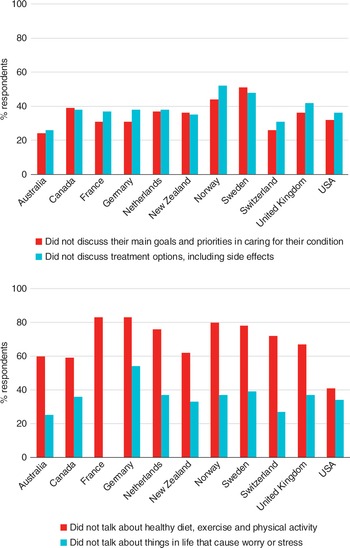
Chronic conditions create a spectrum of needs that require multifaceted responses over extended periods of time, from a range of professionals as well as active patient engagement (Reference Holman and LorigHolman & Lorig, 2000). It is clear that the traditional approach to health care, with its focus on acute, episodic illness, is not suited to meet the long-term and fluctuating needs of those with chronic illness. Instead, services should be centred on the needs of patients and grounded in partnerships between patients and providers working to optimize outcomes (Reference Nolte and McKeeNolte & McKee, 2008). Yet, as data from an international survey among adult people with chronic conditions in 11 countries show, patient involvement in their own care remains suboptimal (Figure 1.1).
Engagement of service users with chronic conditions in their own care, 2016

Fragmentation of services along the care continuum means that patients often receive care from many different professionals or providers, in particular when they have multiple health and care needs. As a result, they are frequently called upon to monitor, coordinate or carry out their own treatment plan. For example, in the aforementioned international survey, between 20% and 40% of respondents who had seen their provider during the past two years reported to have experienced coordination problems, such as the specialist did not have information on their medical history, or they had received conflicting information from different health professionals (Reference OsbornOsborn et al., 2016). Failure to coordinate services along the care continuum may result in suboptimal outcomes, including potentially preventable hospitalizations, medication errors and other adverse events (Reference VogeliVogeli et al., 2007). In addition, there are numerous other negative patient outcomes associated with a lack of coordination that are less well documented, such as anxiety, worry and distress, along with feelings of being lost in the system, frustration and disempowerment (Reference Sambamoorthi, Tan and DebSampson et al., 2015; Reference Schiøtz, Høst and FrølichSchiøtz, Høst & Frølich, 2016), and, ultimately, loss of trust (Reference PedersenPedersen et al., 2013).
Reference OsbornOsborn et al. (2016) further found that among people who have a regular doctor or place of care, between 10% in Australia and the Netherlands and up to 36% in France reported that their doctor did not spend enough time with them and did not explain things in a way they could understand. This can be seen to be of particular concern in light of advances in medical technology, from diagnostic testing to therapeutic treatments and procedures. These provide significant potential for new methods of delivering and organizing health care such as providing care closer to people’s homes in response to changing population health and care needs. But countries have to ensure that any such technology is used effectively and appropriately and at a cost that is affordable, with associated changes carefully balancing growing consumer expectations and respecting people’s needs, wants and preferences (Reference ElshaugElshaug et al., 2017).
At the same time, a growing service user movement, facilitated by modern digital technologies, in particular social media, is challenging the traditional way in which people use health services. Examples include health-related online discussion forums and virtual patient networks for the provision of information about health and health concerns as well as for patient support; the online forum PatientsLikeMe has developed into a clinical research platform that collects and analyses data generated by patients to inform research and practice (Reference Okun and GoodwinOkun & Goodwin, 2017). Virtual user platforms were found to have both positive and negative effects on people, such as enhancing (for example through the experience of positive relations with others) but also reducing subjective well-being (for example producing negative emotions through feelings of worry and anxiety) (Reference SmailhodzicSmailhodzic et al., 2016). They can also affect the patient–health professional relationship, leading for example to more equal communication while also potentially undermining the interaction, such as when the professional’s expertise is being challenged. Online user platforms have considerable potential to inform and promote person-centred care, and possibly person-driven care, especially for those with chronic conditions. Examples include harnessing the knowledge and lived-experiences of patients and their carers, but such approaches have yet to be integrated strategically into practice (Reference Amann, Zanini and RubinelliAmann, Zanini & Rubinelli, 2016).
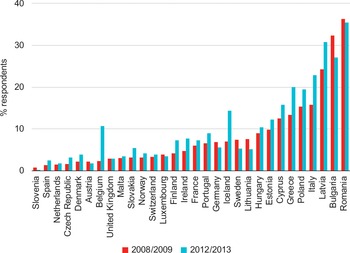
These challenges come against a backdrop of persistent and, in some settings, rising health inequalities and inequities in access to and utilization of health care services. Reference ElstadElstad (2016) analysed data on self-reported unmet need for medical care because of costs, waiting time or geographical distance from the European Union Statistics on Income and Living Conditions (EU-SILC) for the period 2008–2013. This showed that levels of unmet need for medical care increased in most countries but in particular among those populations considered most vulnerable because of their low socioeconomic status and health problems (Figure 1.2). For these populations, unmet need for medical care tended to be higher in countries with larger income inequalities. This highlights that countries with a more equal income distribution had been more able to protect their populations, and vulnerable groups in particular, against worsening access to medical care in the context of economic crises. The findings also suggest that there is a need for a shift from service delivery that simply responds to demand to a service that proactively seeks need, even when it is not voiced as demand, in the knowledge that those whose needs are greatest may be least able to access care. Such a shift will be of particular importance in light of increasing reliance on digital health technologies, which, while having considerable potential to support person-centred systems, may exacerbate social inequalities in health if not carefully designed (Reference Latulippe, Hamel and GirouxLatulippe, Hamel & Giroux, 2017).
Forgone medical care (%) in 2008/2009 and 2012/2013 among disadvantaged populations in 30 countries
Note: disadvantaged defined as (i) being in the lowest income tertile (the lower third of the income distribution in the country sample, age 30–59, in the given survey), and (ii) reporting health difficulties in terms of either a long-standing (chronic) disease or self-rated overall health status as fair or bad.

A health system that is focused on the person at the centre is seen as a means to address these challenges through ensuring (World Health Reference OrganizationOrganization, 2017) that:
everyone has access to the quality health services they need, when and where they need them (equity in access)
safe, effective and timely care that responds to people’s needs and that is of the highest possible standard (quality)
care that is coordinated around people’s needs, respects their preferences and allows for their participation in health care (responsiveness and participation)
ensures that services are provided in the most cost-effective setting with the right balance between health promotion, prevention, and in- and outpatient care, avoiding duplication and waste of resources (efficiency)
that the capacity of health actors, institutions and populations is strengthened to prepare for, and effectively respond to, public health crises (resilience).
Conceptualizing person-centredness: a guiding framework
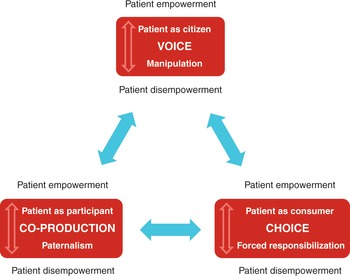
This study was initially guided by a broad framework that builds on a ‘service user typology’ proposed by Reference FotakiFotaki (2013) in the context of governing public services systems. This was developed further by Reference Dent and PahorDent & Pahor (2015), who sought to conceptualize the rise of the idea of ‘patient involvement’ in European health care settings over past decades in an attempt to enable cross-country comparison of strategies and approaches that aim to strengthen the individual’s role in the health system. The framework principally distinguishes three core roles: consumerist, deliberative and participatory, which Reference Dent and PahorDent & Pahor (2015) summarized under the broad headings of ‘choice’, ‘voice’, and ‘co-production’ (Figure 1.3).
The conceptual framework guiding the study

Choice relates to the general idea of the patient or service user as a consumer within the health system. The notion of voice represents the individual patient or service user as a citizen who is actively involved in decision-making (bodies) related to health. Co-production can be seen to be located at the interface between voice and choice and describes how patients or service users engage, individually or collectively, in the delivery of their own treatments and care in partnership with providers (Reference FotakiFotaki, 2013). Although the idea of co-production may be less familiar to readers, it is increasingly seen to be key to public services reforms (Reference OsbornOsborne et al., 2016; Reference PestoffPestoff, 2014) and is gaining traction in the health services and systems literature, too (Reference BataldenBatalden et al., 2016).
These distinctions are not clear-cut, but rather present different roles that individuals can take, at times simultaneously, as a patient, decision-maker, taxpayer and active citizen (Reference CoulterCoulter, 2002). For example, individuals might exert their right to make decisions about the provider they wish to consult (choice), and at the same time participate in decision-making bodies about how to organize delivery (voice) and work with their own provider towards shared decision-making (co-production) to clarify acceptable medical options and choose an appropriate treatment.
The different notions of involvement or ‘person focus’ as conceptualized in Figure 1.3 may have positive outcomes in terms of better quality or service delivery, as well as unintended consequences. Outcomes will also depend on whether the strategy under consideration truly empowers or disempowers individuals (Reference Dent and PahorDent & Pahor, 2015; Reference FotakiFotaki, 2013). For example, policies that use public deliberation processes to legitimize decisions rather than engage the public in a true exchange might be seen to be tokenistic or even manipulative rather than giving a ‘voice’. Likewise, service users might be made responsible for their choices (forced responsibilization), or they are asked to choose from services they have little control over, which weakens the individual’s role in the system.
It is important to emphasize that the framework presented in Figure 1.3 should not be interpreted as a normative model in an evaluative sense. We used it simply as a descriptive frame to categorize and guide our preliminary analyses of individual strategies and systems more broadly. In doing so, we further operationalized the three principal categories at the level of the different tiers of the health system. These include the primary process of patient care (‘micro’ level), the organizational (‘meso’) context and the financing and policy context at system (‘macro’) level, each with distinct rationales and perspectives concerning the delivery of health care (Reference Plochg and KlazingaPlochg & Klazinga, 2002). This structure provided one way of organizing the different themes that will be reviewed in this book, while acknowledging the close links and overlaps between the different roles of service users within the system. We also recognize that alternative frameworks exist, for example focusing on themes related to the challenges of developing coordinated and integrated care from a service provider perspective. Our approach looks explicitly at roles that service users can take, which in turn will have implications for service providers in their attempts to coordinate and integrate services.
Our approach to the analysis
The study as presented in this book was led by the European Observatory on Health Systems and Policies, in collaboration with the Swedish Agency for Health and Care Services Analysis (Vårdanalys). The principal approach is an exploration of key themes of person-centredness, based on a synthesis of the theoretical and empirical evidence from a wide range of mostly high-income countries. The selection of key themes to be explored was guided by an initial expert workshop held in June 2015 and the conceptual framework described above. It is reflected in a series of themed chapters that examine ‘voice’ in the context of public involvement in health care decision-making and research; ‘choice’, of provider, of payer and of services; and ‘co-production’, largely revolving around the individual as a service user in the primary context of patient care.
For each of the themes covered in this book, we commissioned experts with proven expertise to contribute an overview of each selected area. Contributors were identified through a range of sources, including a track record in the relevant scientific literature and an international profile through, for example, membership in advisory groups on the topic under study, further informed by the editors’ own professional networks. Contributors, or teams of contributors, were invited to produce a chapter on the given topic area in line with a set of terms of references developed by the editors. Specifically, authors were asked to set out:
(i) the drivers behind the subject under analysis (how the topic has evolved; what the anticipated impacts in relation to health system performance are);
(ii) measurement issues (how do we know that the subject under analysis has been implemented, and what is the evidence of impact);
(iii) bottlenecks for implementation;
(iv) innovations and future developments; and
(v) policy lessons learned.
Chapter authors were encouraged to give examples of relevant person-centred approaches that have been implemented in European countries for further illustration of the topic area being explored.
Each of the themed chapters was externally peer reviewed by an academic expert in the field and by a service user to ensure that the content of the relevant chapter is covered comprehensively, that it adequately reflects the key issues, in particular those arising from a service user perspective, and that it does not overlook important evidence. A separate review process concerned the study as a whole. It focused on the four framing chapters 1–4 in particular to ensure coherence, appropriateness, relevance and quality.
Outline of the book
While this book takes an explicit systems approach, it should be emphasized that it cannot capture the full complexity of the idea of person-centredness. We see the analyses presented as a starting point for a more critical engagement with a concept that is widely but variously used in different contexts, often without a clear understanding what it is actually meant to convey. Yet, as the brief introduction to this book has shown, a more person-centred approach is expected to address, or perhaps even solve, a wide range of challenges contemporary health systems are facing. We examine a range of perspectives on person-centred strategies to help inform whether and how available strategies are suited to meet these challenges and to guide the development of more informed policies and practices. Inevitably there are trade-offs between the breadth and depth of relevant strategies and approaches that we could have covered in this book. We opted for an in-depth analysis of selected perspectives, recognizing that other, equally relevant, perspectives will have been left out for others to address.
The book is divided into two broad parts. The first part comprises Chapters 1–4, which set out the overall conceptual framework for the work presented in this book and provide a synthesis and analysis of the key themes examined in-depth in the second part (Chapters 5–13). In brief, Chapter 2 explores the evolution of the concept of person-centredness by reviewing insights from the published academic literature and policy documents. It finds that there is wide variation in the terminology and interpretation of the idea of ‘centredness’, reflecting different professional disciplines, perspectives and clinical settings, as well as different regional and country contexts. At the same time, there is agreement on the fundamental ethical premise that patients and service users should be treated as persons, with respect and dignity, and that care should take into account their needs, wants and preferences. Yet beyond this, there remains considerable diversity among different stakeholders in how to translate this common understanding into practice, and it is this diversity that we will need to disentangle in order to understand and inform policy development.
Chapter 3 synthesizes the main insights and lessons that emerge from the in-depth analyses presented in Chapters 5–13, building on the principal framework of voice, choice and co-production as described above. They examine the different roles people take in health systems, from engaging in and leading on health service and system development (Chapter 5) and research (Chapter 6), evaluating the quality of health services and systems (Chapter 7), and making decisions about purchasers or providers of individual care packages and services (or choosing not to do so) (Chapters 8–10), to participating in their own care (Chapters 11 and 12), along with legal frameworks seeking to ensure that people can exercise their rights as taxpayers and citizens (Chapter 13). The synthesis of these in-depth chapters finds that there is a need to move to a more complex model of engagement that considers people’s values and preferences at the level of the individual patient–professional relationship (micro level), as well as the organizational (meso) and the governance and finance, along with wider societal (macro) levels in order to systematically implement person-centred strategies. These issues are then examined further in Chapter 4, which also provides pointers to the range of options, or levers, that show promise in supporting a move to more person-centred care. It discusses some of these options, highlighting the opportunities while also considering problematic issues that need to be overcome in order to move to person-centred health systems.
Who should read this book?
The starting point for this book is the various roles people take in health systems, and it is perhaps fair to say that very few of us will go through life without being affected, directly or indirectly, by the system. This might be as service users, carers, taxpayers or voting citizens, or those working in and with the health system, whether as health professionals, managers or policy-makers, or as representatives of patients, carers or the public more widely. This book will, inevitably, be of most interest to practitioners, managers, representatives of service user organizations and policy-makers, but we hope that there will also be something useful in it for others, including the growing number of researchers in the field. The nature of health care is changing, in many cases quite rapidly. It will be ever more important for those designing, directing and governing services to implement effective approaches and strategies that place individuals, their families and communities at the centre of the health system and enable service users to play a more central and directing role in their own care as well as in shaping the system that serves them. There are no easy answers, and those working in and for different health systems must find approaches that are appropriate to their own circumstances. Yet there is also considerable scope for shared learning from successes as well as failures. This book seeks to contribute to this process.

 Open access