
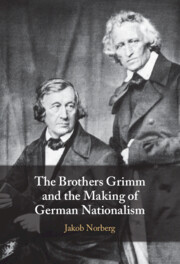
In the first comprehensive English-language portrait of Jacob and Wilhelm Grimm as political thinkers and actors, Jakob Norberg reveals how history's two most famous folklorists envisioned the role of literary and linguistic scholars in defining national identity. Convinced of the political relevance of their folk tale collections and grammatical studies, the Brothers Grimm argued that they could help disentangle language groups from one another, redraw the boundaries of states in Europe, and counsel kings and princes on the proper extent and character of their rule. They sought not only to recover and revive a neglected native culture for a contemporary audience, but also to facilitate a more harmonious and enduring relationship between the traditional political elite and an emerging national collective. Through close historical analysis, Norberg reconstructs how the Grimms wished to mediate between sovereigns and peoples, politics and culture. This title is also available as Open Access on Cambridge Core.
‘… succeeds admirably in exploring and explaining the Grimms’ nationalist commitments.’
Kevin S. Amidon Source: Journal of Folklore Research
‘… synthesizes a large body of work on political thought to create a composite of early 19th-century German nationalism …’
Paul Michael Kurtz Source: The German Quarterly
Loading metrics...
* Views captured on Cambridge Core between #date#. This data will be updated every 24 hours.
Usage data cannot currently be displayed.
This section outlines the accessibility features of this content - including support for screen readers, full keyboard navigation and high-contrast display options. This may not be relevant for you.
Accessibility compliance for the HTML of this book is currently unknown and may be updated in the future.

