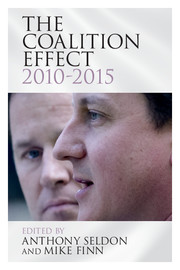
Book contents
- Frontmatter
- Contents
- Contributors
- Acknowledgements
- David Cameron as Prime Minister, 2010–2015: The verdict of history
- Part I The coalition and the government of Britain
- Part II The coalition and policy
- 6 The coalition and the economy
- 7 The coalition and energy policy
- 8 The coalition and infrastructure
- 9 The coalition and society (I): Home affairs and local government
- 10 The coalition and society (II): Education
- 11 The coalition and society (III): Health and long-term care
- 12 The coalition and society (IV): Welfare
- 13 The coalition and foreign affairs
- 14 Europe: The coalition's poisoned chalice
- 15 ‘What the coalition did for women’: A new gender consensus, coalition division and gendered austerity
- 16 The coalition and culture: ‘Bread, circuses and Britishness’
- Part III The coalition and political culture
- Part IV Conclusion
- Index
8 - The coalition and infrastructure
Published online by Cambridge University Press: 05 April 2015

Book contents
- Frontmatter
- Contents
- Contributors
- Acknowledgements
- David Cameron as Prime Minister, 2010–2015: The verdict of history
- Part I The coalition and the government of Britain
- Part II The coalition and policy
- 6 The coalition and the economy
- 7 The coalition and energy policy
- 8 The coalition and infrastructure
- 9 The coalition and society (I): Home affairs and local government
- 10 The coalition and society (II): Education
- 11 The coalition and society (III): Health and long-term care
- 12 The coalition and society (IV): Welfare
- 13 The coalition and foreign affairs
- 14 Europe: The coalition's poisoned chalice
- 15 ‘What the coalition did for women’: A new gender consensus, coalition division and gendered austerity
- 16 The coalition and culture: ‘Bread, circuses and Britishness’
- Part III The coalition and political culture
- Part IV Conclusion
- Index
Summary
This was the government that liked to dress in Dayglo orange, hard hats and safety boots. The outfit became such a staple of ministerial visits that some began to speculate whether the Chancellor left London wearing anything else. The look was an obvious visual cue for the much talked-of ‘long term economic plan’ – hard work, investment and skills in one simple, optimistic shot, endlessly repeated at road schemes, rail yards and businesses all over Britain.
But there was more to it than marketing. After the success of the London 2012 Olympics Britain began to believe once again in the power of building big things. The need to restart economic growth opened minds to new approaches. The word ‘infrastructure’ took on totemic power as a route to post-crash recovery. The BBC started to show long series in prime time about projects such as Crossrail. Broadband and mobile networks became fundamental to commerce and leisure – and the lack of them in parts of rural Britain and the lack of speed and reliability in many other places a long-running sore. There was a sense that communication networks of all kinds, as well as engineering, manufacturing and the apprenticeships which could be linked to them, mattered to national strength as they had not in recent decades, when finance had seemed to hold most of the cards. The term ‘industrial strategy’ began to be dusted down.
The state of infrastructure in 2010
It is true that before May 2010 there were stirrings of change. These came partly from Lord Adonis, the energetic Labour policymaker whose appeal – and past – straddled parties. Although he was the Transport Secretary for less than a year before the election, as a junior minister at the department from October 2008 he had thrown himself into promoting transport as a radical driver of social and economic progress.
Information
- Type
- Chapter
- Information
- The Coalition Effect, 2010–2015 , pp. 209 - 227Publisher: Cambridge University PressPrint publication year: 2015
Accessibility standard: Unknown
Why this information is here
This section outlines the accessibility features of this content - including support for screen readers, full keyboard navigation and high-contrast display options. This may not be relevant for you.Accessibility Information
Accessibility compliance for the PDF of this book is currently unknown
and may be updated in the future.