


19.1 What Can Mined-Out Pacific Phosphate Islands Teach Us about the Limits of the Planet?
At the 79th session of the United Nations General Assembly, the President of the Pacific island nation of Nauru, David Adeang, said that ‘the international community must not let “fear and misinformation” block the exploitation of sea-bed minerals that could be critical to the global energy transition’ (Pearl Reference Pearl2024). Adeang argued that the minerals in the seabed would provide essential ingredients for electric vehicle batteries and other green technologies declaring:
The greatest risk we face is not the potential environmental impacts of mineral recovery, but the risk of inaction …. There is a risk of failing to seize the opportunity to transform to renewable energy and to decarbonize our planet. We cannot let fear and misinformation hold us back.
One of the region’s most respected political analysts, Associate Professor Tarcisius Kabutaulaka of the University of Hawai‘i’s Center for Pacific Islands Studies, responded publicly on Facebook asking: ‘Mining the ocean floor to save the environment? What kind of twisted logic is this? Coming from Nauru, of all places’ (Kabutaulaka Reference Kabataulaka2024).
Kabutaulaka’s confusion resonates with many Pacific scholars and policy folks who are well aware of Nauru’s long history of phosphate mining and the calamitous impacts that German and Australian colonialism and phosphate extraction has had on Nauruan society, culture, politics, economy, and environment. Mined first by a consortium of British, Australian, and New Zealand agricultural interests from the early 1900s, Nauru took over the mining of its own island in 1968, further degrading their environment and reducing its ecological resilience considerably while similarly eroding Nauruan culture, health, traditional knowledge, and sense of place. A hundred and twenty years after mining began, and following the loss of millions of dollars and millions of tons of the island’s surface, it is not surprising that certain Nauruan leaders have turned to the seabed as the next frontier for extraction. Their values align with those of far more powerful actors, particularly in the United States, who have resuscitated the bold, extractive ethos of the industrial age, deliberately ignoring scholars, activists, and communities who have worked so hard to warn others of the limits of our ancestral places, and indeed, the earth’s natural resources.
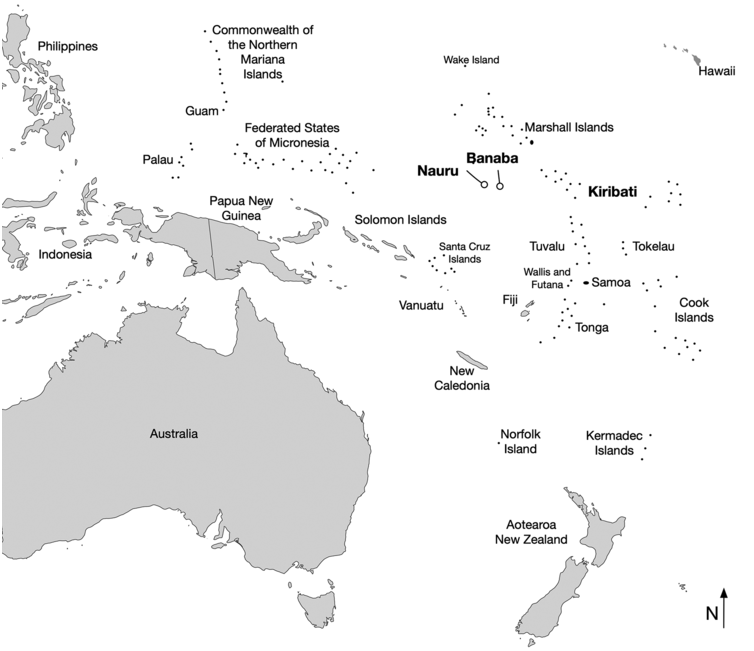
Using the logic of decarbonization to argue for the exploitation (and likely destruction) of another corner of the planet continues a practice of self-sabotage that is well entrenched in the age of calamitous, anthropogenic climate change. I have long studied the impacts of phosphate mining on Nauru’s nearest neighbour, Banaba, also called Ocean Island, and my family’s ancestral home, in what is now the Republic of Kiribati. It is abundantly clear that the colonial introduction of phosphate mining in tandem with Christianity and western economic, legal, and governance systems, on both these islands, dramatically changed cultures that had survived and thrived for millennia on phosphate islands. These island societies were once focused on safeguarding and regenerating their cultures and critical environmental resources. After phosphate rock was identified by an Australian and New Zealand–based British commercial business in 1900, many in these islands were forced to adopt laws, currencies, and industrial lifestyles that were touted as superior to their once sustainable practices and values.
There were two particularly destructive consequences of these changes. The first was the imposition of patriarchy and the removal of women’s political and environmental authority and role to safeguard land and critical resources such as freshwater. The second was the severing of epistemological, ontological, and axiological ties between islanders and their lands and waterways, so that they came to see themselves as above and separate from the islands they once experienced as intimately connected to their own bodies, minds, and spirits. These changes are global in terms of the impacts of European and Asian colonialism and imperialism over Indigenous cultures where these ontologies were fundamental. Such values are captured in Pacific languages where the terms describing people, such as te aba, vanua, whenua, fenua, fanua, and aina, encapsulate both land and people. Banaba, for example, was known as te buto, the ‘navel of the universe’ (Maude & Maude Reference Maude and Maude1932: 265).
The message, from the British and antipodean phosphate stakeholders, was that mining and the conversion of phosphates into fertilisers were for the good of humankind (K. Teaiwa Reference Teaiwa2014). It was viewed to be critical for mass agriculture, critical to feeding rapidly expanding global populations, and critical to developing farming-based settler colonies such as Australia and New Zealand. In the United States, the Guano Act of 1856 not only signalled the strategic value of phosphate – in this case in the form of more easily accessible bird and bat droppings, such as guano (Cushman Reference Cushman2013) – but also a strategy for acquiring more territory in a critical region between the United States, Russia, and East Asia. Many of these islands are now part of the Pacific Islands Heritage Marine National Monument covering 1.2 million square kilometres of the Pacific Ocean and governed by the US Fish and Wildlife Service. This is 1.2 million square kilometres of potential ocean for deep sea mining and other forms of marine exploitation.
Between the seventeenth and mid twentieth centuries, colonial, capitalist actors and interests in settler colonies, and across agricultural enterprises and commodity chains, appropriated lands, appropriated labour, and removed the ability for slaves, their descendants, and most Indigenous populations to have access to the resources they needed for sovereign capabilities and self-determination. It was no different in the Pacific. Banabans and Nauruans were forced to give up their islands to miners and farmers from Australia, New Zealand, and across the British Empire, resulting in severely ruined landscapes, waterways, and cultures (K. Teaiwa Reference Teaiwa2014).
19.2 Planetary Boundaries
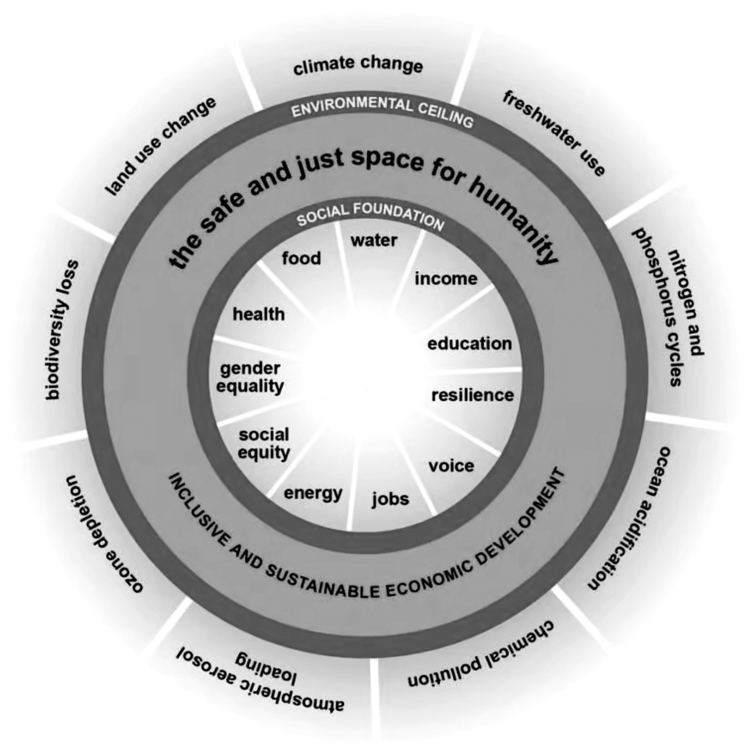
In 2012, Kate Raworth, a senior research analyst with Oxfam in Britain, proposed a conceptual and visual framework which brought the concept of planetary boundaries outlined by Johan Rockström and his colleagues at the Stockholm Resilience Centre, together with that of social and moral boundaries (Stockholm Resilience Centre n.d.). Imagined as a global-scale compass shaped like a doughnut (Figure 19.1), the framework aimed to chart the course between sustainability, on the one hand, and justice and equity between nations, on the other (Raworth Reference Raworth2012). Raworth’s goal was to create a safe and just space between the social and environmental imperatives in which humanity can thrive. This, she argues, requires equity in the use of natural resources and greater efficiency in transforming those resources to meet human needs.
The ‘Doughnut’ for a safe and just planet. The 11 dimensions of the social foundation are illustrative and were based on governments’ priorities for Rio+20. The nine dimensions of the environmental ceiling are based on the planetary boundaries set out by Rockström et al. (Reference Rockström, Steffen and Noone2009). The material ‘A safe and just space for humanity: can we live within the doughnut?
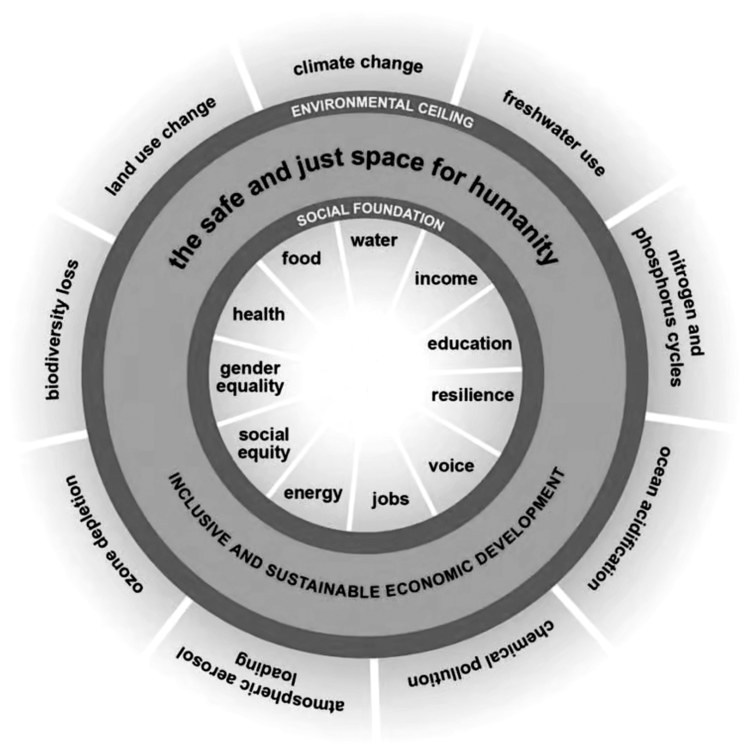
Figure 19.1 Long description
The diagram shows the following details. The inner ring is labeled, social foundation with 11 elements namely, water, income, education, resilience, voice, jobs, energy, social equity, gender equality, health, and food. The outer ring is labeled, environmental ceiling. In between the two rings is the safe and just space for humanity with inclusive and sustainable economic development. Beyond the outer ring are nine planetary boundaries namely, climate change, freshwater use, nitrogen and phosphorus cycles, ocean acidification, chemical pollution, atmospheric aerosol loading, ozone depletion, biodiversity loss, and land use change.
It is worth sharing Raworth’s own summary of her integrated vision which is also a compass of sorts, to guide policymakers through decision-making, and the interlinked systems:
The Doughnut raises four key implications for the pursuit of human wellbeing in the Anthropocene. First, it highlights the dependence of human wellbeing on planetary health…. The best chance of enabling a life of dignity and opportunity for more than 10 billion people over the coming century therefore depends on sustaining Holocene-like conditions, such as a stable climate, clean air, a protective ozone layer, thriving biodiversity, and healthy oceans. Second, the concurrent extent of social shortfall and ecological overshoot reflects deep inequalities – of income and wealth, of exposure to risk, of gender and race, and of political power – both within and between countries. The Doughnut helps to focus attention on addressing such inequalities when both theorising and pursuing human wellbeing. Third, the Doughnut implies the need for a deep renewal of economic theory and policymaking so that the continued widespread political prioritisation of gross domestic product growth is replaced by an economic vision that seeks to transform economies, from local to global, so that they become regenerative and distributive by design, and thus help to bring humanity into the Doughnut. Last, the Doughnut might act as a 21st century compass, but the greater task is to create an effective map of the terrain ahead. Thanks to ongoing socioecological systems research, this century is likely to be the first in which humanity begins more fully to understand and appreciate the complex interdependence of human wellbeing and planetary health.
Agricultural scientists have long argued that industrial and mass agriculture is necessary to feed the planet’s rapidly expanding population, predicted to increase to almost 10 billion people by 2050. But mass agriculture utilizing limited resources such as phosphate has primarily transformed diets, particularly in the developed world, increasing consumption of meat and dairy products that require large-scale animal and mono-cropping operations. One would have hoped that in the twenty-first century there would be more sophisticated, equitable, and sustainable techniques harnessed to feed the planet than those applied during the Green Revolution of the 1950s that relied on the breeding of high-yield crops, and application of pesticides and fertilizers. But in addition to the pollution generated, and the overconsumption of water and fuel to power these industries, agricultural technologies have actually generated excessive and inessential food and related products that provide an abundance of choice for industrial nations while depriving Indigenous and other smaller societies of the relatively sustainable agriculture, soil- and water-based knowledges, food varieties, and techniques they once employed.
Political choices across many powerful countries today indicate that the manipulation and re-shaping of our natural environment for human consumption based on wants, rather than needs, have not changed much over time. The lack of real commitment to climate change goals and mechanisms that emerged from the Conference of the Parties (COP) meetings since the 1990s is but one indicator of the global appetite, or lack thereof, for real change. While many global consumers express care for sustainably sourced and manufactured products, they are simultaneously as likely to vote for leaders with values that undermine any real gains made on the sustainability and equity fronts. Or, they are unaware or apathetic to the ways in which the wealthiest of industries and players, from the tech conglomerates and retail, to oil, gas, and weapons manufacturers, are deeply uninterested in sacrificing wealth for planetary and species health.
Breaching the thresholds of the planet’s nine essential terrestrial, aquatic, atmospheric, and biogeochemical systems, including the nitrogen and phosphorus cycles, is what Rockström and his colleagues strongly cautioned against in their model. Raworth’s framework grounded all this in the social, political, and moral contexts that drive many of the extractive decisions and practices in the first place. But there is far more that drives people, both everyday folks and the disproportionately wealthy, beyond scientific, environmental, social, political, and moral imperatives or threats.
19.3 Phosphate Stories
Phosphorus is not an infinitely abundant planetary resource (Elser & Haygarth Reference Elser and Haygarth2021). And yet, as highlighted by Rockström and colleagues, along with nitrogen, phosphorus is absolutely essential for life on Earth. The majority of the world’s phosphate reserves are concentrated in a few countries including Morocco, with over 70 per cent of the world’s known phosphate rock reserves; China, a major producer of phosphate, though its reserves are relatively smaller than Morocco’s; the United States with significant reserves, primarily in Florida; and Russia and Jordan, along with smaller sources in other lands. While the size of these reserves is relevant to global markets, the quality of the phosphate is just as important. In fact, the mined-out Pacific islands yielded some of the world’s highest quality, and most easily accessible, phosphoric acid, which is the critical ingredient in agricultural fertilisers (K. Teaiwa Reference Teaiwa2014).
In the late 1800s when British, Australian, New Zealand, French, and German prospectors were scouring the Pacific looking for guano and phosphate rock supplies to manufacture these important phosphate fertilizers, they frequently used the phrase ‘for the good of mankind’, to justify the destruction of island landscapes, the use of low-paid labour, and the displacement of communities and cultures. One might consider Raworth’s attempts to bring questions of equity and justice into conversation with those of food security, environmental and human sustainability and wonder how the needs of small, Indigenous groups fit into the equation. This is particularly challenging when assumptions of scale and significance are at stake: feeding 8 billion humans today and 10 billion in the near future versus a couple of thousand disposable islanders.
Indigenous rights are now more widely recognized than they were on Banaba and on Nauru in the early twentieth century when massive phosphate mines extracting millions of tons of phosphate were in full industrial swing (Williams & Macdonald Reference Williams and Macdonald1985). Banabans and Nauruans had lived in their home islands sustainably for over two thousand years, and yet their traditional knowledge of resilience and effective use of natural resources, like that of many Indigenous peoples, was and is still not valued.
Today, Banaba in particular is a decimated landscape with rusted, dilapidated infrastructure, asbestos, and dozens of artefacts of science, progress, and industry lying in a state of waste and ruin. In my earlier work, primarily utilizing family, archival, and cultural sources, I took a close, ethnographic, historical, multi-sited, and multi-scalar look at the lives of Banaban landowners, mining company workers, and the families of mining management and labourers, alongside the transformation of our tropical, ancestral island landscape into a global industrial hub and, eventually, a mining ghost town. I found the format of text, of journal articles and a book limiting in terms of the kinds of visual, archival, and oral resources I was drawing upon, and the forms of embodied and cultural tactics that Banabans utilized to resist the displacement of their lands and their own communities. Text alone did not adequately capture how Banabans were forced to cross many cultural taboos, boundaries, and thresholds that would not have been imagined before prospectors from Australia and New Zealand landed on their shores (but see a celebration of that colonial history in Williams and Macdonald (Reference Williams and Macdonald1985)). Ignoring such, often quite gendered, boundaries opened up spaces for extraction and environmental degradation that had never existed before.
For example, young Banaban women were the only people allowed into underground water caves, or bangabanga, to collect fresh drinking water for their communities. These were the only sources of potable water on an island with no wells, rivers, or streams. The bangabanga were some of the first spaces white men requested to explore while prospecting in order to map the required resources to support the mining enterprise. This quickly undermined women’s social and political authority as their roles to hold land, water, and culture were thrust aside by the patriarchal and conservative Christian mining and colonial personnel who quickly took over island governance while cultivating their own Banaban, male allies (K. Teaiwa Reference Teaiwa2014).
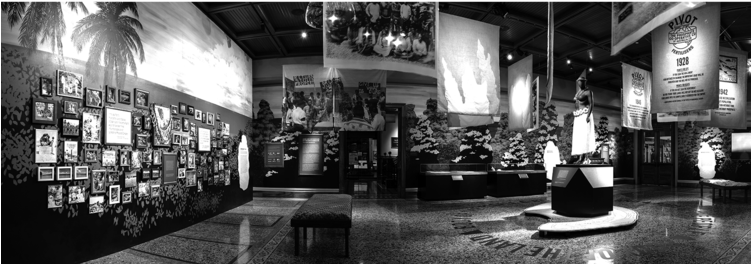
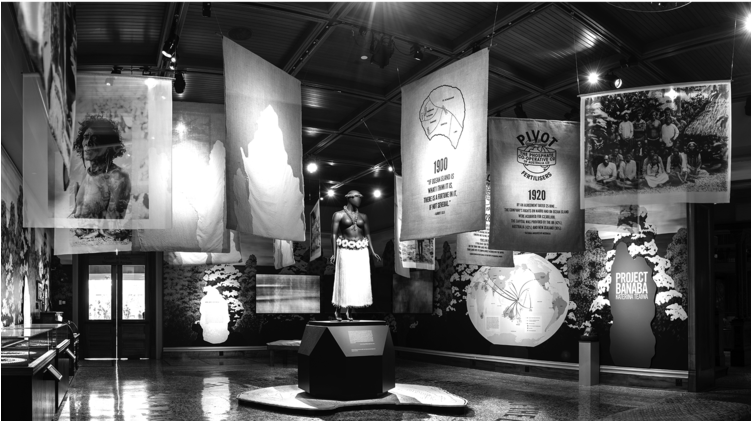
Thinking critically about what was lost in this process, I expanded insights from my book into a multimedia exhibition in 2017 (Figures 19.2 and 19.3a,b). I utilized stories and photographs from the vast Australian and New Zealand phosphate archive and my own embodied research on Banaba, Tarawa, Tabiteuea (both sources of phosphate mining labour), and on Rabi where Banabans were displaced in 1945. Like most Banabans, I-Kiribati, and Fiji Islanders, I had grown up learning cultural and other dances and was able to harness methods and tools from the choreographic context, to better understand how islanders remembered and resisted their challenging histories.
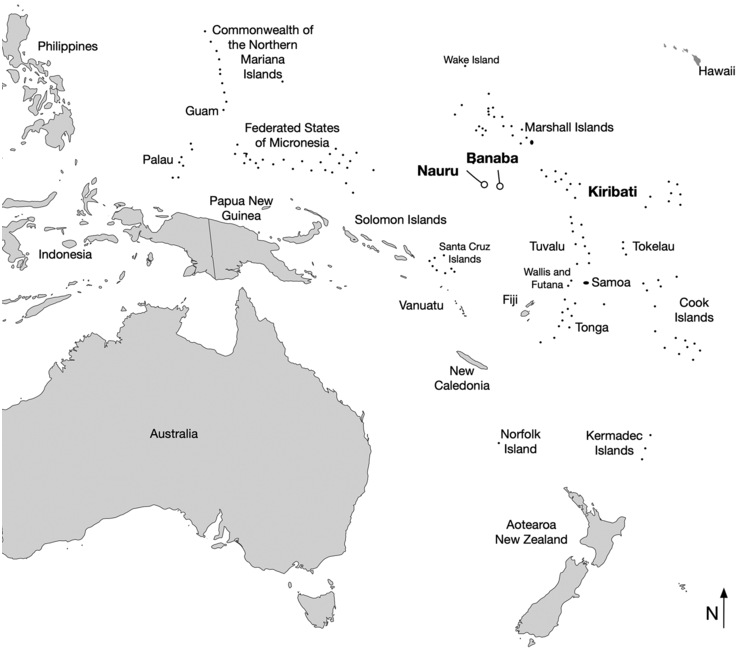
A map of Banaba.
Project Banaba by Katerina Teaiwa curated by Yuki Kihara, Joy Enomoto, and Healoha Johnston, 2023–2024. Bishop Museum, Honolulu. Exhibition stills by Gui Taccetti. In these images, a multi-sited and multi-temporal sense of the impacts of mining is reconstructed in a gallery where you can journey through 80 years of mining in visual, textual, and audio-visual forms.
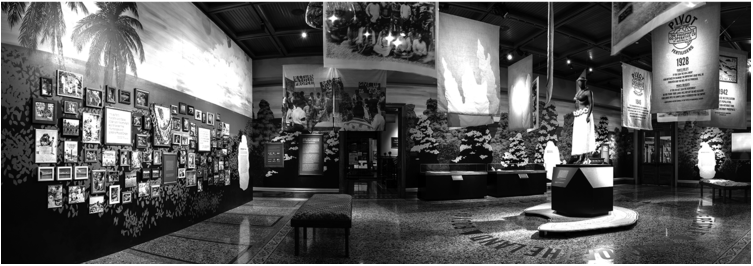
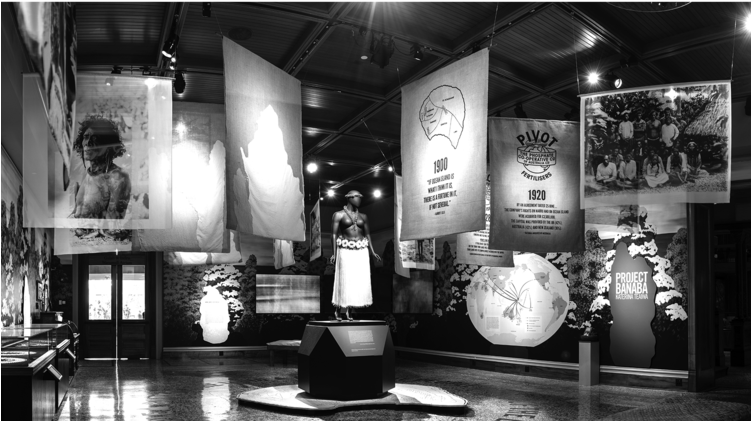
The exhibition followed the history and routes taken by the Pacific Islands Company, The Pacific Phosphate Company, and the British Phosphate Commissioners over almost a century of mining on Nauru and Banaba (Figure 19.2). The show has travelled from Sydney in Australia where Nauruan phosphate was discovered and Banaba identified as a geological phosphate twin, to Napier and the Hawke’s Bay in 2019 where millions of tons of Pacific phosphate was processed and distributed to farms across New Zealand. It also travelled to Auckland in 2021 where one of the company headquarters were based, and to Honolulu in Hawai‘i in 2023–2024 where shipments of phosphate were received for use on American plantations.
My exhibition attempted to move the stories of phosphate beyond academic institutional, scholarly, and disciplinary boundaries, into public spaces where families, and people of all ages, could reflect on one critical ingredient to grow the food that has nourished many generations of settlers in the antipodes. The science of global agriculture in the twentieth century mandated that phosphate fertilizer was key to fuelling the chain of agricultural commodities, but at what costs, ethically and materially, to Pacific Islanders? As humanity seeks to find new technical solutions to food challenges, whose lives, lands, and waterways will be improved or transformed, and whose will be ruined?
All living organisms require daily phosphorus intake to produce energy and the element of ‘P’ cannot be replaced; there is no synthetic substitute. Phosphate fertilizers that agribusiness was so hungry for in the nineteenth and twentieth centuries were manufactured, globally distributed, and allowed humans to double their food production. Food production was doubled, but many were deprived of food and sustainable resources in the process. Much phosphorus, after undergoing chemical transformation, is wasted and not cycled back into the system but enters others, like waterways, and wreaks havoc on those systems (Brownlie et al. Reference Brownlie, Alexander and Cordell2024). Through mass agriculture, we have profoundly altered the planet’s natural cycles for maintaining and keeping the flow of phosphorus and nitrogen in forms that are long-term and sustainable (Egan Reference Egan2023).
19.4 Repairing Islands?
What can Pacific Islands teach us about the limits of the planet? In many ways the scale of industrial activities on islands across Oceania provides rich opportunities to reflect on global challenges. Banaba is 6 square kilometres of rock that yielded over 22 million tonnes of phosphate for fertiliser. The size of a landscape tells us nothing about its depth or its value for global food production, which, in the case of Nauru and Banaba, was significant. I became an academic not to enrol in a field or discipline and devote my career to furthering its theories and methods, but to find out what happened to Banaba and why. I stayed in academia because such institutions gave me space to investigate why we were wrenched from places that had sustained our ancestors for millennia.
My research on phosphate histories and their impacts on peoples and environments could be summarized into three questions that I contemplate almost daily and that have truly shaped my transdisciplinary career. The first is: how do we research and teach in ways that are inspired and motivated by issues of justice, transformation, healing, and well-being? Neither the scientific imperative of objectivity nor the false rationality of neoliberal economics provides pathways towards Indigenous or environmental justice. As I have become more involved with Banaban activism on the ground and observed economic initiatives by Banabans and Nauruans who now subscribe to colonial and extractive approaches and values, I’ve focused more on the need for environmental, social, and spiritual healing, repair, and well-being on both Rabi in Fiji, and Banaba in Kiribati. Such opportunities to critically reflect on the intergenerational and structural consequences of mining have rarely happened for Banaban communities.
The second question is: how do we share such work towards healing and repair in forms and formats inspired by the records, materialities, environments, values, practices, and lives of the communities (and places) we work with and belong to? This is an older challenge based on various attempts to draw, dance, perform, and story my way through tertiary teaching, learning, and research while dodging the institutional pressure to be trained, rigorously, in specific theories, methods, and ways of presenting knowledge. My background, before postgraduate studies, was in the natural sciences, dance, media, and visual arts, and as I began to study Banaba, I found myself in spaces such as history and anthropology that had little interest, or skills, in producing knowledge in other forms – including the visual, embodied, choreographic, or oral, that harmonized with what their informants and sources were teaching them.
I have learned a lot from students who increasingly identify themselves as neurodiverse, recognizing that I probably would’ve needed to do the same as an undergraduate, but didn’t have the language to explain why the standard approaches to teaching, learning, and assessment gave me such high levels of anxiety. While the reality of being in a perpetual state of fight or flight in an unstable world is better understood today, I’m not sure any of us has a handle on the intergenerational trauma that embeds this hyper-awareness of being unsafe in our blood, our organs, our bones, muscles, and across all senses. If you are of the land, and the land is of you, I can imagine the clearing, the blasting, the digging, the removing, the drying, the loading, and the shipping of pieces of the land leaves your body feeling quite unsafe. So, I’ve tried to dance in ‘weird’ spaces, to push the boundaries of fields filled with scholars who need explanations for what is going on, and for why anyone is trying to move beyond the boundaries of disciplinary genealogies, legacies, and norms (K. Teaiwa Reference Teaiwa, Davis and Rae2024). Twenty-plus years of back pain later, I have been experimenting with telling Banaban stories in ways that require audiences to move, to listen, to watch, to wayfind through 124 years of Banaban attempts to have stable, joyful, and efficacious lives.
The third issue, which is a very live and sometimes daily issue depending on what’s happening amongst my family, leaders, and communities on Rabi Island, on Banaba, and across Fiji and Kiribati is: how do we move beyond these disciplinary and institutional genealogies, legacies, and norms to empower Pacific islanders to work towards healthy, non-extractive futures (K. Teaiwa Reference Teaiwa, Davis and Rae2024)? The recent and now-persistent interest of Australian and other mining companies to explore and potentially extract remaining phosphate and limestone pinnacles from Banaba has revealed that very little has changed amongst some Banabans who now view their ancestral island as relatively dead, disposable, and a quick road to imagined wealth. They speak of ‘my land’ and ‘our lands’ like property in the capitalist sense, but with an assumption that there is a deep and forever wellspring of phosphate for long-term prosperity. These contemporary Banabans do not resemble pre-mining ancestors who, even in the face of devastating droughts at the end of the nineteenth century (Maude & Maude Reference Maude and Maude1994), climbed aboard slave ships travelling to Tahiti and Hawai‘i and committed to returning and repopulating their home island because it was te buto and te aba – the body of the land and the body of the people. Many Banabans today are locked in an almost 124-year-and-counting pattern of extraction, dispossession, celebration, desperation, creative survival, and the search for saviours and ‘big men’, like the miners and colonial officials who mined out their lands, to lead them to a biblical promised land (Silverman Reference Silverman1971). Thankfully, there are also courageous Banabans on Rabi and across Fiji and Kiribati, such as the Banaban Human Rights Defenders. Led by inspired youth following global climate activist Itinterunga Rae Bainteiti, and elders such as Pelenise Alofa and Toanuea Taratai, these folks embody the care, resistance, and activism of their Banaban forebears, including many women, who attempted to safeguard their lands, culture, and environment.
19.5 Islands and Planets
The framework of planetary boundaries, its warning about critical thresholds for nine essential processes for the global system, is a powerful, useful, and great forecasting tool that also completely misses the things that lead to such boundaries being crossed – the politics and the social and cultural values driving capitalism, consumption, colonialism, land grabbing, and other damaging human practices. Kate Raworth’s doughnut gestures towards but does not fully grasp the materiality or spirituality of severing peoples from places. We need a moral, social, ideological, and spiritual boundary that indicates clearly where human values and practices have exceeded the well-being of planet and people.
In 2025, particularly after the re-election of Trump in the United States, and an administration in the world’s most powerful government filled with conservative Christians, tech billionaires, climate deniers, and leaders tearing down programmes that focus on social, environmental, and planetary equity, sustainability, and well-being, ruination at a much larger scale than tiny Banaba or Nauru is most likely. War, death, and genocide have and continue to rage across our world and such state-sanctioned, state-supported violence certainly crosses critical life-giving thresholds.
The concept of planetary boundaries has certainly helped visualize the intense impact of the Anthropocene on planetary systems, and Banaba with its rich phosphate has been one significant source of phosphorus for eight decades. But if the flows of phosphorus are critical to those humans thinking about and coming up with solutions for living within environmental means, surely what happened to Banaba, to ‘Ocean Island’, as tiny as the island is, is an important and sobering lesson for the whole planet.
Islanders and most Indigenous peoples understand the power and purpose of both connections and boundaries. I learned much of this from my elder sister, Teresia Kieuea Teaiwa, who passed away in 2017 after a short, but deeply impactful, life of Pacific scholarship, teaching, activism, and poetry that critiqued the colonial, political, and gendered manner in which Pacific peoples, and particularly Pacific women, had been robbed, forced, and gaslit out of their lands, dignity, sovereignty, and self-determination at all levels. She taught me that what happens to the land happens to the people; what happens to the ocean and to the island, happens to the whole planet. Teresia’s poem “To Island” (T. Teaiwa Reference Teaiwa and Baldacchino2007) was transformed into a poignant, animated story by Mana Moana, a collective of artists who produced video works for COP27 to amplify and support Pacific initiatives to drive global action to reduce greenhouse gas emissions. She wrote:
Shall we make ‘island’ a verb? As a noun, it’s so vulnerable to impinging forces. Let us turn the energy of the island inside out. Let us ‘island’ the world! Let us teach the inhabitants of planet Earth how to behave as if we were all living on islands! For what is Earth but an island in our solar system? An island of precious ecosystems and finite resources. Finite resources. Limited space. The islanded must understand that to live long and well, they need to take care. Care for other humans, care for plants, animals; care for soil, care for water. Once islanded, humans are awakened from the stupor of continental fantasies. The islanded can choose to understand that there is nothing but more islands to look forward to. Continents do not exist, metaphysically speaking. It is islands all the way up, islands all the way down. Islands to the right of us, islands to the left. Yes, there is a sea of islands. And ‘sea’ can be a verb, just as ‘ocean’ becomes a verb of awesome possibility. But let us also make ‘island’ a verb. It is a way of living that could save our lives.

 Open access