


In 1946, Shriman Narayan Agarwal, a disciple of Mahatma Gandhi (and later the governor of Gujarat), wrote a proposal laying out the principles for a future Indian constitution.Footnote 1 In the introduction to his proposal, Agarwal argued that India should not base its constitution on Western models. Instead, it should create a “swadeshi” (that is, made in India) constitution, one which would reflect “our national genius, culture and traditions.” India, he explained, “is a very ancient land.” It experimented with various forms of government “at a time when Europe and the New World had not even come within the pale of civilization.” It would be “a great insult to India” to create a constitution that would be based on a mixture of rules taken from the West. “Administrative systems cannot and should not be transplanted,” he asserted. Each nation “has its unique culture and civilisation which may be called its ‘Soul.’ … we have aped the West for long,” he concluded, “let us now be proud of our Indian culture and institutions.”Footnote 2
Benegal Narsing Rau was one of India’s leading jurists and diplomats in the early postcolonial period. He also served as an advisor to the Indian Constituent Assembly. In an article he wrote in 1949, Rau discussed the choice that faced the Indian Constituent Assembly between a presidential and parliamentary system of government. Rau chose to analyze this topic not by turning to Western constitutional models. Instead, he suggested that it would be profitable to “take a peep into the history of India … and see how far her people have been accustomed to the theory and practice of parliamentary modes of government.” Rau then remarked that while ancient Indian states were mostly monarchies, kings were expected to heed the advice of their ministers, who, in turn, were responsible to the people. He also noted that one can find ancient Indian texts dealing with procedures in assemblies, which “anticipate to an astonishing extent” the rules prevalent in modern parliaments. Therefore, he concluded, parliamentarism was a concept that was familiar to the ancient Indians.Footnote 3
The particularist and historicist approach to constitution-making evident in both Agarwal’s and Rau’s works expressed, in the realm of public law, the Western historicist jurisprudential notions about the relationship between the “spirit” of a people and its laws that we encountered in the previous chapters. Montesquieu already argued, in the eighteenth century, that each nation had its own unique constitutional forms.Footnote 4 This idea later appeared in the works of the leader of the German Historical School, Friedrich Carl von Savigny, who declared that “in the earliest times to which authentic history extends, the law will be found to have already attained a fixed character, peculiar to the people, like their language, manners, and constitution [verfassung].”Footnote 5 It was also common among nineteenth-century English political thinkers.Footnote 6 In India, these ideas can be traced back to a body of works that emerged in the early decades of the twentieth century in connection with the newly reformed University of Calcutta. These works – which can be collectively called the “Hindu polity” literature – analyzed the history of ancient Indian political ideas and institutions and also sometimes discussed ancient Indian public law, or more specifically, constitutional and international law.Footnote 7 Both Agarwal and Rau cited the Hindu polity literature.Footnote 8 In this chapter, I explore this literature.Footnote 9
I begin with a brief description of how constitutional law and international law were taught in England and India in the late nineteenth century. I will then offer a group portrait of the authors who produced the Hindu polity literature. Next, I turn to several significant themes in these works, which stood at the intersection of history, political science, and constitutional law.Footnote 10 I conclude by analyzing the general characteristics of this literature and the context which gave rise to it.
The Study of Constitutional and International Law in England and India
Constitutional law gradually emerged as a distinct subject in English legal education only in the second half of the nineteenth century. Before that time, it was intertwined with other subjects. Thus, the first book of Blackstone’s Commentaries on the Laws of England, published in 1765, which was based on lectures that Blackstone delivered at Oxford, dealt with subjects that we would now regard as belonging to constitutional law but also discussed administrative law, family law, labor law, and corporate law.Footnote 11
The first professor of “English law and jurisprudence” at King’s College, London, was John James Park, appointed in 1831. His book, The Dogmas of the Constitution, was published in 1832. However, shortly thereafter, in 1833, Park died, and subsequent professors of law at King’s College had little interest in constitutional law.Footnote 12 Decades later, in the 1870s, Sheldon Amos served as the University of London examiner in constitutional law and history and wrote on the topic.Footnote 13 Constitutional law was also taught, beginning in 1850, at Queen’s College, Birmingham and at Haileybury College, where the East India Company trained its administrators until 1858.Footnote 14
Five Readers teaching both constitutional law and legal history were appointed at the Inns of Court in 1852 – the same year that a Bachelor of Civil Law degree was introduced at the University of Oxford.Footnote 15 At Oxford, too, English constitutional law was first taught solely as part of the exam on the history of English law. It was only in 1886 that a paper on constitutional law per se was required of students.Footnote 16 During this period, English history professors such as William Stubbs and Edward Freeman published leading works on English constitutional history.Footnote 17 In the first decades of the twentieth century, the emphasis on history in the study of constitutional law at Oxford declined; administrative law was also added to the curriculum, and more attention was paid to the analysis of the case law relevant to modern constitutional law.Footnote 18
The teaching of a topic related to constitutional law – international law – at English universities followed a similar trajectory of gradual growth. A Chair in International Law and Diplomacy was established at Oxford in 1859, and international law was one of the four examination topics at the Oxford School of Law and Modern History in the last decades of the century.Footnote 19 At King’s College, international law was taught in the second half of the nineteenth century by Leone Levi, who wrote mainly on commercial law but also published two books on international law in 1855 and 1887.Footnote 20
In India, too, the teaching of constitutional law developed gradually. At the beginning of the twentieth century, constitutional law was not taught at any of the law colleges affiliated with the University of Calcutta, although Indian constitutional law was taught at the Madras Law College.Footnote 21 By the 1920s, however, constitutional law had become one of the four topics of the preliminary exams for bachelor of law students at the University of Calcutta.Footnote 22 Constitutional and administrative law also became part of the curriculum of the MA program in Political Philosophy and Political Economy.Footnote 23 In addition, the MA program in Ancient Indian History and Culture required extensive study of ancient Indian constitutional history. Several Tagore Law Lectures delivered during the first decades of the twentieth century dealt with various topics related to modern constitutional and administrative law.Footnote 24
Public international law was not taught at the University of Calcutta College of Law in the early decades of the twentieth century, although private international law was a compulsory subject of the Master of Law degree.Footnote 25 However, public international law was mandatory for all postgraduate students in History and those studying Political Philosophy and Economics at the university. A Chair in International Law, held by Arthur Brown, was established in the 1920s. Foreign international law scholars such as Harvard University professors Manley O. Hudson and George Grafton Wilson also lectured on the topic there in the 1920s.Footnote 26 International law, too, was the subject of several University of Calcutta lecture series.Footnote 27
Some constitutional law teachers at the University of Calcutta focused mainly on the modern era – that is, on the constitutional arrangements of colonial India. For example, Naresh Chandra Roy, a professor of history and political science at City College Calcutta and a lecturer at the University of Calcutta, published several works on the constitutional and administrative structure of British India.Footnote 28 Jyoti Prasad Sarvadhikari, who taught constitutional law and Hindu law at the University of Calcutta College of Law, also published a book on modern constitutional law in the late 1920s.Footnote 29 However, there were many people affiliated with the University of Calcutta whose research was devoted to the study of ancient Indian constitutional history, often as part of a broader interest in the nature and institutions of ancient Indian states.
Authors
This section offers a collective portrait of the authors of the Hindu polity works.Footnote 30 Unlike Pal and Eisenstadt, discussed in Part II of this book, there is less biographical information about most of the authors that I will discuss here. Nevertheless, they seem to have shared some similar traits. Many belonged to the same age group – born in or around the 1880s and coming of age in the first decade of the twentieth century. Most were educated in colleges affiliated with the University of Calcutta, and many later taught there or were associated in some other way with this institution. A few authors worked in other locations, but even in this case, they often had some link with the University of Calcutta.
Indian historians were already writing works on the history of India, inspired by Western models, in the nineteenth century.Footnote 31 Interest among Indian scholars in ancient Indian constitutional history became evident in the first decade of the twentieth century.Footnote 32 However, this interest received a significant boost with the discovery, in the South Indian city of Mysore, of the most important ancient Indian treatise on statecraft, the Arthashastra (translated as “the science of government” or “the science of wealth”) in the first decade of the twentieth century. This treatise was traditionally attributed to the fourth-century BC Indian philosopher and statesman Chanakya (also called Kautilya), an advisor to the first Mauryan Emperor, Chandragupta. The manuscript of this treatise was discovered sometime before 1905 by Rudrapatna Shamasastry, the Chief Librarian of the Mysore Government Oriental Library. Shamasastry began publishing translations of sections of the Arthashastra in 1905, and an English translation of the entire work was published in 1915.Footnote 33
The founding father of the Hindu polity literature was Kashi Prasad Jayaswal. Jayaswal, born in 1881, came from a low-caste (kalwar) but wealthy family. He studied history at Oxford and was also called to the English Bar. In England, he also came into contact with Indian nationalist revolutionaries and became a follower of the Hindu nationalist activist V. D. Savarkar. Jayaswal returned to India and settled in Calcutta in 1910, working there as a lawyer. He accepted the invitation of the Vice Chancellor of the University of Calcutta, Asutosh Mookerjee, to join its Department of Postgraduate Studies, but the British blocked his appointment because of his “seditionist” political views. Jayaswal moved to Patna in 1914, working there as a lawyer, journalist, and scholar.Footnote 34 Despite the move to Patna, Jayaswal’s affiliation with the University of Calcutta continued even after his relocation, ultimately resulting in an invitation to deliver the Tagore Law Lectures in 1917.Footnote 35
In 1913, Jayaswal published an article entitled “An Introduction to Hindu Polity” in the Calcutta nationalist magazine, The Modern Review (based on earlier articles published in 1911 and 1912). Here, he sought to show that, until the modern era, Indian governmental institutions had been “at par if not superior” to Western ones.Footnote 36 Such was the response to the publication that it prompted a trend of similar works.Footnote 37 Jayaswal continued working on the topic, publishing a two-volume book on Hindu polity in 1921.Footnote 38
Other authors followed in Jayaswal’s footsteps. Many of these were scholars who were educated and then taught at the University of Calcutta: Narendra Nath Law taught law, history, and philosophy at the university.Footnote 39 Pramathanath Bandyopadhyay (or Banerjee) also taught law and history. He was the Principal of the College of the Law in the late 1930s, and in 1946 he replaced Radhabinod Pal as the Vice-Chancellor of the university.Footnote 40 Pramatha Nath Banerjea, who studied at the Inns of Court, and also obtained a doctorate in economics from the University of London, was a professor of Economics.Footnote 41 Benoy Kumar Sarkar was a leading nationalist and pan-Asian intellectual in early twentieth-century Bengal. He became actively involved in the National Education Movement, the educational wing of the nationalist Swadeshi Movement which emerged in Bengal in 1905 in response to the British decision to partition the province. He later taught at the Department of Economics of the University of Calcutta, becoming head of the department in 1947.Footnote 42 Devadatta Ramakrishna Bhandarkar was the second Carmichael Chair of Ancient Indian History and Culture at the Department of History of the University of Calcutta, a chair established by Asutosh Mookerjee in 1912.Footnote 43 Bhandarkar’s successor as the Carmichael Chair was Hemchandra Raychaudhuri.Footnote 44 Upendranath Ghoshal was a professor of history at Presidency College in Calcutta and a lecturer at the Departments of History and Politics at the University of Calcutta.Footnote 45 Narayan Chandra Bandyopadhyaya lectured at the University of Calcutta Departments of History and Anthropology.Footnote 46
Interest in ancient Indian political ideas and institutions was not limited to the law professors, economists, and historians teaching at the University of Calcutta. Scholars teaching at other Indian higher education institutions during the last decades of British rule in India were also interested in the topic. Often, these scholars were affiliated in some way with the University of Calcutta, either because they studied there during the heyday of interest in the subject in the 1910s or because they were invited to teach or lecture on the topic at Calcutta. This group included three scholars who completed their doctoral dissertations at the University of Calcutta during the 1910s. Radhakumud Mookerji earned his doctorate in 1915. He taught at the Bengal National College, a nationalist institute of education in Calcutta, moving in 1916 to Benares Hindu University, then to Mysore University, and finally to Lucknow University, where he served as the head of the History Department. He also served as a vice-president of a Hindu nationalist political party, the Hindu Mahasabha party.Footnote 47 Mookerji’s younger brother, Radhakamal Mukerjee, taught economics and sociology at Lucknow University.Footnote 48 Ramesh Chandra Majumdar wrote a doctoral dissertation at the University of Calcutta, published as a book in 1918. He was then appointed as the Dean of the Faculty of Arts at Dacca University.Footnote 49
Three other scholars who wrote works on ancient Indian constitutional history had some affiliation with the University of Calcutta. As mentioned above, Rudrapatna Shamasastry was the person who discovered Kautilya’s Arthashastra. He was a librarian and historian based in Mysore. In 1919, he was invited by Asutosh Mookerjee to deliver a ten-lecture series on subjects connected with the Arthashastra as part of the postgraduate lecture series at the University of Calcutta.Footnote 50 K. V. Rangaswami Aiyangar was a professor of history and economics at the Maharaja’s College in Trivandrum in South India. In 1916, he published a book on ancient Hindu polity.Footnote 51 Aiyangar had various ties to the University of Calcutta. He served as an examiner on ethnology and anthropology there, and, in 1934, he delivered a series of lectures at the university on Indian cameralism.Footnote 52 Sivaswamy Aiyer was the Advocate-General of the Madras presidency and, later, Vice Chancellor of Madras University and Benares Hindu University.Footnote 53 In 1929, he delivered the Kamala Lectures at the University of Calcutta entitled “The Evolution of Moral Ideas in India.”Footnote 54
All the authors I have mentioned thus far had some affiliation with the University of Calcutta. There were other scholars not affiliated with the university whose works were also part of the corpus of works on Hindu polity. For example, Beni Prasad, who taught history, politics, and civics at the University of Allahabad, published two works in the late 1920s on ancient Indian theories of government and ancient Indian political institutions.Footnote 55 V. R. Ramachandra Dikshitar was a professor of History and Archaeology at the University of Madras. He published a book on Hindu administrative institutions.Footnote 56 Anant Sadashiv Altekar, too, was a historian and archaeologist. He taught at Benares Hindu University and later at Patna University.Footnote 57 His works include a book on the position of women in ancient India, and an article about the lessons that ancient Indian constitutional history holds for the drafters of India’s future constitution.Footnote 58 Finally, K. A. Nilakanta Sastri, who was trained at the University of Madras and ultimately became a professor of History there also displayed an interest in Kautilya’s Arthashastra.Footnote 59
Themes
The authors of the Hindu polity literature saw the study of ancient Indian statecraft as a way to show “the genius of Hindu culture.”Footnote 60 To do so, they sought to refute conventional negative Western images of ancient (and modern) India and, instead, to emphasize various positive aspects found (or purportedly found) in ancient Hindu texts. In the following paragraphs, I explore some common themes found in their works. My interest does not lie in asking whether the early twentieth-century works accurately interpreted the authentic meaning of the ancient texts and correctly depicted the true nature of early Indian institutions. This is a question for historians of ancient South Asia. I am interested in how Indian scholars in the early twentieth century used the ancient texts to undermine negative Western images of India and to further their nationalist agendas.
Ancient Indian Political Theory: Practical, Secular, Innovative
Western Indologists in the late nineteenth and early twentieth centuries often portrayed Indians as inherently spiritual and religious, suggesting they lacked aptitude for practical and secular pursuits. For example, the nineteenth-century German-English Indologist Max Müller argued that the Indians were “a nation of philosophers” and that “India has no place in the political history of the world.”Footnote 61 Arthur Berriedale Keith, who taught Sanskrit and constitutional law at the University of Edinburgh in the first decades of the twentieth century, condescendingly acknowledged that one could find in India a “pedantic” and “intensive study of the practical aspect of government.” Still, he also disparagingly noted that “the subtle and profound spirit of India … is alien to the conception of man as a political organism, whose true end can be found only in and through membership of a social community. Hence, India offers nothing that can be regarded as a serious theory of politics in the wider sense of that term.”Footnote 62 A related argument was that Indians, unlike Westerners, lacked a sense of nationalism and patriotism. Both arguments, said the Indian historian Sharma, were used to justify Western imperialism.Footnote 63
The Hindu polity writers sought to show that India had its own pragmatic political tradition.Footnote 64 Narendra Nath Law, for instance, began his 1914 book with the statement that the Arthashastra proved the “secular and practical achievements of the ancient Hindus, as distinguished from the[ir] spiritual and intellectual [achievements].”Footnote 65 Ghoshal noted that the study of statecraft separated from the general Vedic culture at an early stage and became, in some sense, “an independent branch of knowledge which might be called a secular science.” He, therefore, rejected Western images of the ancient Indians as uninterested in politics, arguing that they reflected a hollow “half-truth.”Footnote 66 Banerjea turned the Western argument about the impractical nature of Indian thought on its head by comparing Kautilya to Machiavelli, noting that Kautilya “far surpassed his Italian rival” because, unlike Machiavelli, he was an active statesman and because his works were not merely abstract discussions of politics but were actually followed in practice.Footnote 67
A related argument advanced by Western scholars was that the pervasive influence of religion in ancient India led to the uncritical acceptance of political ideas as dogma. This perception, argued Ghoshal, needed to be corrected because Buddhist political thought and the political theories found in the Arthashastra appealed to human reason rather than religious dogma. Ancient Indian political thinkers, said Ghoshal, were “earthy” and concerned with concrete problems of administration. They were not interested in speculative discussions of ideal polities.Footnote 68 Sarkar, too, argued that ancient Indian states were “thoroughly secular.”Footnote 69
Nationalist movements often claim that the national past was glorious. Jayaswal argued that “the constitutional progress made by the Hindu has probably not been equaled, much less surpassed, by any polity of antiquity.” Jayaswal could not ignore the fact that, when he was writing these words, the British ruled India. The Golden Age of the Hindus, he therefore comforted his readers, “lies in the future” because “the [Hindu] race which evolved the greatest constitutional principles in antiquity” had now come into contact with “the greatest constitutional polity of modern times [i.e. Britain],” and this contact could “rejuvenate the race.”Footnote 70
The argument about the glorious nature of ancient Indian political theory was not only made abstractly. The Hindu polity authors also argued that certain major modern political concepts had an ancient Indian pedigree.Footnote 71 One such concept was the social contract theory. Thus, Bhandarkar noted that while Europeans believed that the social contract theory originated with Hobbes, one could already find it in the Arthashastra. Indeed, according to Bhandarkar, the Hindu version of the theory was superior to the European one. Hobbes’ social contract transferred absolute power irrevocably from the people to the king, while, in the Indian version, the king did not enjoy unlimited power and was deemed a servant of the people. This was evident from the fact that taxes paid by the people to the king were seen as a wage that he received in return for providing security.Footnote 72
Another claim about the originality of ancient Indian statecraft texts had to do with international law. Historians of international law are aware of the fact that international law’s pedigree does not begin with Grotius in Europe in the early modern era but has non-European antecedents, including Indian ones.Footnote 73 However, when discussing the first scholars in the twentieth century who attempted to undermine the Eurocentric narrative about the history of international law, the existing scholarship ignores the works of early twentieth-century Indian scholars.Footnote 74
The main argument of Bandyopadhyay’s 1920 book International Law and Custom in Ancient India was that contrary to Western claims that international law was a modern European invention, it had in fact existed in the ancient world. Specifically, Bandyopadhyay argued that ancient Indians created rules for the governance of interstate relations 2,000 years before Europe.Footnote 75 Based on sources such as the Arthashastra and the Code of Manu, Bandyopadhyay claimed that the religious norms governing interstate relations in ancient India could be defined as “laws” and were not just theoretical but were followed in practice. He admitted that certain topics (such as maritime warfare and blockades or rules about extradition and naturalization) were not dealt with by ancient Indian international law, but he insisted that the field itself did exist.Footnote 76 Bandyopadhyay’s book went on to discuss the sources of international law, sovereignty, rules regarding ambassadors, rights, and duties of states, treaties, and alliances, the laws of war, norms regarding enemy persons and property, and the notion of neutrality.
Bandyopadhyay not only sought to show that the ancient Indians had created a body of international law rules. He also argued that “the rules of interstate relationships followed in ancient India were much more humane and much more elaborate than the rules followed by all nations of antiquity, and even by nations of modern Europe down perhaps to the time of the French Revolution.”Footnote 77 Thus, while the ancient Greeks and Chinese (as well as modern Europeans) used the idea of “the family of civilized nations” to justify their mistreatment of the “barbarians,” the ancient Indians saw even “wild tribes” and non-Aryans as deserving of the respect and protection of the law.Footnote 78
A related theme found in the Hindu polity literature was the claim that ancient Indian states were, in some ways, similar to modern states in the scope of their intervention in the life of their subjects. Narendra Nath Law noted that the state described in the Arthashastra “anticipated” some of the functions of modern states by protecting “the disabled, the helpless and the infirm” and also “lower animals.”Footnote 79 Radhakumud Mookerji argued that “socialism and communism (representing advanced democratic ideals of the modern age)” were to be found in ancient Indian self-governing organizations.Footnote 80 Hemchandra Raychaudhuri wrote an article claiming that “the ideal state depicted by Kautilya is far from one of laissez-faire, and the functions of such a state do not consist simply in protecting the personal freedom and property of the individual.”Footnote 81
An article by Dikshitar, published in 1939, argued that the goals of ancient Indian states were to “ensure the liberty of the citizens and to secure the general moral welfare.” The Indian kings sought to protect the whole world, including all creatures, and their states were not despotic. Unlike modern totalitarian states, whether communist or fascist, ancient Indian states were tolerant and did not crush the individual.Footnote 82 Another theme that Dikshitar emphasized – perhaps because it was significant in works on the nature of Hinduism, because of the growing political rift between Hindus and Muslims, or in response to the rise of racist states in Europe at the time – was that: “… tolerance was the corner-stone of the Hindu national state. It was a commonwealth composed of different groups, each allowed to develop its ideas and ideals and to follow its religious faith. Political rights were not denied to these groups, enabling their members to rise to their full stature in the discharge of their duties and the enjoyment of their rights.”Footnote 83
Altekar also argued (in 1947) that “the ancient Indian state was not merely a tax-gathering corporation, interested only in preserving law and order.” The state in ancient India, he said, “interested itself in a number of ministrant activities of the nation-building type, which are being undertaken by the modern governments only in relatively recent times.” The example he provided was in the realm of public education: state funding for “non-official colleges and universities.”Footnote 84 Similarly, and at about the same time, the South Indian historian K. A. Nilakanta Sastri claimed that the administrative innovations discussed in Kautilya’s Arthashastra proved that “under Kautilya’s guidance the Mauryan Empire was attempting to evolve into a new type of state, more ubiquitous and far-reaching in its concern for the welfare of the people than anything known in India before, a state which we should now call the ‘social-welfare State.’”Footnote 85
While many Hindu polity authors uncritically sought to create an Indian pedigree to modern Western political ideas, others were more tentative in their claims. Like other Hindu polity writers, Upendranath Ghoshal argued that ancient Indian works introduced, for the first time, the idea of a social contract as the foundation of the political order.Footnote 86 However, generally speaking, Ghoshal was less infatuated with the ancient Indian texts; in the appendix to his book, in which he compared Indian and Western theories, he noted that Indian thinkers were less sophisticated than Western philosophers such as Hobbes, Grotius, Locke, or Rousseau. According to Ghoshal, the Indian works were unsystematic and were less rational than Western ones; and, while concepts such as the social contract were, indeed, found in ancient Indian works before they emerged in the West, the Indian writers fell “below the level attained by the [early modern] European exponents of these theories.”Footnote 87
Democracy, Republics, and Constitutional Limits on the Power of Monarchs
The attempt to refute the Western notion of Oriental despotism was another central theme in the Hindu polity literature. The image that dominated modern European thought about politics in ancient India was that of states ruled by absolute kings, who were considered divine.Footnote 88 Western texts describing ancient Indian political theories often repeated Manu’s statement that kings were “God[s] in human form.”Footnote 89 As for Kautilya’s Arthashastra, S. G. Vesey-FitzGerald, who taught Oriental law at Oxford and London, observed in 1923 that:
Rome, or rather Byzantium, forgot her popular principles in a despotism … [whereas] Hindu polity seems never to have had any popular principles to forget. If the Arthashastra … can be accepted as giving a fair picture, the Maurya Empire rested on a system of … espionage as paralysing as that of Tiberius or Domitian. For all that we mean by self-government, the world is indebted to the barbarians of the North, to the Frank, the Anglo-Saxon, and the Dane. To many of the best Hindu minds, even to-day, the idea of popular election to public office is an indecency.Footnote 90
Already in the nineteenth century, liberal Indian thinkers sought to show that precolonial Indian governments had democratic aspects, such as the separation of powers.Footnote 91 Many Hindu polity works were animated by the same desire to refute the notion that Indian states were governed by despots and to prove the democratic credentials of these states.Footnote 92 Here, one can distinguish between two subthemes: the existence of republics in ancient India and the fact that Indian monarchs did not enjoy absolute power because institutional checks constrained them, or because they were constrained by law.
Some Hindu polity authors sought to show that non-monarchical states were not a Western invention. This argument was already present in Jayaswal’s 1913 article, in which he asserted that monarchies were not the only form of government known in ancient India. Republics also existed.Footnote 93 Jayaswal was not the first to note the existence of such republics. The English Indologist T. W. Rhys Davids mentioned them in a 1903 book. However, Jayaswal certainly created a widespread interest in studying these republics.Footnote 94
Jayaswal associated republics with the term gana (previously translated by European scholars as “corporation” or “tribe”).Footnote 95 His book discussed the appearance of republics in Buddhist sources, in the Arthashastra, and in the works of ancient Greek writers on India. Indian republics, Jayaswal argued, took various forms, some of them being democracies in which there were “parliaments,” where every man could cast his vote to elect the state’s leaders and where decisions were made by majority rule, based on procedures similar to those of modern parliamentary systems.Footnote 96 Jayaswal also claimed that at least some Hindu republics were based on the notion of political equality.Footnote 97 His book argued that Hindu republics were characterized by their morality, justice, discipline, efficient administration, and equality. They represented, he believed, a successful and long-standing governmental form.Footnote 98
The same arguments can be found in Banerjea’s 1916 book. Banerjea mentioned examples of republics that had existed during the Vedic era and noted that, as late as Alexander’s invasion of India, some Indian states lived under democratic institutions, and the government of others was aristocratic rather than monarchical.Footnote 99 Through a detailed analysis of the sources, Bhandarkar, too, sought to provide a more granular discussion of the nature of ancient Indian republics, marshaling philological evidence to distinguish between different republican forms (oligarchy, aristocracy, and democracy).Footnote 100
In 1919, Radhakumud Mookerji sought to challenge the image of Oriental despotism by highlighting the history of local organizations in ancient India. He argued that village communities and other local organizations, such as guilds, were “little republics,” independent from state intervention, and thus able to preserve and develop Hindu culture even during the period of “alien” Islamic rule. Muslim rulers, Mookerji said, were unable to impose on the Hindus the “Semitic” model of a society governed by a single absolute ruler.Footnote 101 Conventional accounts of early Indian society depicted it as based on “respect for tradition and authority,” but in fact, it was characterized by “the democratic principle,” a principle which was manifested in the way village communities governed themselves and also in the existence of many “self-governing, ‘kingless’ states.”Footnote 102 Shamasastry observed in his 1919 lectures (published in 1920) that the earliest Aryan societies in the West and the East had been democratic and that republics had existed in Vedic India.Footnote 103 Narendra Nath Law also argued in 1921 that some ancient Indian states were republics, and some of these republics were based on a democratic form of government.Footnote 104
Unlike all these authors, Ghoshal cautioned in his 1923 book against the anachronism of “crediting the Hindus with notions of popular sovereignty and the like.” However, he, too, was interested in countering the “Oriental despotism” notion. He stressed that “Indian states were not, contrary to the usual view, modeled after a uniform pattern, that of despotic monarchy.” Instead, republics had existed in ancient India from the earliest periods until at least the fifth century AD. One could also find rival political theories in ancient India. The Brahmanical theory about the divine nature of kings existed side by side with the contractual Buddhist theory of society. Ghoshal did admit, though, that while republics existed, it was monarchies that “dominated the scene.”Footnote 105
According to Jayaswal, republics disappeared at a certain point in Hindu history, partly because they could only function well when states were small. As the territory of Indian states grew, republics were replaced by monarchies. However, Jayaswal assured his readers that Hindu monarchies also reflected laudable modern democratic notions. During Vedic times (and even later), monarchies were contractual, and kings, who were not considered divine, were elected by popular assemblies.Footnote 106 Such assemblies, said Jayaswal, were “national assembl[ies] of the whole people.” They were tasked with electing kings (or re-electing them in the case of banishment), and everyone could participate in their work (unlike, for example, the folk assemblies of Western Europe).Footnote 107 Public opinion and the opinions of councils of ministers checked the power of kings – the king was seen as a servant or slave of the state, shackled by strictly enforced limitations on his power.Footnote 108
Banerjea, too, noted that, gradually, monarchies replaced other forms of government, mainly due to the growing size of Indian states, which made it difficult for popular assemblies to govern. He also argued that the king’s power in these monarchies was limited. During Vedic times, kings were elected and deposed according to the will of the people. Later, kingship became hereditary. However, even then, the power of kings was constrained by the authority of their ministers and priests. Indian kings were, therefore, constitutional monarchs, and there were very few instances of Indian kings who could be described as despots. Another facet of absolute monarchy, the idea of the divinity of kings, was indeed present in India. However, unlike medieval European kings, who could do no wrong, in India, kings were considered divine only if they were righteous. Furthermore, kings were not owners of the territories of their state; the state existed for the well-being of the people, and the king was supposed to be the servant of his subjects and to further that well-being. Kingly power was never absolute (at least in theory).Footnote 109 Banerjea also discussed the history of popular assemblies and noted their gradual decline over time, again due to the growing size of states (as well as the increasing rigidity of caste structures).Footnote 110
Shamasastry argued that, while there were already kings in Vedic India, sovereign power was not hereditary. Kings were elected and could be expelled.Footnote 111 Early Indian kingdoms were characterized by a unique institution – non-hereditary bachelor kings, who were required to consult with a “people’s assembly” composed of representatives of all classes of society. The power of the early kings was kept in check by this assembly, which could banish or demote kings by majority vote. These constitutional checks were, he argued, employed against tyrannical kings in “a calm and peaceful” way, in contrast to the bloody revolutions against despotic kings “in other nations.”Footnote 112 The king had a duty to consult frequently with the assembly and also with the members of the priestly aristocracy.Footnote 113
According to Shamasastry, Dravidian kingdoms were first established in the Middle Ages in reaction to Jainism and Buddhism. Their rise was accompanied by a new model of kingship: theocratic monarchies. The deification of kings freed them from popular checks. However, while these types of kings have usually been viewed as despotic, Shamasastry argued that they, too, were restrained: their power was reined in by religion and priestly power. The Islamic conquest, Shamasastry said, had stopped the further evolution of Indian polities. Had the Indians been able to continue their political evolution, Shamasastry assured his readers, they would have developed “a limited monarchy subject to popular will,” just as Britain had done.Footnote 114 Despotism was, thus, according to Shamasastry, only a mark of one (late) period in the history of Indian political institutions; and, even during this period, it was checked by religion and by priestly power.
Narendra Nath Law repeated the theme of the elective rather than hereditary nature of ancient kings and noted the fact that the people could sometimes expel kings. He also said that the king’s power was curbed by an assembly or state council, which, at least during the Vedic era, was “more or less of a democratic character.” Monarchies rather than republics were the standard form of government in India. However, this resulted from the fact that the Aryans in India were surrounded by hostile races.Footnote 115
Bhandarkar noted that while kings were considered divine, they were also seen as servants of the people, and their power was not absolute. There were many checks on the king’s power – for example, the fact that society was made up of various self-governing communities whose rules and regulations the king did not have the luxury of ignoring.Footnote 116
Again, a more critical approach was found in Ghoshal’s 1923 book. Ghoshal did note that, during the Vedic period, tribal assemblies checked the king’s power.Footnote 117 He also observed that Hindu thinkers developed principles and maxims limiting the king’s arbitrary exercise of power and regarding his role as being that of servant of the people. However, while some scholars have viewed this idea of the king as the people’s servant as an indication of the development of notions of popular sovereignty in India, Ghoshal was not willing to go so far. He believed that while there were “germs of the idea of the sovereignty of the people in Hindu [political] theory, these were never worked out into an independent and logically complete system.”Footnote 118
Law as a constraint on the power of monarchs was also a major theme in the Hindu polity works. According to Jayaswal, kings were seen as protectors of the law. The rituals undertaken during their coronation ceremony portrayed them as being not above the law but under the law. The law was thus “the king of kings,” and it, rather than the king, reigned supreme.Footnote 119
Ghoshal quoted the Brihadaranyaka Upanishad, which said that “the Brahman created law which is the Kshattra of the Kshattra. Therefore, there is nothing higher than the Law. Thenceforth, even a weak man rules stronger with the help of the Law …”Footnote 120 Ghoshal also commented that, while the king in ancient India was entrusted with “the highest executive function,” the concept of sacred law, interpreted by the Brahmans, was wholly separate from the power of the king. The king was tasked with duties such as protecting the traditional rights of individuals and groups – rights that were enshrined in sacred law. Thus, kingship, even when the doctrine of the divine nature of kings was dominant, was perceived as “an office and not a lordship,” and the king was viewed as subject to law, like any other person.Footnote 121
Not all scholars accepted this natural law version of ancient Hindu jurisprudence. In the works of Banerjea, we find an argument about the gradual growth in the power of kings to legislate. According to him, the law was first viewed as being higher than society and of divine origin. Kings had to abide by the laws and the customs of the country and were not seen as above the law but as its servants.Footnote 122 However, bodies of priests, as well as the king, subsequently began to create new norms indirectly, in a way somewhat similar to modern legislation.Footnote 123 Similarly, Nilakanta Sastri argued in 1947 that, at least in Kautilya’s Arthashastra, monarchical legislation was placed above all other sources of law: royal decrees were seen as superior to the three other sources of norms: Dharma, contract, and custom.Footnote 124
Equality
When discussing legal procedures, Banerjea noted that one feature of the legal system of ancient Indian states that was “not … very pleasing to note” was that “the idea of equality before the law was not fully developed in Ancient India … The law was not the same for all but depended upon the status of the person concerned.” Thus, people belonging to one of the higher castes were immune from some of the punishments imposed on lower-caste criminals.Footnote 125
How did Indian authors deal with the problem of caste? Sometimes, the tactic regarding castes was to argue that Western observers misunderstood the ideals of Hindu society. S. S. Setlur, a judge and Professor of Law at the Government Law College in Bombay, explained in 1907 that because “the oriental and the occidental are as poles asunder in their mental outfit,” Westerners misunderstand Hindu society. In this society, duty instead of right governs social life, and the higher one is on the social scale, the more restrictions and duties one has.Footnote 126
Other authors argued that ancient Indian political theory actually contained egalitarian notions. For example, Shamasastry argued that the modern Western principles of “equality, fraternity, and liberty” had counterparts in ancient India’s Jain and Buddhist states.Footnote 127 The rise of Jainism and Buddhism, calling for the equality and fraternity of men (and also “charity to man and beast alike”), was accomplished with neither violence nor destruction. Jainism and Buddhism sought to reform India’s religious and social order, creating an order without distinctions between persons and classes and with no priestly oligarchy. Unlike similar social revolutions in the West, which were accompanied by much loss of life, the social revolutions of Jainism and Buddhism occurred “with no trace of bloodshed” – due, perhaps, to the uniquely peaceful temperament of the ancient Indians.Footnote 128
A chapter of Aiyer’s 1935 book on Hindu moral ideas discussed slavery. Aiyer began the chapter by pointing out that slavery was a common phenomenon in most countries including civilized ones, and then went on to discuss in detail various rules which mitigated the lot of slaves in ancient Hindu law. For example, masters had a duty to treat their slaves kindly, and slaves could inherit and acquire property and also redeem themselves. During Buddhist times, the position of slaves further improved, and in any event, the slaves of “oriental countries” were “generally free from the cruelty and inhumanity which attended the treatment of negro slaves by the Christian nations of Europe.” Indeed, specifically speaking of the British, “the system of slavery which prevailed in the British colonies and in the slave states of North America surpassed in cruelty the slavery of any pagan country, ancient or modern.”Footnote 129
Another problematic issue was the way ancient Hindu law treated women. Sarkar devoted a part of his book, The Political Institutions and Theories of the Hindus, to “the Hindu Constitution.” In this part, he discussed, among other topics, women’s rights, arguing that ancient Hindu law reflected views on women comparable to those in modern legal systems. In ancient Hindu law, Sarkar said, one could discern two important attributes associated with modern law: that individuals were treated as independent of collective entities such as the family; and that women were seen as self-standing individuals whose rights were not dependent on their husbands’ will. Sarkar compared the rules regarding marital property in modern European states with the Hindu rules and concluded that modern European rules would have fallen short of the rules protecting women’s rights in ancient India. For example, in ancient Hindu law, the husband had no right to his wife’s property. Similarly, discussing ancient Hindu criminal law, Sarkar argued that, in contrast to the criminal legislation of the Maurya Empire (which was extremely severe), that of the Gupta and Vardhana Empires was extremely mild. Indeed, the fact that there was no use of judicial torture and that capital punishment was extremely rare meant that “the modern world is still behind the conscience of the Hindu world of the fifth century.” Sarkar also claimed that one of the most significant Western institutions fostering liberty, the jury, was not a uniquely European concept because juries were also found in ancient Hindu law.Footnote 130
Dikshitar argued in a 1939 article that the Western critique of the ancient Indian society as unequal was wrong. A conventional image of Hindu society was that Hindu women were treated as slaves – but, in fact, they were honored and could possess wealth and own property. As for the role of castes in Hindu society, Dikshitar contended that the modern argument that all were equal was purely theoretical. In ancient Indian society, “there was nothing too high, nothing too low, in that social organisation. Each individual rose to his full mental vigour in his own sphere and made his mark.” Indeed, “the cry of equal rights for all men would confuse the social relationship. We can speak only in theory of the equal worth of persons.” In practice, argued Dikshitar, “persons are not equally worthy.” Furthermore, he observed that Hindu society was similar to the ideal Platonic society, which was divided into three classes according to their respective social functions.Footnote 131
Pan-Asianism and Islam
The discovery of Kautilya’s Arthashastra in 1905 coincided with Japan’s victory in the Russo-Japanese War. Some Indian intellectuals linked the two events, seeing the discovery as yet more proof of the fact that Asia could compete with the West.Footnote 132 One manifestation of this idea is evident in Sarkar’s works.Footnote 133 In his article “Democratic Ideals and Republican Institutions in India,” published in 1918 in American Political Science Review, Sarkar offered a comparative study of political institutions in Asia. He argued that the democratic conception of the equality of all men, which in the West was rooted in the Bible, had its equivalent in Hindu, Chinese, and Muslim works.Footnote 134 Another aspect of democracy that Sarkar found in both the West and Asia was the non-absolutist concept of kingship. According to Chinese political theory, a king was subject to deposition if he misbehaved. In India, too, kings were not regarded as divine and were subject to fines or expulsion if they violated the law.Footnote 135 While these two aspects of the ideal of democracy surfaced, according to Sarkar, in both China and India, other features (the existence of republics, popular assemblies, councils of ministers, village assemblies, and decentralization) were only to be found, it seems, in ancient India. Therefore, most of Sarkar’s article focused on these institutions in India during the Vedic and later periods, relying on earlier works by Jayaswal and Law.Footnote 136
Like Sarkar, Ghoshal argued that the one reason for the study of the ancient Indian literature was that it could serve as a contribution to the creation of a truly global study of politics by furnishing “the data, from an Eastern point of view, of a true science of Comparative Politics, a science taking cognisance of distinct types of institutions and theories conceived to be rooted in different conditions of existence and forms of race-consciousness, and involving the fullest recognition of the multilinear evolution of human social organisations.”Footnote 137
However, pan-Asian notions of solidarity were not shared by all the scholars I mentioned. As I noted before, Radhakumud Mookerji identified “alien” Islamic rule with the “Semitic” model of a society governed by a single absolute ruler, and Shamasastry argued that the Islamic conquest of India stopped the evolution of Indian political institutions toward constitutional monarchy and popular government.
The relationship between Islamic law and political theory and notions such as popular sovereignty, republicanism, liberal values, and other topics that I explored in this chapter was, of course, also of concern across the Muslim world in the nineteenth and twentieth centuries, and Islamic religious scholars, intellectuals, and politicians devoted much attention to them.Footnote 138 It is not surprising, therefore, that simultaneously with the appearance of the Hindu polity literature, one could find Indian Muslim legal scholars exploring the nexus between Islam and Western political ideas, and that these scholars, like the Hindu compatriots, argued that the notion of the rule of law, constitutional constraints on executive power, popular sovereignty, and republicanism were compatible with Islamic law.Footnote 139
For example, the Madras judge, Abdur Rahim, devoted a chapter of his 1911 book on Islamic jurisprudence to a discussion of Islamic constitutional, administrative, and international law. He noted that the supreme executive head of the Islamic state, the Caliph, Imam, or Sultan, was bound by the law and by the decisions of the courts like any other citizen. The “true Islamic idea” (though, unfortunately, not the practice) was of a “vast Muslim republic”: the Caliph was supposed to be elected by the notables of the community, and he could be deposed if he did not follow the law. Abdur Rahim did not claim that Islamic societies were based on egalitarian notions, but he did mention examples of egalitarian norms regarding women – for example, the fact that according to Islamic law, women could be appointed as judges (although they could not adjudicate criminal law matters). As for international law, the Islamic law of war allowed Muslims to kill or enslave prisoners of war, but women, children, the aged, and the diseased were not to be killed or maltreated. International treaties between Muslim and non-Muslim states were respected (in most circumstances).Footnote 140
Salahuddin Khuda Bukhsh, an Oxford-educated barrister and lecturer on the history of Islam at the University of Calcutta, translated several German works on the political history of Islam. Khuda Bukhsh described Islamic law as “second only to Roman law in breadth of view, in refinement, in humanity, and wisdom” and argued that Arab political discourse was more impressive than that of “Hobbes or Locke or the revolutionary scribes of France and Germany.”Footnote 141 In an essay on the notion of sovereignty in Islam, Khuda Bukhsh discussed at length the idea of elected rather than hereditary rule in Islam, attempting to prove the dominance of this notion based on early Islamic history but also based on the writing of medieval Muslim philosophers such as al-Mawardi, who, he claimed, espoused an early version of the social contract theory.Footnote 142
There were also works dealing specifically with Islam and international law. For example, in 1912, Syed H. R. Abdul Majid, an English-trained barrister, published an article on Islamic international law. In it, he claimed that the Muslim laws of war were humane and “compared favourably” with those of other nations of antiquity, and with those of the medieval West. Muslim warriors were forbidden from destroying enemy property or killing prisoners of war, and the Christian and Jewish residents of towns conquered by the Muslims were granted religious freedom.Footnote 143
Characteristics
The Rise and Decline of the Hindu Polity Literature
As we have seen, among the factors that led to the appearance of the Hindu polity literature was the discovery of Kautilya’s Arthashastra by Shamasastry. However, interest in the topic was not merely the result of the scholarly opportunities afforded by the discovery of a new historical source. The emergence of the Hindu polity literature was also spurred by personal and political factors at work in early twentieth-century Bengal.
The first factor was the personal influence of Asutosh Mookerjee, who, in many respects, was the instigator of the academic interest in studying ancient Indian history and society, including ancient Hindu constitutional history and law, at the University of Calcutta. Jayaswal, it should be recalled, moved to Calcutta from the United Kingdom in 1910, and it was there that he wrote his pioneering 1913 article. He did so while in close contact with Asutosh Mookerjee, who asked him to join the University of Calcutta Department of Postgraduate Studies. The manuscript of the book that Jayaswal published on the topic was deposited with Mookerjee and was supposed to be published by Calcutta University Press. Due to an attempt to plagiarize the book, Jayaswal ultimately published it in Patna. Nevertheless, he retained his links with the University of Calcutta and Mookerjee, even after leaving the city in 1914.Footnote 144 The books written by Bhandarkar, Shamasastry, Majumdar, and Ghoshal contained dedications to Mookerjee or lavish praise of Mookerjee’s support and contributions to the study of the history of ancient India.Footnote 145
Mookerjee himself, in his 1922 convocation address, mentioned the attempts of “narrow-minded and unsympathetic” Western scholars to disparage Indian cultural achievements. Specifically, he mentioned the claim by the Oxford historian Vincent Smith that India was unfit for self-government because representative institutions did not exist in ancient India and then mentioned the works of Bhandarkar, Jayaswal, Radhakumud Mookerji, Majumdar, and Law, who he said “demolished” this argument.Footnote 146
A second factor leading to the appearance of the Hindu polity literature was related to political trends in Bengal and in India, more generally, during the first decade of the twentieth century. As Aiyangar noted in an article published in the late 1920s, the study of ancient Indian political forms has blossomed “mainly as the result of national feeling, and the natural desire to seek in our past history the justification for current political reforms and ideals.”Footnote 147
In Chapter 1, I discussed several factors that led to changes in the nature of education at the University of Calcutta in the first decade of the twentieth century: the 1904 Indian Universities Act, which sought to strengthen government control of Indian universities and thus undermine their independence and was vehemently opposed by Indian nationalists; the British decision in 1905 to partition Bengal, resulting in the Swadeshi Movement leading to the creation of the National Council of Education in Bengal; and the appointment in 1907 of Asutosh Mookerjee as the Vice Chancellor of the University of Calcutta.
The emergence of the Hindu polity literature, associated chiefly with scholars affiliated with the University of Calcutta, can be viewed as one specific manifestation of the more general idea that animated the Swadeshi Movement, the concept of Indian self-building.Footnote 148 This link between politics and the Hindu polity literature did not go unnoticed. A review of Jayaswal’s book by Arthur Berriedale Keith, published in 1925, noted the “large number” of works recently published on the history of Indian political thought and organization and stated that the appearance of this literature was a result of “the growth of interest in India in political reform.”Footnote 149 Keith’s words here may have referred to Indian demands for self-government, of which the Swadeshi Movement was just one manifestation, or he may have been thinking of the various constitutional changes that the British embarked on in response to these demands in the first decades of the twentieth century. Specifically, two such major changes were the 1909 Morley–Minto Reforms (the Indian Councils Act of 1909), which increased the participation of Indians in the executive and legislative branches of the government of India, and the Montagu–Chelmsford Reforms (the Government of India Act of 1919), which sought to promote “self-governing” institutions and introduced a system of dyarchy in India, with some areas of government at the provincial level transferred from British control to the control of Indians elected through an expanded system of voting.Footnote 150 Indeed, as historian Milinda Banerjee has noted, in the debates regarding the Government of India Act of 1919, the Hindu polity literature was cited by the only Indian member of the Viceroy’s Executive Council, C. Sankaran Nair.Footnote 151
The peak of interest in the topic of Hindu polity came in the second half of the 1920s and was followed by a sharp decline. This can be observed in Figure 5.1, which shows a Google Ngram Viewer chart of the frequency of the appearance of the term “Hindu Polity” in books written in English between 1800 and 2020.Footnote 152
The frequency of the appearance of the term “Hindu Polity” in books in English.
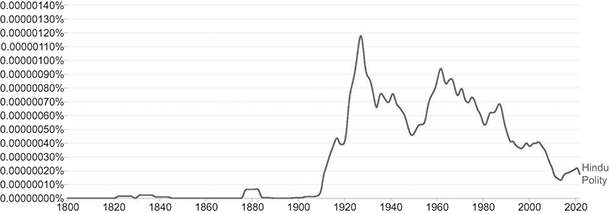
What can explain this decline? One reason may have been the death of Asutosh Mookerjee in 1924. Other, broader, reasons were mentioned by historians Ram Sharan Sharma and Maria Misra. Sharma noted the restricted social appeal of the Hindu polity literature. These works mainly attracted the educated middle classes and members of the upper castes; they could not appeal to members of the lower castes or Muslims.Footnote 153 According to Misra, the social values associated with a major source of the Hindu polity tradition, Kautilya’s Arthashastra, did not accord with the ideas of two important groups of Indian nationalists: Hindu revivalists such as Bal Gangadhar Tilak disliked the secular and amoral nature of the Arthashastra, its lax attitude toward the Hindu caste-based social hierarchy and Brahmin dominance, and its relatively pro-female values. Nationalist politicians such as Gandhi and Nehru disliked its cynical and unethical tone.Footnote 154 Interest in ancient Indian political theory, Misra concludes, thus reflected one specific phase in the history of pre-independence Indian nationalism, the phase associated with the Swadeshi Movement and Hindu activists in Bengal.
Apologetics
Within the Hindu polity literature, one can identify two opposite trends. Many works were driven by an anachronistic and apologetic desire to counter Western images of ancient India and to instill pride in the Hindu past by highlighting the similarities between ancient India and the modern West. However, some scholars looked askance at this apologetic motivation. The critique came from Western scholars but also from Indian ones. One example of the former can be found in Keith’s review of Jayaswal’s book, in which he argued that Jayaswal’s desire to find indications of democracy in ancient India was unsupported by the evidence. Keith said that the claim that republics existed during the Vedic period was based on a mistranslation. Republics did exist during later periods but they were aristocratic rather than democratic. The description of kings as elected, subject to law, and bound by the advice of their ministers was not the actual reality, Keith added, but merely “Brahmanical speculation.”Footnote 155
However, critique was not limited to Western scholars. In his 1921 book, Sarkar expressed the view that much of the existing literature did not clearly distinguish between actual institutions and “pious wishes or ideals of [political] theorizers.”Footnote 156 Echoing this skepticism, Bhandarkar remarked that Jayaswal’s work was “unfortunately vitiated by the patriotic bias” and by the fact that he was known “not only for misquotations but also experiments at translation.”Footnote 157 Ghoshal’s work, too, was far less celebratory than other Hindu polity works. Rejecting the anachronism embedded in the attempt to trace the origins of modern Western institutions back to ancient India, Ghoshal was willing to compare ancient Indian political notions unfavorably with early modern Western ones and also keen to reject apologetic theories such as the elected rather than divine nature of Vedic kings, the popular and democratic nature of Vedic assemblies, the existence of republics in the Vedic era, or the contractual nature of the state described in ancient Indian texts.Footnote 158
Nevertheless, Ghoshal did emphasize the originality of certain aspects of Hindu statecraft literature, such as the fact that Buddhist texts contained perhaps the earliest version of the social contract theory (albeit in a less systematic and developed form than in early modern European political theories). In an article entitled “The Genius of Indian Polity,” Ghoshal first identified two contradictory approaches to the history of Indian political thought. He associated one of these approaches with Western scholars (such as Vincent Smith, the author of The Oxford History of India, or Henry Herbert Dowell, the editor of The Cambridge History of India). These scholars regarded Indian political thought as uninteresting because, they claimed, it did not evolve and because autocracy was the dominant form of government. In contrast, scholars like Jayaswal, Radhakumud Mookerji, Altekar, and Majumdar advanced the opposing view that the Indian king was “virtually a constitutional slave” and ancient India a “vast rural democracy.” Ghoshal adopted an intermediate position, rejecting the argument that the ultimate disappearance of republics in ancient India meant that democratic institutions were somehow alien to its culture (Ghoshal reminded his readers that, in Europe, too, republican forms of government were not universal and that, for most of European history, monarchical forms had dominated the continent). While self-governing institutions existed during Vedic times, said Ghoshal, they tended to be replaced by centralized bureaucracies. Therefore, the picture of India as a “vast rural democracy” was inaccurate. It would also be wrong to conceptualize Dharma rules regarding the duties of kings as equivalent to modern constitutional law since these rules were not based on popular consent, and there was no human mechanism to enforce them. More generally, Ghoshal argued, it would be wrong to claim that ancient Indian states had a system of checks and balances to limit monarchical power.Footnote 159
The Role of Law
The Hindu polity literature was the product of lawyers, historians (and archaeologists), and social scientists. However, several of the historians and social scientists also possessed legal training. For example, Pramatha Nath Banerjea was a professor of Economics but was also called to the English Bar. Several chapters of his 1916 book Public Administration in Ancient India were devoted to legal matters, such as the structure, procedure, and rules of evidence of ancient Indian courts.Footnote 160 He also discussed various sources of law in ancient India, including custom and legislation.Footnote 161
Nevertheless, naturally, each professional group approached the topic of Hindu polity with its own emphasis. Historians such as Bhandarkar invested much intellectual effort in philological questions about the exact meaning of specific Sanskrit terms.Footnote 162 Social scientists like Sarkar were drawn to the ancient Hindu polity texts as sources for creating a non-Eurocentric (or, as Sarkar put it, non-“Eur-American” [sic]) science of comparative politics.Footnote 163 Lawyers were keen to examine specific rules governing ancient Indian institutions, and one can sometimes find in their works arguments that the topic was important because of its relevance to the constitutional law of modern India.
Jayaswal’s 1921 book can be seen as an example of an effort to extract norms relevant to modern constitutional law from ancient sources, even when this was problematic because of the lack of sources and the anachronism involved. The book included a chapter dealing with what might be called parliamentary procedures in the assemblies of ancient Hindu republics. Jayaswal could locate only one historical reference to this topic, a story about members of the sixth century BC Shakya republic deciding by majority vote whether to surrender to the Kingdom of Kosala. Jayaswal, therefore, suggested an “indirect” way of reconstructing parliamentary procedures in ancient Indian republics. The rules for making decisions in Buddhist monastic assemblies (samgha or sangha), he argued, were copied from the rules of decision-making in political communities. Hence, by studying the rules of these monastic assemblies, one could arrive at an idea of the rules of political ones. Jayaswal then embarked on a highly detailed discussion of the procedural rules dealing with decision-making in Buddhist monasteries, which he took from works such as the collection of Buddhist texts edited in the late nineteenth century by T. W. Rhys-Davids and Hermann Oldenberg.Footnote 164 Topics analyzed by Jayaswal included the exact language of the motions that started deliberations in the assembly, requirements regarding quorum, the existence of an assembly “whip,” rules regarding votes of members present in the assembly and absentee members, the use of ballots, delegations of decisions to ad-hoc committees, res judicata, censuring members of the assembly, the role of clerks and recorders of the House, and the use of referenda.Footnote 165
A similar interest in reconstructing the detailed rules of ancient Hindu law is found in Narendra Nath Law’s 1914 book. This book was divided into two halves. The first half was devoted to non-legal topics discussed in Kautilya’s Arthashastra (mining, irrigation, livestock, communications, and public utilities). The second half dealt directly with legal matters, beginning with courts and their procedure (including rules related to evidence). Law then turned to a long and detailed examination of various aspects of ancient Indian contract law based on the Arthashastra and many other sources. Contract law, a private law topic, was not discussed by other Hindu polity authors, and it is not clear what prompted Law to devote a sizeable portion of the book to it. The discussion included topics such as the requisites of a valid contract (dealing with norms regarding the parties, the role and use of witnesses, the time, the place, and the identity of the contracting parties, rules regarding undue influences, and consideration). Additional issues discussed were contracts for the sale of immovable property, the antiquity of the right of pre-emption, the sale of moveable property, loans, deposits, pledges, mortgages, bills of exchange, contracts of service, and partnerships.Footnote 166
Outcome
In discussing the impact of the Hindu polity literature, one can distinguish between, on the one hand, its academic impact in the West (that is, how Western Indologists and other Western scholars viewed it) and, on the other, its practical impact in India. Reactions to the Hindu polity literature in the West were mixed. Jayaswal’s pioneering 1913 article – which was based on a historical approach to Hindu law characterized by viewing this legal system as dynamic and comprehensive, not confined to personal law only – was praised by the German comparative lawyer Josef Kohler, who was perhaps the most important comparative law scholar in the first decades of the twentieth century.Footnote 167
However, many Western scholars in the early twentieth century continued to view ancient Indian states through the conventional nineteenth-century Western lens, associating them with despotism.Footnote 168 Accordingly, the nationalist tone of the Hindu polity literature was received with suspicion.Footnote 169 In a 1925 review of the Hindu polity literature, the Indologist Julius Jolly argued that it was not scientific enough. The nationalist tendencies and desire for Indian independence had led Indian scholars to mix history and politics, and, therefore, their conclusions were to be received with caution, he claimed.Footnote 170 Similarly, Arthur Berriedale Keith stated in 1927 that “the interest and value of the theme [of Hindu polity] have suffered unhappily from the unwise enthusiasm of some writers who have attempted to prove that India made notable contributions to the theory of politics, and that constitutional monarchy was early recognised.”Footnote 171
The same attitude can be found in Western discussions of Indian works that dealt with ancient Hindu international law. In a 1922 article, a British lawyer, W. S. Armour, criticized those Indian authors who argued that “there was a complete system of international law in ancient India.” The use of a term such as “international law,” said Armour, “with a history wholly modern” was inappropriate because:
… the territories of Indian Rajas could scarcely be called states at all in the modern sense of the term. Non-Indian peoples do not come within the scope of the Hindu religion or social system, and the rules I have cited could scarcely be called laws. It is doubtful whether some were even customs, as the evidence does not show that they were observed.Footnote 172
Western scholars adopted a critical attitude toward the Hindu polity literature. Within India, one could distinguish between those scholars who were focused only on the historical significance of the ancient Indian texts and those who were keen to explore their practical application to modern constitutional debates. Some Hindu polity works were based on a “scientific” or antiquarian approach, with no explicit call to apply their lessons to the present. However, other works, such as those by Radhakumud Mookerji, called for applying Indian constitutional history to modern constitutional debates. In his 1919 book, Mookerji stated that studying the history of ancient Indian institutions would be useful not just for teaching the people “national self-respect” but also for more practical reasons. Such study would enable the government to “shape” new governmental institutions “upon the lines of the old.”Footnote 173
Non-academic writers echoed this approach. In 1934, an Indian lawyer, Achintya Mukherjee, published an article that urged the makers of the future constitution of India to study ancient Indian constitutional history. “Every nation,” Mukherjee explained, “builds up a polity of its own, which reflects its own distinctive type of culture.” Constitutional changes, if introduced, “should be congenial to the nature of the political evolution of the nation.” He then went on to briefly discuss some significant themes found in the Hindu polity literature: kings were elected; the Danda Neeti – that is, “the Constitutional Law of the land” – was placed above the kings, who had a duty to protect their subjects; there was an “Aryan Constitution,” according to which kings did not have absolute power but had to fulfill the instructions of their assemblies and councils, in which all segments of society were represented; and, generally speaking, the ancient Indian monarchy was a constitutional rather than an absolute monarchy.Footnote 174
The 1940s saw additional calls to use the Hindu polity literature as a source of inspiration for the Indian Constitution. At the beginning of this chapter, I mentioned Agarwal’s and Rau’s works, but there were other examples. An article by Anant Sadashiv Altekar of Benares Hindu University published in 1947 stated that: “India is at present engaged in framing a new constitution. It will, therefore be not uninteresting to survey ancient Indian polity and its achievements. If we take an impartial survey of it we may learn some important lessons for the present and the future.”Footnote 175
What lessons were offered by Altekar? First, he noted the existence of republics in ancient India and argued that they disappeared because they were only appropriate in smaller states united by tribal loyalty. However, he argued, modern India could become a democratic republic despite its massive size because “distances have been annihilated now,” and the idea of representative government could replace the need for tribal loyalty. A further reason for the decline of republics was internal strife within their assemblies. This should be a lesson to the future Indian Parliament, Altekar contended.Footnote 176
Moving on to Indian kings, Altekar noted that ancient Indian monarchs were seen as trustees and were celebrated only if they promoted the well-being of their subjects. Modern Indian monarchs could continue to rule Indian (princely) states, but only if they were virtuous, he reasoned. One of the problems with ancient Indian kings was that the mechanisms designed to restrict tyrannical tendencies were weak. Popular assemblies were one such mechanism, but they disappeared after the Vedic era, leaving mainly the fear of divine punishment as a constraint on tyranny. Modern India, he said, should, therefore, develop secular, practical remedies to control the actions of tyrannical rulers.Footnote 177 Another mechanism to constrain tyranny in ancient India was decentralization, as evident in the need to obtain the consent of town and village councils for many governmental actions. The complexity of modern life, Altekar observed, made the reliance on village councils more problematic. Nevertheless, he did recommend using them in some instances.Footnote 178
Altekar discussed the fact that ancient Indian states accepted and promoted the caste system and that, therefore, the idea of the equality of all citizens before the law did not exist in ancient India. However, he assured his readers that “inequalities existed in all civilisations, eastern and western, and have not completely disappeared even in modern times.” In this sense, India was not unique.Footnote 179 Finally, Altekar noted that ancient Indian empires were based on a model of a central government that also permitted the existence of local governments enjoying relative autonomy. This idea of a strong and united India that also granted full autonomy to its provinces should be followed now, he urged.Footnote 180
Conclusion
The Hindu polity literature was a result of a specific time and place: Calcutta in the 1910s and 1920s. This body of works had a close affinity with the Swadeshi Movement in Bengal. Many of the Hindu polity authors were lawyers by training, but their writings were not taught at the College of Law of the University of Calcutta. Instead, their works became part of the curriculum in related fields such as History, Political Science, and Economics. While historians were naturally interested in this literature, it also had some contemporary relevance. It echoed Indian nationalist themes prevalent in the first decades of the twentieth century, and it was also mentioned in (although it had little impact on) Indian constitutional discourse in the period leading up to and immediately following Indian independence in 1947.
The depictions of ancient Indian political theory and institutions found in the Hindu polity works may have been anachronistic, and, as more critical observers already noted in the 1920s, the nationalist ideology of the authors may have led them to describe the nature of ancient Indian states inaccurately. Nevertheless, the Hindu polity literature is interesting as an expression of Indian and Hindu cultural nationalism during the first decades of the twentieth century. Similar things can be said about works dealing with Jewish public law that appeared during the same period in Europe, North America, and Mandatory Palestine. These works will be discussed in the next chapter.

 Open access