Book contents
- Frontmatter
- Contents
- Contributors
- Introduction
- I DEFINITION, CONCEPTUALIZATION, AND MEASUREMENT ALTERNATIVES
- 1 Identity as a Variable
- 2 Conceptualizing and Measuring Ethnic Identity
- 3 Trade-offs in Measuring Identities: A Comparison of Five Approaches
- II SURVEY METHODS
- III CONTENT ANALYSIS AND COGNITIVE MAPPING
- IV DISCOURSE ANALYSIS AND ETHNOGRAPHY
- V EXPERIMENTS
- Bibliography
- Index
3 - Trade-offs in Measuring Identities: A Comparison of Five Approaches
Published online by Cambridge University Press: 05 June 2012

Book contents
- Frontmatter
- Contents
- Contributors
- Introduction
- I DEFINITION, CONCEPTUALIZATION, AND MEASUREMENT ALTERNATIVES
- 1 Identity as a Variable
- 2 Conceptualizing and Measuring Ethnic Identity
- 3 Trade-offs in Measuring Identities: A Comparison of Five Approaches
- II SURVEY METHODS
- III CONTENT ANALYSIS AND COGNITIVE MAPPING
- IV DISCOURSE ANALYSIS AND ETHNOGRAPHY
- V EXPERIMENTS
- Bibliography
- Index
Summary
INTRODUCTION
Which measures of identity are best suited to particular research puzzles and conceptualizations of identity? This chapter considers five measurement strategies – experiments, discourse and content analysis, and open- and closed-ended surveys – employed in work mainly on Israeli and Palestinian identities. The focus of this chapter is on methodological trade-offs and their consequences for identity research, and like other chapters in this volume, we rely largely on our previously published work as a basis for an extended methodological review. The discussion here supplements and complements the second chapter's explication of techniques that can be used to measure identity. This chapter presents the reasons for selecting particular measurement strategies, discusses how measures were constructed, and compares the virtues of the various strategies for answering questions within a research program.
There are clear trade-offs between the measurement approaches discussed in this chapter, including a focus on elites versus the general population, the necessity of direct access to the subjects of research, and the epistemological commitments entailed by the approach. Perhaps the most significant trade-off is whether the approach requires the researcher to rely on preconstructed categories of identity, or whether the researcher inductively defines the relevant identities as a part of the research project itself. Choosing between these trade-offs depends largely on the goals of the research being undertaken. Throughout this chapter, we discuss the trade-offs between these methods by drawing on the research program of the authors.
Information
- Type
- Chapter
- Information
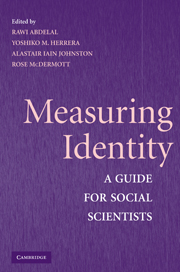
- Measuring IdentityA Guide for Social Scientists, pp. 72 - 110Publisher: Cambridge University PressPrint publication year: 2009
Accessibility standard: Unknown
Why this information is here
This section outlines the accessibility features of this content - including support for screen readers, full keyboard navigation and high-contrast display options. This may not be relevant for you.Accessibility Information
Accessibility compliance for the PDF of this book is currently unknown
and may be updated in the future.
- 3
- Cited by