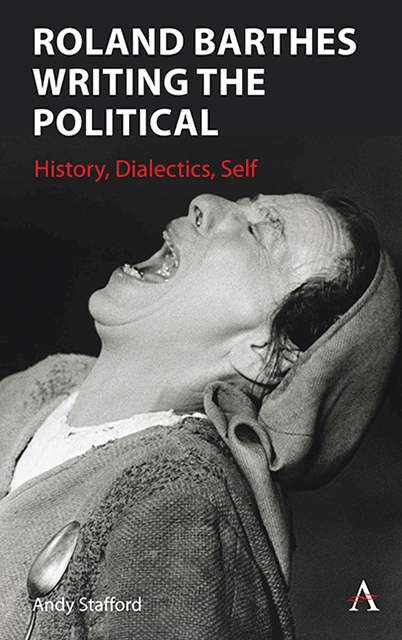
Roland Barthes Writing the Political

-
Select format
-
- Publisher:
- Anthem Press
- Publication date:
- 08 June 2023
- 08 November 2022
- ISBN:
- 9781785278983
- 9781785278976
- Dimensions:
- Weight & Pages:
- Dimensions:
- Weight & Pages:
- Subjects:
- Literature, Literary Theory
You may already have access via personal or institutional login- Subjects:
- Literature, Literary Theory
Show more authors 
You may already have access via personal or institutional login
Book description
With typical rhetorical flourish and beholden to paradox, Roland Barthes defines his work on 'myth' as an attempt to 'define things'; and yet he is known foremost for his work on language. The aim of this book is to take 'things' here as social relations, objects and other human beings with which the self interacts. It does so via language. Language in Barthes's conception is double: alienating, alienated on the one side; liberating, inspiring on the other. It is this double that we investigate in this book: a spectre is haunting Barthes studies, the spectre of dialectics; and the spectral presence of dialectics is what we will define in this book as the Barthesian 'spirit', in both senses of the word, that is, haunting his analyses and, at once, providing us with a double approach. 'I have tried to define things, not words' (Barthes 2009, 131n1).
Contents
Contents
Metrics
Full text views
Full text views helpTotal number of HTML views: 0
Total number of PDF views: 0 *
 Loading metrics...
* Views captured on Cambridge Core between #date#. This data will be updated every 24 hours.
Usage data cannot currently be displayed.
Accessibility standard: Unknown
Why this information is here
This section outlines the accessibility features of this content - including support for screen readers, full keyboard navigation and high-contrast display options. This may not be relevant for you.
Accessibility Information
Accessibility compliance for the PDF of this book is currently unknown and may be updated in the future.