To save content items to your account,
please confirm that you agree to abide by our usage policies.
If this is the first time you use this feature, you will be asked to authorise Cambridge Core to connect with your account.
Find out more about saving content to .
To save content items to your Kindle, first ensure no-reply@cambridge.org
is added to your Approved Personal Document E-mail List under your Personal Document Settings
on the Manage Your Content and Devices page of your Amazon account. Then enter the ‘name’ part
of your Kindle email address below.
Find out more about saving to your Kindle.
Note you can select to save to either the @free.kindle.com or @kindle.com variations.
‘@free.kindle.com’ emails are free but can only be saved to your device when it is connected to wi-fi.
‘@kindle.com’ emails can be delivered even when you are not connected to wi-fi, but note that service fees apply.
Subaltern Lives has argued for a biographical centring of men and women in histories of and in the Indian Ocean. It has used a life-writing approach to piece together fragments from the archives in order to explore issues around convict transportation, penal settlements and colonies, society and social transformation and the networking of Empire. Many of the lives presented in the book lack the narrative beginnings and endings that underpin traditional historical biography. However, if we shift our postcolonial gaze to move along and through archives and their institutional borders, it turns our attention towards people who have been absent from ‘history’, and opens up new ways of thinking about Empire. The book has not been concerned primarily with the production of ‘typical’ experiences, or with a search for ‘authenticity’, but rather with the use of men and women's lives as historical kaleidoscopes into some of the small and large questions of colonialism. Each chapter has suggested one possible interpretation of an individual's life, and the way in which it is embedded in its broader context. Given the limitations of subaltern life-writing work most chapters have also taken a prosopographical approach to incorporate other individuals into the narrative too.
The visual field in India underwent rapid transformation from the middle of the nineteenth century onward. This was due to an increased circulation of pictorial techniques and images from Europe and elsewhere, and to the introduction of technologies of mass-reproduction such as lithographic printing, photography and eventually cinema. New pictorial forms developed through a relay of three distinct elements: existing iconographic and artistic traditions, modern practices of fine art introduced in the colonial era and – in the twentieth century – elements of both local and global popular cultures. These forms were enthusiastically taken up as part of a growing Indian culture industry, particularly in the vernacular business arena that emerged from the trading communities of what historians have called the ‘bazaar’. Mass reproduction and commodification allowed images to become more mobile and thus circulate in an arena delinked from the territorial and symbolic control of temples and courts. As naturalism and realist techniques provided an alternative to strict iconographic codes, and access to images no longer depended exclusively on the intercession of priests or membership of a particular caste or class, commercially available images came to address – and indeed to constitute – differently composed audiences. These newly commercialized images then became available to the various projects of identity formation that have come to characterize Indian modernity – projects of nation, region, sect, caste and language, as well as the political and ideological projects of the nascent nation-state.
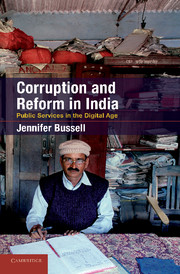
Why do some governments improve public services more effectively than others? Through the investigation of a new era of administrative reform, in which digital technologies may be used to facilitate citizens' access to the state, Jennifer Bussell's analysis provides unanticipated insights into this fundamental question. In contrast to factors such as economic development or electoral competition, this study highlights the importance of access to rents, which can dramatically shape the opportunities and threats of reform to political elites. Drawing on a sub-national analysis of twenty Indian states, a field experiment, statistical modeling, case studies, interviews of citizens, bureaucrats and politicians, and comparative data from South Africa and Brazil, Bussell shows that the extent to which politicians rely on income from petty and grand corruption is closely linked to variation in the timing, management and comprehensiveness of reforms.
In an interview on a leading Hindi news channel in 2009, Congress Member of Parliament Ambika Soni remarked that she had never watched as much television in her life as she had in the five months since taking office as the Minister of Information and Broadcasting. ‘You never know when an NGO or fellow MP might raise a complaint about a programme being unsuitable for broadcast.’ Her remark referred in part to complaints against specific shows that had been aired on private television channels in 2009; their content had been criticized as being unsuitable for Indian audiences. Soni went on to say that most of the complaints related to the depictions of women or children, and the publicization of issues that Indians consider ‘extremely private’. ‘There are things,’ she said, ‘that Indians are not mentally prepared to publicise in front of everybody … even if we don't do it ourselves, seeing somebody else do it is hurtful.’ The complaints addressed two reality shows that were aired in July and October 2009, both adaptations of foreign reality shows: Sach Ka Samna (‘Facing the Truth’; hereafter SKS) was the Indian version of US television giant Fox's The Moment of Truth and Pati, Patni, aur Woh (Husband, Wife, and the Other; hereafter PPW) was the Indian version of the BBC 3 reality show Baby Borrowers.
I reached Calcutta about the first of August where the ship was sold and went ashore and remained till I joined the Naval Brigade for three years I suppose you have heard about the seapoys in India and how the[y] rose and slaughtered the whites in India, well the Brigade is to keep them watched down, our Barracks is on a small Island and it is very healthy, we have a pretty good time being most all sailors who joined to defend the Settlement, we have dancing and singing in the Barracks I often think of you when I am engaging myself here thinking of the pleasant evenings that I have spent in your Company in Dixmont this is a very pleasant Country but nothing to my native state of Maine where I hope to end my travels.
Chapter 5 closed with a discussion of Britain's colonisation of the Andaman Islands in 1858, to examine rebel convict Liaquat Ali's likely fate after his transportation in 1872. This chapter will take a more detailed look at the Andamans during the early years of colonisation, through the life of a convict guard called Edwin Forbes. Forbes was American, and he was stationed in the Andaman Islands between 1861 and 1864. He was an ordinary sailor, but he wrote a diary and a series of letters during this period. They centre on descriptions of the everyday in the Andamans, but as rare evidence of the perspective of a guard, they also open up a different view on penal settlements and colonies to that explored in the book so far. This opens out further many of the broad themes of Subaltern Lives. Forbes’ manuscript provides an important glimpse into life in the naval brigade in the mid-nineteenth century. It speaks also to the impact of the penal colony on the indigenous peoples of the islands, to the connections between the Andamans and the outside world, and to the homosociality of early colonial settlement. Further, Forbes’ diary and letters provide important insights into the experiences of an American serving the British Empire.
The famous scholar of Indo-European syntax Berthold Delbrück (1842–1922) published this study of Sanskrit syntax in 1888. It focuses on the stage of the language that was termed 'Vedic' by the Indian grammarian Panini (c. 400 BCE). Delbrück's intention was to describe that material as clearly and thoroughly as possible in order to facilitate future comparative or in-depth studies. The book begins with chapters devoted to basic sentence structure and word order, before moving on to number, gender, case, declension of nouns, and then adjectives, adverbs, pronouns and verbs with their tenses, moods and conjugations. Prepositions and particles follow, and the book ends with discussion of subordinate clauses and other complex structures. The grammatical points are illustrated by numerous text examples, with references and translations into German, and there are thorough indexes of words and of textual passages cited.
Sir Edward Belcher (1799–1877) was a British naval officer who served as surveyor on several long voyages in the Atlantic and Pacific. Published in 1848, this two-volume account, interspersed with charts and illustrations, was the second of his journals to appear in print, and appealed to Victorian readers' enthusiasm for books on exploration, natural history, ethnology and adventure. Volume 1 combines reports on navigation and encounters with pirates with vivid descriptions of coral reefs, villages and temples. It describes the topography and inhabitants of exotic locations including Borneo, Manila, Singapore and Korea, and visits to sultans, rajahs and governors. It also documents the expedition's gathering of practical and strategic information on subjects including reliable water supplies, the goldmines of Sarawak and the quality of coal available for naval steamships.
In the film Shankarabharnam (Telugu, 1979), a drama about a south Indian classical singer and a young prostitute's devotion to him, there is a scene which epitomizes the way ‘classical’ music and ‘film’ music came to be opposed to each other in post-colonial south India. The larger theme of the film, the backdrop against which its events take place, is the destruction of south Indian, or Karnatic, classical music at the hands of charlatan gurus and hypocritical concert organizers, and through the steady encroachment of Westernized musical tastes. In this particular scene, the hero, Shankara Sastri, is fast asleep one night in his house when he is suddenly awakened by the strains of electric guitars being played Western-style. He opens his door to find a band of ruffians mocking his devotion to Karnatic music. ‘Our music is an ocean’, they sneer, parodying what is often said about Karnatic music to invoke its depth and complexity. Shankara Sastri challenges them to a musical contest. The ruffians sing their song, and Shankara Sastri proceeds, to their utter astonishment, to convert it into the syllables used to sing Karnatic music and sing it back to them. Then, improvising a short piece of Karnatic music, he challenges them to reproduce it, leaving them completely at a loss. Shankara Sastri scolds them: ‘While so many foreigners recognize the greatness of Indian music, how can you mock it? It is like making fun of your own mother.’ To make his point, apparently too important to be uttered merely in Telugu, he switches into English: ‘Music is divine, whether it is Indian or Western.’
In essence, food is a way of fulfilling a biological need – nutrition – within an ecologically and culturally defined context. At the same time, it is a way of expressing one's sense of self – individually and collectively – in relation to the past, present and future. Concerns about authenticity and belonging, taste and distinction, health and safety converge when food is at issue, as do embodied feelings like comfort, pleasure, craving and deprivation. This constellation of ideas and emotions makes food a particularly rich site for exploring the diverse ways in which Indians construct cultural identities at the cusp of imagined traditions and desired modernities. This chapter explores these processes of social formation – cultural being and becoming – by relating them to shifts in the modes of producing and consuming food. It attempts to analyse some of these shifts through a selective discussion of changing food practices in post-Independence India. It locates these changes in the context of the political economy of agriculture since the Green Revolution of the late 1960s and 1970s, a programme that radically reconfigured how and which foods are cultivated and consumed. The chapter goes on to delineate the widening circuits of food as a commodity form within the home and outside, spanned by the growth of processed foods and the practice of ‘eating out’. And it examines the multiple meanings that food conveys for different social groups by drawing upon three ethnographic vignettes from western India.
No.: 9 – Name: Narain Sing – Father's Name: Wezur Singh Sikh alias Motee Singh – Native Place: Lahore and Patna – Caste: Hindu Brahmin service – Description: Black mustachees, both ears bored slightly pitted with pock marks on his face, a scar near the right eyebrow a mole on his temple, a wart on the left side of his throat, a scar on his right limb, several moles throat belly and back, a boil mark on his right shoulder and one on his right thigh, height 5 ft 7 1/4 inches age 25 years – Conduct in district jail: turbulent to jail officers and when about to have his handcuffs struck off on his arrival at the Agra Jail threw them off like a pair of gloves and threw down to the Mohureer with some insulting remarks – Conduct in Alipore Jail: behaved remarkably well.
On the afternoon of 23 June 1850, British magistrate of the north Indian city of Patna, Bihar, E.H. Lushington wrote a somewhat breathless letter to the secretary to the government of Bengal. He described how the night before, Captain C.M. Cawley, commander of the steamer Brahmapootra, had arrived at his house in disarray, to tell a ‘desperate and fatal’ tale. His steamer had been towing a river flat called the Kaleegunga, which was carrying a chain gang of thirty-nine convicts from Allahabad to Calcutta along the River Ganges. Like hundreds of men and women each year, the convicts on board were to be imprisoned in the huge jail at Alipur on the outskirts of Calcutta while they awaited their transportation overseas. Their destination was Moulmein in the Tenasserim Provinces, the place to which the British shipped all Indian transportation convicts that year. But this usually routine journey had erupted in violence and bloodshed. About 20 miles from Patna, a ‘notorious Sikh Sirdar’ called Narain Sing had, Lushington reported, broken off the convicts’ irons, raided the vessel's weapon store and, having seen off the crew and passengers, taken charge of the ship. Captain Cawley had run his ship ashore and ‘fled for his life’.
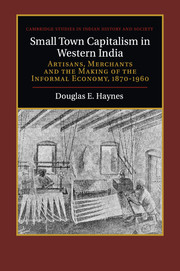
This book charts the history of artisan production and marketing in the Bombay Presidency from 1870 to 1960. While the textile mills of western India's biggest cities have been the subject of many rich studies, the role of artisan producers located in the region's small towns have been virtually ignored. Based upon extensive archival research as well as numerous interviews with participants in the handloom and powerloom industries, this book explores the role of weavers, merchants, consumers and laborers in the making of what the author calls 'small-town capitalism'. By focusing on the politics of negotiation and resistance in local workshops, the book challenges conventional narratives of industrial change. The book provides the first in-depth work on the origins of powerloom manufacture in South Asia. It affords unique insights into the social and economic experience of small-town artisans as well as the informal economy of late colonial and early post-independence India.
A large majority of India's population – 72 per cent according to the 2001 census – live at least partially rural lives and derive a significant portion of their income from agriculture. Some village residents migrate seasonally or occasionally for urban employment, and significant numbers of village households have family members already located, permanently or temporarily, in urban areas. Rural-to-urban migration trends are ongoing, but demographic shifts have not been as dramatically rapid as some had predicted. While global flows and urban cultures seem to epitomize the twenty-first century, rural life remains of vital significance to understanding Indian modernity. Tremendous changes have continuously affected India's rural spaces from the agrarian revolutions of the 1960s to the communications revolutions of the present. These changes permeate every aspect of life from domestic relations to cropping patterns; entertainment choices to employment opportunities; social and gender hierarchies to political formations. Government development projects as well as a multitude of non-governmental organizations concerned with improving agricultural productivity, primary education, adult literacy, health care, gender equity and environmental sustainability – to mention only a few major foci of ongoing interventions – are at work modernizing rural India.
To survey all such manifestations of change, or to outline comprehensively the concrete, quantifiable elements of rural modernity is not possible in one chapter. Here, drawing on ethnographic fieldwork, I focus on people's perceptions of and responses to change as they experience it. Specifically, I aim to highlight the ways that residents of one small region in central Rajasthan have described to me transformations which they understand to be both material and moral.
Liaquat Ali: Previous history: Of no importance prior to 1857 but then became a ringleader. Though evidently a coward he is a determined plotter against the British Government. Possesses a great deal of influence amongst Mahomedans, and is connected with Wahabees. Since 1857 he has been engaged in preaching sedition – Father's Name: Mehir Ali – Religion: Mussulman Sheik.
Amy Bennett: I am aged 33 years. I reside in Calcutta my father's name is Captain Horne. He commanded a vessel.
The preceding chapters of this book have explored the life histories of a range of convicts, including Indians, Indo-Europeans and Africans. Their trials, convictions, transportation (and on occasion retransportation) to colonial penal settlements in Mauritius, the Cape, Burma, the Straits Settlements and Australia during the first half of the nineteenth century reveal much about the drawing of lines of social distinction in the Indian Ocean. Clearly, there were layered and multi-directional intersections between colonial understandings of race, religion, masculinity, military service and status in the making of categories of rule, and of society and social transformation. Subaltern Lives has centred individual convicts in a prosopographical analysis that touches necessarily on other marginal and marginalised people in the Indian Ocean, who were not necessarily transportation convicts. They include slaves, ex-slaves, apprentices, indentured labourers, state prisoners, Indo-Europeans and sailors. Collectively, even as, or perhaps rather because, they inhabited the edges of Empire, we are encouraged to approach and to configure colonial archives in ways that open up new subaltern perspectives on histories of and in the Indian Ocean. This biographical approach offers a kaleidoscopic view of their profound impact on colonial knowledge formation, as well as on the cultural, productive and geographical networks of Empire.
‘Notwithstanding the fact that she has studied in and been deeply influenced by the West, Miss Sher-Gil's work must be considered as a clear sign of the artistic awakening in India’, wrote the art critic Charles Fabri in 1937. Fabri, an Indologist by training and a Hungarian citizen by birth, was a partisan of modern art and Gandhian nationalism. His overwhelmingly positive review of the painter Amrita Sher-Gil's exhibition in Lahore indexed dominant understandings of Indian art, modern art and the relationship between India and the West in the 1930s. The idea that Sher-Gil's art heralded a national renaissance despite its incubation in the West reflected the way in which, by the early twentieth century, Indian art and Western art had come to be viewed as mutually exclusive cultural forms.
The idea of Indian art as decorative and fundamentally opposed to the naturalistic impulses of Western art was promoted by British colonial authorities from the middle of the nineteenth century. This opposition between Indian art and Western art was seized upon by anti-colonial nationalist artists, notably in Bengal, to produce a modern art that claimed to be ‘Indian’ by rejecting Western models. By the 1930s, when Sher-Gil came to practise art in India, however, there was a growing sense that this rejection could not by itself serve as the basis of what Fabri called an ‘artistic awakening’. There had to be a critical engagement with the forms of Western modernity alongside those of India's pre-colonial past.
The economic and political position of tribal populations in modern India is not unusual. It is familiar enough from what we know of similarly marginalized peoples in other parts of the world. What is perhaps less obvious is how tribes in India utilize language and religion to express their identity in the ongoing encounter with modernity.
Tribal populations
Tribes constitute only about 8 per cent of India's total population, and they are unevenly distributed (1 per cent of Tamil Nadu but 95 per cent of Mizoram is tribal, for instance). These roughly ninety million people are largely concentrated in two regions: the central and eastern hills of Chhattisgarh, Orissa and Madhya Pradesh; and the mountainous states in the north-east. Sizeable populations also live in Rajasthan, Gujarat and Jharkhand. Among these approximately 500 tribal groups, the variety of social practices, cosmologies, rituals and material culture is staggering. And the ethnographic record is still far from complete.
Such heterogeneity is not easily categorized, and we have known for a long time that the term ‘tribe’ is imprecise. For some anthropologists, the salient criterion in defining a population as a ‘tribe’ is its type of political authority, while for others it is social organization, descent system or religious belief; and many definitions ultimately rely on a specious spectrum stretching from simplicity to complexity. Confusion arises, in part, because the concept of ‘tribe’ is inseparable from modernity. As a convenient shorthand for pre-industrial societies, it helped to define, by contrast, the new world of rational, wage-earning citizens.
Recent discussions of cinema and national identity in the ‘third world’ context have tended, by and large, to cluster around the concept of a ‘third cinema’. Here the focus is on recovering or reinventing local aesthetic and narrative traditions against the homogenizing impulses of Hollywood in its domination over markets and normative standards. One of the hallmarks of third-cinema theory has been its firmly unchauvinist approach to the ‘national’. In its references to wider international aesthetic practices third cinema asserts but also problematizes the boundaries between nation and other. In the process, it also explores the ways in which the suppressed internal others of the nation, whether of class, sub- or counter-nationality, ethnic group or gender, can find a voice.
A substantial lacuna in this project has been any sustained understanding of the domestic commercial cinema in the ‘third world’. This is important because in countries such as India the commercial film has, since the dawn of the ‘talkies’, successfully marginalized Hollywood's weight in the domestic market. This is not to claim that it has functioned within an entirely self-referential autarchy. The Indian popular cinema stylistically integrated aspects of the world ‘standard’, and has also been influential in certain foreign markets. But it constitutes something like a ‘nation-space’ against the dominant norms of Hollywood, and so ironically fulfils aspects of the role which the avant-garde third cinema proclaims as its own.