To save content items to your account,
please confirm that you agree to abide by our usage policies.
If this is the first time you use this feature, you will be asked to authorise Cambridge Core to connect with your account.
Find out more about saving content to .
To save content items to your Kindle, first ensure no-reply@cambridge.org
is added to your Approved Personal Document E-mail List under your Personal Document Settings
on the Manage Your Content and Devices page of your Amazon account. Then enter the ‘name’ part
of your Kindle email address below.
Find out more about saving to your Kindle.
Note you can select to save to either the @free.kindle.com or @kindle.com variations.
‘@free.kindle.com’ emails are free but can only be saved to your device when it is connected to wi-fi.
‘@kindle.com’ emails can be delivered even when you are not connected to wi-fi, but note that service fees apply.
Intimate interactions across ethnic and cultural lines were integral to the archive of memory within Eurasian families in colonial Penang. Through histories of their European and Asian ancestors, Eurasian families inherited a sense of travel and geographical mobility, and complex forms of cultural exchange often shaped their everyday lives. Eurasian family histories provide access to the messy, lived interactions which formed their social and domestic worlds, but they also hint at their limits. The idea of ‘Eurasian’ in colonial Malaya was a contentious one, a site for debate, as it was experienced by different people in different ways. During the interwar period, members of Penang's Eurasian elite attempted to define and discipline the divided Eurasian communities of Malaya, by purifying Eurasian family histories of their unruly diversity. In exploring the Eurasian social world of colonial Penang, this paper aims to delineate the fragility of such processes of interaction and exchange.
Around 1930, at a time of rising nationalisms in China and India, English-educated Chinese and Indians in the British colony of Singapore debated with great intensity the issue of national identity. They sought to clarify their own position as members of ethnic communities of immigrant origin, while remaining individuals who identified the territory of British Malaya as their home. Readers' letters published in the Malaya Tribune, an English-medium newspaper founded to serve the interests of Anglophone Asians, questioned prevailing assumptions of how to define a nation from the perspectives of territory, political loyalty, race, and language. Lived circumstances in Malaya proved that being Chinese or Indian could encompass a range of political, cultural, and linguistic characteristics, rather than a homogenous identity as promoted by nationalist movements of the time. Through these debates, Chinese and Indians in Malaya found ways to simultaneously reaffirm their ethnic pride as well as their sense of being ‘Malayan’.
This paper traces a set of interlinked Asianist networks through the activities of Mahendra Pratap, an Indian revolutionary exile who spent the majority of his life at various key anti-imperialist sites in Asia. Pratap envisioned a unified Asia free from colonial powers, but should be regarded as an anti-imperialist first and a nationalist second—he was convinced that India's independence would materialize naturally as a by-product of a federated Asia. Through forging strategic alliances in places as diverse as Moscow, Kabul, and Tokyo, he sought to achieve his goal of a united ‘Pan-Asia’. In his view, Pan-Asia would be the first step towards a world federation, in which all the continents would become provinces in a new world order. His thought was an intricate patchwork of internationalist ideas circulating in the opening decades of the twentieth century, and his travels and political activities are viewed in this context. Pratap's exploration of the relationship between the local, the regional, and the global, from an Asian perspective, was one of many ways in which Asian elites and non-elites challenged the legitimacy of the political order in the interwar years.
This book is an incisive analysis of Japan's deepening economic presence in Asia. It challenges neoclassical economists, arguing that instead of simply building a 'yen bloc' or responding to market forces, Japanese business and government elites are working together to build an expanded - and potentially exclusive - production zone. The authors suggest that the transplantation of many standard Japanese business practices in Asia is based on the concept of keiretsu (enterprise group) which allows a complex web of production networks to develop. The book shows that such strategic control of technology is a unique model of globalisation. While informed by economic theory, Asia in Japan's Embrace is highly accessible, containing interviews and anecdotal evidence from factory floors and board rooms. It is comprehensive and controversial, outlining policy implications and the impact on global trade.
Joseph Davey Cunningham (1812–1851) joined the East India Company's army thanks to the patronage of Sir Walter Scott. He became the assistant to Colonel Claud Wade, a political agent on the Sikh frontier, in 1837, and spent eight years in various political roles living among the Sikh in the Punjab. While writing a report in 1844 for the government, he decided to undertake the history of the Sikhs, and received encouragement for the project from his father, Scottish poet and author Allan Cunningham. He spent four years on the book, and while it established his reputation as a historian of India, it also destroyed his career as a colonial official: he fell foul of the Army in India for his revelation of supposedly secret negotiations with Sikh leaders, and allegations of corruption, during the First Anglo-Sikh War of 1845–1846.
Richard, Marquess Wellesley (1760–1842) became one of the most controversial politicians of his generation during his time as Governor-General of Bengal (1798–1805). Although this period saw him achieve territorial gains and military victories in India - including the defeat of Tipu Sultan, the ruler of Mysore - the financial cost was considered too high. The East India Company Court of Directors in London disagreed with many of the changes he made, and Wellesley was forced to return to England. This five volume collection of papers, edited by the political activist and historian Robert Montgomery Martin (1800–1868), was published in 1836–1837 and documents Wellesley's period of office in India. Volume 4 focuses on the period 1804–1805, and includes documents about peace treaties with local rulers, the establishment of Fort William College for the training of British civil servants (especially in Asian languages), and Wellesley's final departure for England.
Like many British authors of books about India before independence, William Harrison Moreland (1868–1938) had worked as a civil servant in the subcontinent. He spent twenty-five years in the North-West Provinces, and for twelve years he was Director of Land Records and Agriculture. He was committed to improving the agricultural system of the region, and even established an agricultural college in Kanpur. After he retired, he decided to examine old land and revenue records, resulting in this work, which was published in 1929. Starting in the thirteenth century, the book gives a historical context to the changing land use and revenue practices in India. Moreland also examines the role of religious law and the influence of successive regimes and rulers on the development of agrarian practices as well as on the lives and work of India's peasantry.
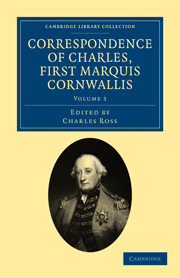
Charles Cornwallis, first Marquis Cornwallis (1738–1805), was a highly influential colonial governor and British army officer, though he is best remembered for his role on the losing side in the American War of Independence (1775–1781). Cornwallis entered military service in 1757. Following the War of Independence, in 1786 he was appointed as first Governor General of India, where he instituted extensive military and civil reforms, and he became Lord Lieutenant of Ireland in 1797. These fascinating volumes, first published in 1858, contain personal letters and official dispatches written by Cornwallis during his long career. These letters vividly describe the historical and political context of events in which Cornwallis participated, and succinctly illustrate his character and personal motivations. These volumes are reissued from the second edition of 1859. Volume 3 contains correspondence from 1798 to 1805.
This study focuses on the uneasy relationship between permanent 'organised sector' and temporary 'unorganised sector' workers in India. Does India indeed have a dual economy and society in which these two groups of workers, only one side enjoying the protection of the Factory Acts and Trades Unions, regard themselves and act as distinct classes with opposed interests? Drawing upon his own extensive fieldwork amongst Indian workers, employers and unionists, and on his familiarity with the anthropological and sociological literature, Dr Holmström strives to come to a better understanding of the thoughts and actions of the workers and the wider economic and political aspects of their situation. He uses a wide range of material, from the opinions and life stories of workers to accounts of recent union movements in the 'unorganized sector', and contributes critically to the- debate on 'dualism' and its underlying assumptions.
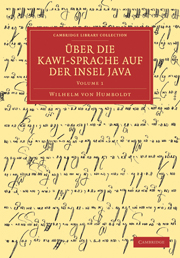
Wilhelm von Humboldt (1767–1835) was a German philologist, diplomat and philosopher. While Minister of Education he was responsible for reforming the Prussian education system. His pioneering achievements in linguistics influenced many later scholars including Chomsky. This monumental three-volume study of Kawi, a traditional formal and literary language of Java belonging to the Austronesian language family, was posthumously published in 1836–9. The manuscript was prepared for the press by J. K. E. Buschmann, a protégé of Humboldt's friend and colleague Bopp (also reissued in this series). Humboldt considered Kawi, which includes many Sanskrit loan-words, to be the common ancestor of all the Malayo-Polynesian languages, though this view is no longer accepted. Volume 1 begins with a preface by Humboldt's brother Alexander describing Wilhelm's extensive academic network, and reprints Wilhelm's famous 1836 essay on language, before focusing on the question of Indian (Sanskrit and Buddhist) influences on Javan language and society.
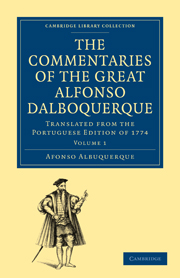
The publications of the Hakluyt Society (founded in 1846) made available edited (and sometimes translated) early accounts of exploration. The first series, which ran from 1847 to 1899, consists of 100 books containing published or previously unpublished works by authors from Christopher Columbus to Sir Francis Drake, and covering voyages to the New World, to China and Japan, to Russia and to Africa and India. Volumes 53, 55, 62 and 69 of the series contain the English translation of The Commentaries of the Great Afonso Dalboquerque, translated and edited by Walter de Grey Birch. Afonso de Albuquerque (1453–1515) was a Portuguese naval officer and nobleman whose successful military campaigns helped establish Portugal's colonies in India. Volume 1, published in 1875, contains an account of de Albuquerque's expeditions to India from 1503 to 1509 and his first conquest of Ormuz (modern Hormuz Island, Iran).
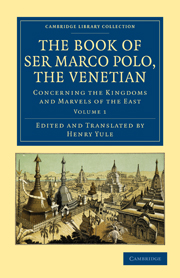
The Book of Ser Marco Polo, the Venetian is a nineteenth-century edition of the famous travelogue written by Rustichello da Pisa and Marco Polo, describing the travels of the latter through Asia, Persia, China and Indonesia between 1271 and 1291. The book secured lasting fame for its editor, the prominent geographer and literary scholar Henry Yule, who was awarded the founder's medal of the Royal Geographical Society for his efforts. The two-volume work, the result of Yule's research in Palermo, Venice, Florence, Paris and London and of extensive correspondence with scholars around the world, has long been considered an authoritative source on Polo's travels. Volume I contains Books One and Two of the travelogue and contains descriptions of the lands of the Middle East and Central Asia that Polo encountered en route to China. Book II covers Polo's time in China and the court of Kublai Khan.
The ubiquitous experience of wartime collaboration in East Asia has not yet undergone the analysis that its counterpart in Europe has received. The difficulty has to do with the political legacies that the denunciation of collaboration legitimized, as well as the continuing hegemony of the discourse of nationalism. Both inhibitors encourage the condemnation of collaboration rather than its historicization. Reflecting briefly on the 1946 trial of Liang Hongzhi, China's first head of state under the Japanese, this essay argues that the historian's task is not to create moral knowledge, but to probe the presuppositions that bring the moral subject of the collaborator into being for us, and then ask whether real collaborators correspond to this moral subject. In the face of the natural impulse to render judgment, this essay argues for the wisdom of hesitation.