To save content items to your account,
please confirm that you agree to abide by our usage policies.
If this is the first time you use this feature, you will be asked to authorise Cambridge Core to connect with your account.
Find out more about saving content to .
To save content items to your Kindle, first ensure no-reply@cambridge.org
is added to your Approved Personal Document E-mail List under your Personal Document Settings
on the Manage Your Content and Devices page of your Amazon account. Then enter the ‘name’ part
of your Kindle email address below.
Find out more about saving to your Kindle.
Note you can select to save to either the @free.kindle.com or @kindle.com variations.
‘@free.kindle.com’ emails are free but can only be saved to your device when it is connected to wi-fi.
‘@kindle.com’ emails can be delivered even when you are not connected to wi-fi, but note that service fees apply.
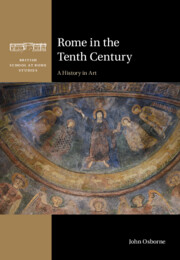
This is the third and final volume in a series examining the history of Rome in the early Middle Ages (700–1000 CE) through the primary lens of the city's material culture. The previous volumes examined the eighth and the ninth centuries respectively. John Osborne uses buildings (both religious and domestic), their decorations, other works of painting and sculpture, inscriptions, manuscripts, ceramics, metalwork, and coins as 'documents' to supplement what can be gleaned from more traditional written sources such as the Liber pontificalis. The overall approach is particularly appropriate for tenth-century Rome, which has traditionally been considered a 'dark age', given recent research on standing monuments and the large amount of new material brought to light in archaeological excavations undertaken over the last four decades. This magnificent and beautifully illustrated volume provides a triumphant conclusion to a series which will be indispensable for all those interested in early medieval Rome.
Book IX of the Odyssey is one of the most often read and discussed sections of Homeric poetry. It contains Odysseus' narrative of his encounter with Polyphemus the Cyclops, which not only typifies him as the trickster-hero that he is, but also resonates thematically with later parts of the narrative. This edition provides solid support in reading, understanding, and enjoying this essential episode. The Commentary is designed to be helpful to undergraduates, postgraduates, and scholars, providing assistance in understanding Homeric language from elementary to advanced levels. The constant attention to narratological details contributes to the literary appreciation of the episode. The Introduction offers a particularly full guide to Homeric meter, language and dialect as well as discussing in detail the place which the Cyclops episode occupies both in the Odyssey as a whole and in Greek mythology and culture as an expression of the colonial imagination.
The research for this book developed from my combined interest in historical and Arabic studies. It was conducted at the Avicenna Institute of Middle Eastern Studies (Hungary), alongside finalising key stages at the Seminar für Arabistik/ Islamwissenschaft at Georg-August-Universität Göttingen. My previous research enterprises exploring the role of tribal groups in Arabia on the eve of Islam and how 13th- to 15th-century Arabic historiographers exploited each other's materials have also combined philological and historical tools. My choice of a topic to be analysed from both angles is thus hardly surprising. However, as I immersed myself in the text of Ibn Aʿtham al-Kūfī's Kitāb al-futūḥ and explored the scholarly literature on the main themes of early Islamic historiography, I became increasingly confronted with the need to change my approach somewhat. As I increasingly recognised the literary nature of these compositions, my attention turned towards an analytical method that is less historical and more literary in nature. Another crucial discovery I had to make concerned the foundational basis of my research. It became evident early on, after exploring the weaknesses of the standard edition of Kitāb al-futūḥ published in Ḥaydarābād, that due to the issues that I discuss in depth in this book, no rigorous philological analysis can be conducted relying solely on its text. All these realisations led me to partially change my intended focus, transforming my research into a somewhat different undertaking compared to what was initially planned. However, it retained a degree of continuity because, despite the shifting emphasis and partial methodological changes, I remained interested in exploring a narrative on the formative period of early Islam.
The following acknowledgements express but cannot completely convey the gratitude I feel for all of the encouragement and support that I have received from so many generous scholars and institutions along the long intellectual journey outlined briefly above.
First, I am deeply indebted to Professor Dr Miklós Maróth and Professor Dr Jens Scheiner, whose unwavering support has been invaluable from the very beginning. I am most grateful to Professor Maróth and the Avicenna Institute of Middle Eastern Studies. Professor Maróth has provided continuous support since my undergraduate years at Pázmány Péter Catholic University. He welcomed me as a colleague at the Avicenna Institute and also facilitated and encouraged my research pursuits.
The Image of an Earlier 4th/10th-Century Islamic Historiographer in Transition
The exploration of the rich historiographic tradition written in Arabic between the early 9th and mid-10th centuries went hand in hand with the emergence of modern historical scholarship in 19th-century Western Europe. The growing interest of European scholars in the past affairs of the Muslim world was hardly independent of the rise of the Western powers’ political influence in the Middle East. To be sure, some Islamic historical works, including the one this book will focus on, had already been introduced to the European audience at that time, but these early enterprises did not immediately result in the birth of the field of Islamic studies. The formation process of the discipline is intimately connected to the first editions of the Arabic texts of early and classical Arabic historiographers, which was enabled by the emergence of large manuscript collections all across Western Europe. The same process took place on the other side of the continent as well, where Russian scholars, mainly based in St. Petersburg, were likewise engaged in the exploration of Arabic and Persian historical and geographical manuscripts in order to extend their knowledge about the Central Asian territories, a region of fundamental interest to the Tsar's empire.
From the middle of the 19th century onwards, a substantial number of 3rd/9thand 4th/10th-century Muslim historical works were edited and appeared in print in surprisingly quick succession. Both universal and thematic chronicles alongside other books of a historical nature (List 1), including biographical and geographical dictionaries (List 2), came to the forefront of interest as the following two brief lists of the main authors aptly indicate:
List 1
• Ibn al-Athīr's (d. 630/1233) al-Kāmil fī al-taʾrīkh, edited and published by Tornberg in Leiden between 1851–1876, fourteen volumes;
• al-Azdī's (d. between c. 170–210/786–825) Futūḥ al-Shām, published by Lees in Calcutta in 1854, one volume;
• the Futūḥ al-Shām ascribed to al-Wāqidī (d. 207/823), published by Lees in Calcutta between 1854–1862, three volumes;
• al-Wāqidī's (d. 207/822) Kitāb al-maghāzī, partly edited and published by Kremer in Calcutta in 1856, one volume;
• al-Balādhurī's (d. 279/892) Futūḥ al-buldān, published by de Goeje in Leiden in 1866, two volumes;
• Miskawayh's (d. 421/1030) Tajārib al-umam, partly edited and published by de Goeje in Leiden in 1871, partial edition, one volume;
No proper understanding of an historical work is possible without setting it against the original landscape of its time and place of production, and the Kitāb al-futūḥ is no exception to this general rule. However, while more fortunate Arabic authors attracted sufficient interest to result in the preservation of their memories in later biographical collections, Ibn Aʿtham was not included in these goldmines of information. Or to put it more precisely, the biographical entries devoted to him were not classified under his nasab, i.e., Ibn Aʿtham, but were arranged according to one of its lesser-known components, for which a chance discovery was needed to explore this information in the research on the Kitāb al-futūḥ. Until this late discovery, several experts tried to pinpoint Ibn Aʿtham's date of death and thereby a time of birth for his only extant writing.
The present chapter sets out to introduce the reader both to the available evidence about Ibn Aʿtham's biography and to review the earlier attempts to locate him in time and space. Although the latter might appear as a superfluous exercise in view of our current knowledge, it is still an essential task for two reasons. Firstly, because the tracking of this two-century-long process reveals much about the circumstances which contributed to the long persistence of the many misconceptions around the work and its author. Secondly, and more importantly, because the currently available single analysis of the entire work, written by Lawrence I. Conrad before the exploration of the key evidence, was based on a date that seems untenable in the light of what we know now. Yet, several insights and conclusions of that magisterial study merit detailed scrutiny and thus, neither those nor his entire argumentation can be simply disregarded merely because he assigned biographical dates much earlier than the actual life of Ibn Aʿtham. On the other hand, the early 3rd/9th-century date proposed by Conrad still exercised a considerable influence on his arguments, and thus it is important to understand how those results came into being and how the information on which they are based can be recontextualised.
Besides this, the present chapter also reviews the reception history of the Kitāb al-futūḥ both in mediaeval and early modern historiography and in the modern scholarly literature.
In contrast to Ibn Aʿtham's biography, which, as we have seen in the previous chapter, stood at the forefront of interest in previous scholarship, the reception history of his Kitāb al-futūḥ has never been systematically scrutinised. The single notable exception is Qays al-ʿAṭṭār, who, in the introduction to his partial edition of the Kitāb al-futūḥ, discussed more than twenty authors who quoted Ibn Aʿtham's book. However, the main objective of al-ʿAṭṭār's survey was to explore Ibn Aʿtham's religious denomination to cross-check Yāqūt's famous characterisation of Ibn Aʿtham as a Shīʿī. In line with this focus, rather marginal attention was paid to other matters, which will be thus explored in detail in the present chapter.
Since very little information on Ibn Aʿtham was available to previous researchers, and what is known comes from a limited number of sources (mostly from al-Sahmī and Yāqūt), some of which have been discovered for the field only quite recently, one could easily get the impression that Ibn Aʿtham was hardly a well-known historiographer. Another factor led to the same effect: given that, as we shall see in section 2.3, the discovery of the Kitāb al-futūḥ's Arabic manuscripts was a slow and gradual process, which did not result in the emergence of a large number of manuscripts, Ibn Aʿtham's mediaeval and early modern importance was by no means suggested by an unmistakable proliferation of interest in his book. The overall image of the author and his book was thus that his oeuvre exercised merely a marginal influence on later sources, and he was hardly counted among the betterknown and frequently consulted Muslim historiographers.
The present chapter sets out to collect and briefly describe those Arabic and Persian writings which make mention or use of Ibn Aʿtham and his Kitāb al-futūḥ in order to qualify this image. My search resulted in the identification of almost thirty works by more than twenty authors covering the timespan from the mid- 4th/10th to the 19th century. During the compilation of this list, I did not strive for completeness, but I hope that this dataset is large enough to draw some solid conclusions from it. In view of the fact that a sizeable portion of the works consulted for my survey has only been published relatively recently, we have good reason to expect the discovery of further references in sources already published and those waiting for publication in manuscript form.