To save content items to your account,
please confirm that you agree to abide by our usage policies.
If this is the first time you use this feature, you will be asked to authorise Cambridge Core to connect with your account.
Find out more about saving content to .
To save content items to your Kindle, first ensure no-reply@cambridge.org
is added to your Approved Personal Document E-mail List under your Personal Document Settings
on the Manage Your Content and Devices page of your Amazon account. Then enter the ‘name’ part
of your Kindle email address below.
Find out more about saving to your Kindle.
Note you can select to save to either the @free.kindle.com or @kindle.com variations.
‘@free.kindle.com’ emails are free but can only be saved to your device when it is connected to wi-fi.
‘@kindle.com’ emails can be delivered even when you are not connected to wi-fi, but note that service fees apply.
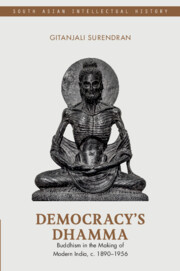
In 1956, B. R. Ambedkar publicly converted to Buddhism raising questions about his turn from constitutionalism to religion. The answer lies in Buddhism itself. In the late colonial era, the struggle to produce an appropriate Buddhism for a nation-in-the-making reveals a secret history foundational to modern India. Thinkers, activists, reformers, pilgrims, and monks from around South, Southeast and East Asia discussed universalism, nationalism, modernity, democracy, and caste radicalism and advocated an Indian return to Buddhism and the Buddha. This book traces this genealogy through the Buddhist itineraries and political projects of figures like Anagarika Dharmapala, Swami Vivekananda, Rabindranath Tagore, Jawaharlal Nehru, Vinayak D. Savarkar, Rahul Sankrityayan and Ambedkar, to reveal how Buddhism emerged as democracy's dhamma, the religion of democracy.
Weaving together thousands of archival fragments, this study explores a shared Black Atlantic world where the meanings of slavery and freedom were fiercely contested and claimed. It recreates the worlds of extraordinary individuals and communities in the long sixteenth century, whilst mapping the development of early modern Black thought about slavery and freedom. From a free Black mother's embarkation license to cross the Atlantic Ocean, to an enslaved Sevillian woman's epistles to her freed husband in New Spain, to an enslaved man's negotiations with prospective buyers on the auction block in Mexico City, to a Black man's petition to reclaim his liberty after his illegitimate enslavement, Chloe L. Ireton explores how Africans and their descendants reckoned with laws and theological discourses that legitimized the enslavement of Black people and the varied meanings of freedom across legal jurisdictions. Their intellectual labor reimagined the epistemic worlds of slavery and freedom in the early modern Atlantic.
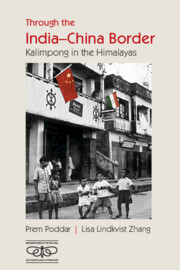
Through the India-China Border mobilizes rarely used documentary material from British, Chinese and Indian archives to shed new light on our understanding of the 'Tibet Question' in China-India relations. Focused on the Himalayan border town of Kalimpong from the 1920s to 1962, it unearths a history of espionage and political intrigue that challenges the way that remote peripheries are seen from the 'centres' of nations. The innovative use of postcolonial and transcultural theory demonstrates how a multidisciplinary framework augments our reading of imperial histories, postwar politics, decolonisation and frontier cultures. Kalimpong emerges from this analysis as a key node in Himalayan history and in the mid-century fashioning of India-China relations.
Today we think of land as the paradigmatic example of property, while in the past, the paradigmatic example was often a slave. In this seminal work, James Q. Whitman asserts that there is no natural form of ownership. Whitman dives deep into the long Western history of this transformation in the legal imagination – the transformation from the ownership of humans and other living creatures to the ownership of land. This change extended over many centuries, coming to fruition only on the threshold of the modern era. It brought with it profound changes, not only in the way we understand ownership but also in the way we understand the state. Its most dramatic consequence arrived in the nineteenth century, with the final disappearance of the lawful private ownership of humans, which had been taken for granted for thousands of years.
The marginalization of Black Americans due to white supremacy and the oppression of Indians under British colonialism featured inescapable similarities. At the turn of the twentieth century, these parallels led Indian and Black nationalists, intellectuals, and activists to share their experiences and engage in dialogues towards improving the social status of their people. Specifically, Black internationalists such as W. E. B. Du Bois, Walter White, and Paul Robeson studied the Indian independence movement, and came to regard India as a template in the fight against white supremacy in the US. Similarly various Indians including Rabindranath Tagore, Lala Lajpat Rai, B. R. Ambedkar, and Taraknath Das theorized crucial parallels between race, colonialism and caste when studying the experiences of Black Americans. This book analyzes how they came together in their desire to overthrow the structures that subjugated them.
Contested Childhoods traces a complex history of caste, race, education, and Christian missions in colonial south India. It draws upon the vast Protestant Christian missionary archives of the London Missionary Society, the Church Missionary Society, and the Basel German Evangelical Missionary Society to showcase the processes of negotiation, tensions, and underlying violence in the encounters between European 'outsiders' and local populations on the question of education. It examines the interplay of caste and education in reshaping ideas and norms of modern childhood and lower-caste community building in the regions of Travancore, Cochin, and Malabar. Set against a comparative historical perspective, the book argues for a greater focus on subaltern histories, especially the meanings and practices associated with educating poor, lower-caste children within the confines of formal schooling and beyond.
Leaving Legacies is a fresh account of the individual in early modern South Asia. A gendered practice carried out by men, leaving legacies involved assembling three kinds of material traces: monuments, books, and sons. Men laid claim to individual distinction within an ethics of remembering worthy individuals by joining their traces with those of men past and reworking older legacies. Their legacies joined their present to the past and future, while also drawing women and non-elite men into a hierarchical order centered upon the individual during Mughal rule and after. This book shows that a concern for the individual self was not an exclusively western phenomenon. Rather, the practice of leaving individual legacies was a crucial means for the production and reproduction of empire, family, and social order in South Asia.
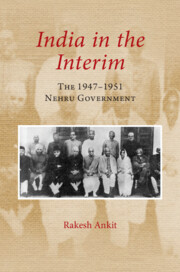
This book looks at the governmental interregnum from August 1947 to the start of the first general election in October 1951, and is a narrative of some of its intermediate moments in light of contemporary politics. It is a multi-track chronicle, which draws attention to its discrete, if not determining, impact on the following decade of consolidation. While it is also a map of the prime minister's words and actions, drawn as it is mainly from his papers, it is embedded in the government. It describes a time of transitional governance in independent India's early political history and gives a glimpse of its multiple individual traits, identity tensions, and institutional trends. The Nehruvian gaze traced here shows what a constant flux governing in those unsettled post-partition years was.
Newly available evidence has shed new light on the inner workings of the socialist state in the Democratic Republic of Vietnam. In a “campaign against modern revisionism” in 1964 the militant faction within the Vietnamese Workers’ Party led by Lê Duẩn sidelined those members who favored a more cautious approach to the struggle for the reunification of the country. After the outbreak of the war, the propaganda machine in the DRV including writers and other artists had to foster popular support for the war and keep morale among civilians and soldiers high. The DRV Ministry of Public Security enforced ideological conformity and after 1965 intensified its efforts to track down and eliminate any party members and individuals who dissented from the aggressive line of the party leadership. Thus, in 1967, in the wake of the Tet Offensive the security apparatus lashed out against those who did not fully support Lê Duẩn’s risky plan for a general offensive and were not deemed fully reliable. The fact that many of those arrested or put under house arrest were close to General Võ Nguyên Giáp shows that the “Antiparty Revisionist Affair,” as the purge came to be known, was also part of internal factional infighting in Hanoi.
The environmental history of the Vietnam War is unique in the twentieth century for the unprecedented scale of aerial bombing and use of incendiaries such as napalm, as well as the United States military’s use of tactical herbicides to destroy forest cover in combat zones. Drawing on recent trends in environmental and military history, this chapter aims to provide a more comprehensive sketch of the environmental legacies of the Vietnam War. Besides the effects of bombing and herbicides, these include inquiries into the footprints of warfare in urban and industrial development, in ethnic and demographic shifts in former warzones, in the dispersion of invasive species, and even in the creation of wilderness or conservation areas.
This paper discusses the succession ceremony organized by Aḥmad ibn Ṭūlūn in 270/884 for his son and heir, Khumārawayh, as described by Egyptian Arabic sources, notably Sīrat Aḥmad ibn Ṭūlūn of al-Balawī, an underutilized text for Abbasid history. The paper considers three overlapping questions. First, how should the accounts be read, as “representational” or, alternatively, as prescriptive, thus of a piece with elements of the Mirror for Princes literature? Second, were Ṭūlūnid networks of loyalty and dependence solely reliant on material inducements or did individuals invest themselves in the Egyptian regime beyond the point of self-interest? The question goes to the problem of material vs. emotional ties of dependency. And, third, was Ibn Ṭūlūn successful in creating a lasting power base? The question goes to the extent to which his contemporaries signed on to his “project” of redefining relations with the Abbasid center.
Chapter One examines the historical and legal context that resulted in the abolition of the East India Company and the formal transfer of political sovereignty from the Mughal state to the British Crown. It focuses on the Uprising of 1857 and is arranged around two questions: How did the colonial state attempt to erase the memory of Mughal sovereignty and the popular character of the violence enacted in its name, and what role did mercy play in this story? The chapter positions the trial and punishment of Bahadur Shah Zafar II as a founding trial of colonial sovereignty which exposed both the extraordinary violence and the absolute limits of colonial sovereign power. A former sovereign would be transformed into a criminal and brought within the British imperial order, but for the sake of the future legitimacy of this political project, he could not be killed.
During the writing of this book, the history of imperial mercy has periodically emerged as a site of national debate in India. The issue has revolved almost singularly around Vinayak Damodar Savarkar, the ideologue of Hindutva and vocal critic of the Indian National Congress. The historical context around this ongoing controversy requires a short summary.
In 1910, Savarkar was placed on trial in the Bombay High Court for waging war against the king and abetment to murder. The charges were a response to the assassination of Arthur Jackson, the collector of Nasik in western India. As explored briefly in Chapter 5, Jackson had been shot dead by the young revolutionary Anant Kanhere. Before Kanhere was executed, he implicated Savarkar in the plot. Savarkar was subsequently found guilty on both counts and sentenced to transportation for fifty years.
This work is a history of ideas, not a history of science. It uses the past to answer the questions of whether the Darwinian Revolution comes from ideas already prevalent in Victoria society – or is it a work of rebellion? – and whether the Darwinian Revolution was truly revolutionary – or is this a mistaken judgment made by historians and others?
Open-source intelligence is readily available and inexpensive. Hamas collected a lot of information from open sources, mainly the Israeli press. In this case, Hamas exploited the fact that Israel is a democratic state with a relatively free press to get valuable information for its operations. This sort of collection activity became more organized after Hamas took control of the Gaza Strip and was Hamas’s main source for strategic analysis. This chapter describes the intelligence content Hamas gathered from open sources and that content’s contribution to its activities.
Politics in South Vietnam (aka the Republic of Vietnam) have long been overlooked in most English-language accounts of the Vietnam War, especially during the final years of the conflict. But the breakdown of the Saigon government’s legitimacy in the eyes of its own anti-Communist constituents during this period was decisive in determining the outcome of the war. This chapter explores the wave of anti-Communist solidarity that swept through South Vietnam’s cities and provincial towns following the 1968 Communist Tet Offensive. It analyzes the South Vietnamese state’s ambitious efforts to implement economic, agricultural, and political reforms. And it demonstrates that President Nguyễn Văn Thiệu’s bid to monopolize political power, following clashes with South Vietnam’s civilian parties and institutions, dealt a fatal blow to the establishment of legitimate anti-Communist government in the South. Thiệu’s autocratic turn betrayed the constitutional order on which the state’s authority was based, deflating post-Tet enthusiasm, accelerating American funding cuts, and precipitating South Vietnam’s collapse from within during the final Communist offensive in 1975. Drawing on newly available Vietnamese-language sources, the chapter examines the underappreciated impact of a diverse range of Vietnamese protagonists, who shaped the decisive political breakdown that brought the Vietnam War to its conclusion.