To save content items to your account,
please confirm that you agree to abide by our usage policies.
If this is the first time you use this feature, you will be asked to authorise Cambridge Core to connect with your account.
Find out more about saving content to .
To save content items to your Kindle, first ensure no-reply@cambridge.org
is added to your Approved Personal Document E-mail List under your Personal Document Settings
on the Manage Your Content and Devices page of your Amazon account. Then enter the ‘name’ part
of your Kindle email address below.
Find out more about saving to your Kindle.
Note you can select to save to either the @free.kindle.com or @kindle.com variations.
‘@free.kindle.com’ emails are free but can only be saved to your device when it is connected to wi-fi.
‘@kindle.com’ emails can be delivered even when you are not connected to wi-fi, but note that service fees apply.
In this chapter, I argue for religious freedom as a first-class right, and I criticise the views of some distinguished scholars who react against traditional conceptions of religious freedom and deny the right to any special protection of religion by legal systems. I focus primarily on Ronald Dworkin and Brian Leiter’s views and arguments. I conclude that Dworkin’s approach to religion belittles the idea of God. Yet conviction about the existence of God and the holding of profound ethical and moral convictions are not so independent as Dworkin argues. Leiter’s approach belittles the idea of religion, which cannot be reduced to a matter of commands, a lack of evidence, and consolation. I argue why religion is more than a matter of conscience and a personal decision about ultimate concerns and questions. Religion cannot be reduced to moral conscience, let alone ethical independence in foundational matters. An increasingly globalised and pluralistic society demands a more comprehensive approach that fully protects all religions and creeds.
The origin of the modern liberal conception of human rights has been traced to the concept of natural rights that has its source in natural law thought, leading some to draw a connection between Thomistic natural law and human rights. However, the Thomistic understanding of natural law is embedded in a religious framework, raising the relevance and possible relation of religious traditions to the contemporary concept of human rights. This chapter explores this relation in the context of Hinduism, which espouses a version of natural law in the idea of Dharma, and gives primacy to duty rather than rights. Can the fundamental tenets, principles and concepts of Hinduism help to develop conceptual groundwork for human rights without subscribing to the Western liberal conception of rights? Exploring this question, the chapter argues for human moral obligations as the link between natural law and human rights. It concludes that human moral obligations serve the same purpose as human rights without being embroiled in controversies that vitiate the Western liberal conception of human rights.
Chapter 5 considers those battles regarding the Abortion Act that found their way to the courts, as broader struggles over the meaning of the Act became framed as narrow, technical questions of statutory interpretation. We consider the role of Pro-Life (and, to a much lesser extent, Pro-Choice) groups in driving this litigation and explore how the focus and framing of these disputes would change over time in line with the shifting centre of the moral debate. We consider how meaning was given to the statutory text, emphasising the important roles played by doctors in giving meaning to the Act before these disputes reached the courts.
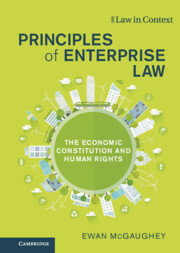
Major enterprises shape our lives in countless ways: big tech and 'surveillance media' that affect democratic debate, algorithms that influence online shopping, transport to work and home, energy and agriculture corporations that drive climate damage, and public services that provide our education, health, water, and housing. The twentieth century experienced swings between private and public ownership, between capitalism and socialism, without any settled, principled outcome, and without settling major questions of how enterprises should be financed, governed and the rights we have in them. This book's main question is 'are there principles of enterprise law', and, if they are missing, 'what principles of enterprise law should there be'? Principles of Enterprise Law gives a functional account of the 'general' enterprise laws of companies, investment, labour, competition and insolvency, before moving into specific enterprises, from universities to the military. It is an original guide to our economic constitution and human rights.
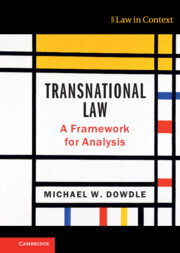
Globalisation impacts every aspect of modern society and today's law graduates are expected to deal with complex legal problems that require knowledge and training that goes beyond domestic law. This textbook provides an overview of how law is becoming increasingly transnational, facilitating theoretical and practical engagement with transnational legal institutions and phenomena. It advances an analytic framework that will help students to understand what to look for when they encounter transnational legal institutions and practices, and what are the practical and normative implications of their findings. By considering both the theory and practice of transnational law and taking a discursive approach to the material, students are encouraged to arrive at their own conclusions. Adopting interdisciplinary techniques and using case studies from around the world, this book offers a holistic, balanced exploration of a new and emerging discipline.
The aim of this book has been to understand the role of quantification in law and its impact on law and development, and judicial reform. It has sought to examine how different institutions shape the making and use of legal indicators. The relevance of this research is evident in that, at the 51st Session of the UN Statistical Commission in March 2020, the issue of indicators and data related to governance was on the agenda. One of the items for discussion within this agenda was a report, which suggested developing a new indicator to measure access to justice and also articulated that any measurement must start from ‘the perspective of people and communities’.
This book aspired to shed light on the limitations of existing quantification tools, which measure the rule of law, and their lack of engagement with concepts and frameworks from plural legal worlds. In addition to a critique of existing frameworks of legal indicators, the book also offers an alternative framework for the measurement of the dispute resolution processes in plural legal orders. This expands beyond an institutional approach to the rule of law to a bottom-up, user-centred approach that places importance on the legal needs and challenges of people through adopting the wider concept of access to justice. Keeping in mind the interdisciplinary nature of the research, the book adopted a socio-legal approach to unpacking not just the frameworks behind rule of law indicators, but also how they impact the social worlds around them. In particular, the book has advanced the idea that we need to incorporate the rule of law as a concept within the more expansive idea of access to justice. This argument is made because access to justice is broader and more flexible as a concept and is able to include different narratives and life worlds.
Through the course of the book, I have examined the views of critics on how quantification simplifies the functioning and complexity with which disputes in legal systems are evaluated. Engaging with these critical challenges to the use of indicators, I have aimed to build a consolidated response to these criticisms by looking at how to build legal indicators that are cognizant of diverse epistemologies of knowledge around justice and the variety and diverse nature of how disputes are resolved in plural legal systems.
The development of legal indicators is a function of many decisions that in turn contribute to the epistemological power of these quantification tools. These decisions include the choices of theoretical concepts and methodologies employed in order to develop indicators, the locations from where the knowledge is constructed and from where it is extracted, the purposes for which the indicators are developed and the desired impact they are meant to achieve. These decisions influence the development of indicators and impact how they function. Through these different choices and decisions, indicators are built with a particular point of view and, as a result, while they can tell stories and convey a particular reading of the world, they also simplify and reduce complexity, create silences and engineer absences in understanding the world.
This chapter is concerned with offering a framework to embed an epistemic plurality and diversity into how we can build and develop legal indicators. It does so by engaging with epistemologies of the Global South and with embedding the realities of legal pluralism in the making of indicator frameworks. It explores how indicator frameworks can pay attention to the way in which concepts and values are represented while also engaging with different experiences and realizations of justice as they materialize in people's lives.
An important starting point for this chapter is an acknowledgment of the ubiquity of quantification. In the next section, I provide an overview of how we live in a quantified society and that legal indicators, like other indicators, have become pervasive in their use in public discourse, government functioning, international business and development cooperation. Acknowledging the pervasiveness of quantification, however, does not mean that the practice of quantification cannot be done differently. In the ensuing section, I will introduce the idea of ‘persistence’ as a strategy to address some of the challenges posed by the critiques and argue that through persistence, steps can be taken to make the process of development and construction of indicators more open and transparent. The aim of this chapter is to address some of the critiques of legal indicators by offering an epistemological perspective, particularly by drawing from legal pluralism and through concepts from the South. It is an attempt to directly address the silences and absences in the current framing of legal indicators.
The promotion of the rule of law has been a major part of development assistance programmes because it is seen as a core element in the fulfilment of various aims such as economic development, peace and security, and respect for human rights. Much of the effort to promote the rule of law has been focussed on strengthening the formal justice systems in countries in the Global South by executing projects such as building new courts and legal institutions, training judges and lawyers, and drafting new laws that are meant to develop the justice system by reflecting successes seen in other jurisdictions, primarily of the Global North. The assumption behind such policies is that if such institutions are built, then the rule of law will automatically follow. Over the years, these policies and projects which have largely focussed on building formal justice systems have cost billions of dollars. A consistent critique of these policies has been that transplantation of legal ideas, values and institutions, without cognizance of local contexts and realities, does not work. Similarly, as this chapter will show, the framing and developing of legal indicators are also influenced by legal formalism and institutional ideas of the rule of law.
Increasingly, however, there has been a shift in rule of law programming with more engagement with local dispute resolution forums such as those based on custom, religion and community practices. For the purposes of the analysis, these will collectively be called non-state justice systems (NSJS). This is not to diminish or ignore the plurality among them and the diversity of their functions but to distinguish them from the state-centred justice systems, which, in this instance, include the executive, the judiciary and the legislature of a country, and their bureaucracies.
The phenomenon of ‘legal pluralism’ has emerged in rule of law programming because development agencies recognize the resilience of NSJS and the limits of top-down legal reform that takes place without cognizance of history, culture and context. Development agencies have also recognized that NSJS have legitimacy and authority in particular regions around the world because they are accessible, affordable and familiar.
In late 2017, India climbed a sharp 30 places in the World Bank's Ease of Doing Business rankings. The rankings were discussed and celebrated as testament to the manner in which the Indian government, under Prime Minister Narendra Modi, had effected policy change to improve the trade, tax and economic climate in the country. The prime minister himself tweeted that it was the outcome of a multi-sectoral reform agenda of his government. A few months later, the Centre for Global Development (CGD) produced a study, which stated that India's rise in the rankings was closely related to a change in the methodology adopted by the World Bank rather than a result of sustained reform in India. This study closely followed a rare admission by the former World Bank chief economist Paul Romer, who questioned the integrity of the Ease of Doing Business ranking, which he argued had been politically motivated. He spoke, in particular, of the case of Chile where the ranking appeared to favour Sebastian Pinera over Michele Bachelet in the presidential race.
The CGD also showed that the fall in rankings of Chile during the time of Bachelet was due to methodological tinkering and not an outcome of any laws or policy changes by the government. On recreating the Ease of Doing Business ranking using a consistent methodology and fixed sample of countries from 2006–2019, the study showed that the performance in Chile had in fact not been as volatile as in the official ranking.
In both the instances of India and Chile, the rankings were seen as objective measures, backed by the influence of the World Bank. They were then used by political actors and rivals as election planks to dismiss rival political visions, performances and abilities to reform. The reasons for their use were that the rankings produced a sense of authenticity and certainty about the state of the country at that point in time. It provided a justification for making sense of the otherwise nebulous concept of ‘ease of business’ by creating criteria that could form a set of rankings. These cases illustrate how the use of numbers in the form of indicators have the power to tell stories, build narratives and affect changes in behaviours—a matter that will be investigated further in this chapter.
A multi-stakeholder Task Force on Justice that brought together United Nations (UN) member states, civil society and international organizations in 2019 released a report that estimated a global justice gap of 5.1 billion people. This number, which makes up over two-thirds of the world's population, was estimated to be of those people who are without meaningful access to justice. The gap has three dimensions that looked at the living conditions of people, matters of dispute resolution and opportunity deprivation to lead a secure life. First, at least 253 million people live in conditions of extreme injustice, of which 12 million are stateless, 40 million work in conditions of modern slavery and 203 million live in conditions of such insecurity that it is difficult to pursue justice. Second, over 1.5 billion people are unable to resolve their justice disputes on account of challenges of the civil or administrative system or unresolved criminal matters. Third, over 4.5 billion people are excluded from political, economic and social opportunities that are provided by the law on account of being unable to access a legal identity, lack of land tenure and informal employment. These are startling figures, which indicate the sheer magnitude of the challenge that confronts those working to address barriers to access to justice. This large exercise also demonstrated a move towards quantifying justice, as a method to articulate these barriers in order to emphasize the urgency for action. Rule of law indicators and measurement frameworks have become increasingly popular and widely used to evaluate the capacities of legal systems. This is so because inter alia, indicators are seen to increase the diagnostic capacity of policy makers to identify bottlenecks in the legal system, enable empirically based solutions for justice reform, and enhance the capacity of civil society to monitor justice delivery. By examining regional variations among various legal systems, analysing elements of state practice and law making, and drawing linkages between access to justice, good governance and democratic validity, these indicator frameworks speak to the question: is the rule of law increasing globally? Through the data collected and subsequently analysed, these indicators are used to indicate and signal a way to assess the state of justice and legal institutions around the world.
This questionnaire is an attempt to trace how the respondent has made the journey through four stages in the search for access to justice that includes understanding a dispute, negotiating a solution, navigating a procedure and obtaining a resolution. The purpose of this questionnaire is to evaluate and record the experiences of the justice user in using a plural justice system. It seeks to showcase the kind of data that will be collected using this method.
This questionnaire is about eight main capabilities:
1 The capacity to name a dispute and acknowledge an injury
2 The capacity to choose how to resolve a dispute
3 The capacity to strategize in a negotiation
4 The capacity to feel and be valued during the negotiation
5 The capacity to relate to the manner of the procedures being used
6 The capacity to share during the procedure
7 The capacity to be enforce a resolution
8 The capacity to belong after a decision at the time of resolution
This chapter seeks to build upon the argument for epistemological diversity proposed in the last chapter by embracing legal plurality and including bottom-up perspectives in understanding and evaluating access to justice, and how people use the law to resolve their grievances. It also calls for engaging with concepts and narratives from the Global South, with the understanding that there are many worlds with different knowledge systems and there is a need to engage with these epistemologies and values to present a truly global legal indicator. To do this, this chapter draws on recent work that recognizes the need for people-centred approaches to address justice problems, and extends these approaches by offering a framework and methodology to measure access to justice in plural legal systems where there are competing forums for dispute resolution, and varied principles, ideas and norms.
Having introduced concepts of ‘access to justice’ and ‘legal pluralism’ in the previous chapters, this chapter analyses how these two concepts can be developed using the capability approach first proposed by Amartya Sen. The purpose of focussing on human capability is to understand and map effective opportunities that people have in order to lead lives that they consider valuable, and in this regard understand how they can also have meaningful access to justice. I argue that if we wish to evaluate how justice systems function, we need to do so by understanding them from a user perspective and by looking at how people experience them and find ways to resolve their grievances.
There are several existing legal indicators. However, a majority of them are designed primarily to measure the rule of law from an institutional approach, with a state-centric notion of justice delivery. In these evaluative tools, the rule of law is measured in terms of institutions responsible for the administration of justice, such as the police, prisons, and courts. The conceptual aspects of these tools are designed primarily for formal justice systems, which are then seen as aspirational models of justice delivery and models to be replicated in other geographies. These indicators, as we have shown in the previous chapter, do not accurately represent the Global South due to the pluralities of dispute resolution institutions that operate with different concepts, procedures and substantive values.