To save content items to your account,
please confirm that you agree to abide by our usage policies.
If this is the first time you use this feature, you will be asked to authorise Cambridge Core to connect with your account.
Find out more about saving content to .
To save content items to your Kindle, first ensure no-reply@cambridge.org
is added to your Approved Personal Document E-mail List under your Personal Document Settings
on the Manage Your Content and Devices page of your Amazon account. Then enter the ‘name’ part
of your Kindle email address below.
Find out more about saving to your Kindle.
Note you can select to save to either the @free.kindle.com or @kindle.com variations.
‘@free.kindle.com’ emails are free but can only be saved to your device when it is connected to wi-fi.
‘@kindle.com’ emails can be delivered even when you are not connected to wi-fi, but note that service fees apply.
The political rise of Robert F. Kennedy Jr. and the Make America Healthy Again (MAHA) movement in the United States has sparked unprecedented interest in US food and farm policy, including subjects such as food chemicals, pesticides, and ultra-processed foods. Kennedy and his adherents in the MAHA movement are demanding sweeping reforms of food and farm policies, challenging powerful interest groups, and inviting new questions from food consumers. Remaking Food and Farm Policy in the United States examines how food and farm law and policy dramatically impacts food safety, food prices, nutrition, hunger, and the fate of the people who feed us. The book summarizes law and policy related to nutrition, hunger, food labels, food marketing, food chemicals, farm subsidies, farm pollution, farm animal welfare, and food and farm workers. It considers how the MAHA movement may reshape our food and looks forward, proposing needed policy reforms.
Herman Melville is traditionally understood as a writer of the open seas, seeking freedom from the constraints of law, politics, and power. This book offers a transformative reading, revealing a different Melville – one who viewed the ocean as a theater of contested sovereignties and crumbling constitutions. Drawing on his experiences under sail and his reflections on whales and the life of the sea, Melville learned to read nature with distinctively political eyes; in each of these contexts and more, he told stories of people escaping from one legal order only to find another. His work illuminates entangled zones of multiple jurisdictions where discretionary powers of conscience and judgment remain vital means for finding justice, equity, and mercy in the tempestuous world in which we live.
The Supreme Court's composition tends to remain stable over time, yet its docket and rulings change, affecting our understanding of the Court's broader political ramifications. In Majority Opinions, Stephen Jessee, Neil Malhotra and Maya Sen examine how the Supreme Court's alignment with public opinion shifts dramatically, shaping its legitimacy, approval, and vulnerability to reform. Introducing an empirical method and framework that systematically compares Americans' preferences on case outcomes with the Court's actual rulings, the authors uncover yawning gaps and unexpected alignments across issues and terms. They show how changes in court composition-Amy Coney Barrett replacing Ruth Bader Ginsburg, for example-can shift the Court's trajectory rightward, while docket choices can move rulings closer to public sentiment after unpopular rulings. Examining how the Supreme Court navigates a polarized political environment, the authors reveal how its choices have profoundly affect influence, legitimacy, and national policy.
Pardons is an unprecedented history of the pardon power, chronicling how British monarchs and American presidents have wielded clemency to afford mercy, reconcile societies, and exert executive supremacy. The book traces the pardon power from its origins as an attribute of absolute monarchy to its adoption by the American Framers as one of the few enumerated powers of the president of the United States. It tells the stories, human and political, of all forty-five presidents who have wielded the pardon power and of those they pardoned. The book argues that the increasing abuse of presidential clemency and the effective elimination of impeachment and criminal prosecution as constraints on presidential misconduct have made the pardon power a threat to the rule of law. To address this growing danger, Pardons calls for presidential pardon powers to be eliminated or transferred to Congress by constitutional amendment.
Critical Evidence taps into a growing body of scholarship that demonstrates evidence law is fundamentally about power, setting the boundaries of whose voices will be heard and what types of knowledge will be cognizable in courts of law in the United States. The book brings together leading and emerging Critical Evidence scholars to examine the major rules that govern admissibility in court, from relevancy to hearsay to privileges. These scholars show that many such rules are not neutral as constructed or applied, but, in fact, privilege insiders at the expense of outsiders, namely poor people, women, people of color, disabled people, and LGBTQ+ people. Through a close reading of rules and doctrine, Critical Evidence shows that evidence law must and should change in order to serve as a system that promotes truth, justice and fairness for all in the American legal system.
Empirical Animal Law challenges long-held assumptions about what animal law reforms help or harm animals. Drawing on original empirical studies and a broad interdisciplinary body of research, the book tests whether familiar tools of advocacy such as incremental reforms, criminal prosecutions, litigation, and protest really reduce animal suffering. Moving beyond moral intuition and ideology the book reveals how people perceive animal harm, which messages and messengers persuade, and when well-intentioned strategies may backfire. With chapters on factory farming reforms, criminal punishment, litigation strategy, protest backlash, and moral framing, Empirical Animal Law offers the first comprehensive, data-driven account of how animal law operates in practice and calls for a new empirically informed movement.
The demise of the 'racial reckoning' that followed George Floyd's death in 2020 occurred without definition, scrutiny or attempts to revive it. In this compelling new book, David Dante Troutt explores the 'what,' 'so what' and 'now what' of this period when much of the US sidelined the pandemic to confront racial inequality. It details how a rare focus on embedded racism shifted toward awareness, leaving deep disparities in wealth, health and policing unaddressed, and how this was overpowered by an enduring conservative backlash. Troutt unpacks how legal doctrine favored colorblindness over inequality, and examines government policies that created segregated zones of racial bargaining in health and wealth. The book also exposes deterrence-proof policing rules and explains the problems and promises of DEI. Reckoning the Racial Reckoning argues that democratic struggles over local resources are essential for creating justice and well-being for Black American communities, and ultimately for all Americans.
This book reveals how Congress quietly shaped American elections across more than a century of constitutional development. Far from a passive observer, Congress used its authority to influence key controversies – from the expansion of slavery in new territories to the reconstruction of the post-Civil War electorate. Congress exercised power under the Elections Clause, the Guarantee Clause, and later, the Fourteenth and Fifteenth Amendments, to combat voter suppression, reimagine representation, and determine who could (and could not) participate in American democracy. Even as Jim Crow laws disenfranchised millions, Congress continued to review and sometimes overturn the elections of its own members, refusing to cede complete control to the states. In doing so, Congress routinely subordinated federalism to politics. In Congress We Trust? provides a new perspective on who truly governs our system of elections by showing that federal authority has been broad, lasting, and decisive.
This is the story of Louis Bieral, a nineteenth-century gangster, politician, sportsman, and Civil War hero. Kidnapped from his birthplace in revolutionary South America, he doused fires in Jacksonian New York, battled Sumatran pirates with the US Navy, and panned for California gold. As a crime boss, he raced horses, boxed champions, and ran brothels. Yet Bieral's adventurous life was also steeped in the brutality of his time. He befriended rowdies like 'Butcher' Bill Poole, returned fugitives like Anthony Burns to slavery, and assaulted abolitionists such as Richard Henry Dana. As a Union officer, Bieral won fame in battle. He was a Gilded-age bodyguard for 'Boss' Tweed, William Seward, and Jim Fisk, becoming a suspect in that tycoon's murder. From the docks of Valparaíso to the dining room of Delmonico's to the cells of Auburn Prison, Bieral's remarkable journey illustrates the violence that bound nineteenth-century America together.
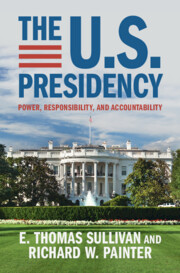
In The U.S. Presidency, E. Thomas Sullivan and Richard W. Painter examine the evolving state of presidential power in the United States, specifically facilitating discussion and debate concerning the power, responsibility, and accountability of U.S. Presidents. How is power acquired? How is it used or misused? How are the President's powers checked and how are they held accountable to and by the people? Rather than promote a single theory of presidential power, Sullivan and Painter answer these questions with a wide range of arguments for and against power in a broad number of circumstances and Supreme Court holdings. Grounded in the intersection of law, politics, and history, this book engages readers across disciplines, helping them understand the remarkable transformation of the United States presidency. Objective and timely, The U.S. Presidency makes a case for a democratic model of self-government centered on accountability and the rule of law.
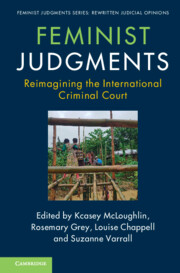
In the past decade, feminist scholars and women's rights activists have used the feminist judgment method to reimagine the relationship between law and gender justice, resulting in rewritten 'feminist' judgments from courts around the world. This groundbreaking book extends this approach and applies it to a wide range of decisions of the International Criminal Court (ICC), the Hague-based court with power to prosecute war crimes, crimes against humanity, genocide and aggression in over 120 countries. With over 60 contributors from the Global North and Global South, including countries where the ICC has been active, this book reflects an international and intersectional feminism. Diverse contributions reveal the gendered implications of crimes (both sexual and non-sexual), command responsibility, defences, complementarity, head of state immunity, sentencing, reparations and more. This title is also available as Open Access on Cambridge Core.
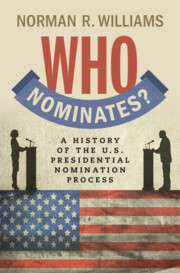
Who Nominates? is an accessible and non-partisan examination of the presidential nomination process, untangling the byzantine web of legal rules that govern modern nomination procedures in both major political parties. Beginning with the Constitutional Convention of 1787, noted constitutional law scholar Norman R. Williams traces the evolution of party rules and state laws regarding which individuals are entrusted with the power to choose the parties' presidential nominees. Only in the 1970s were ordinary voters fully included in the process, and even today, the rules governing nominations exclude or devalue a large number of voters. Williams' analysis provides context for modern debates about the role and influence of party elites, such as the Democrats' “superdelegates,” and examines how the rules governing the process today contribute to the increasingly divisive ideological polarization of presidential contests.
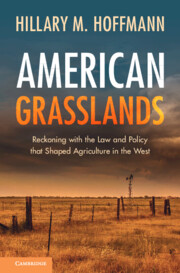
American Grasslands provides a comprehensive review of select laws and policies that have shaped modern western agriculture. Through compelling stories of both famous and lesser-known ranches, the book explores the trajectory of law and policy that has consolidated power in western ranchers and agricultural enterprises. Drawing lessons from historical events such as the Dust Bowl and the current climate and extinction crises, the book illustrates the harmful externalities of agricultural activity and the need for meaningful reform. The book also addresses recent national calls for social and racial justice in the context of western agriculture and public resources like water, land, and wildlife. After highlighting the problems created by current laws and policies, the book offers practical recommendations for future legal and policy reform. American Grasslands is a must-read for anyone interested in the history and future of western agriculture and the role of law and policy in shaping it.
We often hear that there is no way out of the modern economic and political tensions that fall along geographic lines. The media regularly declares that rural America is dying and that rural voters are driven only by anger. This narrative of hopelessness centers on the role that markets have played in abandoning rural regions and populations. In Reviving Rural America, Ann M. Eisenberg analyzes our society's laws and policies' role in the urban/rural divide to make the case for hope. She demonstrates how law and policy, as well as decision-makers acting on their own subjective values, have contributed to modern rural challenges. Each chapter debunks a common myth about rural people, places, and policies, helping reveal how we got to where we are now. Ultimately calling for our laws and policies to steward rural America holistically, as a collective resource for all, this book envisions an alternative, more resilient and more just future.
The internet has reshaped the media landscape and the social institutions built upon it. Competition from online media sources has decimated local journalism and diminished the twentieth century's established journalistic gatekeepers. Social media puts individual users front and center in the creation of the content that they consume. Harmful speech can spread further and faster, and the institutions responsible for policing that speech-Facebook, TikTok, YouTube and the like-lack any clear twentieth-century analog. The law is still working to catch up to the world these changes have wrought. This volume gathers sixteen scholars in law, media, technology, and history to consider these changes. Chapters explore the breakdown of trust in the media, changes in the law of defamation and privacy, challenges of online content moderation, and financial viability for journalistic enterprises in the internet age. This title is also available as Open Access on Cambridge Core.
How Government Built America challenges growing, anti-government rhetoric by highlighting the role government has played in partnering with markets to build the United States. Sidney A. Shapiro and Joseph P. Tomain explore how markets can harm and fail the country, and how the government has addressed these extremes by restoring essential values to benefit all citizens. Without denying that individualism and small government are part of the national DNA, the authors demonstrate how democracy and a people pursuing communal interests are equally important. In highly engaging prose, the authors describe how the government, despite the complexity of markets, remains engaged in promoting economic prosperity, protecting people, and providing an economic safety net. Each chapter focuses on a historical figure, from Lincoln to FDR to Trump, to illustrate how the government-market mix has evolved over time. By understanding this history, readers can turn the national conversation back to what combination of government and markets will best serve the country.
In the United States and elsewhere, the questions of who should serve as a judge and how these judges should be chosen are increasingly contested. In Litigating Judicial Selection, Herbert Kritzer examines these questions with a comprehensive analysis of judicial-selection litigation over time and place. With a data set of over 2,000 cases from around the world, Kritzer offers new insight into the judicial selection by way of in-depth statistical analysis and an extensive narrative description of several important case studies. This book should be read by anyone seeking insight into the way judges are selected in the twenty-first century.
ERISA, the detailed and technical amalgam of labor law, trust law, and tax law, directly governs trillions of dollars spent on retirement savings, health care, and other important benefits for more than 100 million Americans. Despite playing this central role in the US economy and social insurance systems, the complexities of ERISA are often understood by only a few specialists. ERISA Principles elucidates employee benefit law from a policy perspective, concisely explaining how common themes apply across a wide range of benefit plans and factual contexts. The book's non-technical language and cross-cutting conceptual organization reveal latent similarities and rationalize differences between the regulatory treatment of apparently disparate programs, including traditional pensions, 401(k), and health care plans. Important legal developments - whether statutory, judicial, or administrative - are framed and analyzed in an accessible, principles-centric manner, explaining how ERISA functions as a coherent whole.
In the warped world of prescription drug pricing, generic drugs can cost more than branded ones, old drugs can be relaunched at astronomical prices, and low-cost options are shut out of the market. In Drugs, Money and Secret Handshakes, Robin Feldman shines a light into the dark corners of the pharmaceutical industry to expose a web of shadowy deals in which higher-priced drugs receive favorable treatment and patients are channeled toward the most expensive medicines. At the center of this web are the highly secretive middle players who establish coverage levels for patients and negotiate with drug companies. By offering lucrative payments to these middle players (as well as to doctors and hospitals), drug companies ensure that inexpensive drugs never gain traction. This system of perverse incentives has delivered the kind of exorbitant drug prices - and profits - that everyone loves except for those who pay the bills.