To save content items to your account,
please confirm that you agree to abide by our usage policies.
If this is the first time you use this feature, you will be asked to authorise Cambridge Core to connect with your account.
Find out more about saving content to .
To save content items to your Kindle, first ensure no-reply@cambridge.org
is added to your Approved Personal Document E-mail List under your Personal Document Settings
on the Manage Your Content and Devices page of your Amazon account. Then enter the ‘name’ part
of your Kindle email address below.
Find out more about saving to your Kindle.
Note you can select to save to either the @free.kindle.com or @kindle.com variations.
‘@free.kindle.com’ emails are free but can only be saved to your device when it is connected to wi-fi.
‘@kindle.com’ emails can be delivered even when you are not connected to wi-fi, but note that service fees apply.
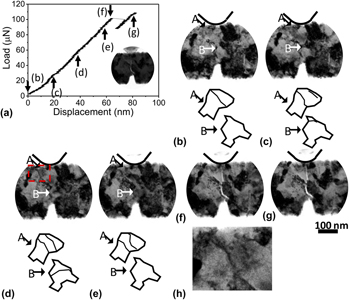
We designed a clamped beam bending test using a nanoindentation holder with help of transmission electron microscopy (TEM) and focused ion beam specimen fabrication. The microstructure evolution and crack propagation in nanocrystalline TiN were studied by electron imaging and load–displacement measurements during mechanical loading. By measuring the loads under which the crack starts and stops propagating and the time, we obtained the film's fracture toughness using the finite element method and crack propagation speed. Among these, we identified three types of crack propagation pathways, namely bridging, intergranular and a mixed mode of transgranular and intergranular fracture, and the associated microstructure changes. The measured fracture toughness is in agreement with the reported values. Thus, our in situ TEM bending test provides the first direct measurement of fracture toughness in a TEM and a correlation of fracture toughness with fracture toughening mechanisms in nanocrystalline TiN. The method is general and can be applied to other nanocrystalline materials.
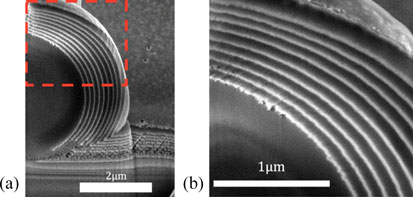
The field of nanophotonics has experienced a dramatic development in recent years, which requires ample candidate structures to achieve desirable functionalities. For many novel device designs in emerging field of transformation optics, optical metamaterials, and others, non-uniform and non-conformal thin films as well as three-dimensional (3D) structures are necessary to achieve advanced functionalities. Here, we report several techniques utilizing angled physical vapor deposition to obtain unique and complex 3D structures such as films with tapered thickness on planar substrates, tapered or uniform films on curved surfaces, and 3D nanorod arrays. These structures could enrich the existing practical design space for applications in nanophotonics and nanoelectronics.
The NbCr2 Laves phase was fabricated by spark plasma sintering (SPS) using spherical Nb and Cr powders. The experimental results revealed that increasing the sintering temperature to 1773 K can result in the formation of NbCr2 Laves phase as major phase, but it always appeared with trace amounts of Nb and Cr solid solutions. Based on the theoretical calculations, the residual of Nb and Cr solid solutions was attributed to the inhomogeneous distribution of temperature increase from the particle-contacting surface to the center of particle when pulsed current passed through. Moreover, the hardness and fracture toughness of the SPS-processed NbCr2 attained 14.05 ± 0.67 GPa and 8.9 MPa·m1/2, which were 1.6 and 7.4 times of the as-cast NbCr2 Laves phase (1.2 MPa·m1/2). The formation of ductile Nb and Cr solid solutions and fine grains were considered to be the reason for the remarkable enhancements in mechanical properties.
DNA-immobilized Fe3O4 particles (DNA–Fe-particles) were prepared by mixing DNA, magnetic Fe3O4 particles, and the silane coupling reagent, bis[3-(trimethoxysilyl)propyl]amine. The DNA–inorganic hybrid material was uniformly immobilized onto magnetic Fe3O4 particles with the diameters of approximately 450 nm. These DNA–Fe-particles were stable in water. Additionally, we could simply collect the DNA–Fe-particles by a magnet from an aqueous solution. Therefore, we demonstrated the accumulation of various metal ions, such as heavy and rare-earth metal ions, by the DNA–Fe-particles. As a result, although these DNA–Fe-particles could selectively accumulate heavy and rare-earth metal ions, these materials could not accumulate the light metal ions, such as Mg(II) and Ca(II) ions. Furthermore, the metal ion-accumulated DNA–Fe-particles could be recycled by washing them with an aqueous ethylenediaminetetraacetic acid solution.
A congruent melting compound LiNaV2O6 has been synthesized by high-temperature solution reaction and it has been grown with sizes up to 11 × 6 × 2 mm3 by the top-seeded growth method for the first time. LiNaV2O6 crystallizes in the monoclinic system with space group C2/c, with a = 10.184(2) Å, b = 9.067(2) Å, c = 5.8324(11) Å, β = 108.965(14)°. UV–Vis–NIR diffuse reflectance spectrum of LiNaV2O6 shows that it has a wide transmittance range from 385 to 2500 nm. The ab initio calculations show that the birefringence of LiNaV2O6 is 0.136 at 589.3 nm. Therefore, LiNaV2O6 may be a new birefringent material. Based on the analysis of the relationship between crystal structure and linear optical properties, it is found that the large birefringence is attributed to the particular arrangement of V–O anionic groups.
Wear and corrosion exist as one of the main important factor of energy and material losses in mechanical and chemical process. Coating is classified as one of the ways to enhance energy, chemical, and mechanical durability. Several previous investigations reported that addition of nanoparticle as an additive will enhance the characteristic of surface roughness and wear properties. The objective of this study is to investigate the wear, surface roughness, and corrosion resistance of Co–Ni–Fe nanoparticles electrodeposited on mild steel. The effect of deposition time toward physical properties (composition, surface morphology, and surface roughness), hardness, corrosion, and slurry wear erosion properties of coated mild steel were investigated. The finding showed that the increase of the deposition time led to an increment of hardness and coating thickness. The optimum Co–Ni–Fe nanoparticles deposited at 30 min produced a uniform coating and microhardness of 277.42 HV. Besides, the cumulative coating mass loss obtained from 30 min deposited coating sample was the lowest at both rotational speeds of 300 and 1200 rpm. It was observed that the optimum deposition time improved the surface roughness, coating morphology, hardness and resistance toward slurry erosion and corrosion.
Glasses doped with rare earth elements (lanthanide series) are the most popular materials used in upconversion devices. The main aspect to develop these devices is to find suitable host materials for rare earth ions. The host material should have a high transmission of the upconverted photons, high thermal stability, good mechanical properties, low price, and easy to manufacture and shaping. Present work is concerned with studying the mechanical and structural properties for the oxide glass system doped with rare earth metal (erbium oxide, Er2O3). Ultrasonic pulse-echo technique is used to measure the sound velocities in the glass system (30%B2O3·30%Bi2O3·20%Li2O·10%BaO·10%Pb3O4·xEr2O3), (x = 0, 0.5, 1, 2, 3, 4) mol%. Ultrasound velocities (longitudinal and shear) are measured as a function of the Er2O3 content at a frequency of 4 MHz for longitudinal wave and 2 MHz for the shear wave at a temperature of 300 K. The elastic moduli and some physical parameters, such as Debye temperature, coordination number, and compressibility, were evaluated. Furthermore, the dimensionality of the glass network has been calculated in terms of the d ratio which equals G/B ratio. These parameters beside the x-ray diffraction, differential scanning calorimetry, and Fourier Transform Infrared (FTIR) measurements throw more light on the structure of the glass system. The measurements in this study exhibit remarkable anomalous changes in the network structure of the investigated glass doped with Er2O3.
The combination of low areal density, high flexural rigidity, and open architecture makes metallic microsandwiching a promising candidate for structural frameworks in small-scale multifunctional devices. We demonstrate a one-step electrodeposition procedure to synthesize an aluminum–manganese (Al–Mn) microsandwich using a porous polycarbonate (PC) membrane template from room-temperature ionic liquid. Mn was added to refine the microstructure and increase the hardness of Al. A cyclic voltammogram study shows Mn codeposit with Al in an acidic chloroaluminate electrolyte. Increasing the MnCl2 concentration in the electrolyte from 0.05 to 0.25 M promoted a crystalline to amorphous phase transition of the deposited structures. Finally, mechanical properties and damage resistance of the microsandwiches were evaluated using nano- and micro-indentation tests as well as finite element methods.
This paper investigates the effects of graphene nanoplatelets (GNPs) as additives in palm-oil trimethylolpropane (TMP) ester blended in polyalphaolefin. Different concentrations of GNPs that were ultrasonically homogenized in blended lubricants consist of 95 vol% polyalphaolefin and 5 vol% TMP ester. Physical properties of the nanolubricants were identified and tribological behaviors of GNP in blended lubricants were studied using standard fourball testing and surface analysis was done on the wear surfaces using scanning electron microscopy and energy-dispersive x-ray techniques. Addition of 0.05 wt% GNP in blended lubricant resulted in the lowest coefficient of friction and wear scar diameter, thus selected as the most suitable concentration of GNP in the blended lubricant. Friction and wear were reduced by 5 and 15% respectively, with the presence of 0.05 wt% GNP in the blended lubricant.
We demonstrate here the design, synthesis and characterization of two new chlorinated polymers, P(NDI2HD–T2Cl2) and P(NDI2OD–T2Cl2) based on N,N′-difunctionalized naphthalene diimide (NDI) and 3,3′-dichloro-2,2′-bithiophene (T2Cl2) moieties. Our results indicate that organic thin-film transistors (OTFTs) based on these new chlorinated polymers exhibit electron mobilities approaching 0.1 cm2V−1s−1 (Ion:Ioff ~ 106–107), with far less ambipolarity due to their lower highest occupied molecular orbital energies, and they are more stable under deleterious high-humidity conditions (RH ~ 60%) and upon submersion in water, compared with those fabricated with the parent non-chlorinated polymers. In addition, OTFTs fabricated with the new chlorinated polymers exhibit excellent operational stabilities with <3% degradations upon bias-stress test.
This study reports new facile approach for gram-scale synthesis of graphene-like nanosheets fine powder, using glucose as precursor. Reduced graphene oxide (RGO) has been prepared in gram-scale via hydrothermal treatment of glucose. Upon increasing the vapor/liquid ratio for aqueous glucose solution within the autoclave system to 3/2, RGO-rich graphitic powder, containing small graphene oxide and amorphous carbon contents and having spherical morphology, is obtained. Then, introducing ammonia into the reaction medium resulted in the formation of pure RGO with reduced O-content and flat nanosheet-like morphology (Amm–RGO3/2). Interestingly, few-layer graphene-like nanosheets with slight oxygen and amorphous carbon contents and few structural defects are produced when annealing Amm–RGO3/2 at 600 °C under inert atmosphere. In summary, hydrothermal treatment of aqueous solution containing just glucose and ammonia followed by moderate-temperature thermal annealing, lead to few-layer graphene-like nanosheets with good structural characteristics. This new simple and efficient approach can be of great potential in the mass production of graphene-like nanosheets.
The first book on the topic, and written by the founder of the technique, this comprehensive resource provides a detailed overview of sum-frequency spectroscopy, its fundamental principles, and the wide range of applications for surfaces, interfaces, and bulk. Beginning with an overview of the historical context, and introductions to the basic theory of nonlinear optics and surface sum-frequency generation, topics covered include discussion of different experimental arrangements adopted by researchers, notes on proper data analysis, an up-to-date survey commenting on the wide range of successful applications of the tool, and a valuable insight into current unsolved problems and potential areas to be explored in the future. With the addition of chapter appendices that offer the opportunity for more in-depth theoretical discussion, this is an essential resource that integrates all aspects of the subject and is ideal for anyone using, or interested in using, sum-frequency spectroscopy.
Inconel 617 alloy (IN 617) is an important candidate material of advanced ultrasupercritical power unit above 700 °C. However, there are some issues in welding of IN 617 such as constitutional liquation and hot cracking. Tungsten inert gas (TIG) is considered as an effective welding method to join IN 617 because of low heat input and high quality. Investigation of the microstructure variation of TIG welded joint and its correlation with properties is helpful in deep understanding the stability and reliability of IN 617 welded joint. In this paper, the microstructure evolution and element segregation of IN 617 welded joint were investigated systematically. It is found that the base metal (BM) with significant banded structure is characterized by austenitic grains and some secondary phases distribute along the grain boundaries and inside the grains. The fine secondary phases are determined as M23C6 enriched with Cr and Mo elements. A few large polygon phases are identified as Ti(C, N) with a size of about 10 μm. The coarsened secondary phases are observed in the heat affected zone (HAZ) close to BM whilst the lamellar structure enriched with Cr and Mo is present along grain boundaries in the HAZ near the fusion line. The weld metal (WM) is fully austenitic with a dendritic structure and contains particles dispersing in the matrix. The element segregation on grain boundaries of IN 617 welded joint was analyzed by energy dispersive spectrometer. No obvious element segregation was observed in HAZ. In WM, the area in the vicinity of solidification grain boundaries and solidification subgrain boundaries (SSGBs) has a local depletion of Ni and Co while the Cr and Mo have no obvious segregation. Microhardness and high temperature tensile test of BM and WM were conducted. The WM has a little bit larger hardness value than BM and HAZ because of the strengthening effect of SSGBs. The fracture position is determined in the middle of WM, which is attributed to the grain boundary failure in the center of WM. The high temperature tensile properties of the welded joint are close to BM. In this investigation, the constitutional liquation in HAZ and solidification in WM have little effect on the high temperature tensile properties. TIG welding method is proved to be a suitable welding method to join IN 617.
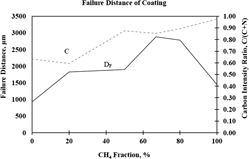
Titanium carbonitride (TiCN) is a popular hard coating for carbide cutting tools in various applications. This paper studied the influence of the carbon content and coating composition within TiCxN1−x coatings with regard to their adhesive strength on tungsten carbide substrate and subsequently, the performance of cutting tool in the dry turning of stainless steel. Among all the TiCxN1−x coatings, the TiCN coating has exhibited the highest adhesivity onto a substrate, followed by a TiC coating and lastly, a TiN coating. It was found that the adhesive strength of TiCN coating increased with the carbon content. The C/N ratio or C–N bond is a vital contributor to the adhesivity of the TiCxN1−x coating rather than the C or N atoms in the TiCxN1−x coating. It was found that the coating was delaminated before the exposure of substrate material. Hence, coating with higher adhesivity will promote longer tool life.
The mesoporous network within photocatalytically and photoelectrochemically active LaTiO2N (LTON) single crystals was investigated by electron microscopy techniques including electron diffraction and scanning transmission electron microscopy imaging. The perovskite-related oxynitride particles were obtained by thermal ammonolysis from monocrystalline micrometer-sized La2Ti2O7 (LTO) particles grown by flux-assisted solid state synthesis. Special attention was paid to the crystal transformation from the monoclinic layered LTO to the orthorhombic perovskite-related LTON within the monocrystalline particles. A detailed analysis of pore directions and pore sizes with respect to the LTON particle shape was performed. The pore formation mechanism taking place during thermal ammonolysis was discussed. Based on the mechanistic understanding of the transformation from the oxide to the oxynitride, a further extension of the mesoporous network toward higher surface areas was proposed for improved photoelectrochemical activity of oxynitride particles, while high crystallinity and particle sizes in the micrometer range continue to enable efficient charge transport.
Surface textures with three-dimensional (3D) architectures demonstrate the ability to control interfacial, optical, chemical, and mechanical properties. Potential applications range from device-scale biomolecule sensing to meter-scale optical or nonwetting coatings. In recent years, capillary forming has become a versatile and scalable approach to creating complex geometries at the nano- and micron scales. Surface tension of a liquid can deform straight pillars and assemble them into 3D architectures with predetermined orientation, where short-range adhesion forces stabilize the final forms. A variety of techniques have been demonstrated for carbon nanotubes and polymer filamentary materials to fabricate useful devices and textures. We discuss these materials and processes as well as the underlying elasto-capillary physics. We indicate the need for new simulation tools to design and engineer elasto-capillary transformations and methods to increase their throughput toward scalable manufacturing.