To save content items to your account,
please confirm that you agree to abide by our usage policies.
If this is the first time you use this feature, you will be asked to authorise Cambridge Core to connect with your account.
Find out more about saving content to .
To save content items to your Kindle, first ensure no-reply@cambridge.org
is added to your Approved Personal Document E-mail List under your Personal Document Settings
on the Manage Your Content and Devices page of your Amazon account. Then enter the ‘name’ part
of your Kindle email address below.
Find out more about saving to your Kindle.
Note you can select to save to either the @free.kindle.com or @kindle.com variations.
‘@free.kindle.com’ emails are free but can only be saved to your device when it is connected to wi-fi.
‘@kindle.com’ emails can be delivered even when you are not connected to wi-fi, but note that service fees apply.
Biological surfaces display fascinating topographic patterns such as corrugated blood cells and wrinkled dog skin. These patterns have inspired an emerging technology in materials science and engineering to create self-organized surface patterns by harnessing mechanical instabilities. Compared with patterns generated by conventional lithography, surface instability patterns or so-called ruga patterns are low cost, are easy to fabricate, and can be dynamically controlled by tuning various physical stimuli—offering new opportunities in materials and device engineering across multiple length scales. This article provides a systematic review on the fundamental mechanisms and innovative functions of surface instability patterns by categorizing various modes of instabilities into a quantitatively defined thermodynamic phase diagram, and by highlighting their engineering and biological applications.
Poly(lactic acid) (PLA)/graphene oxide (GO) nanocomposites were prepared by solution mixing. Differential scanning calorimetry results indicated that GO was an effective nucleating agent. The size of spherulites decreased, the density of spherulites increased with increasing GO and the crystallinity of PLA increased from 4.34 to 49.01%. For isothermal crystallization, the crystallization rates of PLA/GO nanocomposites were significantly higher than that of neat PLA, in which t0.5 reduced from 9.0 to 2.8. Spindle-like nanopores (about 100–200 nm) that arranged like spherulites were prepared by low temperature foaming. It was found that the crystallization rate increase and spherulite morphology change were insignificant when the content of GO exceeded 0.5 wt%, because the excessive GO increased the number of nucleation sites while restricting the PLA crystal growth. Thus, the arrangement of nanopores did not mimick the spherulites because of imperfect crystal morphology.
Materials that can expand and collapse, fold, and transform into a variety of shapes have attracted significant interest and have applications in the design of flexible electronics, color displays, smart windows, actuators, sensors, and both photonic and phononic devices. But how can we render a rigid device super-flexible so that it can wrap around a sphere without bending and stretching? How can flat surfaces be transformed into any desired three-dimensional (3D) structure without disruptive or catastrophic deformation? The key lies in cuts. Here, we review recent research progress in the design of super-conformable and foldable materials by employing fractal cutting and lattice-based kirigami elements that combine cutting and folding. By prescribing cuts with different motifs, identifying edges in the right geometry, and by programming the folding directions, we show that a single flat sheet can be transformed into a variety of targeted 2D and 3D structures—a pluripotent platform for new technologies.
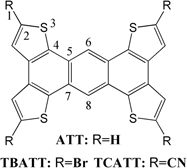
The charge transport properties of anthra-tetrathiophene (ATT) and its brominated and cyanated derivatives (TBATT and TCATT) were investigated by the density functional theory (DFT) coupled with incoherent charge-hopping model. The crystal structure of TCATT is predicted by the dispersion-corrected DFT (DFT-D) method, and those of ATT and TBATT are retrieved from the Cambridge Crystallographic Data Center. The introduction of electron-withdrawing substituents of bromine and cyano decreases the frontier molecular orbital energies but increases the electron affinities, which is beneficial to electron injection and guarantees charge carrier stabilization. The π–π stacking of neighbor molecules with a short distance and large coupling area contributes to the largest transfer integral. The predicted electron mobility of TCATT reaches up to 1.851 cm2/(V·s), indicating that the cyanation of ATT is favorable for improving the electron transport. The angular dependent simulation for electron mobility shows that the electron transport is remarkably anisotropic.
Layered transition metal dichalcogenides which are part of the two dimensional materials family are experiencing rapidly growing interest owing to their diverse physical and optoelectronic properties. Large area controllable synthesis of these materials is required for transition from lab scale research to practical applications. In this work, we present a single step chemical vapor deposition process for large area monolayer growth of molybdenum selenide (MoSe2). We also demonstrate controllable thermal conversion from molybdenum selenide to molybdenum sulfide.
In this study, surface texturing and hydrogenated amorphous carbon (a-C:H) diamond-like carbon (DLC) coating was combined to evaluate the coating performance at various temperatures in oil lubricated reciprocating sliding tests. Micro dimples were created by laser surface texturing on M2 steel using a Pico second laser. DLC coating was deposited by hybrid magnetron sputtering on textured substrates. Textured a-C:H showed stable coefficient of friction at 30, 80, and 125 °C compared to un-textured a-C:H. At 30 °C, graphitization was not observed for both textured and un-textured DLC coating. Graphitization was more pronounced in the case of un-textured a-C:H at 80 and 125 °C. Results show that, at all temperatures tested (30–125 °C), DLC textured samples showed higher wear resistance compared to un-textured DLC coating. The improvement in wear resistance can be explained by the lower graphitization of textured DLC coating. Lower graphitization in the case of textured DLC might be due to the wear particle capturing and lubricant retention ability of textures.
The friction and wear behaviors of reciprocatingly extruded AA 6061–SiC composites form the focal point of this study. To find the optimum way for refining the grains of the matrix, reciprocating extrusion (RE), as a deformation processes, is conducted and found to be feasible. Accordingly, RE has been applied on SiC particles reinforced AA 6061 matrix composite. Using the RE passes as a base, wear behaviors of the composites have been investigated at ambient temperature under dry and lubricated forms. Optical microscopy, transmission electron microscopy and scanning electron microscopy techniques were used to reveal the effect of the RE passes on the microstructure of the materials. As a result, it is found that there is a clear relationship between the weight loss, wear resistance and hardness of the samples. As the load and the number of passes increase, the weight loss in the samples increases. The worn surfaces of the reinforced composites have commonly adhesive and abrasive type of wear.
Single- and multi-layer amorphous carbon (a-C) films of varying thickness were deposited on Si(100) substrates by radio-frequency sputtering in a pure Ar atmosphere. The thickness, roughness, coefficient of friction, and residual stress of the a-C films were measured by profilometry, atomic force microscopy, surface force microscopy, and curvature method, respectively. The through-thickness nanostructure and elemental composition of the films were examined by cross-sectional transmission electron microscopy and electron energy loss spectroscopy. The multi-layer a-C films, consisting of alternating ∼10-nm-thick hard and soft a-C layers deposited under 0 and −200 V substrate bias, respectively, were found to exhibit lower roughness, coefficient of friction, and residual stress and slightly higher tetrahedral carbon atom hybridization than single-layer a-C films of similar thickness. The results of this study reveal a strong correlation of the friction characteristics with the surface roughness and nanostructure of single- and multi-layer a-C films.
Fibrillar collagen networks template and direct biocompatible silica mineralization to produce hybrid materials for biomedical applications. Silica mineralization kinetics is critical for precision-tuning material properties, including mechanical strength, microstructure, and interface thickness. We investigated the effect of varying collagen template fibril volume fraction (0.2–0.8) and elasticity (G′ 200–1500 Pa) on silica mineralization rates. Measurement of the depletion of mono- and disilicic acids by silicomolybdic acid titration showed that silica condensation on collagen fibrils follows third-order kinetics. Resulting third-order rate constants increased linearly with storage modulus and quadratically with fibril volume fraction. A unique rheological approach used to probe the collagen template surface elasticity in real-time during silicification suggested a two-phase mechanism with high levels of surface-localized gelation in Phase 1 and high levels of bulk solution-localized gelation in Phase 2. These results provide a tool for controlling hybrid collagen-silica material properties by controlling local silica condensation rates.
2D materials play a special role in the race to make smaller and smaller devices. Their unique and strong in-plane bonding makes them impervious to diffusion into other layers and provides excellent thickness control. Their van der Waal's bonding with other monolayers or substrates allows for heterostructures unattainable by any other technique. This is reflected by the abundant popularity of research into graphene and other 2D materials. In this review article, we will describe the out-of-plane properties of graphene and functionalized graphene. We will use three specific examples to illustrate how these out-of-plane properties can be used in spintronic devices, in section “Graphene as a Tunnel Barrier” we will describe a magnetic tunnel junction (MTJ) based on graphene. Section “Graphene Based MTJs” will describe the spin injecting properties of a graphene tunnel barrier on silicon. Section “Graphene in Semiconductor Spintronic Devices” describes how you can use functionalized graphene to make a homoepitaxial graphene device. The second part of this article reviews monolayer transition-metal dichalcogenides (TMDs). First, we will show how TMDs are grown and specifically how we can grow large-area TMDs by chemical vapor deposition. Secondly, we will describe the optical properties of several TMDs and compare the results from several authors. Finally, we choose a chemical sensor as a specific example to show how TMDs can be used in a device.
In this article, we have explored the interface states that form between the channel of a monolayer MoS2 transistor and a high-κ gate dielectric. These interface states lead to large hysteresis in the drain current versus gate voltage characteristic or the so-called transfer characteristic of the transistor. By applying carefully designed pulses to the gate of the transistor, we show that it is possible to both understand the nature of the interface states and minimize the hysteresis, so that the transfer characteristic can be reliably used for subsequent extraction of material parameters such as mobility.
Dentinogenesis imperfecta type II (DGI-II) lacks intrafibrillar mineral with severe compromise of dentin mechanical properties. A Dspp knockout (Dspp–/–) mouse, with a phenotype similar to that of human DGI-II, was used to determine if poly-L-aspartic acid [poly(ASP)] in the “polymer-induced liquid-precursor” (PILP) system can restore its mechanical properties. Dentin from six-week old Dspp–/– and wild-type mice was treated with CaP solution containing poly(ASP) for up to 14 days. Elastic modulus and hardness before and after treatment were correlated with mineralization from Micro x-ray computed tomography (Micro-XCT). Transmission electron microscopy (TEM)/Selected area electron diffraction (SAED) were used to compare matrix mineralization and crystallography. Mechanical properties of the Dspp–/– dentin were significantly less than wild-type dentin and recovered significantly (P < 0.05) after PILP-treatment, reaching values comparable to wild-type dentin. Micro-XCT showed mineral recovery similar to wild-type dentin after PILP-treatment. TEM/SAED showed repair of patchy mineralization and complete mineralization of defective dentin. This approach may lead to new strategies for hard tissue repair.
The effect of 0.5 wt% Mn addition on the microstructure and mechanical properties of cast Al–2Li–2Cu–0.8Mg–0.4Zn–0.2Zr (wt%) alloy was investigated. Results showed that the grain size of Mn-containing alloy was smaller than that of Mn-free alloy in both the as-cast and solution treated state. Al20Mn3Cu2 dispersoids were formed during solution treatment in the Mn-containing alloy. After aging at 175 °C for 32 h, a large volume fraction of coherent Al3Li/Al3(Li, Zr) particles were precipitated in both Mn-free and Mn-containing alloys, while more Guinier–Preston–Bagaratsky zones were observed in the Mn-free alloy. Mn addition improved the elongation significantly, which was 1.7% for Mn-free alloy and 3.3% for the alloy with 0.5 wt% Mn addition.
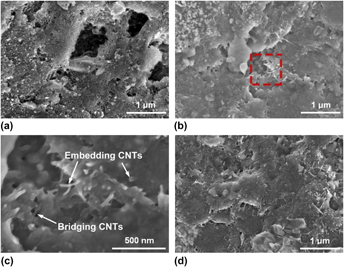
Carbon nanotubes (CNTs) reinforced Ti matrix composites with tailored microstructures and properties were fabricated by direct metal laser sintering (DMLS). A relationship of processing conditions, distribution characteristics of CNTs, and properties was established. The appearance of balling phenomenon and micropores at relatively low laser energy input reduced the densification level of DMLS CNTs/Ti composites. As a η of 700 J/m was properly settled, the composite part with a near-full 96.8% density was obtained. On increasing the laser energy input, the distribution states of CNTs in Ti matrix changed markedly from agglomeration to homodisperse. The optimally prepared fully dense CNTs/Ti composite with uniform distribution of CNTs had significantly enhanced Hd of 9.4 GPa and Er of 328 GPa, which showed respectively ∼2.5- and ∼3.4-fold increase upon that of unreinforced Ti, and resultant a relatively low friction coefficient of 0.23 and reduced wear rate of 3.8 × 10⁻⁵ mm3/(N m).
In this work, we present a detailed investigation of the growth of palladium-seeded GaAs nanowires. Nanowires grown on GaAs (111)B substrates consist of three different morphologies, denoted as curly (containing multiple kinks), inclined (relative to the substrate, such as 〈001〉), and vertical. We show that the relative yield of the different types is controllable by a combination of V/III ratio and temperature, where vertical and inclined nanowires are promoted by a high temperature and low V/III ratio. These growth conditions are expected to promote a higher Ga incorporation into the Pd particle, which is confirmed by energy dispersive x-ray analysis. We propose that the observed relationship between particle composition and nanowire morphology may be related to the particle phase, with liquid particles promoting straight nanowire growth. In addition, particles at the tips of nanowires are sometimes observed to be smaller than the initial particle size, suggesting that Pd has been lost during the growth process. Finally, we demonstrate the importance of initial particle size-control to interpret diameter changes after growth.