To save content items to your account,
please confirm that you agree to abide by our usage policies.
If this is the first time you use this feature, you will be asked to authorise Cambridge Core to connect with your account.
Find out more about saving content to .
To save content items to your Kindle, first ensure no-reply@cambridge.org
is added to your Approved Personal Document E-mail List under your Personal Document Settings
on the Manage Your Content and Devices page of your Amazon account. Then enter the ‘name’ part
of your Kindle email address below.
Find out more about saving to your Kindle.
Note you can select to save to either the @free.kindle.com or @kindle.com variations.
‘@free.kindle.com’ emails are free but can only be saved to your device when it is connected to wi-fi.
‘@kindle.com’ emails can be delivered even when you are not connected to wi-fi, but note that service fees apply.
The microstructural evolution of spray-formed high speed steel during hot deformation was investigated as well as the effects of spray forming parameters on the porosity formation. Four distinct zones are identified in the as-deposited material, and interstitial porosity is present in the bottom and peripheral zones, while gas-related porosity is mainly found in the central zone. It can keep the porosity at a minimum value by using the optimum parameters, e.g., the average porosity of central zone is 3.7% for a superheat of 170 °C and a gas-to-metal flow rate of 0.7. During hot deformation at 1150 °C, the amount of porosity can be obviously decreased by increasing the height reduction which also plays a key role in breaking up eutectic carbides. The critical height reduction for the breakdown of the eutectic carbides is 50%, the dominant mechanism being mechanical fragmentation.
Direct coagulation casting of alumina via controlled release of high valence counter ions using ammonium polyphosphate (APP) chelate complex as the coagulating agent was proposed. APP chelate complex suspension was prepared from APP and calcium chloride. Calcium used as high valence counter ions was chelated by APP. The average particle size of the chelate complex is 0.13 μm with a narrow particle size distribution which is close to the size of alumina particles. Glycerol diacetate was used to tailor the pH value of the suspension by hydrolysis which produces acetic acid. The lowering of the pH value helps to decompose the chelate complex, and enhance to release the calcium chelated. It is indicated that the viscosity of the suspensions with the addition of APP chelate complex suspension and glycerol diacetate increases to approximately 20 Pa s after heating at 40–70 °C for 1.5–5 h, which is high enough to coagulate the suspension. 55 vol% alumina suspension with a addition of 3 vol% APP chelate complex suspension and 5 vol% glycerol diacetate treated at 60 °C could coagulate completely within 2 h with a compressive strength of 2.1 MPa. Dense alumina with a relative density of above 97% and a flexural strength of 388 ± 23 MPa can be prepared by this method from 55 vol% alumina suspensions without a burnout process.
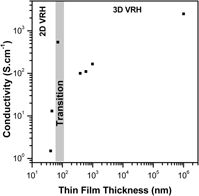
In the present work, we are investigating the electronic transport mechanism for antimony-doped tin oxide (ATO) ultrathin films produced by a colloidal deposition process (CDP) of nanocrystals synthesized via a solvothermal route in organic medium. The ATO ultrathin films were prepared from nanoparticles containing 9 mol% of Sb and the observed electrical resistivity at room temperature was 1.55, 1.10 × 10⁻¹, and 1.83 × 10⁻³ Ω cm, respectively, for the 40, 45, and 71 nm films. X-ray diffraction, transmission electron microscopy, scanning electron microscopy, and atomic force microscopy were carried out to investigate the films and electrical resistivity measurements taken in the four-probe mode with temperature ranging from −260 to 27 °C (13–300 K ± 0.1 K). Results show a good data fitting on Mott's two-dimensional (2D) noninteracting variable range hopping for the 45 nm thin film, which is not further observed for the ATO ultrathin films obtained from CDP.
The co-doped ZnB2O4:Eu3+, Tb3+ phosphor was prepared by a thermal conversion method using Zn[B3O3(OH)5]·H2O:Eu3+, Tb3+ as the precursor, which was characterized by energy dispersive x-ray spectrometer, x-ray powder diffraction, infrared, scanning electron microscopy, and photoluminescence. The effects of doped concentration, calcining temperature, and calcining time of precursor on the luminescence property of ZnB2O4: Eu3+, Tb3+ phosphor were investigated. The results showed that the ZnB2O4: Eu3+, Tb3+ phosphor with maximum luminescent intensity was obtained by calcining the precursor at 900 °C for 6 h. It is found that the ZnB2O4: Eu3+, Tb3+ phosphor prepared by this method exhibits much stronger emission intensity than that synthesized by conventional high temperature solid-state method. Meanwhile, ZnB2O4: Eu3+, Tb3+ also has stronger emission intensity and higher red to orange ratio than those of ZnB2O4: Eu3+.
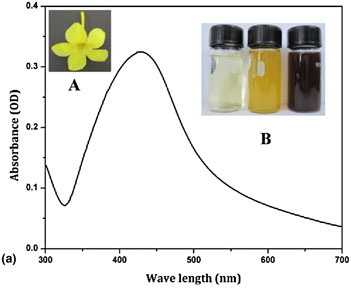
The present study aimed to develop an easy method to synthesis silver nanoparticles (AgNPs) using Allamanda cathartica flower extracts. The phytocompounds converted silver nitrate into AgNPs. UV–visible spectra show the maximum absorbance between 350 and 450 nm and x-ray powder diffraction results reveal AgNPs crystallized in cubic phase. Fourier transform infrared spectrum reveals that phytochemicals act as a reducing, stabilizing, and capping agent. Energy-dispersive spectrum, particle size distribution, and transmission electron microscopy analyses show that the nanoparticles are pure, spherical shaped with size of 39 nm. In addition, AgNPs show significantly antibacterial and antioxidant activity compared with commercial antibiotic. Hence, A. cathartica flower extracts mediated AgNPs which will be a new candidate for biomedical applications.
We have developed a new synthesis method that includes a chemical vapor deposition process in a chamber settled in organic liquid, and applied its nonequilibrium reaction field to the development of novel carbon nanomaterials. In the synthesis at 1110–1120 K, using graphene oxide as a catalyst support, iron acetate and cobalt acetate as catalyst precursors, and 2-propanol as a carbon source as well as the organic liquid, we succeeded to create carbon nanofiber composed of novel pot-shaped units, named carbon nanopot. A carbon nanopot has a complex and regular nanostructure consisting of several parts made of different layer numbers of graphene and a deep hollow space. Dense graphene edges, hydroxylated presumably, are localized around its closed end. The typical size of a carbon nanopot was 20–40 nm in outer diameter, 5–30 nm in inner diameter, and 100–200 nm in length. A growth model of carbon nanopot and its applications are proposed.
The article discusses the structure and properties of noncrystalline carbon films synthesized by ion-plasma sputtering of a graphite target in an argon atmosphere at direct current. Analysis of the molecular structure of carbon films was performed using Raman spectroscopy and dependence of the structure of synthesized films on the synthesis temperature and substrate material was revealed. Besides the main G peak possesses the values in a broad frequency range from 1500 to 1575 cm−1. The evolution of molecular structure peculiarities of synthesized carbon films depending on the synthesis conditions was clearly shown using the numerical methods of the Raman spectra decomposition. Studies of the optical spectra showed that the band gap of synthesized films varies from 0.78 to 1.67 eV and with increasing optical band gap, the value of G peak position decreases under laser excitation of 2.62 and 1.96 eV.
Rapid solidification of Al30Si70 alloy was studied via electromagnetic levitation technique. The solidification kinetics and the morphology of the solidification front of the Si phase were analyzed in situ by using a high-speed video camera and subsequent microstructural analysis of as-solidified samples. It shows that solidification of the sample always starts from one point. After that, nucleation continues to proceed at the interface front during growth. The morphology of primary Si transforms from faceted wafer to nonfaceted equiaxed grain and the grain size decreases with increase of undercooling. At small undercooling, the growth velocity of primary Si decreases with time and the floated Si wafers have a trend to agglomerate, while at large undercooling, the nucleation rate decreases with time, which are explained by the fact that silicon content, undercooling and density at the solid–liquid interface change with time in solidification. Finally, the nucleation rate and growth velocity were discussed in combination of classical theory.
The aim of this study is to prevent cracks in large foam bodies prepared by thermo-foaming of alumina powder dispersions in molten sucrose. Cracks initiate in the binder burnout stage during which the bodies undergo shrinkage in the range of 32–49 vol% depending on sucrose content. Intermediate pyrolysis of the sucrose polymer binder prevents the cracking of large foam bodies as the carbon produced by pyrolysis binds the alumina particles during the initial stage of shrinkage and provides adequate strength to withstand the internal stresses produced during the pyrolysis and subsequent carbon burnout. The carbon bonded alumina foam bodies obtained after pyrolysis do not show any visible cracks during subsequent carbon burnout and sintering because the alumina particles establish a firm network with each other due to particle drag and rearrangement during pyrolysis of the sucrose polymer binder as evidenced from microstructure analysis. The carbon bonded alumina foam bodies show high compressive strength (2–1.3 MPa) and are amenable to machining operations such as milling and drilling without cracking.
Device quality CdS/CdTe heterostructures and completed solar cells (∼12% efficient) have been studied using photoluminescence (PL) as a function of temperature and laser excitation power. The CdS/CdTe junctions were grown on transparent conducting oxide covered soda lime glass using radio frequency sputter deposition. In the current work we found that the PL spectra of sputtered and thermally evaporated CdTe absorber films share common features. It was found that the luminescence shifts from being dominated by sub-gap defect-mediated emission at lower excitation powers to near band edge excitonic emission at higher excitation powers. It was found that the presence of Cu suppresses the sub-band gap PL emissions. This effect was concluded to be due either to Cu occupying cadmium vacancies (VCd) or forming acceptor complexes with them. This points to a potential role of Cu in eliminating sub-band gap recombination routes and hence increasing the charge separation ability of the device.
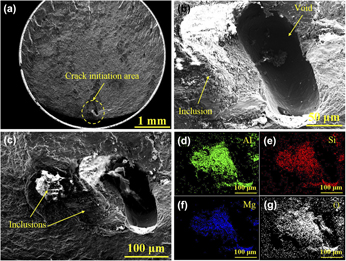
Narrow gap submerged arc welding method accompanied with multilayer and multipass technology was used to manufacture advanced 9Cr and CrMoV dissimilarly welded joint used as a newly developed turbine rotor. The aim of this investigation was to evaluate the high cycle fatigue (HCF) behavior of the welded joint at room temperature. Uniaxial-stress controlled HCF tests at stress ratio R = −1 were performed with specimens chipped from the welded joint of mockup and the S–N curve up to 1.0 × 10⁸ cycle lifetime was obtained. It was found that the fracture location transferred from heat affected zone (HAZ) of CrMoV side to weld metal (WM) with decreasing stress amplitude. The microstructure of the welded joint was characterized and microstructure diversity was found to be responsible for the failure locations both in the CrMoV–HAZ and WM. Fracture morphology of failure samples were also investigated by a scanning electron microscope. It is detected that the stress amplitude required to drive the inclusion to be the crack initiation of the CrMoV–HAZ lies behind the transition. With decreasing stress amplitudes, void in the WM more easily tends to be the initiation of a fatigue crack than inclusion.
Effect of a transverse magnetic field on macrosegregation and growth of primary Al2Cu dendrites in directionally solidified Al–40 wt% Cu alloys was investigated experimentally. The experimental results indicated that the magnetic field caused the formation of channel-like and freckle segregations. It was also found that the application of the magnetic field benefited the growth of primary Al2Cu dendrites and the axial segregation. Moreover, the magnetic field decreased the primary dendrite spacing and the mushy zone length; however these effects weakened with the increase of the magnetic field intensity. The above experimental results should be attributed to the formation of the thermoelectric magnetic convection during directional solidification under the transverse magnetic field.
We now know how to design sequences that should be pretty good at leading to a particular motif. We have studied extensively how to make a branched junction with a number of arms, and how to prevent branch migration in one. In this chapter, we are going to discuss several different routes to designing motifs to use as the basis for making objects, lattices, and devices. The key concept in designing motifs is the notion of reciprocal exchange. This is a process found within biological systems, but we are going to approach it somewhat differently: we are not actually going to perform reciprocal exchange in the laboratory, but merely on paper. We will then use the sequence-selection procedures of the preceding chapter to make the strands that will come together to form the motifs we design.
The notion behind reciprocal exchange is shown in Figure 3-1. The left side of the drawing shows two strands, a red strand and a blue strand. Following reciprocal exchange, we see on the right side a red–blue strand (going from upper left to lower right) and a blue–red strand (going from upper right to lower left). Thus, we still have two strands, but now they are each a mixture of the two strands we had before. We mentioned in Chapter 1 that the strands of DNA have a chemical polarity, called 5′ to 3′ polarity, so that one end of a strand is called the 5′ end and the other end is called the 3′ end. Following the reciprocal exchange shown in Figure 3-1, the red–blue strand contains the 5′ half of the red strand and the 3′ half of the blue strand, while the blue–red strand contains the 5′ half of the blue strand and the 3′ half of the red strand. Resolution in this context means that the crossover is cut and we go back to two juxtaposed bulges or hairpins. This is an idea that derives from recombination chemistry, where crossovers are resolved in one direction or the other to yield different products (e.g., see reference 3.2).
So far, this is just a formalized concept. It would probably help to see what happens in the context of a double helix.
With the preamble of the previous chapters, we are now ready to talk about making things from DNA that are larger than individual units like the knots or catenanes or polyhedra discussed in Chapters 3 and 4. The initial goal of structural DNA nanotechnology was to self-assemble crystals, usually thought of as repeating units in three dimensions. However, the notion of periodicity is not limited to 3D; it can also apply to 2D and 1D. In fact one of the most influential ideas of the early twentieth century was Schrödinger's discussion of Delbrück's suggestion that genetic material, thought correctly at the time to be one-dimensional, was an aperiodic crystal. As we all know, that's a pretty good description of the naturally occurring DNA double helix, remarkably good for the early 1940s. In this chapter, we'll talk about one-dimensional, two-dimensional, and three-dimensional arrangements of DNA motifs. It's a little hard to separate the different types of crystals, so we will discuss them when particular points relevant to those dimensions arise, rather than separating topics by dimensionality. For example, you might think of tubular structures as one-dimensional or two-dimensional, depending on whether you are thinking about their tubular axes or about the surface arrangement of their components.
As you might imagine from all the discussion in Chapter 4, topology comes to play a major role when we concatenate DNA motifs. The basic quantum of DNA topology is the half-turn of double helical DNA; we emphasized this point when we discussed converting knot structures to single-stranded DNA constructs. Sometimes we call the half-turn a “unit tangle.” Figure 7-1 is a slightly larger version of Figure 1-8, which showed four 4-arm junctions being assembled into a quadrilateral, with lots of sticky ends left over to make something bigger. Besides the number of junctions, the difference in Figure 7-1 is that the twisting of the DNA duplex is included in the picture. Figure 7-1a shows what the structure looks like when there is an even number of double helical half-turns (in this case four) between vertices. The resulting structure is akin to chain mail, with a red circle linked twice (because there are two turns between vertices) to each of four blue strands that flank it; likewise, the blue circles are linked twice to each of the four red strands that flank them.
Everyone knows that DNA is the genetic material of all living organisms. Its double helical structure has become an icon for our age. The publication of its double helical structure by Watson and Crick in 1953 revolutionized biology. Its most prominent applications today are in clinical diagnosis of genetic diseases and pathogenic organisms and in forensics. The key element of DNA is that it contains information – information in a form that is easy to understand, utilize, and manipulate. The central feature of this information is that it is linearly encrypted in the sequence of the DNA polymer. There are four different elements to this information, known as A, T, G, and C. We'll get into the chemical details of what those letters mean a little later. The important thing is that the molecule is in its most stable state (has the lowest free energy) when A on one strand is opposite T on the other strand, and when G on one strand is opposite C on the other strand. As Watson and Crick famously put it, it did not escape their attention that this complementary pairing leads immediately to a mechanism for replication: an A on the parental strand means you put a T on the daughter strand, and vice versa; similarly a G on the parental strand means you put a C on the daughter strand, and vice versa. It is important to realize that strands exhibiting this complementarity can be put together in vitro, a fact first noted by Alexander Rich and David Davies. A key and often unvoiced aspect of this mechanism is that the helix axis is linear, not in the geometrical sense of being a straight line, but in the topological sense that it is not branched. This book is about what happens when the helix axis is branched and how we can use it to make new and interesting molecules and materials on the nanometer scale.
The chemical details of the classical structure of DNA are shown in Figure 1-1, and the backbone structure of DNA is shown in Figure 1-2. The double helical structure has many interesting features that need to be mentioned. First, the backbones are antiparallel. What do we mean by that? There is a chemical polarity to the molecules, so that the strands have directionality.
The initial goals of structural DNA nanotechnology did not stop with the organization of nucleic acid molecules into interesting and attractive shapes, or into lattices. The very first paper in the field had the goal of organizing other molecules into 3D periodic arrays, with the hope that if they were well enough ordered those guest molecules would be susceptible to crystallographic diffraction analysis. Figure 14-1 illustrates this point, where the DNA scaffold is shown in magenta and the guest macromolecule is drawn in turquoise. This motivating goal has yet to be realized in practice, but efforts continue, nearly 35 years after its initial proposal: it is truly a holy grail of structural DNA nanotechnology.
Indeed, one of the earliest subsequent papers suggested that DNA could be used to organize the components of nanoelectronics. Figure 14-2 shows two branched junctions forming a metallic “synapse” from two molecular wires, and Figure 14-3 shows the proposed 3D organization of a 107 Å3 memory element. The structures of the 4-arm and 6-arm junctions illustrated there are not particularly realistic, but the notion that DNA could scaffold the spatial organization other species of molecules was reinforced by these suggestions. As we will see below, the organization of nanoelectronic components by DNA remains an attractive goal.
Control of polymer topology. One of the earliest attempts involving nucleic acids and heteromolecules entails the use of DNA to direct the topology of industrial polymers. The initial experiments in this program entailed hanging alternating pendent diamino and dicarboxyl groups off the 2′ position of RNA molecules (the atom furthest from the helix axis in A-form RNA) so as to direct their topology. Although novel topological species have not yet been produced by this approach, this system has been used to demonstrate the templated 2′, 2′ ligation of nucleic acids that produces a peptide bond. Likewise, it has been used to generate topological targets with connectivity parallel to the helix axis. The catenane produced by joining one amine with one carboxyl group is illustrated in Figure 14-4.
Metallic nanoparticles. The advent of metallic and semiconducting nanoparticles has spurred a lot of effort to organize them by DNA. Very early attempts to assemble nanoparticle clusters were performed by Alivisatos and his colleagues, as well as by Mirkin and his collaborators. These approaches fundamentally used DNA as “smart glue” to put DNA-coated nanoparticles together.
So where's it all going? People are trying to make better bricks and bigger origami constructs, and put more automation into the field. Everybody who works in the area knows we need better molecular modeling, particularly better physical models. Everybody wants to know what's next. Figures A-1, A-2, and A-3 are how I end my seminar these days. A-1 asks what's next, A-2 says it's no longer my responsibility, and A-3 reinforces that notion.
Nevertheless, although there are far too many people in the field for it to be my own enclave, that doesn't meant that I don't have my own ideas of what should be pursued. My top priority is to increase the control that we already have. We have improved the 2-turn tensegrity triangle crystals to the point where they diffract to a touch better than 3 Å resolution. We got there by tweaking the sticky ends, and that seems not to be the correct route for the larger triangles that can actually host macromolecules of significant dimensions. Yossi Weizmann's recent progress with knots has encouraged me to see whether synthetic knot topoisomers can be distinguished. Current work with Henry Chapman suggests that there is a major role for DNA nanotechnology to play in the establishment of new scattering methods.
I look forward to extending the role of DNA to control the structure of matter on larger scales, such as the micron scale, as well as on the nanoscale. By contrast, I foresee the assembly line as the first of its kind, but certainly not the last. With luck, we'll be able to drop the scale on it, so that real chemical assembly can be programmed at the level of bonds. This will certainly be a challenge, but that's what Science is all about. Nature does it, meaning that sooner or later, we can too. It's just a matter of time.