To save content items to your account,
please confirm that you agree to abide by our usage policies.
If this is the first time you use this feature, you will be asked to authorise Cambridge Core to connect with your account.
Find out more about saving content to .
To save content items to your Kindle, first ensure no-reply@cambridge.org
is added to your Approved Personal Document E-mail List under your Personal Document Settings
on the Manage Your Content and Devices page of your Amazon account. Then enter the ‘name’ part
of your Kindle email address below.
Find out more about saving to your Kindle.
Note you can select to save to either the @free.kindle.com or @kindle.com variations.
‘@free.kindle.com’ emails are free but can only be saved to your device when it is connected to wi-fi.
‘@kindle.com’ emails can be delivered even when you are not connected to wi-fi, but note that service fees apply.
Addressing the active and challenging field of spectral theory, this book develops the general theory of spectra of discrete structures, on graphs, simplicial complexes, and hypergraphs. In fact, hypergraphs have long been neglected in mathematical research, but because of the discovery of Laplace operators that can probe their structure, and their manifold applications from chemical reaction networks to social interactions, they have now become one of the most active areas of interdisciplinary research. The authors' analysis of spectra of discrete structures embeds intuitive and easily visualized examples, which are often quite subtle, within a general mathematical framework. They highlight novel research on Cheeger-type inequalities that connect spectral estimates with the geometry, more precisely the cohesion, of the underlying structure. Establishing mathematical foundations and demonstrating applications, this book will be of interest to graduate students and researchers in mathematics working on the spectral theory of operators on discrete structures.
Rectifiable sets, measures, currents and varifolds are foundational concepts in geometric measure theory. The last four decades have seen the emergence of a wealth of connections between rectifiability and other areas of analysis and geometry, including deep links with the calculus of variations and complex and harmonic analysis. This short book provides an easily digestible overview of this wide and active field, including discussions of historical background, the basic theory in Euclidean and non-Euclidean settings, and the appearance of rectifiability in analysis and geometry. The author avoids complicated technical arguments and long proofs, instead giving the reader a flavour of each of the topics in turn while providing full references to the wider literature in an extensive bibliography. It is a perfect introduction to the area for researchers and graduate students, who will find much inspiration for their own research inside. This title is also available as open access on Cambridge Core.
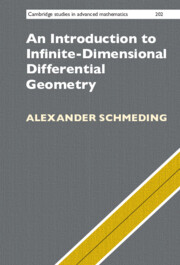
Introducing foundational concepts in infinite-dimensional differential geometry beyond Banach manifolds, this text is based on Bastiani calculus. It focuses on two main areas of infinite-dimensional geometry: infinite-dimensional Lie groups and weak Riemannian geometry, exploring their connections to manifolds of (smooth) mappings. Topics covered include diffeomorphism groups, loop groups and Riemannian metrics for shape analysis. Numerous examples highlight both surprising connections between finite- and infinite-dimensional geometry, and challenges occurring solely in infinite dimensions. The geometric techniques developed are then showcased in modern applications of geometry such as geometric hydrodynamics, higher geometry in the guise of Lie groupoids, and rough path theory. With plentiful exercises, some with solutions, and worked examples, this will be indispensable for graduate students and researchers working at the intersection of functional analysis, non-linear differential equations and differential geometry. This title is also available as Open Access on Cambridge Core.
Recommend this
Email your librarian or administrator to recommend adding this to your organisation's collection.