To save content items to your account,
please confirm that you agree to abide by our usage policies.
If this is the first time you use this feature, you will be asked to authorise Cambridge Core to connect with your account.
Find out more about saving content to .
To save content items to your Kindle, first ensure no-reply@cambridge.org
is added to your Approved Personal Document E-mail List under your Personal Document Settings
on the Manage Your Content and Devices page of your Amazon account. Then enter the ‘name’ part
of your Kindle email address below.
Find out more about saving to your Kindle.
Note you can select to save to either the @free.kindle.com or @kindle.com variations.
‘@free.kindle.com’ emails are free but can only be saved to your device when it is connected to wi-fi.
‘@kindle.com’ emails can be delivered even when you are not connected to wi-fi, but note that service fees apply.
In 1870 Wagner was approaching the summit of his creative achievement as he brought the Ring towards completion with the orchestration of Siegfried Act III and the composition of Götterdämmerung. There was also a longed-for and welcome improvement in his domestic circumstances: Cosima's marriage to Hans von Bülow was formally dissolved on 18 July, leaving Wagner and Cosima free to legalise their union and legitimise their already well-established domestic household at the Villa Tribschen on Lake Lucerne. The pair married in the Protestant Church in Lucerne on 25 August with Hans Richter and Malwida von Meysenburg as witnesses.
1870 was also a momentous and fateful year on the wider political stage of continental Europe. On 19 July, Prussian Minister President Otto von Bismarck had finally goaded France into declaring war on Prussia, which on 2 September was to reach the culmination of its first stage with the capture of Emperor Napoleon III and the defeat of France at the Battle of Sedan. Wagner's patron, King Ludwig II, had already placed Bavarian troops at the disposal of the Prussian High Command in the complex series of power games that preceded the outbreak of hostilities. The conflict encouraged Wagner's deepseated anti-French sentiments and it is clear from Cosima's diaries that enthusiasm for the war ran high at Tribschen.
It is a received commonplace that Wagner's prose works are difficult of access to the English reader. The entire corpus exists in translation only in the late Victorian version prepared by William Ashton Ellis. Although it is fashionable to denigrate Ellis for the prolixity of his rendering of Wagner's prose into English, it must be said in his defence that his often convoluted syntax and arcane vocabulary come close to replicating that of the original German. Whatever its faults may or may not be, Ashton Ellis's work represents a formidable achievement for which the English-speaking student of Wagner's ideas must remain ever grateful.
Beethoven (1870) has been better served for the English reader than most of Wagner's prose works: it also exists in an undated pre-Ellis translation by Wagner's advocate in England Eduard Dannreuther, and there is a substantial extract elegantly and imaginatively translated by Martin Cooper in 1988. This present version originated as a series of discrete excerpts prepared as supporting material for tutorial teaching at Oxford. There was no initial intention to translate the entire essay. The impulse to do so came from the late Brian Hitch, a retired diplomat with astonishing linguistic skills supported by a profound knowledge of music and boundless generosity with his time.
The first two parts of this book having been organised broadly chronologically, the third part will look more to after-lives, to performative reception, to some of the process of writing history and histories. Such matters have not of course been absent earlier; they may now, however, move centre-stage. ‘Working’ is shown in the treatment of Stefan Herheim’s Bayreuth production of Parsifal, opportunities to see that staging in three different seasons having afforded a further opportunity to look back at the progression of my thoughts on work and staging, and also to bring that cumulative experience together through further reflection. That chapter might therefore seem something of an exception, but insofar as it is, exceptionality pertains to style rather than idea. Discussion of Herheim’s Parsifal remains and indeed participates in a context of what we might learn about musical dramas and their status as artworks, both in and through history.
Parsifal, as already discussed, is in many respects an unusual or, perhaps more accurately, an extreme work. That characteristic of extremity certainly holds for issues of performance, since, as William Kinderman has pointed out, the work’s ‘special position … is closely bound up with the renewal of the Bayreuth Festival in 1882’. What Kinderman unassumingly calls an ‘unusual performance restriction’ had the consequence of confining the work to Bayreuth. That restriction pertained until its flouting in the so-called theft of the Grail by New York in 1903 – the United States not being a signatory to the Berne Convention – and the expiry of copyright shortly before the outbreak of war: the terminus, as we shall see, for Herheim’s first act. Though unsuccessful, Cosima’s bizarre, if far from financially disinterested, attempt to have the Reichstag pass a ‘Lex Parsifal’, restricting the work to the temple of Bayreuth in perpetuity, gained support not only from Strauss, who as a conductor had obvious reason to remain in favour with Wahnfried and who spent eight days lobbying the Reichstag, but from farther afield too; petition signatories included Gustave Charpentier and Puccini. Not until 1934 would Bayreuth itself mount a new production, though some changes had been made to the ‘original’ in the meantime. ‘The notion of Urtext’ could therefore, in this almost unprecedented situation for a repertoire work, be understood as applying to the staging too.
Having staged not just one but two Ring cycles, Keith Warner has become something of a Wagner veteran. In an interesting and, in the best sense, provocative essay, he points out that Wagner ‘almost single-handedly invented, certainly in opera’, the role of director, ‘almost certainly provoked into action by the work of the Duke of Saxe-Meiningen [George II] and his celebrated acting troupe’s artistic director, Ludwig Chronegk’, whose production of Kleist’s Der Hermannsschlacht he had seen in 1875, the year before the first Bayreuth Ring, ‘which Wagner chose to direct rather than conduct’. It is not difficult to imagine why, on a personal level, either Wagner or a modern stage director such as Warner should wish to further the Meiningen concept not only of greater professionalism – especially noteworthy for attention paid to individual members of the crowd – but also of a single authority presiding over a production, though it is not altogether clear that Wagner was following that concept rather than working in tandem with it. The directorial Konzept, beloved of devotees of modern Regietheater and detested by its opponents, stands not so very distant; although, by the same token, the Duke’s insistence upon naturalistic historical verisimilitude would find favour with opponents rather than devotees. It is likewise not difficult to understand why Wagner or modern directors should wish to lessen, and preferably to abolish, the cult of ‘star’ performers, a key feature of the Meiningen agenda – and a cause célèbre for all manner of operatic ‘reformers’ from at least Gluck and Calzabigi onwards. Theirs is no more a ‘neutral’ stance than any other; nor should it be. Yet their vision, for which there may be justification to speak of in the singular, which it is no exaggeration to consider both modern and modernistic, has held and continues to hold consequences for the understanding and experience of works both new and from the ‘museum’. The same might be said about the histories we write of those works and the performances which, for many, give them life – and history.
Leaving aside the swiftly outdated naturalism of the designs for Bayreuth’s first Ring – with which Wagner was in any case unhappy – what stands out from contemporary reports of rehearsals is, as Warner remarks, the abnormality of the composer-director’s approach.
Welches Verhältniss? – doch nur zum deutschen Geiste? Wie verhält sich dieser zur ‘Schönheit?’ – Begriff der Schönheit – dem Griechischen Geiste eigen; diesem als Begriff entnommen. Der Bildenden Kunst einzig zu eigen. Der Poesie insofern, als sie von Vorstellungen sich nährt, welche der bildenden Kunst zufallen: die wesentlichsten Ingredienzen der Poesie entstammen aber der Musik. In wiefern ist Musik schön?
Nähere Untersuchung. Ausgangspunkt Sch: W. als W.u. V. II. 415. Der dunkle Hintergrund im Bewusstsein für die Idee. Hierzu: 418. Unterschied in dem nach aussen u. dem nach gekehrten Bewusstsein.
Dieses zweite ist das, aus welchem der Musiker schafft. Grosse Verschiedenheit, Traumtheorie. (Tagseite – Göthe. Nachtseite – Beethoven.) Traumdeutung. Musik das unmittelbare Traumbild. Die innerste Kraft, aus der unsre Dichter sich unbewusst ernährten, welche sie ahnten und zu erklären suchten. In Beethoven unmittelbar schaffend. Nach welchen Gestzen? Eigener Schrei –äusserer Schall. Indiv: – Natur. Plastik nur als unmittelbarer Lebensakt i. Tanz. Volksleid. – Weiter – Ideale Realität. – (Franzosen – Italiener.)
Confusion im Erfassen der Musik. Unklarheit u. Geschmacklösigkeit. Selbstverkennen. Die Bildner u. Dichter geben der Nation was sie scheinen möchte, der Musiker was sie in Wahrheit ist. Der Schrecken über die innere Welt Grund des Erhabenen. Erhabenheit. Die Wirkung der Musik ist immer die des Erhabenen: ihre Form aber die der Schönheit, d.i. zunächst Befreiung des Individuum's von der Vorstellung jeder Causalität. Die Musikalische Schönheit ist die Form, in welcher der Musiker mit dem Erhabenen spielt.
This article analyses the complicated and conflicted critical response to Andrew Lloyd Webber’s The Phantom of the Opera within the political, economic and cultural context of the Thatcher/Reagan era. British critics writing for Conservative-leaning broadsheets and tabloids took nationalist pride in Lloyd Webber’s commercial success, while others on both sides of the Atlantic claimed that Phantom was tasteless and crassly commercial, a musical manifestation of a new Gilded Age. Broader issues regarding the relationship between the government and ‘elite’ culture also affected the critical response. For some, Phantom forged a path for a new kind of populist opera that could survive and thrive without government subsidy, while less sympathetic critics heard Phantom’s ‘puerile’ operatics as sophomoric jibes against an art form they esteemed.
When Sergei Prokofiev chose to adapt War and Peace for the Soviet opera stage in the 1940s, he faced both operatic conventions and Soviet ideological demands that ran counter to the philosophy and structure of Tolstoy’s sprawling masterpiece. Prokofiev’s early decision to split his opera into Peace and War, making the first a romantic love story of individuals and the second a collective story of the people’s love for Mother Russia, marked a major divergence from Tolstoy. This article explores how Prokofiev reworked Tolstoy’s philosophy of love and human connection to make his opera acceptable for the Soviet stage. Moving away from Tolstoy’s family ideal in Peace, with its basis on intimate sibling bonds, Prokofiev shifted the family to War, turning it into a national Russian family of Father Kutuzov, Mother Russia and their children – the Russian people. The opera uses choral glorification of these heroic parents to foster on a national scale the type of intimacy Tolstoy had advocated in the home.
Scholarship on Monteverdi’s Orfeo has frequently considered Orpheus’s failure to persuade Charon during his grand aria-oration, ‘Possente spirto’, in terms of style and performance. In the eyes of academics such as the Accademia degli Invaghiti (for whom Orfeo was first composed), however, these issues would have been viewed as secondary to the goal of offering moral instruction, in keeping with the Ciceronian maxim, ‘instruction is the first goal, followed by the movement of the mind, and the delight of the senses’. After assessing the compatibility of my ‘academic’ reading of Orfeo with those that have focused on the subject of music and its power, this article considers the Invaghiti’s practice and philosophy of oratory, as well as Monteverdi’s knowledge of this art. The reasons for Orpheus’s failure as an orator are then considered through a comparative analysis of ‘Possente spirto’ and the other full oration from Orfeo, La Musica’s Prologue, as well as further ‘musical orations’ from Monteverdi’s catalogue. This analysis is based primarily on the teachings of the Ancients, as interpreted in the writings of Academy member Stefano Guazzo – in particular his dialectic on ‘civil conversation’ – as well as the model presented in academy member Pompeo Baccusi’s oration, ‘In defence and praise of women’, given for the Invaghiti in 1571.
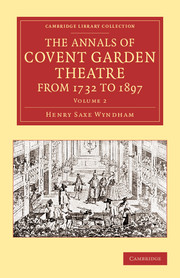
Commissioned by the enterprising actor-manager John Rich, Covent Garden's Theatre Royal first opened its doors in December 1732. Principally a playhouse during its first century, the venue has had an eventful history involving two disastrous fires and riots over ticket prices. Most notably, it hosted Handel's incomparable operas and oratorios, and was where he presented regular seasons from 1735 until his death in 1759. Not until 1847, under Michael Costa, did the theatre dedicate itself to opera, and in 1892 it received the name by which it is known today: the Royal Opera House. Secretary of the Guildhall School of Music from 1901 to 1935, Henry Saxe Wyndham (1867–1940) published this richly illustrated two-volume account in 1906, celebrating the venue's legendary personalities and productions. Volume 2 covers the period 1819 to 1897 and includes appendices which list principal events and managers.
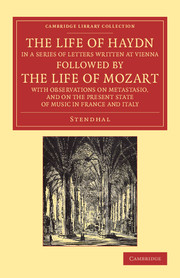
Marie-Henri Beyle (1783–1842), better known by his pen name Stendhal, is remembered today for such novels as Le Rouge et le Noir. In his lifetime, he wrote in a variety of literary genres and under a multitude of names. Louis-Alexandre-César Bombet was his choice of pseudonym for these early works, originally published in French in 1814. His lives of Haydn and Mozart were substantially derived from works by Giuseppe Carpani and Théophile Winckler respectively. Despite this audacious plagiarism, Stendhal's passion for music is evident, especially for Mozart, whose Clemenza di Tito he had enjoyed in Königsberg during the winter of 1812 whilst serving in Napoleon's army. Of especial interest to the modern reader are Stendhal's frequent digressions expressing his forthright opinions on the issues and figures of his day. This reissue is of Robert Brewin's English translation of 1817, with additional notes by the composer William Gardiner.
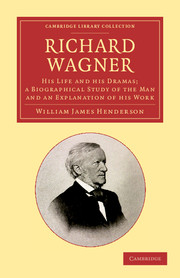
The American music critic and lecturer William James Henderson (1855–1937) wrote for The New York Times and The New York Sun, provided the libretto for Walter Damrosch's opera Cyrano (1913) and authored fiction, poetry, sea stories and a textbook on navigation. He also taught at the New York College of Music and the Institute of Musical Art. Taking up the cause of Wagner with considerable understanding, he published this substantial work in 1902, barely twenty years after the composer's death. It is an illuminating account of Wagner's life and artistic aims, complemented by an insightful analysis of each of his music dramas from Rienzi to Parsifal. Its purpose, states Henderson, 'is to supply Wagner lovers with a single work which shall meet all their needs'. With Ernest Newman's Study of Wagner (1899), also reissued in this series, it reflects the composer's contemporary popularity.