To save content items to your account,
please confirm that you agree to abide by our usage policies.
If this is the first time you use this feature, you will be asked to authorise Cambridge Core to connect with your account.
Find out more about saving content to .
To save content items to your Kindle, first ensure no-reply@cambridge.org
is added to your Approved Personal Document E-mail List under your Personal Document Settings
on the Manage Your Content and Devices page of your Amazon account. Then enter the ‘name’ part
of your Kindle email address below.
Find out more about saving to your Kindle.
Note you can select to save to either the @free.kindle.com or @kindle.com variations.
‘@free.kindle.com’ emails are free but can only be saved to your device when it is connected to wi-fi.
‘@kindle.com’ emails can be delivered even when you are not connected to wi-fi, but note that service fees apply.
Punctuation and use of capital letters has been standardised. Contractions and suspensions have been extended silently unless the scribal intention is unclear, in which case the extension has been placed in square brackets. The use of the letters c, t, i, j, u and v, sometimes used interchangeably in the documents, has been standardised according to pronunciation and the spelling of modern English words derived from the Latin or French words in which they occur.
1. BL Cotton MS Vespasian E xix (Cartulary of Nostell priory), fol. 14r
Copy of letter patent of Henry de Lacy, earl of Lincoln, receiving Richard of Warter, prior-elect of Nostell (Yorkshire), 30 December 1276.
Littera domini Henrici de Lascy comitis de receptione electi.
Henricus de Lascy comes Lync' et constabularius Cestr' omnibus presentes litteras visuris vel audituris salutem in Domino. Noveritis quod cum frater Ricardus de Wartria canonice electus esset in priorem domus Sancti Oswaldi de Nostle et ipse, pro conservatione libertatis prioris dicte domus eligendi et presentandi per antecessores nostros sibi concesse nos extra provenciam1 Ebor[acensem] tanquam verum patronum suum admissionis gracia querere non deberet sed potius nobis extra predictum provinciam existentibus seneschallo nostro Pontis Fracti presentari, nobis tamen in omnibus reverenciam volens exhibere, versus nos appropin-quans presenciam nostram apud Kynstan' infra predictam provinciam exspectavit, ubi electione nobis exhibita et libertate sua cognita, quia eidem in nullo prejudicare voluimus, ipsum fratrem Ricardum electum canonice per dilectum clericum nostrum Adam de Potterton' litteram nostram patentem deferentem prout decuit gratanter admisimus. […]
Ecclesiastical patronage rights were property, belonging to and acquired with land. They belonged to the lord on whose estates the ecclesiastical institution – church or religious house – had been built, and from whom it had received its endowment. The rights that donors exercised in recognition of the gifts they had made descended with their estates. Broadly speaking, the patronage of a parish church was associated with the lordship of the manor in which the church was situated. The building of local churches between the tenth and twelfth centuries stemmed partly from the sense that ownership of a church was felt to confer status, although it is also true that such churches met the spiritual needs of ordinary people, enabling them to worship and to receive the sacraments of the Church within their own village communities. The patron of a church might be the lord of just one manor, but the more manors a lord had, the greater the number of churches he was likely to have in his gift. And, just as the establishment of a church on a local estate enhanced a local lord's standing, so the endowment of a religious house was associated with the acquisition of a larger fief. In particular, many religious houses in England were established by the companions of William the Conqueror or their descendants, often alongside their castles, so that both became symbols of their dominion and status.
CENTRAL WORKS OF PHILOSOPHY is a multi-volume set of essays on the core texts of the western philosophical tradition. From Plato's Republic to the present day, the volumes range over 2,500 years of philosophical writing covering the best, most representative, and most influential work of some of our greatest philosophers. Each essay has been specially commissioned and provides an overview of the work and clear and authoritative exposition of its central ideas. Volume 1 examines ten of the most important works of philosophy to have been written in the ancient and medieval periods, beginning with some classic works of ancient Greek philosophy: the Republic, Plato's study of justice; Nicomachean Ethics, Aristotle's investigation of the good life; and On the Nature of the Universe, Lucretius's poetic version of Epicureanism. In addition the book examines two major works of philosophy of the Roman period: Sextus Empiricus's account of the sceptical philosophy of Pyrrho in Outlines of Pyrrhonism and the Neoplatonism of Plotinus's The Enneads. The second part of the book covers the period, from the fall of the Roman Empire to the dawn of the Renaissance, when philosophy in western Europe sought to harmonize the ideas of the great philosophers of antiquity with Christian belief. Five works are examined: City of God by the Christian philosopher and Church Father, Augustine, which fuses the ideas of Plato and Neoplatonism with Christianity; Anselm's Proslogion in which he outlines his famous "ontological" argument for the existence of God; the monumental Summa Theologiae, Aquinas's supreme synthesis of the philosophy of Aristotle and Christianity; Duns Scotus's Ordinatio, a reaction against the ideas of Aquinas, which meticulously explores detailed metaphysical problems of existence and identity; and finally, Ockham's Summa Logicae, which develops a nominalist metaphysic through some brilliant logical theory.
The eagerly-awaited second volume of The Cambridge Translations of Medieval Philosophical Texts will allow scholars and students access for the first time in English to major texts in ethics and political thought from one of the most fruitful periods of speculation and analysis in the history of western thought. Beginning with Albert the Great, who introduced the Latin west to the challenging moral philosophy and natural science of Aristotle, and concluding with the first substantial presentation in English of the revolutionary ideas on property and political power of John Wyclif, the seventeen texts in this anthology offer late medieval treatments of fundamental issues in human conduct that are both conceptually subtle and of direct practical import. Special features of this volume include copious editorial introductions, an analytical index, and suggestions for further reading. This is an important resource for scholars and students of medieval philosophy, history, political science, theology and literature.
This is a major new study of Thomas Aquinas, the most influential philosopher of the Middle Ages. The book offers a clear and accessible guide to the central project of Aquinas' philosophy: the understanding of human nature. Robert Pasnau sets the philosophy in the context of ancient and modern thought, and argues for some groundbreaking proposals for understanding some of the most difficult areas of Aquinas' thought: the relationship of soul to body, the workings of sense and intellect, the will and the passions, and personal identity. Structured around a close reading of the treatise on human nature from the Summa theologiae and deeply informed by a wide knowledge of the history of philosophy and contemporary philosophy, this study will offer specialists a series of novel and provocative interpretations, while providing students with a reference commentary on one of Aquinas' core texts.
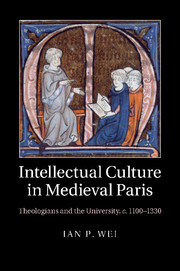
In the thirteenth century, the University of Paris emerged as a complex community with a distinctive role in society. This book explores the relationship between contexts of learning and the ways of knowing developed within them, focusing on twelfth-century schools and monasteries, as well as the university. By investigating their views on money, marriage and sex, Ian Wei reveals the complexity of what theologians had to say about the world around them. He analyses the theologians' sense of responsibility to the rest of society and the means by which they tried to communicate and assert their authority. In the late thirteenth and early fourteenth centuries, however, their claims to authority were challenged by learned and intellectually sophisticated women and men who were active outside as well as inside the university and who used the vernacular - an important phenomenon in the development of the intellectual culture of medieval Europe.