To save content items to your account,
please confirm that you agree to abide by our usage policies.
If this is the first time you use this feature, you will be asked to authorise Cambridge Core to connect with your account.
Find out more about saving content to .
To save content items to your Kindle, first ensure no-reply@cambridge.org
is added to your Approved Personal Document E-mail List under your Personal Document Settings
on the Manage Your Content and Devices page of your Amazon account. Then enter the ‘name’ part
of your Kindle email address below.
Find out more about saving to your Kindle.
Note you can select to save to either the @free.kindle.com or @kindle.com variations.
‘@free.kindle.com’ emails are free but can only be saved to your device when it is connected to wi-fi.
‘@kindle.com’ emails can be delivered even when you are not connected to wi-fi, but note that service fees apply.
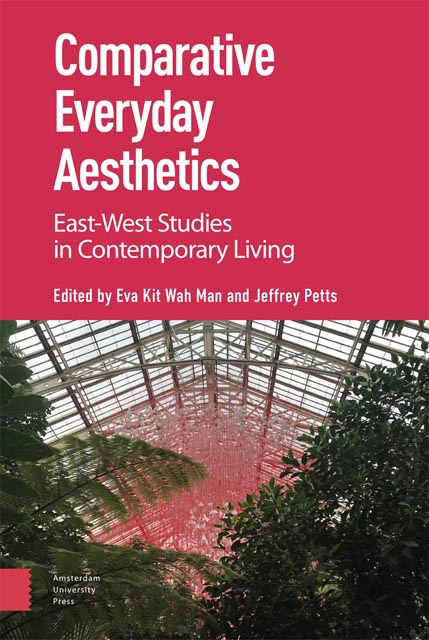
Leading international scholars present analysis and case studies from different cultural settings, East and West, exploring aesthetic interest and experience in our daily lives at home, in workplaces, using everyday things, in our built and natural environments, and in our relationships and communities. A wide range of views and examples of everyday aesthetics are presented from western philosophical paradigms, from Confucian and Daoist aesthetics, and from the Japanese tradition. All indicate universal features of human aesthetic lives together with their cultural variations. Comparative Everyday Aesthetics is a significant contribution to a key trend in international aesthetics for thinking beyond narrow art-centered conceptions of the aesthetic. It generates global discussions about good, aesthetic, everyday living in all its various aspects. It also promotes aesthetic education for personal, social, and environmental development and presents opportunities for global collaborative projects in philosophical aesthetics.
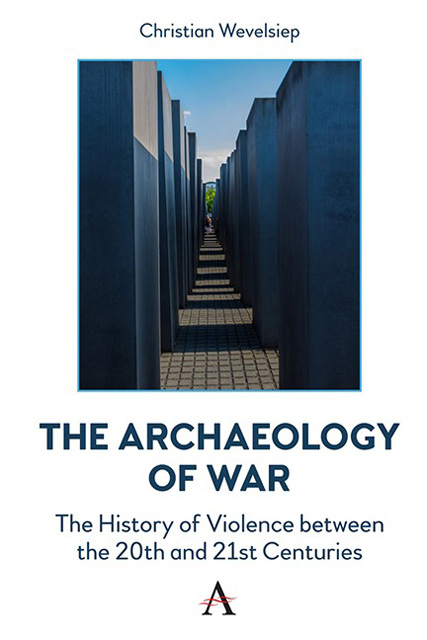
The twentieth-century holds many titles that emphasize the extraordinary. It was a century of totalitarianism, but also one of betrayal, an age of extremes and the incomprehensible. Betrayed, that is, at the mercy of unrestrained violence, were not only the people themselves, but also, as it were, the idea of the human being. For up to a certain point, one could weigh oneself in an unfounded security of an inner connection between people. As is well known, such certainties were knocked out of hand in that century. Many situations, many images, motifs and sources can be named for this experience of unbounded violence, which now, at the beginning of the twenty-first-century, requires new forms of transmission. In an era flooded with images, however, attention is more difficult. One has to embark on a search for traces; not because the sources are lacking, but because the form of inscription in history is problematic. This search for clues leads directly to the present monograph.
This book is inspired by the quest for the proper function of Aristotle's active intellect presented in De Anima 3.5. The urge to grasp its essence has always driven philosophy ahead. Nevertheless, the true nature of nous poiêtikos remains far from being grasped. The author did not unravel it here either, her aim was far more modest: to get through the existing interpretations and try to systematise them somehow. To speak in a more poetic, metaphorical way: the author's aim was to shed some light upon the subject - explore the light metaphor from De Anima 3.5 on many levels. To avoid getting lost in Aristotle and Aristotelian interpretations, the author divided the readings of nous poiêtikos into mystical and rational ones.
Kant's early critics maintained that his theory of freedom faces a dilemma: either it reduces the will's activity to strict necessity by making it subject to the causality of the moral law, or it reduces the will's activity to blind chance by liberating it from rules of any kind. This Element offers a new interpretation of Kant's theory against the backdrop of this controversy. It argues that Kant was a consistent proponent of the claim that the moral law is the causal law of a free will, and that the supposed ability of free will to choose indifferently between options is an empty concept. Freedom, for Kant, is a power to initiate action from oneself, and the only way to exercise this power is through the law of one's own will, the moral law. Immoral action is not thereby rendered impossible, but it also does not express a genuine ability.
Throughout his life, Martin Buber insisted that his dialogical thinking was “not the result of reading but of personal experience.” This emphasis on his own generative experience does not vitiate the fact that, as Buber likewise acknowledged, “in all ages it has undoubtedly been glimpsed that the reciprocal essential relationship between two beings signifies a primal opportunity of being, and one, in fact, that enters into the phenomenon that the human being exists.” Although historical antecedents pointed toward Buber’s dialogical thinking, its crystallization occurred during the tumultuous years of the First World War, when he underwent a conversion, personal as well as intellectual, from the mysticism of his prewar writings to his signature postwar dialogical thinking.
The aim of this book is to explore the impact of the First World War on German philosophy through a series of analyses of the paths taken by central figures of the German 20th-century philosophical tradition in such a way that recognizes the complexity of the philosophical issues that animated their thinking, as well as the demands of wartime and its aftermath to which these thinkers responded: Hermann Cohen, Max Scheler, Martin Buber, Georg Simmel, Ernst Bloch, Gyorgy Lukacs, Franz Rosenzweig, Ernst Cassirer, Martin Heidegger, and Edmund Husserl
On March 21, 1918, the German Army launched “Operation Michael” against British positions around Arras as the first stage of an offensive along the Western Front. Bolstered by reinforcements from the Eastern Front after the October 1917 Revolution and cessation of hostilities with Russia, the Kaiserschlacht, as it was called, represented a final gambit to win the war. A few days after the start of this titanic onslaught, Georg Simmel confided in a letter of March 25 to his friend Hermann Graf von Keyserling: “Now I am in the midst of very difficult ethical and metaphysical investigations […]” (G. Simmel, Briefe 1912–1918. Jugendbriefe. Frankfurt: Suhrkamp, 2008). It was not only premature aging that conspired against reaping his philosophical harvest: Simmel had been diagnosed with terminal liver cancer. As he writes to his friend, he finds himself in “very bad health” and severely reduced in “intellectual energy.”
“What now? Enough is enough. Now we have to begin. Into our hands, life has been given.” With these exasperated words, Ernst Bloch’s The Spirit of Utopia begins like no other work of philosophy. In anger and aspiration, it does not begin with a pedantic preface or scholarly introduction. It begins in situ with a catastrophe that has thrown human existence back upon itself, from which no deliverance seems to be at hand. What is to be done? How can one survive? Caught in the condition of pitching “senselessly back and forth,” something nonetheless endures, we know not what, we know not how, but with nothing in our hands save our own obscurity, life still darkly speaks, for which, in this end of days, we want to be its initiative as well as its end.
At the outbreak of the war, Ernst Cassirer enjoyed an international reputation as a leading figure in the Marburg School of Neo-Kantianism. Still a Privatdozent after years at the University of Berlin and repeatedly thwarted from obtaining a chair of philosophy in Germany due to entrenched anti-Semitism, Cassirer’s erudite publications had garnered widespread recognition. Rudolf Eucken, recipient of the Nobel Prize and “a famous man,” as Cassirer writes to this wife, Toni, in 1911 even asked him out to lunch when invited to speak at the University of Jena. Numerous professors and “a huge crowd of other people” were in attendance. His works were on display in bookshop windows along with the announcement of his lecture in the spiritual capital of Weimar Classicism.
On many fronts, 1916 marked a point of no return. After the collapse of optimism for swift victory following the outbreak of hostilities, the inconclusive bloodlettings at Verdun and the Somme, and mounting economic hardships on the home front, the prospects for German triumph seemed increasingly dim. Attitudes became more resigned to a war like no other, a war without end. Dampened expectations gave way to creeping pessimism matched by defiant fatalism. A number of prominent intellectuals and academics who in 1914 eagerly supported the war now came to express their doubts or else fell conspicuously silent regarding the fate of the nation. Once the most vocal of advocates for the war, Ernst Troeltsch began to see things differently and came to accept the political deficiencies of the Wilhelmine Empire with its deleterious militarism.
In late 1917, with the war having taken its grim toll on the student population drawn to the service of the Fatherland, after the collapse of General von Falkenhayn’s intended breakthrough at Verdun and the equally calamitous struggle on the Somme in 1916, with an increasingly deteriorating economic situation at the home front, resumption of unrestricted submarine warfare, and entry of the United States into the war, Edmund Husserl delivered three lectures on “Fichte’s Ideal of Humanity” at the University of Freiburg. The initiative for these lectures – “emergency wartime seminars” – came directly from the military High Command, most likely at the personal request of General Erich von Gündell, who had studied under Husserl in Göttingen before the war and was Commander General of the Reserve Corps (Fifth Army), in which Husserl’s two sons fought.
In July 1914, Vladimir Lenin and his comrade Gregory Zinoviev found themselves as political émigrés “in a god-forsaken little mountain village in Galicia.” Under gathering clouds of war, Zinoviev recalls making a bet with Lenin that the German Social Democratic Party would never support financing a war. Lenin gladly took up this wager in full confidence that European socialist parties, as declared by the Second International, would call for a general strike of the proletariat in the event of war. As Zinoviev recalls, Lenin observed that “no, they [German Socialist Party or SPD ] are not such scoundrels as all that. They will not, of course, fight the war, but they will, to ease their conscience, vote against the credits lest the working class revolts against them.”
For countless soldiers, revelation as to the significance of their lives entwined with the fate of God, the Nation, or whatever Absolute claimed to give meaning to it all could occur in the most fearful of situations, but also in the most inauspicious of moments. For many, the war was experienced as a rite of passage and self-discovery. Many emerged from the war transfigured, set upon a new course of life. There were those, as with Ernst Jünger, who entered the war with an adventurous heart in search of something more than what domestic life had on offer; there were those, as with Karl Löwith, who did not go to war adventuring but in need of an ill-defined alternative, returning from the war scarred for life; there were those, as with Dietrich Mahnke, who through the war found confirmation of what had already been known but as yet existentially evidenced; there were those whose philosophical promise was extinguished on the battlefield, as with the deaths of Emil Lask and Adolf Reinach; and there were those who, philosophically active before 1914, disappeared from the stage of history after 1918, whose postwar quietude, as with Johannes Daubert, poignantly bespoke the extinguishing of thinking.
On August 25, 1914, three weeks after the invasion of Belgium (August 4) and two months after the fateful assassination of the Archduke Franz Ferdinand and his wife in Sarajevo (June 28), German troops entered the city of Leuven and destroyed its celebrated university library. Some 300,000 books and more than a thousand irreplaceable Medieval manuscripts were burnt along with the torching of 2,000 buildings and the killing of 248 civilians. The devastation was so intense that Dietrich Mahnke, a student of Edmund Husserl’s serving in the 75th Reserve Infantry Regiment, could still observe the city burning on August 27 as his company marched through the village of Korbeek-Lo a few kilometers northwest of Leuven. Outrage among intellectuals, politicians, and the public in Allied nations was swift.