To save content items to your account,
please confirm that you agree to abide by our usage policies.
If this is the first time you use this feature, you will be asked to authorise Cambridge Core to connect with your account.
Find out more about saving content to .
To save content items to your Kindle, first ensure no-reply@cambridge.org
is added to your Approved Personal Document E-mail List under your Personal Document Settings
on the Manage Your Content and Devices page of your Amazon account. Then enter the ‘name’ part
of your Kindle email address below.
Find out more about saving to your Kindle.
Note you can select to save to either the @free.kindle.com or @kindle.com variations.
‘@free.kindle.com’ emails are free but can only be saved to your device when it is connected to wi-fi.
‘@kindle.com’ emails can be delivered even when you are not connected to wi-fi, but note that service fees apply.
We have learned a star to be a radiating gaseous sphere, made predominantly of hydrogen and helium. Radiation may be regarded as a photon gas, each ‘particle’ carrying a quantum of energy hν, proportional to the frequency ν of the associated electromagnetic wave, and a momentum hν/c, where h is Planck's constant and c is the speed of light. This mixture of gases that makes up a star is governed by frequent collisions between its particles, ions, electrons and photons alike. This is how Sir Arthur Eddington describes The Inside of a Star:
… Try to picture the tumult! Dishevelled atoms tear along at 50 miles a second with only a few tatters left of their elaborate cloaks of electrons torn from them in the scrimmage. The lost electrons are speeding a hundred times faster to find new resting-places. Look out! there is nearly a collision as an electron approaches an atomic nucleus; but putting on speed it sweeps round it in a sharp curve. A thousand narrow shaves happen to the electron in 10−10 of a second; sometimes there is a slide-slip at the curve, but the electron still goes on with increased or decreased energy. Then comes a worse slip than usual; the electron is fairly caught and attached to an atom, and its career of freedom is at an end. But only for an instant. […]
This chapter differs from previous ones by being descriptive rather than analytical. An account will be given of the evolution of stars as it emerges from full-scale numerical calculations – solutions of the set of equations (2.54), with accurate equations of state, opacity coefficients and nuclear reaction rates. Such numerical studies of stellar evolution date back to the early 1960s, when the first computer codes for this task were developed. The first to program the evolution of stellar models on an electronic computer were Brian Haselgrove and Hoyle in 1956. They adopted a method of direct numerical integration of the equations and fitting to outer boundary conditions. A much better suited numerical procedure for the two-boundary value nature of the stellar structure equations (essentially a relaxation method) was soon proposed by Louis Henyey; it is often referred to as the Henyey method and it has been adopted by most stellar-evolution codes to this day. Among the numerous calculations performed by many astrophysicists all over the world since the early 1960s, the lion's share belongs to Icko Iben Jr. The detailed results of such computations cannot always be anticipated on the basis of fundamental principles, and simple, intuitive explanations cannot always be offered. We must accept the fact that, being highly nonlinear, the evolution equations may be expected to have quite complicated solutions.
As the complete solutions of the evolution equations provide, in particular, the observable surface properties of stars, we shall focus in this chapter, more than we have previously done, on the comparison of theoretical results with observations.
The past two decades have seen remarkable advances in observations of sunspots and their magnetic fields, in imaging of spots and fields in distant stars and in associated theoretical models and numerical simulations. This book provides a comprehensive combined account of the properties of sunspots and starspots. It covers both observations and theory, and describes the intricate fine structure of a sunspot's magnetic field and the prevalence of polar spots on stars. The book includes a substantial historical introduction and treats solar and stellar magnetic activity, dynamo models of magnetic cycles, and the influence of solar variability on the Earth's magnetosphere and climate. This volume is a valuable reference for graduate students and specialists in solar and stellar physics, astronomers, geophysicists, space physicists and experts in fluid dynamics and plasma physics.
Luminous hot stars represent the extreme upper mass end of normal stellar evolution. Before exploding as supernovae, they live out their lives of a few million years with prodigious outputs of radiation and stellar winds, dramatically affecting both their evolution and environments. A detailed introduction to the topic, this book connects the astrophysics of massive stars with the extremes of galaxy evolution represented by starburst phenomena. A thorough discussion of the physical and wind parameters of massive stars is presented. HII galaxies, their connection to starburst galaxies, and the contribution of starburst phenomena to galaxy evolution through superwinds, are explored. The book concludes with the wider cosmological implications, including Population III stars, Lyman break galaxies and gamma-ray bursts, for each of which massive stars are believed to play a crucial role. This book is ideal for graduate students and researchers in astrophysics interested in luminous hot stars and galaxy evolution.
How do you predict the parameters of future solar cycles? What is the role of dynamo theory in the cyclic activity of the Sun and similar stars? And what are the implications of chaos theory for stellar cycles? This book answers these questions and offers a timely review of studies in the cyclic activity of the Sun and other stars. This authoritative reference shows the importance of reliable predictions of the parameters of future solar cycles, and carefully explains the methods currently used to determine these (with special reference to the maximum of cycle 22). Some of the latest research into solar cycles is clearly presented; this includes helioseismology, observations of the extended activity cycle and the polar fields reversal, and contributions from dynamo theory and chaos theory. For graduate students and researchers, this monograph provides a much-needed synthesis of our understanding of activity cycles in the Sun and other stars.
Humans have long thought that planetary systems similar to our own should exist around stars other than the Sun, yet the search for planets outside our Solar System has had a dismal history of discoveries that could not be confirmed. However, this all changed in 1995, after which astonishing progress can be seen in this field; we now know of more than 200 extrasolar planets. These findings mark crucial milestones in the search for extraterrestrial life – arguably one of the most intriguing endeavors of modern science. These proceedings from the 2005 Space Telescope Science Institute Symposium on Extrasolar Planets explore one of the hottest topics in astronomy. Discussions include the Kepler mission, observational constraints on dust disk lifetimes and the implications for planet formation, and gravitational instabilities in protoplanetary disks. With review papers written by world experts in their fields, this is an important resource on extrasolar planets.
The Sun continually ejects matter into space, blowing a huge bubble of supersonic plasma. This solar wind bathes the whole solar system and shapes all planetary environments. The growth of space technology has considerably increased our knowledge of this medium. This 2007 book presents an introduction to the subject, starting with basic principles and including all the latest advances from space exploration and theory. It contains a short introduction to plasma physics and discusses the structure of the solar interior and atmosphere, the production of solar wind and its perturbations. It explains the objects of the Solar System, from dust to comets and planets, and their interaction with the solar wind. The final sections explore the astrophysical point of view. The topics are treated at various levels of difficulty both qualitatively and quantitatively. This book will appeal to graduate students and researchers in earth and atmospheric sciences, and astrophysics.
This book treats the classical problem of gravitational physics within Einstein's theory of general relativity. It presents basic principles and equations needed to describe rotating fluid bodies, as well as black holes in equilibrium. It then goes on to deal with a number of analytically tractable limiting cases, placing particular emphasis on the rigidly rotating disc of dust. The book concludes by considering the general case using powerful numerical methods that are applied to various models, including the classical example of equilibrium figures of constant density. Researchers in general relativity, mathematical physics, and astrophysics will find this a valuable reference book on the topic. A related website containing codes for calculating various figures of equilibrium is available at www.cambridge.org/9781107407350.
This book presents the first comprehensive account of the properties of plasma loops, the fundamental structural elements of the solar corona. Plasma loops cover a wide range of sizes, and range in temperature from tens of thousands to millions of degrees. They not only define the structure of individual active regions but connect different active regions - even across the solar equator. Loops also play an integral and decisive role in the enormous solar explosions called flares. Over recent years a wealth of space and ground-based observations of loops has been obtained in various widely-spaced regions of the electromagnetic spectrum. In this book the authors have selected the best observational material from the literature on which to base a detailed account of the properties of flare and non-flare loops. The book also explores the larger implications of the loop structures in our understanding of solar and stellar coronae. The text is enhanced by a large number of illustrations and unique and beautiful photographs obtained from the ground and from space.
This graduate/research level text is a self-contained exposition of the applications of kinetic theory to basic problems in modern cosmology, such as the role of stable and unstable massive neutrinos and the theory of cosmological helium production. There has been rapid development of the theory of the origin and evolution of the universe in recent years, stimulated in large part by new observations and theories in astrophysics and particle physics. This book takes a different approach and studies what can be concluded from the application to cosmological problems of kinetic theory and, in particular, the Boltzmann equation and its solutions. The book begins with a brief survey of the necessary relativity, cosmodynamics, and kinetic theory, before going on to discuss specific problems, such as the role of stable and unstable massive neutrinos, electron-poritron annihilation, and the theory of cosmological helium production. The focus is in obtaining both theoretical understanding and concrete numerical results.
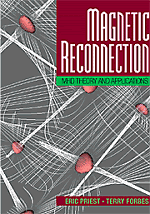
Magnetic reconnection is at the core of many dynamic phenomena in the universe, such as solar flares, geomagnetic substorms and tokamak disruptions. In an authoritative volume, two world leaders on the subject give a comprehensive overview of this fundamental process. The book provides both a full account of the basic theory and a wide-ranging review of the physical phenomena created by reconnection - from laboratory machines, the Earth's magnetosphere, and the Sun's atmosphere to flare stars and astrophysical accretion disks. It also provides a succinct account of various mechanisms of particle acceleration and of how reconnection can be important in such mechanisms. The clear and pedagogical style makes this book an essential introduction for graduate students and an authoritative reference for researchers in solar physics, astrophysics, plasma physics and space science.
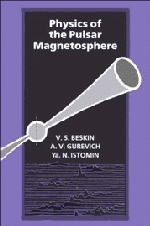
This book presents the theory of the electrodynamic phenomena which occur in the magnetosphere of a pulsar. It also provides a clear picture of the formation and evolution of neutron stars. The authors address the basic physical processes of electron-positron plasma production, the generation of electric fields and currents, and the emission of radio waves and gamma rays. The book also reviews observational data, and devotes a complete chapter to a detailed comparison of this data with accepted theory and with some recent theoretical predictions. Tables containing the values of the physical parameters of all observed radio pulsars are also provided. The book is illustrated throughout and is fully referenced. Graduate students and researchers in astrophysics and plasma physics working in the field of radio pulsars will find this book of great value.
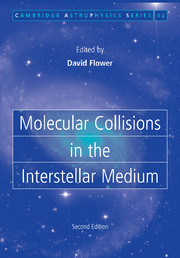
In the interstellar medium - the space between the stars in galaxies - new stars are born from material that is replenished by the debris ejected by stars when they die. This book is a comprehensive manual for studying the collisional and radiative processes observed in the interstellar medium. This second edition has been thoroughly updated and extended to cover related topics in radiation theory. It considers the chemistry of the interstellar medium both at the present epoch and in the early Universe, and discusses the physics and chemistry of shock waves. The methods of calculation of the rates of collisional excitation of interstellar molecules and atoms are explained, emphasising the quantum mechanical method. This book will be ideal for researchers involved in the interstellar medium and star formation, and physical chemists specialising in collision theory or in the measurement of the rates of collision processes.
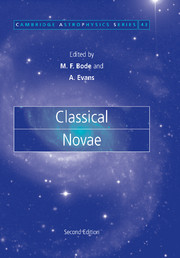
This second edition has been updated and revised and contains contributions covering important developments in this field, and reflecting on interesting insights into classical novae. The book examines thermonuclear processes, the evolution of nova systems, nova atmospheres and winds, the evolution of dust and molecules in novae, nova remnants and observations of novae in other galaxies. It includes observations across the electromagnetic spectrum, from radio to gamma rays, and discusses some of the most important outstanding problems in classical nova research.