To save content items to your account,
please confirm that you agree to abide by our usage policies.
If this is the first time you use this feature, you will be asked to authorise Cambridge Core to connect with your account.
Find out more about saving content to .
To save content items to your Kindle, first ensure no-reply@cambridge.org
is added to your Approved Personal Document E-mail List under your Personal Document Settings
on the Manage Your Content and Devices page of your Amazon account. Then enter the ‘name’ part
of your Kindle email address below.
Find out more about saving to your Kindle.
Note you can select to save to either the @free.kindle.com or @kindle.com variations.
‘@free.kindle.com’ emails are free but can only be saved to your device when it is connected to wi-fi.
‘@kindle.com’ emails can be delivered even when you are not connected to wi-fi, but note that service fees apply.
Historical analysis sits at the heart of the social sciences, yet historical data is often treated as if it provides objective knowledge about the past. This book challenges this assumption, revealing the uncertainty, selectivity, and interpretive mediation embedded in every historical claim. Advocating an intersubjectivist approach that avoids both naïve positivism and radical relativism, the authors show how rigorous historical analysis can strengthen theory building, causal inference, and generalization. Along the way, the book highlights common hazards – from presentism and confirmation bias to unreflective data use – that threaten the credibility of historical research. Outlining five general principles, each supported by practical procedures, it provides a clear roadmap for reducing bias and strengthening the credibility of social science history. The result is an essential methodological guide for social scientists seeking to use historical evidence with greater clarity, care, and scholarly integrity.
Interest in social networks – patterns of relations between social actors such as individuals, corporations, and countries – has grown in the last decade, and analysis of longitudinal network data has moved forward strongly. Social networks often change; understanding this process, where changes lead to other changes, requires tools that can uncover the rules driving these changes. In 'Stochastic Actor-Oriented Models for Longitudinal Networks,' Tom A. B. Snijders and Christian Steglich bring together the first comprehensive textbook on the Stochastic Actor-Oriented Model (SAOM), a leading method for analyzing dynamic network data. They present the diverse SAOM variants developed over the past three decades, covering the co-evolution of networks and actor attributes as well as the co-evolution of multiple one-mode and two-mode networks. Providing a foundation for applying the methods as well as advice for problems encountered in practice, this book offers a detailed guide into the best practices of modeling longitudinal network data.
While existing qualitative, case-study methods deliver specific explanations, quantitative approaches to causal inference emphasize valid inferences at the expense of explanations. In this book, David Waldner presents a hybrid method drawing on both approaches to ensure that explanations are based on validly inferred causes and to avoid making valid inferences that have limited explanatory power. Qualitative Causal Inference and Explanation integrates a qualitative identification strategy based on graph-theoretic analysis into traditional process-tracing methods by introducing three novel methodological concepts: hypothetical interventions, invariant causal mechanisms, and event-history maps. This new approach provides clear and feasible standards for making valid, unit-level causal inferences. The result is a groundbreaking approach to explaining complex social and political phenomena, one that better avoids false positives while providing explanations that satisfy the criteria of explanatory depth, density, relevance, and unification.
Can interviews or a focus group improve the causal inferences drawn from experiments? Can quantitative text analysis help develop workflows as a qualitative scholar? Can we learn from a single case in a way that helps us with a statistical model? There is much to learn from the careful use of all these methodological combinations. The Practice of Multi-Method Research is aimed at practical researchers: from undergraduates preparing for an honors thesis, to graduate students designing a dissertation, through to seasoned scholars considering a new approach for their next set of studies. It offers a hands-on, practical guide to combining research across various methodological traditions: qualitative, machine learning, and quantitative approaches to concepts and measurement, adding quantitative and data-science components to process-tracing designs and to qualitative case studies in general, how qualitative research can strengthen regression-type designs, and how to mix qualitative elements with experiments..
Collaboration is the key to solving global challenges, but are research groups trained in the team dynamics that drive success? This book offers practical strategies to strengthen team dynamics, foster innovation and meet funder expectations. It’s an indispensable guide for researchers in any discipline.
This is a one-stop guide to systematic evaluation. With real-world case studies and practical tools, it offers straightforward advice on overcoming common challenges and delivering effective, fit-for-purpose evaluations across public, academic and voluntary sectors.
Durable social connections are priceless resources for support, companionship, and opportunity. They make life worth living. However, not everyone has equal access to these seemingly free social resources. Like many other valuable things in life, 'social capital' is both a source and a consequence of inequality throughout the population – something that reinforces the status quo and existing social hierarchies. In Friends and Fortunes, the authors painstakingly document that the distribution of social connections in American society is as stark as income inequality. Through detailed analyses and colorful real-life illustrations, they reveal how rich elites hoard both the most prized and the most deceptively frivolous social ties. Drawing on over one hundred measures of social capital from dozens of datasets and over one million people, they explain how social networks create a remarkable and omnipresent web of connections that subtly feed hidden systems of power, prestige, wealth and, ultimately, life chances.
Drawing on the multinational qualitative study 'Children's Understandings of Well-being' (CUWB), this book offers practical insights into conducting fieldwork across diverse contexts. Featuring experts from thirteen countries, the book provides valuable perspectives for researchers across a wide range of academic settings.
Geoffrey T. Wodtke and Xiang Zhou's Causal Mediation Analysis offer a comprehensive yet accessible guide to causal mediation analysis for social scientists. They explore why an exposure affects an outcome by quantifying the processes and mechanisms through which a causal effect operates. Covering everything from traditional methods through machine learning techniques and experimental designs for analysing mediation, the authors make these methods broadly accessible through clear explanations, practical examples, and the inclusion of extensive Stata and R code, allowing readers to replicate all the empirical illustrations and apply the methods directly to their own data. Starting with methods for intuitive, simple settings, they build up to more complex analyses, ensuring a smooth learning experience. Rich in examples from across sociology, psychology, political science, and economics, the authors demonstrate the application of cutting-edge methods to real-world empirical research, providing practical tools and examples for rigorous empirical research across disciplines.
First articulated more than 250 years ago, deterrence remains a central theory in criminology and continues to be the bedrock of the vast bulk of criminal justice policy. But few updates to the original theory of deterrence have been made, and crime-based punishment has only grown tougher, resulting in a historically unprecedented growth in imprisonment and an even greater reliance on deterrence to justify all kinds of punishment. These changes have occurred despite consistent or strong evidence to show that such punishments actually deter crime. In this book, renowned criminologists Daniel P. Mears and Mark C. Stafford provide an in-depth understanding of the classical account of deterrence theory, its limitations, and a reconceptualized version that establishes a more complete and powerful picture of how legal punishments can deter crime. Thorough and corrective, Comprehensive Deterrence Theory gives readers a new way of thinking about and understanding legal punishment.
There are many ways of conducting an analysis, but most studies show only a few carefully curated estimates. Applied research involves a complex array of analytical decisions, often leading to a 'garden of forking paths' where each choice can lead to different results. By systematically exploring how alternative analytical choices affect the findings, Multiverse Analysis reveals the full range of estimates that the data can support and uncovers insights that single-path analyses often miss. It shows which modelling decisions are most critical to the results and reveals how data and assumptions work together to produce empirical estimates. Focusing on intuitive understanding rather than complex mathematics, and drawing on real-world datasets, this book provides a step-by-step guide to comprehensive multiverse analysis. Go beyond traditional, single-path methods and discover how multiverse analysis can lead to more transparent, illuminating, and persuasive empirical contributions to science.
Experiments have gained prominence in sociology in recent years. Increased interest in testing causal theories through experimental designs has ignited a debate about which experimental designs can facilitate scientific progress in sociology. This book discusses the implications of research interests for the design of experiments, identifies points of commonality and disagreement among the different perspectives within sociology, and elaborates on the rationales of each. It helps experimental sociologists find appropriate designs for answering specific research questions while alerting them to the challenges. Offering more than just a guide, this book explores both the historical roots of experimental sociology and the cutting-edge techniques of rigorous sociology. It concludes with a tantalizing peek into the future and provides a roadmap to the exciting prospects and uncharted territories of experimental sociology.
A user-friendly introductory guide to the empirical study of social networks. Jennifer M. Larson presents the fundamentals of social networks in an intuition-forward way which guides theory-driven research design. Substantial attention is devoted to a framework for developing a network theory that will steer data collection to be maximally informative and minimally frustrating. Other features include: Coverage of a range of practical topics including selecting operationalizations, cutting survey costs, and cleaning data; A tutorial for getting started in analyzing networks in R; Technical sections full of examples, points to hone intuition, and practice problems with solutions. Designing Empirical Social Networks Research will be a valuable tool for advanced undergraduates, Ph.D. students in the social sciences, especially political science, and researchers across the social sciences who are new to the study of networks.
In this final book by renowned sociologist Margaret S. Archer, her groundbreaking morphogenetic approach is defended, refined and extended through a series of engagements with her critics. Archer, a pioneer of critical realism, addresses key debates surrounding her work on structure, agency, and social change. Each chapter responds to critiques from a different scholar, using these exchanges as springboards to further develop her powerful explanatory framework. Through these lively dialogues, Archer elaborates her tools for analysing social and cultural dynamics. This book offers readers a unique window into Archer's thought as she clarifies, sharpens and expands her theoretical contributions in response to constructive criticism. It will be an essential read for scholars and students across the social sciences, and for anyone seeking to understand the forces that shape our social world and how we can reshape it.
Linear regression analysis, with its many generalizations, is the predominant quantitative method used throughout the social sciences and beyond. The goal of the method is to study relations among variables. In this book, Schoon, Melamed and Breiger turn regression modeling inside out to put the emphasis on the cases (people, organizations, and nations) that comprise the variables. By re-analyzing influential published research, they reveal new insights and present a principled way to unlock a set of more nuanced interpretations than has previously been attainable. The emphasis is on intuition and examples that can be reproduced using the code and datasets provided. Relating their contributions to methodologies that operate under quite different philosophical assumptions, the authors advance multi-method social science and help to bridge the divide between quantitative and qualitative research. The result is a modern, accessible, and innovative take on extracting knowledge from data.
A state-of-the-art comprehensive exposition of combining Qualitative Comparative Analysis (QCA) and case studies, this book facilitates the efficient use and independent learning of this form of SMMR (set-theoretic multi-method research) with the best available software. It will reduce the time and effort required when performing both QCA and case studies within the same research project. This is achieved by spelling out the conceptual principles and practices in SMMR, and by introducing a tailor-made R software package. With an applied and practical focus, this is an intuitive resource for implementing the most complete protocol of SMMR. Features include Learning Goals, Core Points, and Empirical Examples, as well as boxed examples of R codes and the R output it produces. There is also a glossary for key SMMR terms. Additional online material is available, comprising machine-readable datasets and R scripts for replication and independent learning.
The radical interdependence between humans who live together makes virtually all human behavior conditional. The behavior of individuals is conditional upon the expectations of those around them, and those expectations are conditional upon the rules (institutions) and norms (culture) constructed to monitor, reward, and punish different behaviors. As a result, nearly all hypotheses about humans are conditional – conditional upon the resources they possess, the institutions they inhabit, or the cultural practices that tell them how to behave. Interaction Models provides a stand-alone, accessible overview of how interaction models, which are frequently used across the social and natural sciences, capture the intuition behind conditional claims and context dependence. It also addresses the simple specification and interpretation errors that are, unfortunately, commonplace. By providing a comprehensive and unified introduction to the use and critical evaluation of interaction models, this book shows how they can be used to test theoretically-derived claims of conditionality.
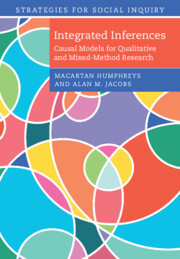
There is a growing consensus in the social sciences on the virtues of research strategies that combine quantitative with qualitative tools of inference. Integrated Inferences develops a framework for using causal models and Bayesian updating for qualitative and mixed-methods research. By making, updating, and querying causal models, researchers are able to integrate information from different data sources while connecting theory and empirics in a far more systematic and transparent manner than standard qualitative and quantitative approaches allow. This book provides an introduction to fundamental principles of causal inference and Bayesian updating and shows how these tools can be used to implement and justify inferences using within-case (process tracing) evidence, correlational patterns across many cases, or a mix of the two. The authors also demonstrate how causal models can guide research design, informing choices about which cases, observations, and mixes of methods will be most useful for addressing any given question.
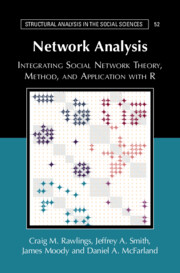
The size and availability of network information has exploded over the last decade. Social scientists now share the stage of network analysis with computer scientists, physicists, and statisticians. While a number of introductions to network analysis are now available, most focus on theory, methods, or application alone. This book integrates all three. Network Analysis is an introduction to both the why and how of Social Network Analysis (SNA). It presents a broad theoretical overview rooted in social scientific approaches and guides users in how network analysis can answer core theoretical questions. It provides a comprehensive overview of descriptive and analytical approaches, including practical tutorials in R with sample data sets. Using an integrated approach, this book aims to quickly bring novice network researchers up to speed while avoiding common programming and analysis mistakes so that they might gain insight into the fundamental theories, key concepts, and methodological application of SNA.
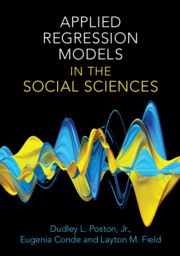
This accessible and practical textbook gives students the perfect guide to the use of regression models in testing and evaluating hypotheses dealing with social relationships. A range of statistical methods suited to a wide variety of dependent variables is explained, which will allow students to read, understand, and interpret complex statistical analyses of social data. Each chapter contains example applications using relevant statistical methods in both Stata and R, giving students direct experience of applying their knowledge. A full suite of online resources - including statistical command files, datasets and results files, homework assignments, class discussion topics, PowerPoint slides, and exam questions - supports the student to work independently with the data, and the instructor to deliver the most effective possible course. This is the ideal textbook for advanced undergraduate and beginning graduate students taking courses in applied social statistics.