


Introduction
Antimicrobial stewardship refers to coordinated interventions to improve appropriate use of antimicrobials in all healthcare settings (acute care, outpatient care, and long-term care). This is achieved through optimizing antimicrobial regimen, dose, duration of therapy, and route of administration. The objectives of antimicrobial stewardship are to (1) achieve the best clinical outcomes related to antimicrobial use while, (2) minimizing the emergence of antibiotic-resistant organisms, Clostridioides difficile infection and other adverse events and (3) reducing excessive costs attributable to suboptimal antimicrobial use. 1
The Centers for Diseases Control and Prevention endorse antimicrobial stewardship program (ASP) co-leadership from a physician and a pharmacist with subspecialty training in infectious diseases. 2 Although the in-depth understanding of diagnosis, management, and therapy of infectious diseases afforded by subspecialty training is advantageous, it is not always practical in settings like long-term care, outpatient care, critical access hospitals, and low-and-middle income countries. Fortunately, several high-quality online resources and certificate programs are available for attainment of requisite knowledge and skills. 1–3 Increasingly, physicians and pharmacists without specialized infectious disease training and infection preventionists are engaged in successful stewardship activities across settings. Reference Sawada, Inose, Goto, Nakatani, Kono and Muraki4 Further, expertise beyond clinical infectious diseases, pharmacology, and microbiology is critical to initiate, maintain, and expand an ASP, including fundamentals of quality improvement and change management, effective communication, data presentation, and methods to measure programmatic success.
Recognizing the need for an update to the original guidance, Reference Cosgrove, Hermsen, Rybak, File, Parker and Barlam5 which continues to be accessed regularly, the Society for Healthcare Epidemiology of America (SHEA) has partnered with the Infectious Diseases Society of America (IDSA), the Pediatric Infectious Diseases Society (PIDS), and the Society of Infectious Diseases Pharmacists (SIDP) to convene a multidisciplinary writing group of experts from academic and non-academic settings and public health departments engaged in advancing antimicrobial stewardship.
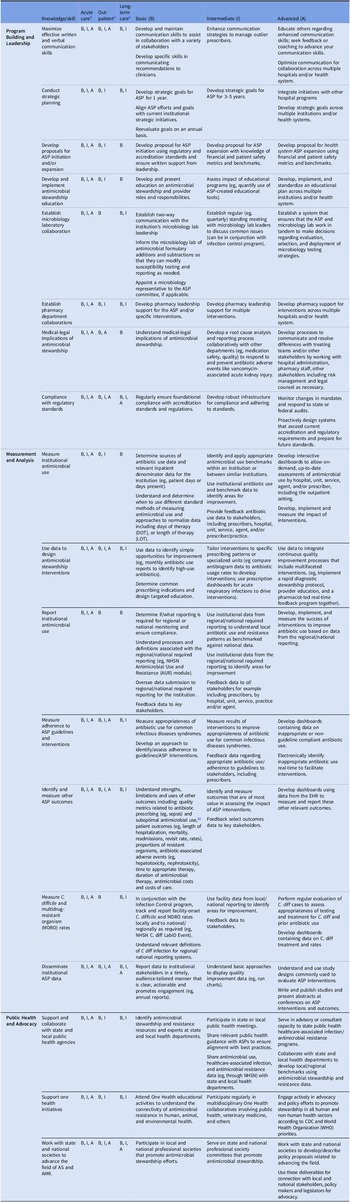
The purpose of this update is to reinforce the knowledge and skills outlined in the original document, now organized by basic, intermediate, and advanced skills applicable to acute care, outpatient care, and long-term care settings (Tables 1–3). Core knowledge and skills include understanding and effectively articulating the rationale for antimicrobial stewardship, performing various ASP interventions and activities a program needs for optimal effectiveness, and measuring processes and outcomes associated with an ASP. Collaboration with infection prevention and control (IPC), microbiology, information technology (IT), and institutional leadership to achieve ASP goals are detailed. Finally, skills focused on leadership, program building, and advocacy are enumerated. Collectively, knowledge and skills described in this document intend to help “raise the bar” for ASPs, like the recent guidance document for IPC programs in which Talbot et al. describe “active” (ie, meeting requirements) versus “effective” IPC programs (ie, those which achieve broader patient safety goals and implement proactive rather than reactive measures). Reference Talbot, Baliga and Crapanzano-Sigafoos6 Similarly, this document delineates skills on a spectrum from basic to advanced skills which serve to augment success of ASPs as they evolve over time. It does not specifically address healthcare resources, staffing models, reporting structures, or percentage of full-time equivalents needed to conduct this work, which will be addressed by future multi-society publications.
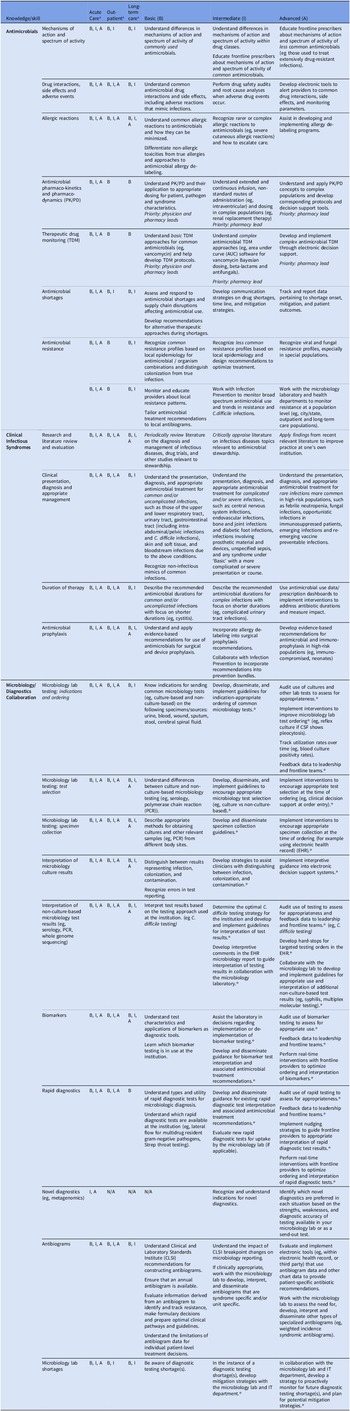
Fundamental antimicrobial stewardship Knowledge and Skills—Clinical Infectious Diseases

Note. *Examples in this category could be considered as diagnostic stewardship activities.
a Column details priority categories for each setting, where applicable.
B, basic; I, intermediate; A, advanced. If not listed in this column, that category may not be readily applicable to this setting and should be evaluated locally.
Fundamental antimicrobial stewardship Knowledge and Skills - Interventions
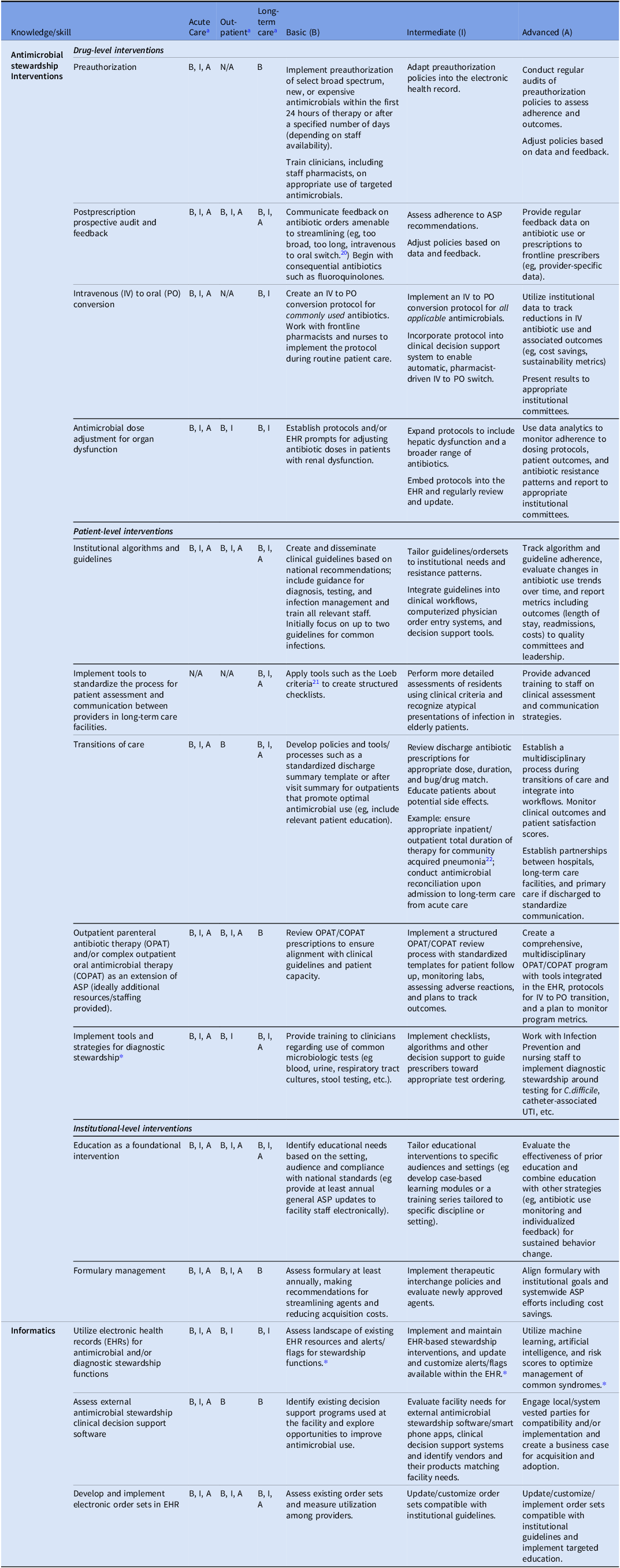
Note.a Column details priority categories for each setting, where applicable.
B, basic; I, intermediate; A, advanced. If not listed in this column, that category may not be readily applicable to this setting and should be evaluated locally.
* Examples in this category could be considered as diagnostic stewardship activities.
Fundamental antimicrobial stewardship Knowledge and Skills – Program Building and Leadership
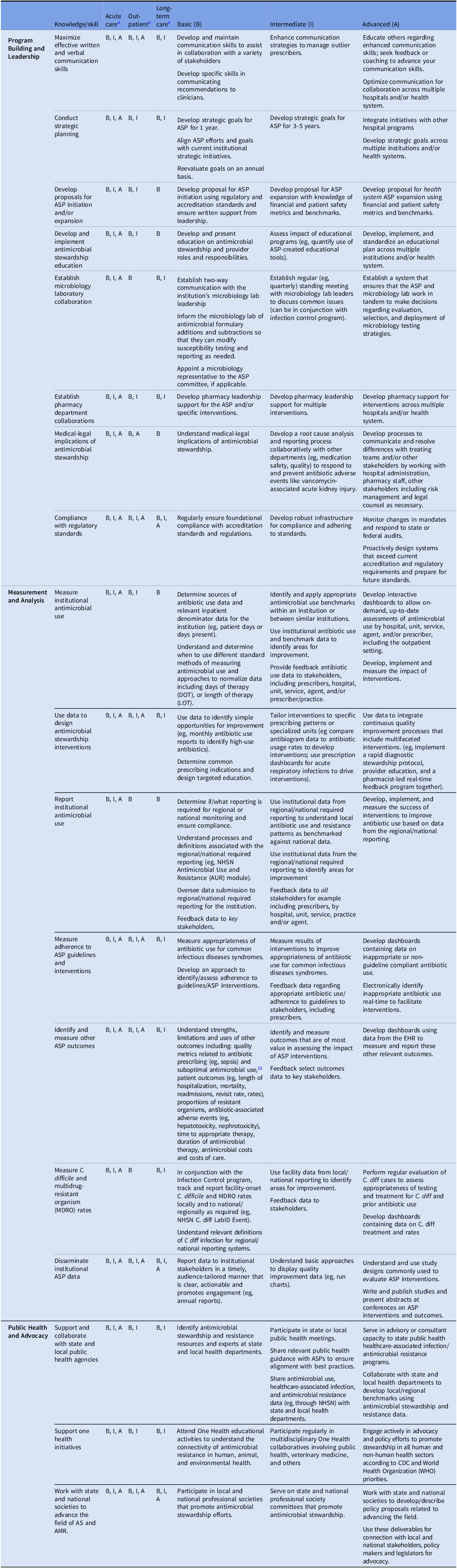
Note. aColumn details priority categories for each setting, where applicable.
B, basic; I, intermediate; A, advanced. If not listed in this column, that category may not be readily applicable to this setting and should be evaluated locally.
This document can be used by the individuals overseeing an ASP, by stewardship teams collectively in their evaluation of current and desired program activities, or by trainees pursuing a career in antimicrobial stewardship. It will facilitate evaluation of what additional skills are needed and inform a plan to acquire additional training to effectively direct an ASP. It also serves as a tool to assess educational needs when developing local curricula related to antimicrobial stewardship and as a framework for administrators to determine what knowledge and skills are needed for overseeing an ASP. Finally, this update also includes a supplementary gap assessment tool to augment the tables (Supplementary Table 1).
Knowledge and skills for implementation, maintenance, and growth of an ASP
The multidisciplinary group of experts delineated key knowledge and skills into the following categories, providing examples and a suggested time frame for acquiring these benchmarks depending on the level of sophistication of a particular ASP. Knowledge and skills may apply to individual program leaders or the stewardship team as a whole (Tables 1–3)
-
Basic—In this phase, programs are establishing the structure and staffing of an ASP and obtaining necessary administrative support; a leader’s focus is on knowledge, skills, and programmatic elements laid out in the Centers for Disease Control (CDC) Core Elements of antimicrobial stewardship in applicable settings 7 and The Joint Commission’s standards for antimicrobial stewardship 8 including antibiotic use and resistance tracking and reporting. ASP leaders must focus on the skills required to establish their program.
-
Intermediate—In this phase, programs must maintain basic programmatic components but have expanded capabilities and resources to grow the program and implement more complex initiatives (eg, electronic health record (EHR)-based interventions, clinical decision support tools, and diagnostic stewardship interventions). ASP leaders must understand the foundation of their ASP and focus on acquiring the knowledge and skills to advance their program.
-
Advanced—In this phase, programs can maintain basic and intermediate programmatic components without significant effort and can secure resources to expand their footprint and impact (eg, develop and disseminate antibiotic use/resistance data dashboards or outpatient/long-term care prescription dashboards, grow staffing and effort to expand into new areas (eg, transitions of care), perform research/produce scholarly output, obtain QI or additional leadership skills, work within a multisite network and participate in multicenter stewardship data collaboratives). ASP leaders at this stage are acquiring knowledge and skills to extend their ASP’s reach into new areas.
Table 1 is intended to serve as a framework only, not a checklist for accreditation or compliance, and is not comprehensive but instead provides relevant examples. As a starting point for ASP leaders, we also suggested priority categories (B, I, A) for each general setting (Acute care, Outpatient, and Long-term care). Although all listed skills are important for optimal stewardship, certain skills are prioritized for distinct settings due to the authors’ recognition of resource and staffing constraints in each setting. We also acknowledge that some skills are optional or aspirational and not prioritized if they do not align with programmatic needs and likely vary by setting (eg, consulting for state public health department healthcare-associated infection (HAI)/antimicrobial resistance programs, publication of research findings, National Healthcare Safety Network (NHSN) reporting, collaboration with microbiology laboratories if all testing is sent to tertiary companies etc.). In addition, some skills outlined in Table 1 may be best suited to either the pharmacy lead (eg, expertise in pharmacokinetic/pharmacodynamic principles) or physician lead (eg, effective communication to department heads or hospital executives), while the remaining skills apply to either pharmacy or physician lead, or other champions leading a ASP (eg, expertise in diagnostic stewardship and collaboration with microbiology and infection prevention for implementation). For these reasons, we developed a gap analysis tool to assist ASP leaders identify key areas for improvement depending upon existing and desired program attributes. (Supplementary Table 1). Finally, given the potential for predictive analytics to augment decision support for appropriate treatment of common infectious syndromes like urinary tract infections (UTIs) and pneumonia, all programs should explore local EHR upgrades to enable these functions. Reference Gohil, Septimus and Kleinman9–Reference Gohil, Septimus and Kleinman12
Developing key partnerships with other hospital programs: an important skill
IPC and ASPs are similarly invested in prevention and appropriate diagnosis and treatment of HAIs, like surgical site infections, methicillin-resistant Staphylococcus aureus (MRSA) bacteremia, C.difficile infections, and others. Tracking performance measures pertaining to HAI rates and antimicrobial resistance apply to both programs. Physicians may have leadership roles in both IPC and ASP and/or report to a common executive leader, such as the chief quality or chief medical officer. Therefore, resources (including financial, technological, and analytic support) may come from the same source and be shared across programs. Moreover, collaboration with the clinical microbiology laboratory is a critical pillar of both IPC and ASP, particularly for diagnostic stewardship for HAIs (eg, ensuring appropriate testing for C. difficile infections, UTIs, and bacteremias), which should be considered a priority area for all hospitals. Reference Singh, Claeys and Advani13 Effective, multidisciplinary diagnostic stewardship involves providing training to frontline providers and nurses on appropriate urine, blood, respiratory, and/or stool testing based on patient symptoms, and implementing checklists or algorithms on appropriate test ordering and collection with feedback mechanisms to these providers. An example of this in action was the 2024 blood culture bottle shortage requiring expertise in diagnostic stewardship to develop evidence-based algorithms to prioritize resource utilization. Reference Ryder, Tong and Gallagher14 Other key collaborations among IPC, ASP, and microbiology include surveillance for antimicrobial resistance, and mitigation of facility outbreaks. Attainment of skills such as quality improvement and implementation science augment the effectiveness of both programs, which is also contingent upon successful communication, change management, and data analytic skills. Additionally, successful implementation of ASP or IPC interventions across large hospitals, health systems, or outpatient networks requires close partnership with IT for maximal dissemination.
Certain patient outcomes are of critical importance to ASP and hospital leadership like readmission prevention, length of stay reductions, and clinical cure from conditions like bacteremia and sepsis. Programs such as outpatient parenteral antibiotic therapy (OPAT) which are often staffed by infectious diseases specialists who may or may not be part of the ASP help optimize these outcomes. Sepsis is another key growth area for ASPs. New opportunities for de-implementation of interventions, including those related to sepsis regulatory measures, may enhance ASP efforts to curb excess antimicrobial use. An important skill for ASP leaders is surveying the future regulatory landscape, anticipating and adapting to changes, and implementing those changes locally. Establishing relationships with other facilities and organizations via collaboratives, health departments, and/or professional societies can help ASP leaders stay abreast of regulatory changes.
Barriers to implementation of ASP interventions
Regardless of skill level or setting, all programs face human, structural, or resource barriers to implementation of ASP best practices. These include:
-
1. Lack of leadership commitment
Building awareness of antibiotic stewardship’s importance requires visible leadership support. We recommend aligning ASP goals with institutional priorities through quality metrics and regulatory compliance (eg, Centers for Medicare and Medicaid Services (CMS) Healthcare Effectiveness Data and Information Set (HEDIS) measures related to appropriate antibiotic prescribing, or reducing 30-day readmissions for pneumonia. 15,Reference Arena, Veve, Fried, Ware, Lee and Shallal16 ) We also recommend meeting regularly with Quality and Safety department and preparing data with common executive-level or “C-suite” metrics such as costs, length of stay, and readmissions.
-
2. Lack of prescriber buy-in to ASP recommendations
Strategies to address this include:
-
a. Providing prescriber education on updated guidelines, potential antibiotic adverse effects, and increased resistance and microbiome disruption.
-
b. Identifying outlier prescribers and providing comparative data and/or feedback using behavioral psychology techniques devices used within the IDSA Stewardship Curriculum. 1,Reference Hojat and Nori17
-
c. Establishing clinical champions, including within the infectious diseases division and outlier prescribers, and an escalation process to address outlier prescribers (eg, informing the clinical chief).
-
d. Providing incentives to prescribers, including financial.
-
3. Limited awareness of ASP strategies among frontline staff
Building awareness, trust, and rapport with frontline staff, including prescribers with varied backgrounds, can occur through regular communications, including face-to-face interactions, and maximum accessibility to local ASP expertise. We recommend serving as an approachable resource and providing support to frontline staff through trainings and tools like quick-reference guides or algorithms. Empower clinical champions to be integrally involved in ASP initiatives.
Regulatory requirements, such as those for antibiotic use data reporting, can be leveraged for IT support for EHR upgrades. ASPs can also adopt existing EHR builds in place at other facilities using the same EHR system (eg, C.difficile diagnostic stewardship alerts), as codes can be shared among IT analysts. Finally, infectious diseases physician or pharmacy expertise can be extended across a growing health system via tele-stewardship services. For staff training and education on appropriate antibiotic use, ASPs can utilize free tools such as online modules and webinars where available. 18,19 Finally, stewardship efforts can be extended through champions readily engaged in ASP activities, (eg, frontline pharmacy and nursing-driven intravenous to oral conversions).
Conclusion
ASPs are critical patient safety and healthcare optimization programs with increasing scope, regulatory requirements, and visibility since the original publication of this multi-society guidance document. In addition to outlining and updating the knowledge and skills necessary to lead ASPs, it offers further specificity by delineating basic, intermediate, and advanced skills applicable to acute care, outpatient care, and long-term care settings according to antimicrobial stewardship experts from key organizations and diverse backgrounds engaged in advancing antimicrobial stewardship. Finally, a gap assessment tool is provided to identify aspirational knowledge and skills and help programs develop work plans to meet these goals.
Supplementary material
The supplementary material for this article can be found at https://doi.org/10.1017/ash.2026.10344.
Acknowledgments
The authors sincerely thank Kristy Weinshel, Valerie Deloney, and the entire SHEA staff for their exceptional support and dedication in bringing this effort to fruition.
Competing interests
The following disclosures reflect what has been reported to SHEA. To provide thorough transparency, SHEA requires full disclosure of all relationships, regardless of relevancy to the topic. Evaluation of such relationships as potential conflicts of interest is determined by a review process which includes assessment by the SHEA Conflict of Interest Committee and may include the Board of Trustees and Editor of Antimicrobial Stewardship and Healthcare Epidemiology. The assessment of disclosed relationships for COI will be based on the relative weight of the financial relationship (ie, monetary amount) and the relevance of the relationship (ie, the degree to which an association might be interpreted by an independent observer as related to the topic or recommendation of consideration). The reader of this guidance should be mindful of this when the list of disclosures is reviewed. TMF is a scientific advisor for ThermoFisher, Merck, Pfizer, Paratek, Shionogi, MicroGenDX, author and section editor for UpToDate, participant on an advisory board for Eagle Pharmaceuticals. He has received speaker honoraria from Pfizer and Merck, travel support for attendance at HealthTrackRx, and funding from Pfizer to his institution for a research study grant. ANM is a physician consultant to the Michigan Department of Health and Human Services and is a shareholder of Pfizer Pharmaceuticals. JP works for the Nebraska antimicrobial stewardship Assessment and Promotion Program, funded by grants from the Centers for Disease Control and Prevention (CDC). PN received an HSII award from PCORI for antimicrobial stewardship in pediatrics. SC receives a stipend for serving on the advisory board for Danaher and Philips. All other authors report no conflicts of interest related to this article.
Review
The document was reviewed by the SHEA Antimicrobial Stewardship Committee, the SHEA Publications Committee, IDSA, PIDS and SIDP, and endorsed by the SHEA Board of Trustees, SIDP Board of Directors, IDSA Board of Directors, and PIDS Board of Directors.


 Open access

