
Hostname: page-component-8678677fb7-q8n7b Total loading time: 0 Render date: 2026-10-06T06:21:12.422Z Has data issue: false hasContentIssue false

A rare miniature and small-scale stencil assemblage from the Gulf of Carpentaria: replication and meaning in Australian rock art

Published online by Cambridge University Press:  26 May 2020

Liam M. Brady*
Affiliation:
College of Humanities, Arts and Social Sciences, Flinders University, Australia
John J. Bradley
Affiliation:
College of Humanities, Arts and Social Sciences, Flinders University, Australia Monash Indigenous Studies Centre, Monash University, Australia
Amanda Kearney
Affiliation:
College of Humanities, Arts and Social Sciences, Flinders University, Australia
Daryl Wesley
Affiliation:
College of Humanities, Arts and Social Sciences, Flinders University, Australia
*
*Author for correspondence: ✉ liam.brady@flinders.edu.au

Abstract

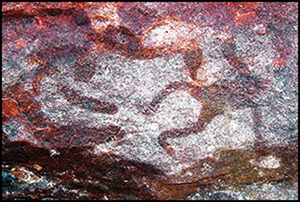
Recent survey in the Gulf of Carpentaria region of northern Australia has identified a unique assemblage of miniature and small-scale stencilled motifs depicting anthropomorphs, material culture, macropod tracks and linear designs. The unusual sizes and shapes of these motifs raise questions about the types of material used for the stencil templates. Drawing on ethnographic data and experimental archaeology, the authors argue that the motifs were created with a previously undocumented stencilling technique using miniature models sculpted from beeswax. The results suggest that beeswax and other malleable and adhesive resins may have played a more significant role in creating stencilled motifs than previously thought.

Information

Type
Research Article
Copyright
Copyright © Antiquity Publications Ltd, 2020

Access options

Get access to the full version of this content by using one of the access options below. (Log in options will check for institutional or personal access. Content may require purchase if you do not have access.)

Article purchase

Temporarily unavailable