


Introduction
Since 2013, “hate demonstrations,” organised by groups such as Zaitokukai (在特会, Zainichi Tokken o Yurusanai Shimin no Kai, or “Citizens’ Group Against Special Privileges for Zainichi Koreans”) and marked by the use of hate speech, have garnered significant media attention (Higuchi Reference Higuchi2016, Reference Higuchi, Kang, Rivé-Lasan, Kim and Hall2020).Footnote 1 These demonstrations stem from historical revisionism, territorial disputes, and online discourse (Yoon and Asahina Reference Yoon and Asahina2021). Around the time the 2016 Hate Speech Law was set on the agenda in 2015, the scale and frequency of these demonstrations began to decline, and the law’s implementation further reinforced this decline (Hatano Reference Hatano, Higaki and Nasu2021, 78; Löschke Reference Löschke2021, 290).Footnote 2 This decline also owed much to counter-protesters, whose new tactics contributed to it (Löschke Reference Löschke2021).
To analyse the institutional and social responses to these counter-protests, this study utilises the analytical concept of framing. Framing is a process in which protesters and other relevant actors assign meaning to protest events to mobilise participants and either bolster or suppress opponents (Snow and Benford Reference Snow, Benford, Klandermans, Kriesi and Tarrow1988, p. 198). Building on this concept, this paper addresses the following research question: How do the interactions among policing, institutional media, and partisan activist discourse shape the negative framing and long-term stigmatisation of counter-protesters in Japan? While these counter-protests significantly hindered hate demonstrations, the prevailing institutional and social responses have often leaned toward negative framing rather than recognition.
Counter-protesters in Japan, influenced by Antifa visual symbols (e.g., red-and-black logos) and slogans such as No Pasarán (“They shall not pass”), first appeared on the streets in early 2013 (Noma Reference Noma2018). They have developed new tactics to verbally attack far-right demonstrators at close range to discourage them and to use electronic noise from megaphones to drown out their speeches (Löschke Reference Löschke2021). In recent years, they have maintained the capacity to mobilise between 20 and 100 participants to counter each far right demonstration or street oratory, depending on its scale (Tokyo Shimbun 2024; Asahi Shimbun 2025a). At the protest sites, different types of activists came together, as some made provocative gestures such as raising middle fingers and others silently glared at far-right activists while holding placards (Noma Reference Noma2018; Shaw Reference Shaw2020). They have often been referred to as “liberal Antifa” (Shaw Reference Shaw2020). They remained nonviolent in contrast to militant Antifa in the specified Western contexts, particularly the United States and Germany, and framed their activism as an effort by the Japanese majority to promote societal fairness, rejecting the paternalistic stance of “protecting minorities” (Noma Reference Noma2018). Building on this approach, the leading national group Shibakitai (しばき隊, Reishisuto o Shibaki-tai, literally “Corps to Bash Racists”) was established in 2013 and reorganised in 2014 as the Counter-Racist Action Collective (C.R.A.C.). Around this organisation, counter-protesters have loosely united, continuously attracting new members over time. Crucially, the aggressive literal meaning of the name “Shibakitai” provided a key linguistic opportunity for opponents to exploit this prevailing negative framing, portraying the movement as inherently violent (e.g., Rokusaisha 2017, p. 59; Sakurai Reference Sakurai2016, p. 19).
Among these counter-protesters, this paper focuses in particular on two key individuals, Yasumichi Noma (野間易通) and Shinhae Lee (李信恵), who emerged as prominent public “faces” of the movement and thus became primary targets of negative framing. Noma, the founder of C.R.A.C., and Lee, a prominent Zainichi Korean writer known for her vocal opposition to hate speech, achieved high visibility through their leadership and public presence in the movement. As detailed in the subsequent analysis, their public profiles made them frequent targets of negative framing across activist discourse. In Lee’s case in particular, such framing often took gendered forms, including misogynistic attacks.
Attention to counter-protesters has increased alongside the rise of the far-right party Sanseito (参政党) since summer 2025Footnote 3 . The party won fourteen seats in the July 2025 House of Councillors election, campaigning with xenophobic slogans such as “Japanese First” (BBC 2025; CNN 2025). Right-leaning outlets, particularly the radical-right Sankei Shimbun (2025),Footnote 4 framed counter-protesters’ actions as “acts of obstruction.” In contrast, left-leaning outlets reported critically that the Sanseito has been calling counter-protesters “Shibakitai” in order to portray them as a “violent group” and target them (TBS 2025). The conflict between counter-protesters and the Sanseito has escalated to the point that the party is preparing a bill to punish protests against its street speeches (Kanagawa Shimbun Reference Kanagawa2025). Sanseito leader Sōhei Kamiya (神谷宗幣) even cited a journalist’s alleged ties to Shibakitai as a reason to exclude him from a press conference (Sanseito 2025).
Such negative framing and delegitimisation of counter-protesters is not a recent phenomenon. Positive coverage of their activities and objectives has largely been limited to left-leaning media, while right-leaning outlets have predominantly portrayed them negatively.Footnote 5 Positive newspaper articles, mostly published between 2013 and 2016, are now accessible only through subscription databases, whereas online content available to the public remains overwhelmingly critical. Despite counter-protesters’ efforts to curb hate demonstrations, negative portrayals have predominated. This study examines such negative framing, focusing on policing, news coverage, and opponent-dominated discourses.
Theoretical framework: three layers of negative framing
This study employs a three-layered framework – policing, news coverage, and public discourse – to examine negative framing. The theoretical framework draws on cross-disciplinary exchanges among social movement studies, media studies, and criminology, using case studies from the United States, Australia, and European countries such as Italy and Germany. This study synthesises previous research into a three-layered framework.
Policing
The first layer conceptualises the dynamics of protest policing. Police selectively employ “hard” and “soft” policing styles (della Porta Reference della Porta1995; della Porta and Fillieule Reference della Porta, Fillieule, Snow, Soule and Kriesi2004; Wisler and Giugni Reference Wisler and Giugni1999). “Soft” policing emphasises negotiation and protest rights, tolerating minor transgressions, whereas “hard” policing involves escalated use of force to impose law and order, even at the expense of demonstrators’ rights. Surveillance is also part of hard policing (Di Ronco Reference Di Ronco2025). In many Western countries, police have tasked specific branches or teams with the mission of monitoring and even harassing radical leftist movements (della Porta Reference della Porta1995; Castle Reference Castle2021; Weis Reference Weis and Weis2022). Police have treated “provocateurs” especially strictly, regarding them as illegitimate protesters intending to disrupt public order and distinguishing them from legitimate protesters aiming to address social issues (della Porta and Fillieule Reference della Porta, Fillieule, Snow, Soule and Kriesi2004). In recent years, police have viewed protesters affiliated with Antifa and Black Lives Matter (BLM) as provocative due to their confrontational stance toward far-right activists and criticism of police violence (Cunningham Reference Cunningham2024; Reynolds-Stenson Reference Reynolds-Stenson2018; Vysotsky Reference Vysotsky2021). Police have also negatively framed protesters by linking current movements to past radical ones. In 2016, they referenced the 1960s–70s civil rights movement and the Black Panther Party to portray BLM protests as potentially escalating into violence or riots (Weis Reference Weis and Weis2022, p. 109). Police antagonism extends even to nonviolent demonstrators perceived as provocateurs. Even when demonstrations remain peaceful, police have employed “hard” tactics, specifically arresting protesters for minor offences, such as vandalism and obstruction of public duty, if they were deemed provocative or illegitimate (Della Porta and Fillieule Reference della Porta, Fillieule, Snow, Soule and Kriesi2004; Di Ronco Reference Di Ronco2025; Martin Reference Martin, Weber, Fishwick and Marmo2017).
Media coverage
The second layer addresses how media coverage reinforces the impact of police measures. Media outlets, especially mainstream media, tend to focus on the deviant behaviour of protesters, often relying exclusively on police and authorities as their primary sources of information, and downplaying the protesters’ grievances and demands (Leopold and Bell Reference Leopold and Bell2017; McCurdy Reference McCurdy2012; Umamaheswar Reference Umamaheswar2020). Because of this reliance, the media tend to attribute crime to protesters, even when supporting evidence is limited. Journalists often use terms provided by the police, such as “troublemakers” and “vandals,” to describe protesters. These exaggerated portrayals help justify hard and sometimes questionable policing, reinforcing the impact of police measures (della Porta and Fillieule Reference della Porta, Fillieule, Snow, Soule and Kriesi2004; Di Ronco Reference Di Ronco2025; Martin Reference Martin, Weber, Fishwick and Marmo2017). In doing so, the media often legitimise or even endorse such policing practices, even when protesters are merely defending themselves against far-right aggression (Castle Reference Castle2021; Cunningham Reference Cunningham2024). Wisler and Giugni (Reference Wisler and Giugni1999) suggest that if the media side with protesters in their coverage, the police are more likely to adopt more moderate policing styles. Thus, the attitudes of the police and the media toward protesters are mutually influential.
Partisan activist discourse
The third layer addresses the public framing of protest movements, especially partisan activist discourse delegitimising counter-protesters. The frame of a protest is shaped not only by media coverage but also by political discourse, including those by opponents (della Porta and Fillieule Reference della Porta, Fillieule, Snow, Soule and Kriesi2004; McCurdy Reference McCurdy2012; Umamaheswar Reference Umamaheswar2020). Even if only a minority of protesters engage in violence, opponents attempt to delegitimise the movement under the pretext of “law and order,” citing media coverage that similarly appeals to the maintenance of “law and order” in line with the police narrative (Cunningham Reference Cunningham2024; Leopold and Bell Reference Leopold and Bell2017; Martin Reference Martin, Weber, Fishwick and Marmo2017). Police, media, and political actors can form a dominant coalition that prioritises “law and order” over protesters’ rights, establishing a negative frame of protest (della Porta Reference della Porta1995; Di Ronco Reference Di Ronco2025; Wisler and Giugni Reference Wisler and Giugni1999).
While Layer 2 and Layer 3 both involve framing processes, they are conceptually distinct. As discussed in the main sections of this paper, Layer 2 is rooted in institutional media, encompassing both elite outlets that claim journalistic neutrality and non-elite media characterised by sensationalism. Layer 3, by contrast, consists of explicitly partisan, opponent-driven discourses produced by political antagonists and intended to delegitimise the movement. This paper adopts the three layers identified by previous research as an analytical framework to examine how counter-protesters opposing hate speech in Japan have been negatively framed.
Japan-specific contexts
Based on previous research, this section outlines what specific historical and institutional conditions in Japan have shaped the three layers of policing, media coverage, and delegitimising discourse, which have negatively framed activists in the country.
Policing in Japan
Protest policing in Japan has been shaped by historical developments and is characterised by greater police discretion than in many Western countries. Since the radicalisation of Red Army factions in the 1970s, political activists have consistently been stigmatised as deviants, particularly because of the hard policing style (Ando Reference Ando2014; Chiavacci and Obinger Reference Chiavacci, Obinger, Chiavacci and Obinger2018; Steinhoff Reference Steinhoff2013). To pre-emptively deter demonstrators, police have exercised broad discretion (Hsu Reference Hsu2020). In contrast to other Western countries, in Japan arrests for minor offences that do not lead to prosecution occur more frequently, and arrestees can be detained for much longer periods, up to twenty-three days (Foote Reference Foote1992; Hsu Reference Hsu2020, 159–162). Legal scholars argue that these practices are rooted in a paternalistic view, aiming to prompt reflection on past acts and deter future offences (Foote Reference Foote1992; Haley Reference Haley1998; Leonardsen Reference Leonardsen2004).
Japan’s hard policing style is also linked to the role of public security police (公安警察, kōan-keisatsu). The security department (警備部, keibi-bu) of local police includes not only the general policing division (警備課, keibi-ka), which is primarily responsible for operational policing during demonstrations, but also the public security division (公安課, kōan-ka), which performs the role of public security police (Hsu Reference Hsu2020, 4). The latter closely monitors both right- and left-wing groups under the pretext of counterterrorism, often in cooperation with the Public Security Intelligence Agency (公安調査庁, kōan chōsa-chō) (Hsu Reference Hsu2020). Activists have reported psychological stress not only from arrests but also from surveillance, including physical tailing (Tominaga Reference Tominaga2014). Although some restrictions on counter-protesters during hate demonstrations were relaxed after the 2016 Hate Speech Law (Löschke Reference Löschke2021, 298–299), police attitudes toward them appear largely unchanged. They have consistently framed both counter-protesters and far-right activists as disruptors of social order, guided by the principle of “kenka ryōseibai” (喧嘩両成敗, in a quarrel, both parties are to blame, whatever the rights or wrongs) (Löschke Reference Löschke2021, 300). Prior research has not clarified whether hard policing styles, such as arrests on minor charges, were applied to counter-protesters, or what role the public security division played.
Media coverage in Japan
The framing of protesters in Japan has historically been shaped by the Japanese media. Both elite and non-elite media have contributed to the framing in distinct ways. Elite media consist of the news divisions of five national newspapers and four major television networks, which form the “press club” system (kisha kurabu), a highly influential “information cartel” (Freeman Reference Freeman2000; Rausch Reference Rausch, Gulyas and Baines2020; Valaskivi Reference Valaskivi and Babb2015). Non-elite media consist of television wide shows, which are infotainment programmes characterised by sensationalism, and tabloid magazines. Although their news coverage often claims to be neutral and fact-based, it relies largely on police and government sources rather than on independent investigation (Burrett Reference Burrett2023; Nakano Reference Nakano and Kingston2017; Prusa Reference Prusa2022). Non-elite media, historically excluded from the press club, are characterised by entertainment, commercialism, sensationalism, and taboo-breaking. TV “wide shows” and tabloid magazines that rose in the 1980s reported political scandals and celebrity gossip in similarly sensational ways (Ergül Reference Ergül2018; McNeill Reference McNeill and Kingston2014, Reference McNeill2021; Prusa Reference Prusa2023; Yada Reference Yada, Anderson and Ward2016).
The radicalisation of the Red Army Faction marked a historical turning point in news coverage of activists’ deviant behaviour. Since the 1970s, elite media have closely collaborated with police, using terms like “extremists” to justify hard policing of the radicalised activists under the pretext of “protecting citizens” (Ando Reference Ando2014, pp. 93–96; Hsu Reference Hsu2020, p. 36). Non-elite media sensationally reported on the activists’ deviance, focusing on the perceived madness and sexual lives of female activists, trivialising their political concerns (Igarashi Reference Igarashi2007; Perkins Reference Perkins2015; Shigematsu Reference Shigematsu2012). This reinforced the stigmatisation of the arrested activists (Derichs Reference Derichs, Colvin and Karcher2019, p. 138). While the research suggests that elite media’s reliance on police sources and non-elite media’s sensationalism can further reinforce the stigmatisation of protesters, it remains unclear whether both media types have similarly framed counter-protesters opposing hate speech since 2013. This study addresses these questions.
Delegitimising discourse in Japan
In Japan, print media published by political opponents have also contributed to delegitimising protesters. As this paper will later show, such publications often remain online for extended periods and continue to be referenced on social media. Since the 1990s, the “hate book” (heito-bon) genre has shaped right-wing discourse. These publications are defined as “books or magazines that contain hate speech” and reached their most recent peak in 2019 (Hanssen and Woo Reference Hanssen and Woo2023, 27, 31). Influenced by humour-infused internet culture that has developed since the 2000s on an anonymous bulletin board called 2channel (now 5channel), these publications have encouraged racism and historical revisionism (Hanssen and Woo Reference Hanssen and Woo2023, 32). Some works specifically mocked and criticised left-liberal activists, achieving commercial success (Kurahashi Reference Kurahashi2018, p. 69). This book genre has continued to thrive even after the passage of the 2016 Hate Speech Law.
Taboo-breaking niche magazines, which cover scandals and other sensitive topics overlooked by mainstream media, have also offered activists a platform to publicise perspectives that were otherwise excluded from mainstream outlets (McNeill Reference McNeill and Kingston2014, Reference McNeill2021). Uwasa no Shinsō, a monthly magazine published from 1979 to 2005, pioneered the exposure of these issues and relentlessly pursued those responsible for misconduct. (McNeill Reference McNeill and Kingston2014). Both the hate book genre and these magazines thus served as arenas for contesting the public framing of social movements. It remains unexplored whether these publications have contributed to the negative portrayal of counter-protesters opposing hate speech.
Applying these contexts, this paper examines negative framing through analogies to 1980s Red Army factions, paralleling U.S. framing of BLM via the Black Panther Party.
Data and methods
This study employs a mixed qualitative approach, combining semi-structured interviews with content analysis of news coverage and activist publications, to examine interactions among counter-protesters, their opponents, local police, and media.
Qualitative interviews
Data were primarily collected through forty-six semi-structured interviews conducted between 2017 and 2023 with forty counter-protesters active in six prefectures (Tokyo, Kanagawa, Aichi, Mie, Kyoto, and Osaka), in regions where Zaitokukai and its successor or affiliated organisations conducted hate demonstrations, either temporarily or continuously. Interviewees were primarily selected based on their affiliation with leading national counter-protest groups, particularly Shibakitai, reorganised in 2014 as C.R.A.C., and The Menfolk (Otoko-gumi), following the focus of prior research (Shaw Reference Shaw2020; Shibuichi 2016). Participants ranged in age from twenty-nine to eighty-two, with an average age of approximately fifty years as of 2020, and six interviewees were women. This study examines processes of public framing and stigmatisation, focusing on the identities and public profiles of individuals who function as the “faces” of the movement. Therefore, the research required the disclosure of real names and related profile information wherever possible. Participants chose to have their names displayed in Japanese characters and Romanised form, in Romanised form only, or to remain anonymous. Informed consent was obtained.
The interviews were designed to cover the three layers, focusing on four main topics: (1) the tactics interviewees employed in counter-protests, (2) their experiences with both soft and hard policing, (3) their perceptions of news coverage about counter-protests, and (4) their experiences of delegitimising discourse from both right- and left-wing activists. Each session lasted three to six hours, producing extensive field notes (typically 7,000 words), which were cross-checked with audio recordings when necessary. This approach provides detailed insight into counter-protesters’ perspectives and the psychological effects of negative framing.
Content analysis
News coverage (Layer 2) and activist discourse (Layer 3) were qualitatively analysed not only by using the interview data but also by conducting content analysis of newspaper articles and activist publications. Ninety-nine articles from five major national newspapers (Asahi, Mainichi, Yomiuri, Sankei, Nikkei) were retrieved from the databases in July 2023 using search terms such as “counter” and “hate speech” (seventy-seven articles), with an additional twenty-two articles containing “Shibakitai,” the group most frequently targeted by negative framing.Footnote 6 Forty-two blog posts and social media posts referencing counter-protester arrests were also incorporated.
Content analysis to capture activist discourse (Layer 3) focused on two activist publications. The first book, The Great Anti-Korean Diary (Dai-Kenkan Nikki, Sakurai Reference Sakurai2016), was written by Makoto Sakurai, founder of Zaitokukai. Sakurai is known for authoring bestselling “hate books” targeting Zainichi Koreans (Hanssen and Woo Reference Hanssen and Woo2023; Kurahashi Reference Kurahashi2018). His 2016 book is also classified as a “hate book” for its explicit discriminatory expressions and was chosen for analysis both because of his prominence and its central aim of delegitimising counter-protesters. The second example is a 2017 book published by Rokusaisha, a partisan niche publisher with roots in 1970s activism. Maintaining the sensationalist style of earlier publications like Uwasa no Shinsō Footnote 7 , this book reported on the “Shibakitai Lynching Incident” to delegitimise individuals it opposed and functioned as a partisan actor rather than a neutral news source. This exposure of the incident, which remained taboo even among left-wing activists, intensified the stigma against counter-protesters.
Both books (204 and 195 pages, respectively) underwent qualitative content analysis. The analysis proceeded from inductive open coding to selective coding, following the methodology outlined by Kennedy and Thornberg (Reference Kennedy, Thornberg and Flick2018). All passages related to Shibakitai and counter-protesters were first extracted and subsequently categorised, resulting in a final coded dataset totalling approximately 62,000 words. In this process, a passage, typically consisting of three to four sentences, was used as the unit of analysis because passages of this length generally cover a single coherent topic.
Analysing these publications alongside policing and media coverage sheds light on the mechanisms of negative framing against counter-protesters in contemporary Japan. Following the three-layered framework, the analysis first addresses policing and news coverage (Layers 1 and 2), followed by a detailed investigation of partisan activist discourse (Layer 3).
Policing and media coverage against counter-protesters
Regarding the media coverage, patterns observed in Western cases also appear in Japan, namely elite media’s reliance on police press releases and non-elite media’s focus on sensationalism. The section further considers Japan’s paternalistic criminal prosecution system.
Arrests and referrals on minor charges related to counter-protests
Both hard policing measures, such as arrests for minor offences, and media coverage of them have stigmatised activists and deterred them from further action. These practices also affected counter-protesters. However, not all police measures against counter-protesters were reported in the media. Therefore, the following subsections discuss policing and media reports separately, as the cases discussed only partly overlap.
Policing
Although the 2016 Hate Speech Law reduced the overall scale and aggressiveness of hate demonstrations, counter-protesters were occasionally subject to arrests on minor charges (微罪逮捕, bizai taiho) or referral for prosecution (書類送検, shorui sōken) during the demonstrations. The police often allowed them to approach participants in hate demonstrations closely without intervening (Interview No. 45, 06.09.2023). As a result, small scuffles sometimes arose when the two sides came too near each other (Ibid.). Such incidents rarely escalated into serious violence, yet the police occasionally exploited them as opportunities for arrests or referrals for prosecution (Ibid.).
Participants in hate demonstrations developed tactics intended to provoke the police into arresting counter-protesters on minor charges, which also contributed to the persistence of such arrests. One such tactic, referred to by counter-protesters as “whiplash hustlers” (当たり屋, atari-ya), is a strategy in which participants in hate demonstrations deliberately or accidentally drop items, such as cameras, or fall, and then file complaints alleging damage or injury. My interviews documented eleven cases that occurred between 2013 and 2023, in which such tactics were applied. From these cases, the following typical scenario emerged: Counter-protesters were either arrested on the spot during hate demonstrations or later referred for potential prosecution without being arrested, based on complaints filed by participants in those demonstrations. Several months later, local police summoned them for brief questioning, usually lasting ten to sixty minutes in a harmonious (和やかな, nagoyaka-na) atmosphere. Most cases were dropped, typically after about a year. Nevertheless, during this period, counter-protesters often felt uneasy and sometimes refrained from or moderated their participation in subsequent protests.
These hard policing practices, in which counter-protesters were either arrested or referred for potential prosecution despite rarely being prosecuted, align with Japan’s criminal justice system. A distinctive feature of this system is its low prosecution rate, which stood at 32.0% in 2024 (MOJ 2024, p. 43). This low rate is due to the system’s allowance of significant police and prosecutorial discretion (Haley Reference Haley1998; Terrill Reference Terrill2016) and its preference for informal restraint over formal bans to maintain social harmony (Leonardsen Reference Leonardsen2004, pp. 29–30). It also reflects the authorities’ paternalistic belief that they know what is best for suspects and can most effectively prevent future offences (Foote Reference Foote1992). Accordingly, local police arrest or refer counter-protesters for potential prosecution, without intending to prosecute them, only to temporarily moderate their actions. Most cases are dropped after a six- to twelve-month “cooling-off” period, which police consider beneficial for both the individuals and society.
Except for the anxiety of potentially being prosecuted due to such paternalistic police measures, counter-protesters faced additional psychological stress because their cases were handled by the public security division (公安課, kōan-ka). While the general policing division (警備課, keibi-ka) manages street protests in a way that causes relatively little fear for activists, the public security division is known for high-level surveillance and political repression, carrying significant social stigma. In Japan, activists fear the public security police, particularly because home or workplace searches often result in social stigma (Tominaga Reference Tominaga2014, 125). Counter-protesters who were interrogated by the public security division felt tremendous stress when asked detailed questions about their occupations and the organising structure of counter-protests and feared that the division would contact their workplaces (Interviews No.28, 03.04.2020; No.44, 10.08.2023; No.45, 06.09.2023).
Counter-protesters’ fear was further heightened by the surveillance system of the public security police. In Musashino City in Tokyo, large-scale hate demonstrations temporarily occurred after the city council proposed a local ordinance granting suffrage to foreign residents in November 2021. In response, seventeen counter-protesters staged a “die-in” by lying on the street to block the hate demonstrators. When the public security division identified all seventeen participants in this die-in incident in December 2021, such high capabilities shocked the counter-protesters within a month (Interview No.43, 09.08.2023).
Another example illustrates the public security division’s tremendous discretion, including its authority to unilaterally change the charges after arrest. I reconstructed the experience of a counter-protester in his early forties from a five-hour interview (No. 45, 06.09. 2023). In May 2021, during a hate demonstration in Tokyo’s Ginza, a fifty-nine-year-old participant brought a camera on a selfie stick very close to a counter-protester’s face. Provoked, the counter-protester lightly brushed the camera with a PVC-wrapped placard. The camera did not fall, and no one was injured. However, minutes later, a plainclothes police officer suddenly stopped and arrested him without specifying a charge. He was taken into custody by the public security division and interrogated. He later learned that he had been initially charged with obstructing official duties, despite having no physical contact with any officer. This charge was subsequently changed to assaulting the participant with the camera. This case highlights the significant discretion the public security division exercises in arresting individuals.
The tendency for police to impose stricter measures on those whose sensitivity to police violence is high, as documented in U.S. cases (e.g., Reynolds-Stenson Reference Reynolds-Stenson2018), is also observable among counter-protesters in Japan. The arrested informant was highly sensitive to police violence and reacted strongly when touched (Interview No.45, 06.09.2023). In contrast, other counter-protesters who were present at the scene but not arrested showed no hostility toward police officers, sometimes greeting and conversing with them (Interviews No.45, 06.09.2023; No.46, 27.09.2023). Those who were highly sensitive to police violence and resisted conciliatory efforts appear to have been treated more harshly.
The severe psychological toll of this hard policing is evident in the experience of the arrested informant (Interview No. 45, 06.09.2023) during his three-day detention. After the first interrogation, all possessions except his underwear were confiscated. On the second day, police searched his parents’ house, where he lived, and seized his computer, which was essential for his advertising job, for three weeks. He reported feeling deep distress over causing trouble for his parents. He later reflected on the experience: “I’m not someone who would commit suicide because I’m afraid I won’t actually die if I try, but someone else who isn’t like me might consider suicide after experiencing something like this.” In contrast, the public security division treated another counter-protester, who generally complied with police conciliatory measures, very differently. He was arrested for minor physical contact with a hate demonstration participant. He underwent two friendly interrogations without being detained, and no search of his home was conducted (Interview No.46, 27.09.2023). This sequence suggests that the disparity in treatment is driven by the interaction between activist behaviour and police interpretation. First, protesters’ heightened sensitivity to police violence frequently manifests as resistant or confrontational behaviour during encounters. In response, law enforcement officers become more attentive to such conduct and are more likely to frame it as a legal violation, such as “obstruction of public duty.” This interpretive shift enables police to exercise their discretionary powers more extensively, leading them to impose stricter measures such as prolonged detention or house searches, regardless of the activists’ initial intent (for example, merely trying to push away a placard).
Media coverage
The impact of hard policing measures against counter-protesters is reinforced by both scandal-driven non-elite media and elite media that rely heavily on police information. Since the 2000s, police have increasingly disclosed information to demonstrate they are properly conducting investigations. In response, even minor offences began to be covered, often in a sensational manner (Brewster Reference Brewster2020; Hamai and Ellis Reference Hamai and Ellis2006). Asano (Reference Asano2015) emphasises that whether the media report an incident and whether they publish the full names of arrestees depend largely on police decisions. For instance, the counter-protester detailed in the previous section (Interview No. 45, 06.09.2023) received no media coverage because the police did not publicise the incident. However, the police have publicised the arrests of counter-protesters whose deviant behaviours they deem beyond acceptable limits. The media have then reported on these cases, stigmatising the arrested activists and deterring them from further activities, as shown below.
The negative impact of such media coverage is further reinforced by social media and online archiving. Reports on arrests, even for minor charges, remain accessible online for over a decade via news aggregators and curation sites such as “Togetter.” As Kawamura and Iwabuchi (Reference Kawamura and Iwabuchi2022, 19) note, curation sites have served as platforms for spreading right-wing users’ views, including hate speech. My investigation confirmed that these sites can also intensify the stigma against counter-protesters.
One male counter-protester’s case in 2014 illustrates the vulnerability of individuals in this media environment in Japan. Sankei Shimbun (2014a) reported that he “was arrested on the spot for physically colliding with a participant using a bicycle while protesting against a Zaitokukai demonstration.” The report also revealed not only his full name but also his address up to the ward level (excluding the street number), his age (twenty-two), and his university affiliation. He found deeply frustrating that the coverage wrongly portrayed him as guilty, despite having neither committed any assault nor faced prosecution or conviction (Interview No.28, 03.04.2020). The police did not tolerate his act of approaching the hate demonstration by bicycle, which was intended merely to startle the participants. Although the original article has been removed from Sankei’s website, copies remain accessible on blogs and aggregator sites nine years later. Several months after this incident, he withdrew from counter-protests.
The second example did not lead to the public disclosure of the full names of the arrested counter-protesters, but it shows that elite media, including left-leaning national newspapers, often disseminate police criticism by quoting the negative terminology and framing provided by the police whenever counter-protesters disrupt public order. In the previously mentioned die-in incident in Musashino City, national newspapers reported that the counter-protesters had violated the Road Traffic Law. The right-leaning newspaper Yomiuri Shimbun (2022) highlighted public disruption, quoting a police release stating that protesters “lay down or sat in the roadway, causing disruption to nearby traffic,” and that “traffic congestion occurred, resulting in delays to bus services.” Even Asahi Shimbun, generally sympathetic to progressive movements, cited the police’s view that the die-in’s “viciousness” (悪質性, akushitsu-sei) was high because it caused traffic congestion, affecting bus operations (Asahi Shimbun 2022). Asahi directly disseminated this police-derived terminology.
In this case as well, right-leaning news aggregators like “Anonymous Post” not only featured articles from major newspapers but also hosted criticism of the counter-protesters in their comment sections. The counter-protestors were derided as “people completely opposed to democracy” and “people who deceive with the concept of democracy” (Anonymous Post 2022). This also shows how news coverage by elite media, which depends on police press releases, provided counter-protesters’ opponents with material to criticise and attack them.
Arrests on minor charges unrelated to counter-protests
Not only arrests of counter-protesters on minor charges during protests but also arrests unrelated to their protest activities exemplify hard policing targeting activists. These arrests have led to extensive reporting in both elite and non-elite media, which have consistently described them as “counter-protester arrests” or “Shibakitai members’ arrests,” referring to the pioneer group of new protest tactics. Such minor offences, in contrast to protest-related arrests, attract more attention from non-elite media, especially “wide shows,” highly popular Japanese TV programmes that combine news and entertainment and often focus on scandals, gossip, and other sensational topics. This coverage has caused lasting stigmatisation, as the full names and photos of those arrested remain accessible online via news aggregators and curated websites for five to nine years. Policing and media coverage are considered together below.
The first case involves a male counter-protester in his late fifties, who was arrested in 2014 for allegedly committing fraud. Between June 2011 and February 2012, he had received a total of 1.1 million yen in public assistance (生活保護, seikatsu hogo) without declaring a private gift of 700,000 yen, which would have made him ineligible to receive such assistance (Sankei Shimbun 2014b). His group, The Menfolk, condemned the arrest as an act of police suppression. According to their official statement (The Menfolk 2014), he had already returned the funds before his arrest, following administrative guidance. Nevertheless, he was arrested and questioned by the public security division, not the fraud division, about ties among counter-protesters.
The arrest itself was damaging, and media coverage further amplified its impact. Although he used a pseudonym during protests and online, the radical-right newspaper Sankei Shimbun (2014b) disclosed his South Korean nationality, Korean name, and address, omitting only the block number. Screenshots from “wide shows” displaying a private photo of him remained online on blogs and video-sharing sites for over a decade. As this activist had been a prominent figure whose activities against hate speech were praised by Asahi Shimbun (2013), the arrest and media reporting discouraged counter-protests in West Japan (Interview No.25, 30.03.2020).
The second case concerns a male member of The Menfolk in his late twenties. He was arrested in Tokyo in 2019 for suspected graffiti vandalism unrelated to protest activities (Interview No.28, 03.04.2020). Since he was detained for the statutory maximum of twenty days, the policing measures can be described as disproportionate. During interrogation, a police officer reprimanded him paternalistically, saying, “What you did is causing trouble for others!” (Ibid.).
Especially non-elite outlets such as “wide shows” sensationalised the case, partly because the second activist was a University of Tokyo graduate. As Picture 1 shows, right-wing bloggers and influencers with tens of thousands of Twitter followers shared a screenshot from a “wide show”. The screenshot included a text overlay reporting his arrest as well as a private Facebook photo taken during a counter-protest against far-right activists. The “wide show” also featured a Facebook photo of him mountain climbing, and the screenshot circulated on social media. Due to the police’s mistaken disclosure to the media, he was falsely linked to Shibakitai in both news reports and online.
Screenshot from a “wide show” programme (posted on 18.01.2019, by @yoshidakoichir1).Footnote 8

The third case, from 2020, involves a counter-protester in their late forties who was arrested in Tokyo for driving a diesel car in a restricted area (Litera 2020). The car was registered in a permissible location. He simply forgot to re-register his car in Tokyo after registering it in his parents’ hometown. Not the traffic bureau, but the public security bureau of the Tokyo Metropolitan Police Department led the interrogation, as in the first case, focusing on the relationships among counter-protesters rather than the vehicle issue (Ibid.)Footnote 9 . This arrest can be seen as carried out by the division for both deterrence and intelligence-gathering.
In this case as well, media coverage amplified the impact on the arrested activist. News outlets extensively publicised the arrest, and screenshots from a news video showing the counter-protester in a police car have remained on right-wing influencers’ blogs and X accounts for over five years (Litera 2020).Footnote 10 As in the second case, news reports and social media posts citing them falsely linked this activist to Shibakitai due to incorrect information provided by the police. The second and third cases were subsequently used to reinforce the negative framing of both Shibakitai and the subsequent group C.R.A.C.
These arrests have discouraged counter-protesters, not only because of such media reports but also because of right-wing discourse aimed at delegitimising them, as discussed in the following section. Right-wing activists emphasised the supposed violence and criminality of counter-protesters by citing arrests in both print and digital media. In a monograph by Zaitokukai founder Sakurai (Reference Sakurai2016), the term “arrest” (taiho) appears fifty-two times to reinforce this narrative.
Delegitimisation through partisan activist discourse
This section addresses the third layer, delegitimising discourse, examining how opponents negatively framed counter-protesters. A “hate book” and a taboo-breaking niche publication attempted to undermine counter-protesters, particularly members of Shibakitai, the pioneering group of new protest tactics. They depicted them as violent and prone to arrest, drawing in particular on a violent incident involving a Shibakitai member. Based on interviews with those involved, this section first reconstructs the sequence of events of the incident.
One friend assaulting another? A group lynching incident?
In December 2014, a violent incident that damaged Shibakitai’s reputation occurred. A Zainichi Korean member in his early thirties assaulted a Japanese graduate student activist in Osaka. The Zainichi activist had played a leading role in protecting Tsuruhashi Korean Town from hate demonstrations and was trusted among counter-activists because of his caregiving role (Interview No. 23, 29.03.2023; No. 31, 06.04.2020). However, the graduate student spread false claims that the Zainichi activist had allegedly made a secret deal with a far-right group, accepting money in exchange for softening counter-protests against the group’s demonstrations (Interview No. 10, 11.03.2020; No. 23, 29.03.2020; No. 31, 06.04.2020). My informants cited jealousy (嫉妬, shitto, やっかみ, yakkami) as the motive for the “betrayal.” The Zainichi activist, who shared a close friendship with the graduate student, was profoundly disappointed and lost his temper. “He was a counter-protester battling ‘haters’ and a Zainichi Korean living in a social climate in which minorities are often stereotypically suspected of theft, as illustrated by the common trope that they are blamed when school lunch fees go missing” (Interview No. 10, 11.03.2020). For this reason, he found the rumour of him taking a bribe to be a particularly “unforgivable false allegation” (yurushi gatai dema) (Ibid.).
The violent incident caused injuries to the graduate student, a fractured nasal bone that took three weeks to heal, and also deeply affected the Zainichi activist’s life. In the criminal case, the police referred him to prosecutors, resulting in a 400,000 yen fine, and in the civil trial, he was ordered to pay over 1.1 million yen in damages (Kanbara Reference Kanbara2019). During court proceedings, his personal information, including his workplace and address, was disclosed online (Interview No. 23, 29.03.2020). This forced him to resign and relocate from the Kansai region (Interview No. 31, 06.04.2020). With support from other counter-protesters, he transitioned to work as a driver and fully disengaged from counter-protest (Interview No. 31, 06.04.2020). He expressed deep remorse to his fellow activists and to the counter-protest movement as a whole for the hardship caused by his violent act (Interview No. 13, 16.03.2020).
The incident prompted opponents of counter-protesters to launch a negative campaign, linking Shibakitai with a past radical movement. These opponents labelled it the “Jūsō Base Incident” (十三ベース事件, Jūsō bēsu jiken), deliberately evoking the “Mountain Base Incident” (山岳ベース事件, sangaku bēsu jiken) committed by the United Red Army Faction (Pixiv Encyclopedia 2020; Rokusaisha 2017; Sakurai Reference Sakurai2016). In the original Mountain Base Incident (1971–1972), fourteen members of the United Red Army were lynched and killed by their peers, and five surviving perpetrators barricaded themselves for nine days. Its sensational live TV broadcast left a lasting collective trauma in Japan (Steinhoff Reference Steinhoff2013). In activist discourse, the 2014 incident was dubbed the “Shibakitai Lynch Incident,” or referred to by its location as the “Jūsō Base Incident,” implying Shibakitai’s participation in a collective lynching akin to the United Red Army.
Drawing parallels between the Red Army’s lynching and the “Shibakitai Lynch Incident” caused significant distress to Shinhae Lee, a female Zainichi activist in her forties. Regarding the Mountain Base Incident, Japan’s media heavily focused on Hiroko Nagata, portraying her “madness” and “inhumanness” in a sensational and misogynistic manner as central to the lynchings (Gerteis Reference Gerteis2021; Shigematsu Reference Shigematsu2012). Building on this past negative coverage, both right- and left-wing authors have likened Lee to Nagata (Rokusaisha 2017, p. 193; Sakurai Reference Sakurai2016, p. 165), despite Lee having issued no instructions to the perpetrator (Interview No. 10, 11.03.2023). The activist discourse skilfully used negative media coverage of past movements (Layer 2) for delegitimising discourse (Layer 3). Because Japanese society has carried the trauma of the Red Army Faction since the 1980s (Perkins Reference Perkins2015; Steinhoff Reference Steinhoff2013), these false parallels between Nagata and Lee have harmed not only Shibakitai’s reputation but also that of counter-protesters more broadly.
Right-wing discourse circulated via authors of bestselling “hate books”
Right-wing discourse has negatively framed counter-protesters, especially in “hate books,” a genre that has been popular since the 1990s for incorporating entertainment into racism and historical revisionism. This subsection analyses Makoto Sakurai’s 2016 work, The Great Anti-Korean Diary. Sakurai, the founder of Zaitokukai, centres his narrative on the conflict with Shibakitai. The first half mocks Shibakitai, the Menfolk, and their supporters, focusing on the members’ arrests, while the second half focuses on the “Shibakitai Lynching Incident” and alleged violence. The following presents the results of qualitative coding, starting from the codes assigned to the largest number of passages.
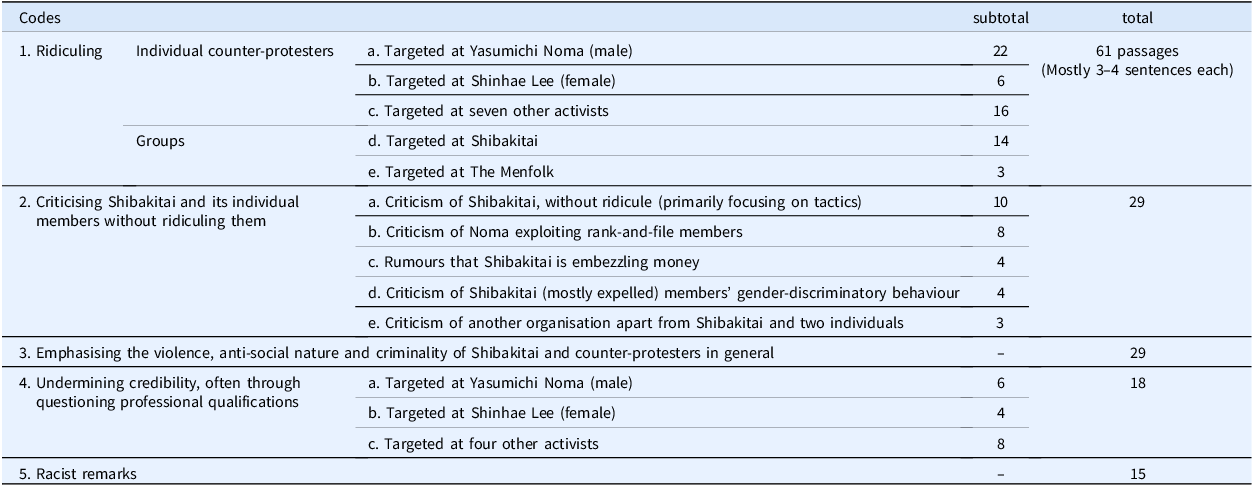
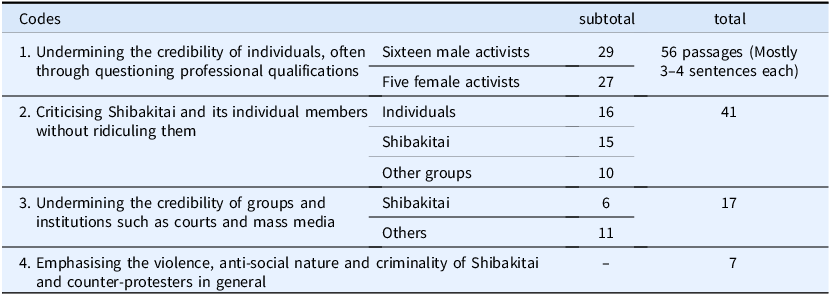
Qualitative coding of passages related to counter-protesters reveals that Sakurai’s 2016 work primarily ridicules individual counter-protesters and key groups like Shibakitai and Menfolk. As Table 1 shows, sixty-one passages ridiculing individuals and groups (Code 1) were extracted. The unit of analysis is a passage consisting of three to four sentences. Since passages related to counter-protesters are found at a rate of roughly one per page, Code 1 passages make up about 30% of the 204-page book. Sakurai’s writing reflects Japan’s online hate culture rooted in 2channel, particularly the cynicism toward liberal leftists that has been emphasised in previous research (e.g., Kawamura and Iwabuchi Reference Kawamura and Iwabuchi2022; Kitada Reference Kitada2005).
Results of qualitative coding for Sakurai Reference Sakurai2016 (204 pp.)

Sakurai’s malicious expressions, categorised as “ridiculing” (Code 1-a.), mostly target Yasumichi Noma, Shibakitai’s fifty-seven-year-old leader. He mocks Noma’s short stature as a “monstrous combination of a small body of a thirteen-year-old and a middle-aged face” (p. 37) and calls him a “little man” (ko-otoko) (p. 44). Sakurai speculates about Noma’s childhood, stating, “It is easy to imagine that Noma must have faced difficulties due to his physical characteristics” (p. 42), and ridicules his behaviour as “typical of a bullied child” (p. 42). In commenting on Noma’s Twitter activity, Sakurai suggests Noma might be addicted to social media and in need of psychiatric help (p. 24). In this way, Sakurai ridicules and slanders Noma to undermine his leadership and credibility, contributing to right-wing discourse delegitimising counter-protesters.
Sakurai’s fixation on Noma extends beyond mere ridicule to criticisms focused on alleged malpractice without using ridicule (Code 2-b.). He asserts Noma exploits rank-and-file members by “persuading them” (kuchiguruma ni noseru) to commit illegal activities, such as violating the Road Traffic Law and public security regulations (p. 29). Exploiting Noma’s lack of arrests, Sakurai argues that Noma “skilfully navigates without getting his hands dirty,” allowing others to be arrested (p. 199). Sakurai frequently references rumours of embezzlement by Shibakitai (Code 2-c.) and claims Noma and other members derive their livelihood from the counter movement, operating it like a “left-wing business” (pp. 76–78). These criticisms cite hard policing (Layer 1), media coverage (Layer 2), and activist-internal rumours that counter-protesters allegedly profited from the movement and deceived the public.
Approximately 14% of the book’s content, or twenty-nine passages, is classified as criticism targeting groups like Shibakitai and individual counter-protesters (Code 2). These passages focus on their tactics and allegedly offensive gestures, such as raising middle fingers at hate demonstration participants (Code 2-a.; Sakurai Reference Sakurai2016, p. 29). Sakurai frames counter-protests as infringing on “freedom of speech” (p. 34) and criticises shop owners near hate demonstration sites (p. 126), while ignoring disruptions caused by the demonstrations themselves.
Sakurai also criticises gender-discriminatory behaviours among Shibakitai members (Code 2-d.), with some criticism grounded in fact (pp. 97–120), but many remarks consist of unfounded insults targeting Shibakitai members, especially Noma. For example, Sakurai alleges Noma created a “harem” and sexually exploits female members, comparing him to North Korean dictator Kim Jong-il (pp. 68–70). These criticisms, especially of Noma, show that activist discourse escalated to spreading rumours that were clearly insulting and obviously exaggerated.
Passages classified as Code 3, about 14% of the book’s content, emphasise Shibakitai’s alleged violence and criminality and reveal links between hard policing against counter-protesters and right-wing delegitimisation. Sakurai details police measures, charges under which counter-protesters were arrested (e.g., Sakurai Reference Sakurai2016, pp. 56–59, 89–92). Since 2015, serious injuries in clashes following hate demonstrations have been very rare. Nevertheless, Sakurai claims Shibakitai adopts a more “violent approach” (bōryoku rosen) (pp. 35, 51). He also misuses hard policing of certain violent incidents from 2013–2014 to highlight alleged counter-protester violence. He portrays Zaitokukai, the group he founded, as “simply a peaceful civilian organisation” (p. 61), ignoring the harm caused by Zaitokukai’s own hate demonstrations. He then labels Shibakitai an “anti-social violent group” (p. 131). This labelling could not have occurred without hard policing (Layer 1) and related media coverage (Layer 2).
Sakurai also invokes the “Shibakitai Lynching Incident” to emphasise the alleged violence, anti-social nature, and criminality of Shibakitai (Code 3). He equates the incident with terrorist acts by Japan’s United Red Army, likening it to the Mountain Base Incident and dubbing it the “Jūsō Base Incident” (pp. 139–140). After detailing the 1972 Asama-Sansō Incident caused by the United Red Army, Sakurai vaguely suggests a similarity between Hiroko Nagata, a female United Red Army terrorist, and Shinhae Lee. He claims that traits ascribed to Hiroko Nagata, including persistence specific to women, malice, and sadism, also appear in Lee’s role in the “Shibakitai Lynching Incident” (p. 165), without providing clear evidence. He even questions Lee’s humanity, cynically calling her the “queen of the anti-discrimination movement” (p. 165). Sakurai exploits misogynistic media coverage from the 1970s.
In discussing the incident, he also criticises the Zainichi male activist (the perpetrator) for describing it as a “quarrel” (kenka) rather than a collective lynching. He argues that this justification resembles “Yakuza tactics” or “Yakuza techniques to avoid being reported to the police” (Sakurai Reference Sakurai2016, p. 158). As mentioned, the perpetrator of the incident was a Zainichi Korean. Building on this point, Sakurai compares Shibakitai to the Nazi Schutzstaffel (SS). He claims that just as the SS treated non-German members as inferior, Shibakitai supposedly favours Zainichi members while treating Japanese members as inferior (p. 143). Furthermore, Sakurai claims that people like Shibakitai members have, in the past, “oppressed and slaughtered Jewish people” (p. 198). This comparison also exaggerates Shibakitai’s alleged anti-social behaviour by invoking such an extreme historical example.
Sakurai’s book also contains elements that make it appropriate to classify it as a “hate book.” There are fifteen racist remarks that convey prejudices against Korean culture and ethnic attributes and imply their inferiority (Code 5), such as “crying woman” (women for professional mourning), “hwabyeong” (a mental illness traditionally attributed to anger suppression in the Korean Peninsula), other derogatory terms like “typical Korean face” and expressions linking crimes like welfare fraud and rape to Korean ethnicity (Sakurai Reference Sakurai2016, 17, 86–93, 160).
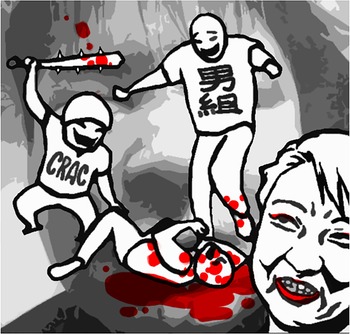
Descriptions of Shibakitai, derived from Sakurai’s book, particularly those of the “Shibakitai Lynching Incident,” have proliferated online through user-generated content and curation sites such as Togetter (2018), Pixiv Encyclopaedia (2020), and Weblio (2022). While these textual contents cite Sakurai almost verbatim, the accompanying illustrations often contain exaggerated elements and factual distortions that are not found in Sakurai’s own work. For instance, as shown in Picture 2, the illustration does not depict the Zainichi male activist who assaulted the graduate student. Instead, it portrays Yasumichi Noma (left), who was not present at the scene, and Shinhae Lee (right), who was inside the building and not involved in the assault. Although no one used weapons, Noma is depicted holding one, and a member of The Menfolk (男組, Otoko-gumi), absent from the scene, is added. The portrayal of Lee watching Noma and another individual carry out the assault, as if secretly pulling the strings from behind, closely corresponds to Sakurai’s depiction.
“Shibakitai Lynching Incident” (Pixiv Encyclopaedia 2020).
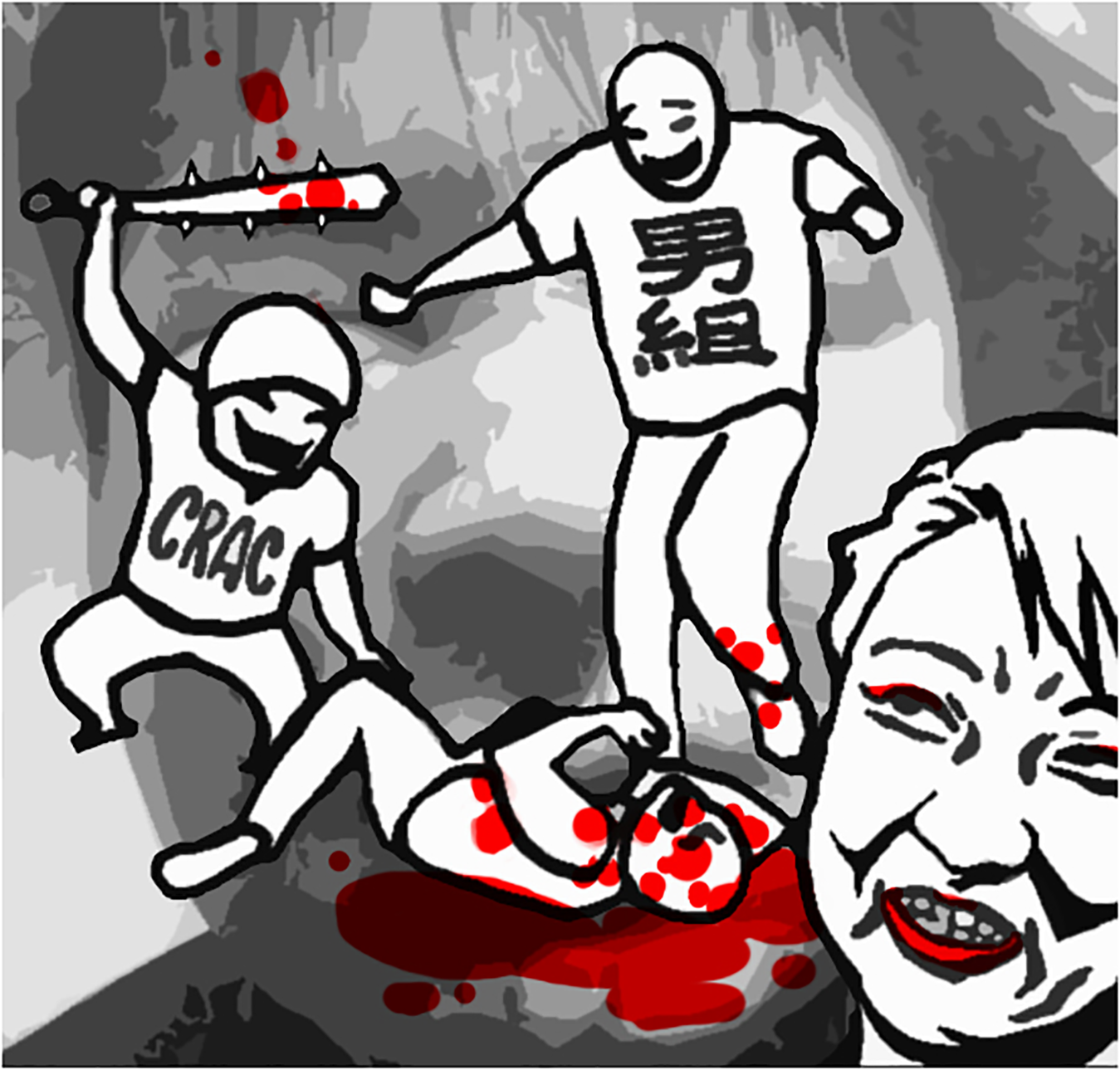
Picture 2. Long description
Panel A: A character named CRAC, wearing a helmet, is holding a spiked weapon above his head. He appears to be in the midst of an attack. Panel B: A larger character with visible ribs and some text on his torso is standing and smiling. He is holding another character by the hair. Panel C: The character being held by the hair is on the ground, appearing injured with blood around him. Another character with a visible mouth and teeth is present in the background.
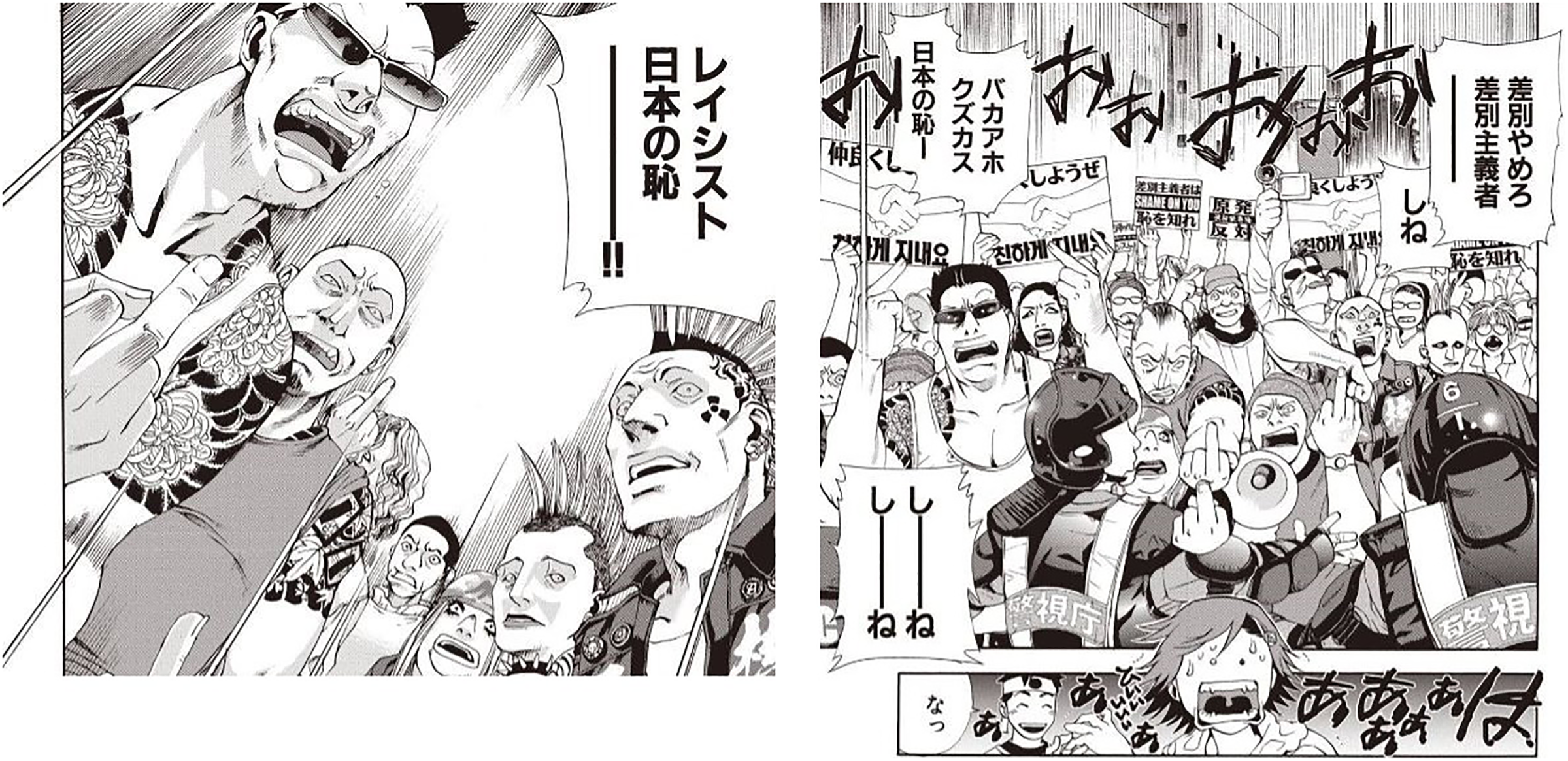
Another example also demonstrates that illustrations containing exaggerations and factual distortions reinforced the negative framing of Shibakitai. Picture 3 shows manga-style depictions of Shibakitai members, also seen in best-selling hate books targeting Zainichi Koreans and counter-protesters, e.g., “Hinomaru Gaisen Joshi” (Tomita and Okada Reference Tomita and Okada2015).Footnote 12 These illustrations present Shibakitai members as outlaw figures, including Yakuza and punk rockers. None of my informants resemble this image. Thus, Shibakitai and counter-protesters have been negatively framed by right-wing activists through various media, including “hate books,” in text and illustrations.
A depiction of Shibakitai members in a manga-style (Tomita and Okada Reference Tomita and Okada2015, pp. 10, 13).Footnote 11
This framing is not solely from right-wing discourse. Left-wing opponents of Shibakitai, who sought to delegitimise and stigmatise counter-activists, also reinforced delegitimising discourse. The final section examines this left-wing discourse.
Left-wing discourse via book publishing
Negative framing of Shibakitai and other counter-protesters came from both right- and left-wing actors. Rokusaisha, a small publishing house in the Kansai region consisting of the owner and seven employees (Rokusaisha 2017, p. 107), has also attempted to delegitimise counter-protesters, especially former Shibakitai members and their supporters. Following the approach of Uwasa no Shinsō, Rokusaisha launched the monthly magazine Kami no Bakudan (Paper Bomb) in 2005 to carry on its legacy. The magazine is widely read among older left-wingers, partly because Rokusaisha’s owner was active in the left-wing student movement of the 1970s (Interview No. 34, 10.08.2021; No. 36, 13.08.2021; Rokusaisha 2017, p. 114).
The left-wing delegitimising discourse emerged after younger counter-protesters severed ties with the then sixty-four-year-old owner of Rokusaisha, an experienced activist. After the 2011 Fukushima disaster, the owner had a good relationship with the members of the anti-nuclear group “Hangenren” (Metropolitan Coalition Against Nukes), who later joined Shibakitai. Rokusaisha donated three million yen to Hangenren (Rokusaisha 2017, p. 136). However, in December 2015, the counter-protesters disassociated themselves from the owner because of his “excessive self-praise” and commanding tone, as if saying, “Listen, everyone, to my valuable words,” as four counter-protesters stated in interviews. The left-wing discourse is not solely caused by the actions of the Rokusaisha owner. Rokusaisha’s special investigation team, made up of his employees, enabled the rapid release of six books. Several left-wing intellectuals and counter-protesters, mostly over sixty, also supported Rokusaisha’s negative stance on Shibakitai and participated in its interviews (Rokusaisha 2017, pp. 32, 61–98, 100–104).
This last section analyses left-wing delegitimising discourse using qualitative interviews with counter-protesters and a content analysis of Rokusaisha’s fourth book (December 2017). Among six books Rokusaisha released between 2016 and 2021, the 2017 book was selected for its detailed account of the owner’s ties to Shibakitai and the “Shibakitai Lynching Incident,” including CVs of those involved. All 195 pages were analysed using qualitative inductive open coding, employing the same procedure as was used for Sakurai’s 2016 work.
A notable feature revealed by the coding results is that Rokusaisha’s 2017 work, unlike Sakurai’s 2016 book, rarely employs cynical ridicule. Instead, it frequently uses adjectives that strongly denounce the personality of those involved, such as “despicable” (daki subeki), “hypocrite” (gizen-sha), “disgraceful behaviour” (shūtai), and “inhuman” (ningen de wa nai). In fact, the book contains only one passage that ridicules counter-protesters. One reason for this may be that the owner, who oversaw editing, was sixty years old and likely unaffected by cynicism-driven internet culture that emerged in the 2000s.
Despite these stylistic differences, Rokusaisha 2017 shares many features with Sakurai Reference Sakurai2016, which was published 1.5 years earlier. Both books focus on misconduct by Shibakitai members and the “Shibakitai Lynching Incident,” using similar logical structures to explain them (e.g., Rokusaisha 2017, p. 31). These expressions, which account for slightly less than 30% of the book’s content (fifty-six passages out of 199 pages; see Table 2), primarily target individuals affiliated with or supportive of Shibakitai. The targets are mainly university professors, whose professional qualifications are often questioned for reasons unrelated to their involvement with Shibakitai.
Results of qualitative coding for Rokusaisha 2017 (195 pp.)
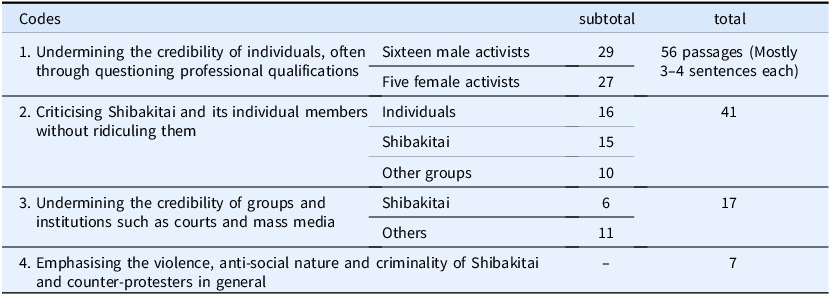
Although Sakurai (Reference Sakurai2016) and Rokusaisha (2017) share similarities in undermining the credibility of Shibakitai members and their supporters, Rokusaisha exhibits more frequent attacks on women, revealing distinct misogynistic tendencies (Table 2, Code 1). Specifically, twenty-nine passages targeted sixteen male activists and supporters (averaging 1.8 passages per person), while twenty-seven passages targeted five female activists (averaging 5.4 passages per person). This gendered framing aligns with a broader tendency in Japanese media since the 1970s (Layer 2), which has covered female activists misogynistically, often trivialising their political concerns. The misogynistic tone within Rokusaisha (2017) thus exemplifies how this historical media legacy is reflected even in left-wing discourse (Layer 3).
Rokusaisha’s attacks on women are particularly aggressive and persistent, targeting not only female counter-protesters but also female supporters. A section, for instance, cites a male psychiatrist’s opinions on Rika Kayama, who was a psychology professor at the time and who supported counter-activism, claiming she “does not display expertise” and that “I can hardly consider her to be a psychiatrist” (p. 69). The portrayal of Hiroko Kōtaki, a lawyer who defended Shinhae Lee, is similarly offensive. She is described as “collecting Shinhae Lee like a minority doll” (p. 25), implying admiration based solely on Lee’s ethnicity, and her qualifications are denied: “She is merely wearing the attire of a lawyer [but she is not a lawyer in substance]” (p. 131). Descriptions of Shinhae Lee herself are even more derogatory, calling her “jinkaku no daraku” (depraved personality) (p. 17) and “simply carried on the tide of popularity [which she doesn’t deserve]” (omikoshi no ue ni notte iru hito) (p. 62). Rokusaisha deliberately cites a male activist’s testimony labelling her an “alcoholic” to further discredit her (p. 102).
Although Rokusaisha’s attacks on male activists are fewer and less aggressive than those targeting female activists, the book nonetheless targets men, particularly Yasumichi Noma, using strategies similar to Sakurai (Reference Sakurai2016). It calls Noma “the guru of a cult” (sonshi) (p. 141), mirroring Sakurai’s claim that he exploits female members sexually in a “harem” (Sakurai Reference Sakurai2016, 68–70). While Sakurai ridicules Noma for lacking a stable income (Reference Sakurai2016, p. 25), Rokusaisha similarly questions whether he has a stable income (2017, p. 121).
Rokusaisha extensively criticises Shibakitai’s tactics and other behaviours without ridiculing individual members (Code 2). It denounces their frequent use of Internet jargon on social media as “indecent” (hinsei ga kakete iru) (p. 142) and labels them “attention-seekers” (medachitagari-ya) (p. 75). The book also cites a male psychiatrist’s critique that Shibakitai members excessively use English and employ distinctive flags and logos (p. 78). Additionally, Rokusaisha baselessly accuses Shibakitai of arrogance (p. 167). These examples demonstrate that the book broadly targets Shibakitai’s conduct, seeking to delegitimise nearly all aspects of their activism.
Rokusaisha further criticises Shibakitai’s interactions with the police, highlighting alleged collusion between law enforcement and group members (Code 3). The book presents claims such as:
-
• “There are Shibakitai members who are connected with the Public Security Intelligence Agency (公安調査庁, kōan chōsa-chō) and the Public Security Police (公安警察, kōan keisatsu)” (p. 57),
-
• “Shibakitai has covertly collaborated with the police and security authorities” (p. 177), and
-
• “Because of the economic and authorities-related advantages [Shibakitai members became active]” (p. 75).
These statements create the impression that Shibakitai deliberately collaborates with the police to exercise power and betray other left-wing activists. Since 2013, counter-protest organisers have often exchanged business cards and communicated with officers from general policing divisions (警備課, keibi-ka) to prevent conflict tactically (Interview No. 16, 18.03.2020; No. 29, 04.04.2020). Generally, older left-wing activists who participated in the anti-war (Ampo) movement in the 1960s and 1970s have long harboured strong hostility toward the police (Ando Reference Ando2014). Experienced older activists may have viewed such interactions unfavourably. The owner of Rokusaisha appears to belong to this group.
Rokusaisha occasionally invokes hard policing measures to further delegitimise both Shibakitai and counter-protesters in general (Code 4), although only a few such passages were identified. It describes arrests on minor charges as evidence of the group’s anti-social or violent tendencies. Rokusaisha (2017, p. 32) describes Shibakitai’s “anti-social nature” (han-shakaisei) as strikingly similar to that of Zaitokukai, equating them with participants in hate demonstrations. The book also claims that Shibakitai adopts a “pro-violence” (bōryoku kōtei) stance. It even asserts that “the essence of the counter-protest is nothing but deception and violence” (p. 57).
Rokusaisha also extends its delegitimising discourse beyond print media. Its blog, “Dejitaru Rokusaisha Tsūshin” (Digital Rokusaisha Newsletter), maintains a section titled “Shibakitai Lynching Incident,” tracking former Shibakitai members and their supporters. Updates were posted daily, including during the writing of this article (October 2025), and condensed versions were shared on X (@digital_rokusai). Between December 2024 and February 2025, new blog entries and X posts under the title “Shibakitai Lynching Incident 10th Anniversary” included photos of Shibakitai members and reached thousands of views. This highlights the wide dissemination power of left-wing delegitimising discourse.
Left-wing discourse against counter-protesters, spearheaded by Rokusaisha, also influenced right-wing discourse through the use of social media. This case demonstrates that social media serve as an important arena where delegitimising discourse (Layer 3) intersects and is amplified. Rokusaisha’s tweets, aimed at intensifying the stigmatisation of counter-protesters, were cited by key members of Zaitokukai (e.g., Seto Reference Seto2020). Seto, chief advisor of Zaitokukai and the Japan First Party, a successor organisation, also promoted Rokusaisha’s 2017 book on his own popular blog (Seto Reference Seto2017).
Conclusion
Growing international attention has focused on how policing, media coverage, and public discourse negatively frame left-wing counter-protesters by portraying their behaviour as deviant (Cunningham Reference Cunningham2024; Leopold and Bell Reference Leopold and Bell2017; McCurdy Reference McCurdy2012). This paper utilises a three-layered theoretical framework – policing (Layer 1), media coverage (Layer 2), and activist discourse (Layer 3) – to analyse the mechanisms that reinforced the negative framing and long-term stigmatisation of counter-protesters in Japan. This analysis demonstrates how these three layers mutually reinforced each other.
The study found that a dominant coalition between police and media, prioritising “law and order” over protesters’ rights, was established. Hard policing measures (Layer 1), such as arrests on minor charges and paternalistic detention intended to compel self-restraint, created significant psychological stress for activists. The impact of these policing actions was reinforced by media coverage (Layer 2), with elite media relying on police press releases and non-elite media sensationalising arrests. This dynamic provided further ammunition for activist discourse to delegitimise counter-protesters (Layer 3).
The analysis further reveals that delegitimising discourse peaked when both opponents falsely linked a single violent incident – the “Shibakitai Lynching Incident” – to the entire counter-protest group. By drawing damaging historical analogies that likened counter-protesters to the radicalised United Red Army Faction, opponents reinforced negative framing. Furthermore, the analysis highlighted a significant difference in attack style: right-wing discourse used cynical language, whereas left-wing discourse was strongly negative, demonstrating a more misogynistic tendency by disproportionately targeting female activists. The analysis also shows that right-wing and left-wing discourse against counter-protesters intersected and amplified each other through blogs and social media.
This three-layered analysis demonstrates how counter-protesters have been marginalized through hard policing measures and subjected to sustained attacks across conventional media (elite and non-elite) and social media over the past decade. However, the primary limitation of this study lies in its methodological reliance on the perspective of counter-protesters, primarily based on qualitative interviews. Consequently, it remains unclear what decision-making process led local police to adopt hard policing measures, or whether news media intentionally engaged in the negative framing of counter-protesters or merely followed established conventions by citing police press releases.
At the time of writing, the label “Shibakitai” continues to function as a powerful tool for stigmatisation. On 13 February 2026, the Osaka-based broadcaster Mainichi Broadcasting System (MBS) reported an incident that occurred in July 2025 in which two male counter-protesters allegedly assaulted a man whom they mistakenly identified as a supporter of the Sanseito (Mainichi Shimbun 2026). The MBS report, which claimed that the victim sustained two fractured ribs, was broadcast without any direct interviews with the accused (Ibid.). The report (Layer 2) did not rely on official police press releases (Layer 1) and instead appears to have drawn on unverified information from partisan activist discourse (Layer 3). MBS appears to have contacted the alleged victim regarding the incident based on information provided by an X-based influencer who presented himself as an “expert on Shibakitai” (Shibakitai kenkyūka) and was openly critical of counter-protesters.Footnote 13 In response, counter-protesters engaged in both street-level and online actions, staging protests in front of MBS offices in Tokyo and Osaka, reporting the disinformation to the platform, and launching hashtag campaigns against MBS. The humour-driven hashtag activism in this case drew on features of online activism identified by Löschke (Reference Löschke2022, Reference Löschke, Asahina and Higuchi2026). After March 26, the Osaka District Public Prosecutors’ Office decided not to prosecute the two individuals, MBS issued an apology for reporting the counter-protesters as the perpetrators of the assault and for falsely labelling them as “Shibakitai” (Mainichi Shimbun 2026).
The recent incident involving MBS illustrates the increasing permeability between Layer 2 and Layer 3. This case demonstrates a blurring of boundaries where contemporary media institutions absorb unverified discourse from social media and abandon journalistic verification in favour of internet-driven sensationalism. This development indicates that negative framing is no longer confined to separate layers but is instead amplified through the interactions of institutional and digital actors. Moreover, this incident suggests the possible emergence of a fourth layer of mediation involving Diet members (members of the Japanese parliament). The leader of the Sanseito, Sōhei Kamiya, referred to the assault during a live-streamed Diet session on 26 February 2026, apparently following the MBS report, thereby presenting the incident as if it were an established fact (Kyodo News 2026).Footnote 14 Taken together, these findings underscore the urgent need for further systematic examination of the interactions between police actors, counter-protesters, far-right actors, and politicians across Layers 1–3, including the possible emergence of a fourth layer.



 Open access

