


Introduction
Footbinding, a cultural practice deeply intertwined with the female body in traditional Chinese society, represents not only a history of bodily discipline but also a discursive system embedded with gendered power dynamics. Within the field of cross-cultural communication, Chinese–English dictionaries serve as pivotal media for semantic transformation and cultural translation. The translational choices made regarding “footbinding” are far from simple linguistic correspondences; rather, they involve complex cognitive constructions and power negotiations. Notably, in Robert Morrison’s A Dictionary of the Chinese Language – a seminal work among early Chinese – English dictionaries – the discourse surrounding footbinding is characterized by a collective absence. Neither the kinetic vocabulary describing the physical practice nor the expressions referring to the bodies of bound-foot women occupy a space within the dictionary’s semantic network. This “silence” should not be understood simply as a deliberate act of ideological erasure, nor can it be reduced to a purely accidental oversight. Morrison’s dictionary, like other early bilingual lexicographical projects, was not exhaustive, and its omissions may partly reflect the limits of scope, access, source materials, and compiler priorities. However, from the perspective of translation studies and critical lexicography, such absence remains analytically significant because a bilingual dictionary does not merely translate words; it also selects, orders, and legitimizes cultural knowledge through the authoritative form of the lexical entry. Morrison’s omission therefore marks a fracture of horizons in early cross-cultural encounters and reveals how female bodily experience could become marginal within the lexicographical reconstruction of Chinese society.
“Footbinding” has long been a central topic in Chinese gender studies and body politics, with its academic trajectory shifting significantly from enlightenment critique to subjectivity reconstruction. In the early twentieth century, studies placed footbinding within the grand narrative of national rise and decline, viewing it as the mutilation of women’s bodies by feudal rituals, a pathological representation contributing to the weak China. The core concern was the class oppression and reformist logic behind it (Fan Reference Fan1997; Levy Reference Levy1966; Lin Reference Lin1935). However, from the late twentieth century to the early twenty-first century, feminist history began challenging this singular “victim narrative.” Scholars turned to exploring footbinding as a complex expression of female cultural capital, class identity, and agency in the Ming and Qing contexts, seeking to restore women’s subjectivity within specific social structures (Ko Reference Ko1995, Reference Ko2001; Shepherd Reference Shepherd2018; Wang Reference Wang1998). In the past two decades, driven by global history and cross-cultural communication perspectives, academia has increasingly focused on footbinding as an “exotic symbol” in Western discourse, analyzing how it was exoticized through literary depictions, photography, and early sinology, thus contributing to the deep construction of Western Orientalist imaginations (Chi Reference Chi2024; He Reference He2024; Huang Reference Huang2020). Although these diverse perspectives have enriched the historical understanding of footbinding, few studies have examined the language politics of bilingual dictionary compilation, investigating how translation strategies subtly manipulate the meaning of the female body in cross-cultural contexts.
The study investigates the discursive evolution of terminology related to “缠足(foot binding)” through the analytical framework of feminist translation ethics and critical lexicography. This investigation focuses on the reconstruction of Chinese women’s bodies through three specific discursive mechanisms: the structural erasure of naming, aestheticized objectification, and static reconfiguration. Rather than approaching bilingual dictionaries as neutral reference tools, the research conceptualizes them as culturally constitutive discourses and, in doing so, exposes the gendered power structures embedded in these translational practices. The ultimate goal is to reveal the systematic effacement of corporeal pain through the authoritative genre of the dictionary, which transforms lived trauma into dehumanized cultural signifiers.
Theoretical foundations: translation, gender politics, and lexicographical discourse
Gendered metaphors and power in translation
Lori Chamberlain’s (Reference Chamberlain1988) seminal essay, Gender and the Metaphorics of Translation, serves as the foundational theoretical cornerstone for this research. Her work elucidates the intrinsic nexus between translation practices and the reproduction of patriarchal power structures. Chamberlain’s core thesis deconstructs the historically gendered metaphor system wherein the relationship between the source and target texts mirrors traditional domestic hierarchies. In this paradigm, the source text is coded as “masculine” (the original, the progenitor, and the authority), while the target text is metaphorically “feminized” – relegated to a derivative, submissive role, aligned with the cultural perception that “in the original abides what is natural, truthful, and lawful, in the copy, what is artificial, false, and treasonous” (Chamberlain Reference Chamberlain1988: 455).
This hierarchy is most vividly captured in the trope of les belles infidèles (unfaithful beauties), which suggests that a translation, like a woman, can be either beautiful or faithful, but never both. Consequently, the target text is subjected to the disciplinary authority of patriarchal esthetics. “Translation transforms the original text and adapts it not only to the linguistic but also to the cultural, ideological and political constraints of the arrival language and culture” (Aboluwarin Reference Aboluwarin, Sotunsa and Yakubu2023: 244). In the cross-cultural translation of gender-related concepts, this power dynamic manifests as a form of “patriarchal fetishism.” Translators, often unconsciously, employ esthetic vocabulary and stylistic choices that reinforce the gender biases of the source culture, effectively erasing subversive or feminine nuances to satisfy the “male gaze” of the receiving literary canon.
Naming and voice as translational intervention
Sherry Simon’s (Reference Simon1996) translation intervention theory further develops and deepens the gender politics of translation by shifting the research focus from the deconstruction of overarching macro power structures to the micro‑level analysis of translators’ active linguistic strategies and interventions. Simon argues that translation is never a neutral linguistic transfer but a cultural and political practice in which translators actively intervene in the production of meaning through specific linguistic choices, thereby shaping how gendered experiences are mediated and perceived in the target culture. In her influential work Gender in Translation: Cultural Identity and the Politics of Transmission, she positions translation as a form of cultural intervention that reframes not only textual authority but also the social and ideological hierarchies embedded within language itself. Simon (Reference Simon1996: 9) emphasizes that “they (translators) can use language as cultural intervention, as part of an effort to alter expressions of domination, whether at the level of concepts, of syntax, or of terminology.”
In this framework, naming and voice selection emerge as two core strategies with significant implications for how women’s experiences are coded and received. “Translators can intervene in gender representation by omitting, rewriting, or adjusting linguistic elements that either reinforce or challenge patriarchal stereotypes embedded in the source text” (Chen and Song Reference Chen and Song2025: 53). The choice of aestheticized versus de‑aestheticized naming directs whether the oppressive nature of women’s physical pain is rendered visible or obscured in the translated discourse. Moreover, decisions around passive versus active voice directly affect the attribution of agency and responsibility – passive constructions can obscure agents of oppression, whereas active constructions foreground them, thereby shaping readers’ critical awareness of systemic gendered violence. These linguistic decisions, far from being neutral stylistic choices, constitute acts of intervention that either perpetuate or challenge patriarchal representation in translated texts.
Bilingual lexicography as recontextualization and ideological discourse
To fully capture the complexity of translating footbinding terminology, this study integrates perspectives from critical lexicography. Critical lexicography examines dictionaries not simply as technical reference tools but as discursive sites where meanings, social values, and power relations are selected, organized, and authorized. Its broader field includes investigations of racism, colonialism, ethnocentrism, gender bias, sexuality, ageism, and other forms of ideological representation (Chen Reference Chen2019; Hornscheidt Reference Hornscheidt2008). A bilingual dictionary is not a neutral bridge but a site of recontextualization (Chen Reference Chen2015). This transformative practice exemplifies how “recontextualization selectively appropriates, relocates, refocuses, and relates other discourses to constitute its own order and orderings” (Bernstein Reference Bernstein1990: 184). While conventional lexicography operates under an epistemic contract of descriptive neutrality, critical perspectives suggest that the act of “recording” a language is never free from ideological positioning.
Within this framework, the transition of terminology is governed by the lexicographical genre, where the framing of definitions is influenced by prevailing gender ideologies (Bertulessi Reference Bertulessi2023; Hu et al. Reference Hu, Xu and Hao2019). Recent scholarship clarifies this point from different angles. Hornscheidt (Reference Hornscheidt2008) formulates a research agenda for examining racism and colonial knowledge in dictionary discourse; Müller-Spitzer (Reference Müller-Spitzer2023) discusses how gender stereotypes may be reproduced in dictionaries and highlights the tension between usage-based lexicography and the social responsibility of dictionaries; Chen (Reference Chen2019) proposes critical lexicographical discourse studies to connect lexicography with critical discourse studies and social accountability; and Fuertes-Olivera and Tarp (Reference Fuertes-Olivera and Tarp2022) show how general dictionaries may reproduce gender bias by making women lexicographically invisible or subordinate to male-centered norms. Although these studies do not all address bilingual translation directly, they establish the broader premise that dictionaries are culturally consequential texts. In bilingual lexicography, this premise requires attention to translation. A translation equivalent is not merely a lexical substitute; once placed inside a dictionary entry, it becomes part of a condensed and authoritative genre that selects, abbreviates, labels, and stabilizes cultural meaning. Thus, translation and lexicography overlap in producing cross-cultural equivalence, but lexicography differs from ordinary translation because it presents such equivalence as institutionalized knowledge.
The perceived objectivity of a dictionary often masks its function as a political and cultural construct. As Chen (Reference Chen2015: 329) asserts, “(Bilingual) dictionaries are not primarily reference tools. They are discourses in their own right, which, like other kinds of discourse, are culturally determined and culturally determining.” Consequently, the dictionary does not merely reflect an external reality; it actively participates in the production and stabilization of that reality through its specific discursive order. This dynamic interaction underscores the necessity that “we must interpret dictionaries in context and see them as both resultant of and constructive of their contexts” (Fishman Reference Fishman1995: 34). This does not mean that every omission is necessarily intentional; rather, dictionary conventions, source materials, institutional authority, and cultural assumptions can together produce ideological effects. An analysis of dictionaries as active cultural interventions reveals that the genre’s scientific authority may legitimize the erasure or aestheticization of women’s embodied suffering. Therefore, Chamberlain’s theory exposes the patriarchal metaphorics behind such aestheticization, Simon’s framework explains how naming and voice function as translational interventions, and critical lexicography situates these choices within the dictionary’s knowledge-power structure. Together, these perspectives allow this study to examine footbinding terminology not as isolated translation errors, but as culturally determining lexical choices within bilingual dictionary discourse.
The politics of absence: “Silence” and “Blind spots” in early Chinese–English dictionaries
Spatial and visual separation
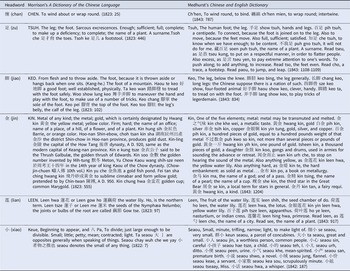
Early Chinese–English dictionaries were largely modeled after the Kangxi Dictionary, adopting a lexicographical structure where individual characters served as primary headwords, followed by associated compounds and concepts. Consequently, Chinese terminology related to “foot-binding” – specifically the four core terms 缠足 (chan zu), 缠脚 (chan jiao), 金莲 (jin lian), and 小脚 (xiao jiao) – must be sought by cross-referencing the characters 缠 (chan), 足 (zu), 脚 (jiao), 金 (jin, 莲 (lian), and 小 (xiao). The consultation of these sources involved a dual-media approach: for dictionaries published before 1900, digital editions were accessed through academic repositories such as Google Books, while for those published after 1900, physical copies or high-resolution facsimile reprints from specialized library collections were examined. The search process for these early works necessitated a rigorous manual inspection of both the radical-based headwords and the sub-entries of associated compounds to ensure exhaustive coverage. However, as illustrated in Appendix A, the two earliest Chinese–English dictionaries – Morrison’s A Dictionary of the Chinese Language and Walter Henry Medhurst’s Chinese and English Dictionary: Containing All the Words in the Chinese Imperial Dictionary, Arranged According to the Radicals – contain no entries or conceptual references related to the practice of foot-binding.
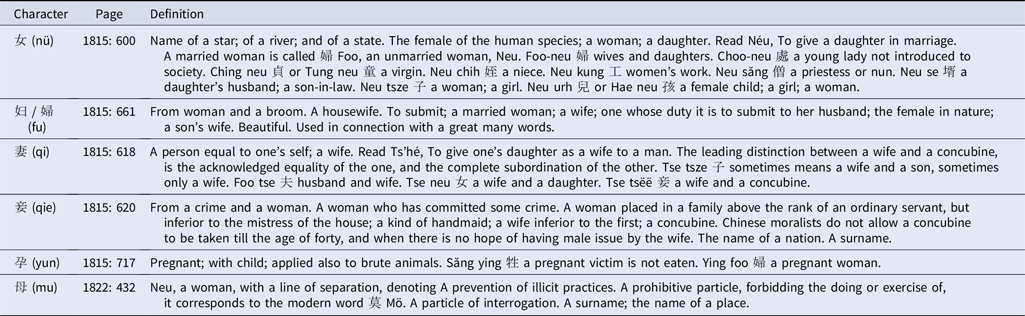
From the perspective of critical lexicography, this initial terminological void should be approached not as direct evidence of individual intentionality but as a lexicographical effect produced by the interaction between dictionary scope, available sources, compiler access, and broader gendered structures of knowledge. Since Morrison’s dictionary was not designed as an exhaustive ethnographic record of Chinese social life, the absence of footbinding terminology may partly reflect the limits of early missionary lexicography rather than a conscious attempt to suppress this practice. Nevertheless, this alternative explanation does not make the omission theoretically insignificant. When Appendix A is read together with Appendix B, a more precise pattern emerges: Morrison’s dictionary does not exclude women as lexical subjects. On the contrary, women appear through entries concerning gender identity, wifehood, concubinage, pregnancy, motherhood, domestic duty, and moral regulation. However, these women-related entries also show that female experience is mainly made visible when it can be incorporated into familial, marital, hierarchical, moral, or reproductive categories. The absence of footbinding-related terminology therefore cannot be reduced to a simple lack of interest in women. Rather, it points to a selective lexicographical silence around women’s embodied suffering, especially forms of pain, deformation, and coercive bodily discipline that did not fit easily into Morrison’s authorized categories of lexical knowledge. Precisely because dictionaries are culturally determined and culturally determining discourses, this contrast between the presence of women-related entries and the absence of footbinding terminology reveals how the female body could fall outside the authorized domain of bilingual lexical knowledge.
As pointed out by Lee (Reference Lee2019: 9), “Footbinding 缠足 was an ethnically Chinese cultural practice which lasted for almost a thousand years from the Song Dynasty 宋 (960–1270) to the Communist Revolution 共产主义革命 (1945–1949).” Whether originating from the legendary performance of Princess Yao Niang 窅娘 on the Golden Lotus Platform or its subsequent diffusion from the elite to the masses, this practice has long been deeply embedded in Chinese historical discourse. However, despite this visual and cultural prominence, a significant terminological void exists in early Chinese–English dictionaries published between 1820 and 1870. While this exclusion may not stem from a deliberate ideological conspiracy by individual lexicographers, it reflects a structural “blind spot” produced by the socio-spatial constraints of the era. This collective silence can primarily be attributed to the strict gendered spatial segregation faced by early male missionaries during their activities in China.
Under Qing restrictions on foreign residence, Morrison’s physical presence was largely confined to the foreign factory quarter in Guangzhou, an overwhelmingly male commercial enclave; this spatial segregation also resonated with the broader gendered order of nei/wai (“men outside, women inside”) in late imperial China (Bayer Reference Bayer2021; Lin and Su Reference Lin and Su2024). Even considering Morrison’s movements between Canton and Macao, his primary social sphere remained fundamentally gender-segregated. Due to the absolute closure of the inner chambers to Western men, footbinding, as an intimate practice belonging to the inner discourse of women, was physically beyond the missionaries’ sight. This natural spatial barrier led early dictionary compilers, in their attempts to name and capture the entirety of Chinese society, to inadvertently fall into an epistemological blindness from the male perspective.
Moreover, this blind spot in perception was further distorted by the regional characteristics of missionary activities. Early Chinese–English dictionaries were primarily compiled along the Guangdong coastal region, where the female demographic structure was highly specific. The missionaries, confined to limited public spaces, were mostly able to observe Hakka and Tanka women, who engaged in heavy physical labor or aquatic work. These two groups, due to their unique survival needs, preserved the “natural foot (天足, tian zu)” tradition and did not follow the footbinding customs of the elite society in the Central Plains or the gentry of Guangzhou. As a result, footbinding, which was prevalent among the upper classes, was largely invisible to the missionaries in their observations. “Footbinding was at once an artistic expression, a nationalist signifier, and a class identifier” (DeCoste Reference DeCoste2020: 2), a practice that was distinctly tied to the cultural and social norms of the elite. In this context, the lexicographical omission of footbinding was less a result of conscious erasure than a manifestation of a knowledge blind spot caused by localized observation.
This geographical bias demonstrates the selective refocusing inherent in the dictionary as a site of recontextualization. Early compilers, in their failure to record the practice, unintentionally used the scientific authority of the lexicographical format to present footbinding as an atypical or non-existent phenomenon in their linguistic reconstruction of Chinese society. Within this power dynamic, the female body was doubly segregated: first by the physical barriers of the inner chambers, and second, by the blind spot in translation discourse caused by the missionaries’ inability to access the spaces where footbinding was practiced.
The elite–popular divide and patriarchal discourse
The collective silence surrounding the terminology of footbinding in early Chinese–English dictionaries cannot be explained solely by the physical segregation of gendered spaces. At a deeper level, it stems from the lexicographical process itself, which relied heavily on official Confucian texts, most notably the Kangxi Dictionary. This reliance on elite textual traditions created an inherent discursive filter. The Kangxi Dictionary was compiled according to stringent principles of linguistic propriety. This archaizing mandate ensured that it deliberately “ignores vulgar forms and expressions” (Yang Reference Yang2014: 315), thereby silencing the lived experiences of the contemporary era. Within this patriarchal linguistic order, women’s bodily practices were classified as belonging to the realms of the vulgar. When Morrison (Reference Morrison1815: ix) emulated the Kangxi Dictionary, he uncritically transferred this traditional exclusion of female experience into a cross-linguistic context.
As a result, the absence of footbinding reflected a structural collusion between Chinese and Western patriarchal linguistic standards, rather than a specific “malice” on the part of the lexicographers. Under this shared standard, women’s suffering and embodied experience were classified at the very origin of textual production as informal knowledge unfit for lexicographical record. This produced a significant rupture: on one side stood the lived reality of bodily suffering; on the other stood the highly abstract normative vocabulary defined by male scholar-officials. Because early translators equated legitimate written authority with the elite “character (字, zi),” the action verbs and material terms associated with footbinding circulating in vernacular speech were excluded from the translational field. As Ko (Reference Ko2009: 84) suggests, “demystification begins with a recognition of the power of language to make and re-order worlds.” By restrictedly adhering to these elite characters, translators utilized this world-ordering power to effectively strip the practice of its somatic reality, ensuring that the history of footbinding was reframed through a sterilized, patriarchal lens.
In this light, the dictionary functioned as a filter of power that stabilized a patriarchal worldview, not necessarily through deliberate censorship, but through the inertia of the lexicographical genre itself. This objective outcome ensured that female pain could not penetrate the authoritative boundaries of the text. This early lexicographical silence foreshadowed a persistent tendency in translation practice to privilege the legitimacy of dominant authority over the authenticity of embodied experience. The ideological positioning of the dictionary was thus established through the cumulative effect of these editorial choices and traditions, effectively constructing a historical narrative that marginalized women’s suffering through the very claim of linguistic propriety.
Incomplete normalization and othering
Before the mid-nineteenth century, Western perceptions of China had not yet been fully structured by a rigid civilizational hierarchy that opposed the “civilized” to the “uncivilized.” As a result, the treatment of footbinding in Chinese–English dictionaries exhibited a peculiar form of semantic absence that may be described as a state of pre-othering. Within the lens of lexicographical discourse, this period represents a stage where footbinding had not yet been refocused by the ideological imperatives of colonial expansion. As the dictionary had not yet been mobilized as a tool for moral intervention, the lexicographical genre maintained a state of semantic vacuum regarding this practice. In the conceptual framework of early lexicographers such as Morrison, China was more often regarded as an ancient civilization with distinctive ritual practices than as a semi-civilized object awaiting rescue or condemnation. Within this context, even when footbinding was occasionally mentioned in travel writings, it was usually treated as an exotic but unremarkable custom that required no specialized definition and was sometimes tacitly perceived as bearing a synchronic resemblance to contemporary European practices such as corsetry.
Because translation activities at this stage had not yet been fully mobilized by the ideological imperatives of later colonial expansion, translators lacked a strong incentive to establish a distinct lexical item in the dictionary that would signify backwardness or cruelty. Consequently, footbinding remained linguistically naturalized, existing as an unexamined practice rather than a marked object of moral or political judgment. This linguistic neutrality can be understood through the lens of translation theory, which posits that “culture‑specific expressions refer to the concepts of a specific source culture which do not have exact equivalent expressions in a specific target culture” (Leppihalme Reference Leppihalme2001: 126). In this context, rather than inventing a derogatory equivalent to bridge this cultural gap, translators allowed the term to remain untranslated or under-defined. The absence of a dedicated term thus reflected not ignorance but a lack of ideological urgency, allowing footbinding to persist in a semantic vacuum.
The notion that “translation operates as a form of intercultural transfer” (Munday Reference Munday2007: 196) suggests that such a semantic void reveals the activation mechanism of translation as an ideological instrument. Bodily practices from a heterogeneous culture acquire a specific political position in translation discourse only after passing through the filter of othering. In early Chinese–English dictionaries, footbinding occupied a state of unnamed everydayness precisely because it was not yet subject to ideological projection. At this stage, Western sinology had not constructed footbinding as a target for critiquing Oriental despotism or the moral excesses of ritual tradition, and translation therefore lacked the impetus for moral intervention.
The resulting discursive lag demonstrates that translation’s attention to the female body is never driven by spontaneous physiological empathy. Rather, it depends on the historical moment at which that body can be incorporated into a global power narrative structured by binary oppositions. Before footbinding was formally transformed into a signifier of barbarity, it could exist in the history of translation only as a neglected and silent norm.
The seduction of metaphor: aestheticized translation and the objectification of bodily pain
Semantic parasitism and the erasure of botanical meaning
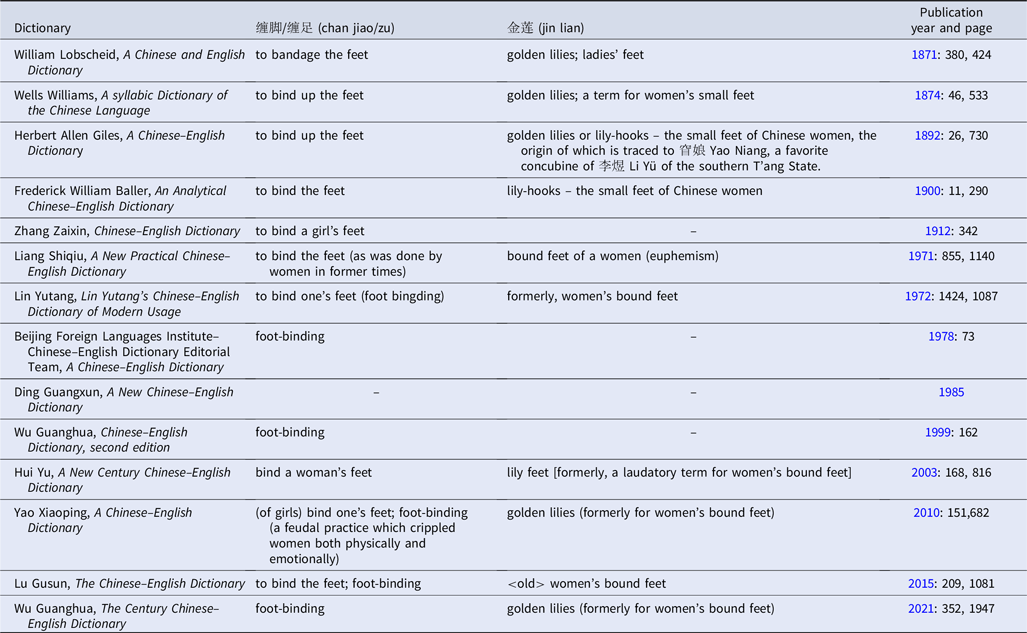
In the history of Chinese–English lexicography, the treatment of terminology related to footbinding underwent a shift from a state of visual blind spot to one of explicit construction as Table 1 shows. A longitudinal survey of successive dictionaries shows that William Lobscheid’s A Chinese–English Dictionary published in 1871 marked a critical turning point. Lobscheid was the first lexicographer to include both “缠脚/足(chan jiao / zu)” and “金莲(jin lian)” as dictionary entries.
Comparative glossary of “缠脚/足 (chan jiao/zu)” and “金莲 (jin lian)” in historical Chinese–English dictionaries

Table 1. Long description
The table presents a longitudinal survey of the treatment of footbinding terminology in historical Chinese-English dictionaries. It includes columns for dictionary names, translations of chan jiao/zu, translations of jin lian, and publication year and page. The table has 13 rows and 4 columns. Row 1: William Lobscheid, A Chinese and English Dictionary, to bandage the feet, golden lilies; ladiesʼ feet, 1871: 380, 424. Row 2: Wells Williams, A syllabic Dictionary of the Chinese Language, to bind up the feet, golden lilies; a term for womenʼs small feet, 1874: 46, 533. Row 3: Herbert Allen Giles, A Chinese-English Dictionary, to bind up the feet, golden lilies or lily-hooks - the small feet of Chinese women, the origin of which is traced to 佚姓 Yao Niang, a favorite concubine of 李恕 Li Yu of the southern Tang State., 1892: 26, 730. Row 4: Frederick William Baller, An Analytical Chinese-English Dictionary, to bind the feet, lily-hooks - the small feet of Chinese women, 1900: 11, 290. Row 5: Zhang Zaixin, Chinese-English Dictionary, to bind a girlʼs feet, -, 1912: 342. Row 6: Liang Shiqiu, A New Practical Chinese-English Dictionary, to bind the feet (as was done by women in former times), bound feet of a women (euphemism), 1971: 855, 1140. Row 7: Lin Yutang, Lin Yutangʼs Chinese-English Dictionary of Modern Usage, to bind oneʼs feet (foot binding), formerly, womenʼs bound feet, 1972: 1424, 1087. Row 8: Beijing Foreign Languages Institute-Chinese-English Dictionary Editorial Team, A Chinese-English Dictionary, foot-binding, -, 1978: 73. Row 9: Ding Guangxun, A New Chinese-English Dictionary, -, -, 1985. Row 10: Wu Guanghua, Chinese-English Dictionary, second edition, foot-binding, -, 1999: 162. Row 11: Hui Yu, A New Century Chinese-English Dictionary, bind a womanʼs feet, lily feet [formerly, a laudatory term for womenʼs bound feet], 2003: 168, 816. Row 12: Yao Xiaoping, A Chinese-English Dictionary, (of girls) bind oneʼs feet; foot-binding (a feudal practice which crippled women both physically and emotionally), golden lilies (formerly for womenʼs bound feet), 2010: 151,682. Row 13: Lu Gusun, The Chinese-English Dictionary, to bind the feet; foot-binding, <old> womenʼs bound feet, 2015: 209, 1081. Row 14: Wu Guanghua, The Century Chinese-English Dictionary, foot-binding, golden lilies (formerly for womenʼs bound feet), 2021: 352, 1947.
Unlike earlier missionaries such as Morrison and Williams, whose work was constrained by the spatial segregation of the Canton Factory System, Lobscheid operated within the more open colonial context of Hong Kong. His dictionary also appeared at a moment when Western perceptions of China were shifting from an emphasis on ritualized civilization toward a focus on exotic and allegedly backward customs. During this period, footbinding ceased to be an unspeakable inner-chamber practice and was instead placed under the analytical gaze of Western sinology. This analytical shift was driven by Lobscheid’s explicit ambition to create a “work having for its Object the diffusion of general knowledge, and the promotion of civilization” (Wong Reference Wong2017: 206). In this process of recontextualization, the lexicographical genre was utilized to transform a private domestic reality into a public object of general knowledge. The dictionary thus functioned as a discourse in its own right, where footbinding was rendered legible through a new, authoritative order of metaphorical objectification.
In her theory of the gender politics of translation, Chamberlain argues that semantic reconstruction in translation constitutes a cross-cultural projection of patriarchal power. She grounds this theory in the claim that “the metaphorics of translation is a symptom of larger issues of western culture” (Reference Chamberlain1988: 465), a dynamic most visible in the way translators categorize and frame the female body. From a conventional lexicographical perspective, the provision of a literal equivalent is often regarded as the primary mandate of the compiler, guided by principles of semantic fidelity and editorial economy. Under this professional code, translators split women’s bodily suffering into cognitively legible practices and visually consumable symbols. William Lobscheid established this binary in his 1871 dictionary. He rendered “缠脚 (chan jiao)” as the action-oriented “to bandage the feet,” while “金莲 (jin lian)” appeared as the botanical metaphor “golden lilies.” This dichotomy remained remarkably stable for over a century.
However, within the framework of feminist translation theory, this neutral fidelity is far from ideologically stagnant. In the absence of critical annotations or paratextual intervention, the lexicographical pursuit of literal equivalence unintentionally facilitates the secondary transmission of patriarchal esthetics. This semantic pattern exemplifies a form of “semantic parasitism,” a process in which the patriarchal discourse of the source language appropriates the benign imagery of the natural world to mask corporeal violence. Through this parasitic operation, the translator strips the plant – the “lily” – of its biological integrity and forcibly superimposes its esthetic qualities onto the deformed female foot. While the lexicographer may simply record an existing cultural ideology, the act of transplanting this metaphor into a bilingual dictionary – without historical contextualization – stabilizes the violent deformation of the body as a naturalized lexical fact.
This dynamic underscores the necessity of a feminist intervention in lexicography. The genre’s commitment to objective correspondence often masks the power dynamics embedded in the source language. When a term born from a patriarchal framework – such as “金莲 (jin lian)” – is faithfully transferred as “golden lilies,” the dictionary ceases to be a passive record. Instead, it becomes an active participant in the cross-cultural perpetuation of women’s objectification. Such metaphorical colonization detaches “golden lilies” from botanical logic and reassigns it to the alienation produced by bodily suffering. Consequently, the term functions as a rhetorical device that masks pain. Even in twenty-first-century dictionaries, such as A New Century Chinese–English Dictionary (2003), the translation “lily feet” is retained. This enduring presence demonstrates the inertia of semantic colonization, where patriarchal power, exercised through metaphor, has been internalized as a form of “lexical common sense.”
The translator’s esthetic complicity with patriarchal Romantic narratives
In 1892, Herbert Allen Giles’ treatment of “金莲 (jin lian)” in his Chinese–English Dictionary was not a mere terminological correspondence but a carefully constructed act of cross-cultural narrative replication. He continued the neutral translation “to bind up the feet“ to define the behavioral aspect of “缠脚 (chan jiao),” yet he invested additional literary elaboration in the rendering of “金莲 (jin lian).” From a traditional lexicographical standpoint, the inclusion of cultural background is often viewed as a pursuit of comprehensive lexical fidelity. Under this professional mandate, Giles’ departure from neutrality exemplifies how the framing of definitions remains inherently influenced by prevailing gender ideologies. This approach aligns with the premise that “translators communicate, re-write, manipulate a text in order to make it available to a second language public. Thus they can use language as cultural intervention, as part of an effort to alter expressions of domination, whether at the level of concepts, of syntax or of terminology” (Simon Reference Simon1996: 9).
Guided by this framework, Giles translated the term as “golden lilies or lily-hooks.” Through the combination of the botanical delicacy of “lily” and the shape-based connotation of “hook,” the lexicographer intensified the esthetic imagery of the entry. Furthermore, the dictionary’s notes traced the origin of the term to the Southern Tang emperor Li Yu’s favored concubine, Yao Niang. Through this anecdotal reference, the lexicographical genre effectively recontextualized a term denoting bodily deformation into a romantic narrative, leveraging its authoritative tone to validate a cultural spectacle. This transformation from bodily practice to cultural spectacle illustrates that the dictionary is both resultant of and constructive of its context: Giles both validated the Chinese patriarchal logic and provided the Western audience with an “Oriental spectacle” that justified an oppressive practice under the guise of a scientific cultural record.
The translation strategy reflects a covert alignment and deep complicity between Chinese and Western patriarchal logics. In the Chinese context, the anecdote “Yao Niang performing a dance in bound feet” was already a product of male literati instrumentalizing the female body, using courtly romance as a discursive screen to obscure the bodily constraints of footbinding. Giles’ choice to replicate this narrative in an English dictionary, coupled with the exoticized translation “golden lilies,” aligned precisely with Western Orientalist imaginaries of the “Eastern female” as an object of visual and tactile fascination. The result was a dual reinforcement, exemplifying the core insight of Chamberlain’s theory of the gender politics of translation: the translator’s unconscious complicity operates as a cross-cultural reinforcement of patriarchal esthetic order. The replication of this narrative provided the Western audience with an “Oriental spectacle,” which justified the dissemination of an oppressive practice under aestheticized terms. Through this process, the dictionary transitioned from a passive record of language to an active participant in the cross-cultural stabilization of gendered objectification.
In the mid- to late twentieth century, this romantic narrative experienced a brief rupture. Dictionaries such as the 1978 Chinese–English Dictionary by Beijing Foreign Studies University and the second edition of Wu Guanghua’s 1999 Chinese–English Dictionary recorded only “foot-binding,” omitting “金莲 (jin lian)” and its related translations. However, this process of de-aestheticization did not constitute an active critique of gendered power relations. Instead, it resembled a form of passive avoidance. The stripping away of the cultural context underlying the term left the core of “缠脚 (chan jiao)” as a practice of gendered oppression untouched, which resulted in “foot-binding” appearing as an abstract action devoid of agency or suffering.
In the twenty-first century, the romanticized narrative returned in a more complex form. In the 2010 Chinese–English Dictionary by Yao Xiaoping, the annotation for 缠脚 (chan jiao) explicitly identifies it as a “feudal practice which crippled women both physically and emotionally,” ostensibly introducing a critical perspective. Nevertheless, the core translation “golden lilies” and the romantic origin associated with Yao Niang were retained as part of the entry’s cultural heritage. This persistence confirms the resilience of patriarchal discourse emphasized by Chamberlain. Even with the introduction of critical commentary, the narrative framework constructed through esthetic complicity continues to operate in cross-cultural transmission. This enduring presence demonstrates that bilingual dictionaries are discourses in their own right, which are both culturally determined and culturally determining. The lexicographical discourse established by early works continues to act as a culturally determining force, repeatedly obscuring women’s bodily suffering within a romanticized cultural narrative.
The dilution of physiological pain through knowledge-archeological specimenization
In his dictionary compilation, Giles (Reference Giles1892) subjected “缠脚 (chan jiao)” and “金莲 (jin lian)” to a dual process of knowledge construction, effectively rendering the practice of footbinding into a form of specimenization. This process instantiates the argument that “translation is not a neutral act of linguistic transfer but a site of ideological construction” (Yang Reference Yang2025: 8). From a conventional lexicographical perspective, the transformation of a term into a historical specimen appears as a pursuit of scholarly depth and cultural fidelity. However, this operation precisely confirms the core insight of Chamberlain’s theory: translation, through the construction of knowledge, can dilute the oppressive essence of a practice. Behind the veneer of cultural erudition, the translator transforms women’s physiological suffering into an object of knowledge available for observation and study. Consequently, the visceral reality of bodily trauma is weakened as it transitions into the realm of abstract historical data.
Unlike Lobscheid (Reference Lobscheid1871), who provided only a basic translation, Giles maintained a neutral rendering of “缠脚 (chan jiao)” but linked it to annotations for “金莲 (jin lian),” situating a single act of bodily oppression within the broader framework of cultural practice. This approach of knowledge archeology represents a classic act of recontextualization. It relocates the pain of the individual woman into the “order and orderings” of a historical narrative, where the dictionary functions as an authoritative site of discourse. For “金莲 (jin lian),” he translated it as “golden lilies or lily-hooks” and elaborated on its historical connection to Yao Niang and Li Yu.
While this detailed record seemingly enriches the cultural meaning of the term, the physiological trauma associated with footbinding – such as skeletal deformities, mobility impairments, and lifelong pain – is effectively diluted within narratives of courtly anecdote and cultural tradition. Through this process of specimenization, the attention of the Western reader shifts toward cultural curiosity rather than the women’s bodily suffering. This shift perfectly illustrates Chamberlain’s argument that translation, through esthetic elaboration, reinforces patriarchal order. In this context, the dictionary’s scientific authority serves to legitimize the specimen while simultaneously silencing the subject of that pain.
In the late twentieth century, dictionaries that recorded only “foot-binding” abandoned the aestheticized and knowledge-based packaging of “金莲 (jin lian).” However, this “de-specimenization” did not address the core issue. As Qin et al. (Reference Qin, Pan, Zhang, Xu, Lao, OLaughlin, Tong, Zhao, Hung, Cheng and Guo2015: 4) note, “For over a millennium, Chinese women of all ages and social classes have bound their feet to a fraction of their original size, suffering great pain and hardship during the process.” The reduction of “缠脚 (chan jiao)” to an abstract behavioral term stripped away both its cultural context and the reality of suffering. This nominalization left the physiological pain of women unacknowledged within the ostensibly neutral lexicographical record. In the early twenty-first century, dictionaries once again included both terms. Although modern annotations introduce critical commentary, the lexicographical discourse established by Giles persists. The continued presence of “golden lilies” and historical narratives demonstrates that the dictionary’s perceived objectivity continues to facilitate the erasure of lived pain. These findings reinforce the need to interpret these lexicographical products as active participants in the preservation of patriarchal esthetic orders, rather than as passive repositories of linguistic truth.
Stasis of the practice: the attenuation of brutality from a modernist perspective
The devolution of dynamic violence into static outcomes
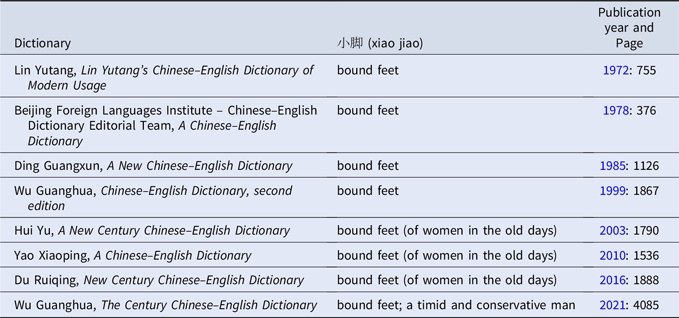
As demonstrated in the fourth section, early Chinese–English dictionaries transformed “金莲 (jin lian)” into “golden lilies” through an aestheticized metaphorical construction, packaging footbinding – a gendered practice of oppression – into a cross-cultural symbol of patriarchal fetishization and effecting the first act of objectification of women’s bodily suffering. By tracing the development of “小脚 (xiao jiao)” across different dictionaries, a significant change in its usage becomes clear. For over a century and a half prior to the publication of Lin Yutang’s Chinese-English Dictionary of Modern Usage in 1972, Chinese–English dictionaries almost entirely omitted this colloquial term, which was only formally included in the 1972 edition.
This prolonged omission was far from accidental. Early lexicographers were constrained both by the functional orientation of dictionaries toward practical communication and cultural curiosity, which favored terms such as “金莲 (jin lian)” with romanticized and exoticized connotations, and by patriarchal discursive logics that avoided direct engagement with women’s bodies. The unembellished term “小脚 (xiao jiao),” which straightforwardly describes bodily deformation, lacked esthetic packaging and exposed the oppressive reality too clearly and was therefore deliberately excluded. The post-1972 inclusion and standardized translation of “小脚 (xiao jiao),” as Table 2 shows, marks a strategic shift from esthetic objectification toward a more covert mode of state-based concealment. Under this modernized linguistic framing, the brutality of the practice is diluted, aligning with Sherry Simon’s theory of translation intervention, which highlights the ideological logic embedded in language.
Evolution of the English translation for “小脚 (xiao jiao)” in Chinese–English dictionaries
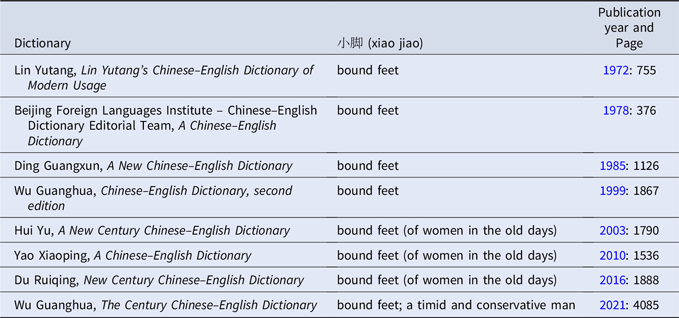
Table 2. Long description
A table comparing the evolution of the English translation for ʼxiao jiaoʼ in Chinese-English dictionaries. The table has three columns: Dictionary, 小脚 (xiao jiao), and Publication year and Page. It contains eight rows with the following data: Row 1: Lin Yutang, Lin Yutangʼs Chinese-English Dictionary of Modern Usage, bound feet, 1972: 755. Row 2: Beijing Foreign Languages Institute – Chinese-English Dictionary Editorial Team, A Chinese-English Dictionary, bound feet, 1978: 376. Row 3: Ding Guangxun, A New Chinese-English Dictionary, bound feet, 1985: 1126. Row 4: Wu Guanghua, Chinese-English Dictionary, second edition, bound feet, 1999: 1867. Row 5: Hui Yu, A New Century Chinese-English Dictionary, bound feet (of women in the old days), 2003: 1790. Row 6: Yao Xiaoping, A Chinese-English Dictionary, bound feet (of women in the old days), 2010: 1536. Row 7: Du Ruiqing, New Century Chinese-English Dictionary, bound feet (of women in the old days), 2016: 1888. Row 8: Wu Guanghua, The Century Chinese-English Dictionary, bound feet; a timid and conservative man, 2021: 4085.
In her theory of translation intervention, Simon (Reference Simon1996) asserts that a translator’s grammatical choices are far from neutral linguistic operations; they constitute interventions that carry ideological intent. By manipulating voice and part of speech, translators can reshape readers’ perception of the nature of events, thereby concealing or reinforcing power relations. This theory finds precise confirmation in the dictionary translations of “小脚 (xiao jiao).” From Lin Yutang’s 1972 dictionary to Wu Guanghua’s 2021 The Century Chinese-English Dictionary, all dictionaries that include “小脚 (xiao jiao),” consistently render it as “bound feet.” This choice exemplifies the linguistic principle that “nominalisation is a means used to make agency or meanings hazier” (Jinfang et al. Reference Jinfang, Kasuma and Moindjie2025: 56), as this nominalized translation effects a semantic devolution from dynamic violence to static outcome, serving as a key linguistic strategy to obscure the brutality of footbinding.
Under the lens of critical lexicography, the dictionary is not a neutral bridge but a discourse in its own right that is both culturally determined and culturally determining. The consistent rendering of “bound feet” suggests that the lexicographical genre prioritizes an authoritative, objective-sounding facade over the somatic reality of the subject. Simon further notes that the erasure of agentive action is a central mechanism of intervention. In “bound feet,” the past participle “bound” loses the dynamic properties of the verb and functions as a descriptive adjective. This grammatical shift produces a profoundly misleading cognitive effect: it entirely removes the dynamic process of “缠 (chan),” including the agents of force (patriarchal families), the instruments of constraint (binding cloths and scissors), and the years-long skeletal deformation and physiological torment. By refocusing the definition on the result rather than the process, the dictionary genre utilizes its inherent power to re-order the world, recasting a sustained corporeal violation into a fixed, static state that is resultant of a patriarchal context yet presented as a naturalized, scientific fact.
This transformative practice demonstrates how dictionaries, as active cultural interventions, leverage their perceived objectivity to legitimize the erasure of women’s pain. Under this modernized translational intervention, footbinding ceases to be an ongoing, painful practice of violence and becomes a sociological specimen that requires no attention to causality or process. As Simon demonstrates, the essence of this nominalization is the linguistic codification of power: by converting the verb into a noun or adjective, translators successfully efface the processual and brutal aspects of bodily experience, shifting readers’ focus from the continually violated body to an established, static bodily condition. The impact of such a shift is significant, as nominalization may increase the lexical density of a text, but it may also decrease its clarity and readability (Liu et al. Reference Liu, Liu, Cheung, Zhao, Li and Lei2023). This reinforces the paradoxical nature of the dictionary’s scientific authority: while it appears to be a neutral reference tool, it serves as an ideological instrument that stabilizes a sanitized perception of gendered violence. This constitutes a secondary attenuation of the violent essence, where the dictionary’s discursive order effectively constructs a context of stasis that silences the echoes of women’s embodied suffering more effectively than the romanticized metaphors of the past.
The secondary erasure of suffering subjects in modern dictionaries
Simon further asserts that the so-called “neutrality” in translation often constitutes a deeper form of discursive intervention. Translators, by deploying seemingly objective and scientific language, construct cognitive barriers that erase the authentic experiences of suffering subjects within existing power structures. Such a process of erasure is fundamentally rooted in the capacity of the translated text to function as a transformative site where “Translation does not merely transfer words between languages; it reshapes narratives, positions identities, and disseminates ideologies within and across cultural boundaries” (Yahiaoui et al. Reference Yahiaoui, Alhirthani, Al-Adwan and Hadjadj2025: 2). This secondary erasure does not occur in isolation from the discursive context described previously. As shown in the fourth section, early dictionaries executed a first erasure through the aestheticized metaphor that rendered “金莲 (jin lian)” as “golden lilies.” This aestheticization transformed women’s bodily suffering into a symbol of patriarchal fetishization. Consequently, the victims’ lived pain lost its capacity for concrete expression in cross-cultural transmission. Once this objectified cognition became established, it remained entrenched and difficult to overcome. Modern dictionaries’ scientifically neutral translations of “小脚 (xiao jiao)” effect a second erasure on top of this first. Through the integration of these terms into the modernized discursive order of the lexicographical genre, these works leverage their perceived scientific authority to reinforce and deepen the triad of voicelessness, objectification, and stasis.
From the 1978 A Chinese-English Dictionary by Beijing Foreign Studies University to Yao Xiaoping’s 2010 A Chinese–English Dictionary, and later to Du Ruiqing’s 2016 New Century Chinese–English Dictionary, compilers included temporal qualifiers such as “of women in the old days” in annotations, yet the core semantic content remained locked in the abstract concept of “bound feet.” Unlike the aestheticized narrative of “金莲 (jin lian)” in the previous section, modern dictionaries abandoned romanticized rhetoric in favor of objective equivalence. However, this shift does not challenge the patriarchal logic governing women’s bodies. On the contrary, by cloaking the translation in scientific language, the logic of objectification becomes more deceptive, and the exercise of power more concealed. Simon’s theory of intervention reveals that this strategy functions as a form of discursive anesthesia. When compilers replace the lived bodily traumas of skeletal deformation, restricted mobility, and lifelong pain with the cold sociological term “bound feet,” the victims’ pain is rendered untransmittable within the neutral language. The erasure is not due to a lack of words but because available terms have been stripped of the experiential intensity of suffering.
Simultaneously, this process abstracts specific bodily trauma into depersonalized knowledge symbols, which perpetuates and deepens the objectification of women’s bodies. In Wu Guanghua’s 2021 The Century Chinese–English Dictionary, the entry for “小脚 (xiao jiao)” even extends to the definition “a timid and conservative man.” This linkage between female bodily deformity and gendered character stereotypes extends objectification from the body to cognitive perceptions of gender. This linguistic evolution mirrors the broader sociocultural mechanism where sexual objectification involves “a cultural prioritizing of women’s sexual appearance and appeal over other attributes” (Ward et al. Reference Ward, Daniels, Zurbriggen and Rosenscruggs2023: 22). The female subject thus becomes a tool for patriarchal categorization. Critically, this ostensibly objective definition – backed by the scientific authority of the lexicographical format – freezes the history of oppression as a static given fact. This act of cultural intervention reframes social and ideological hierarchies embedded within language itself and deprives readers of the motivation to reflect on historical brutality.
The falsity of this so-called neutrality lies in its pretext of avoiding value judgments, which conceals the historical reality of patriarchal power exerted over women’s bodies and deprives readers of empathy for victims of footbinding. This constitutes the essence of the secondary erasure. Building on the initial aestheticized objectification that caused voicelessness and abstraction, the scientific veneer further deprives suffering subjects of being understood or empathized with, making the triad of voicelessness, objectification, and stasis a persistent inertia in cross-cultural transmission. This modernized veil of concealment is more subtle and resilient than the earlier esthetic metaphor of “金莲 (jin lian),” further solidifying the gendered politics and cultural constructions behind footbinding within ostensibly neutral knowledge production.
Conclusion
Far from being a neutral repository of linguistic exchange, the two-century history of Chinese–English lexicography unveils a systematic discursive transformation of the female body, characterized by a transition from visual isolation and esthetic objectification to static stabilization. The longitudinal review of dictionary entries demonstrates that (bilingual) dictionaries are discourses in their own right, which are both culturally determined and culturally determining. From the terminological gaps in Morrison’s era produced by gendered spatial segregation and elite Confucian linguistic standards, to the semantic colonization effected through the metaphor of “金莲 (jin lian)” in the works of Giles (Reference Giles1892) and Lobscheid (Reference Lobscheid1871), and finally to the modern treatment that reduces dynamic violence to the nominalized form of “小脚 (xiao jiao, bound feet),” translation has consistently reshaped rather than merely represented the bodily experiences of Chinese women. This evolutionary arc not only confirms Chamberlain’s argument regarding the maintenance of patriarchal order through translational metaphor but also exemplifies Simon’s insight into the covert logic of ideological intervention enacted through grammatical choices. Furthermore, it reveals how the lexicographical genre leverages its perceived scientific authority to provide a formalized venue for the recontextualization of bodily suffering.
The central finding of this study is that, across centuries, Chinese–English translation has failed to transcend a male-centric perspective, resulting in the substantial loss of women’s lived experiences within translational gaps. In the early stage, the deployment of Chamberlain-style aestheticized metaphors converted corporeal pain into cultural spectacles accessible to the patriarchal gaze. In the modern stage, the transition toward Simon-style neutral interventions utilizes nominalized, static expressions for the removal of both the agents of violence and the ongoing physiological suffering. Although this discursive evolution appears to move from romanticization to scientization, it is in essence a variation of the same power logic. Through the integration of these terms into a modernized discursive order, both strategies jointly effect a secondary erasure of footbound women as suffering subjects. This modernized veil of concealment, cloaked in scientific neutrality, serves to freeze the history of oppression as a static, given fact, thereby depriving the suffering subject of empathy.
On this basis, the study advocates for a translation and lexicographical practice informed by feminist ethics, in which translators actively intervene in existing power structures during cross-cultural transfer. Recognizing the power of language to make and re-order worlds, such practice must remain vigilant against the traps of aestheticized metaphor and overcome the cognitive barriers imposed by nominalized descriptions. The reclamation of lost verbs is essential for the restoration of the dynamic nature of bodily experience. Through the incorporation of more agentive interpretive strategies into dictionary compilation, the dismantling of closed discursive networks constructed by terms such as “golden lilies” or “bound feet” becomes possible. Such an intervention aims not to abandon objectivity, but to expose the unilateral perspectives hidden behind the mask of neutrality, enabling an objective reconstruction of women’s bodily discourse in cross-cultural communication.
Acknowledgements
I would like to thank the anonymous reviewers for their generous time and thoughtful comments on earlier versions of this article. Their suggestions were valuable not only in improving the article but also in broadening my perspective as an early-career scholar. I am also grateful to the editorial team of the International Journal of Asian Studies for their careful work and support throughout the publication process.
Competing interests
The author declares none.
Appendix
Search results for footbinding terminology in the dictionaries of Morrison and Medhurst
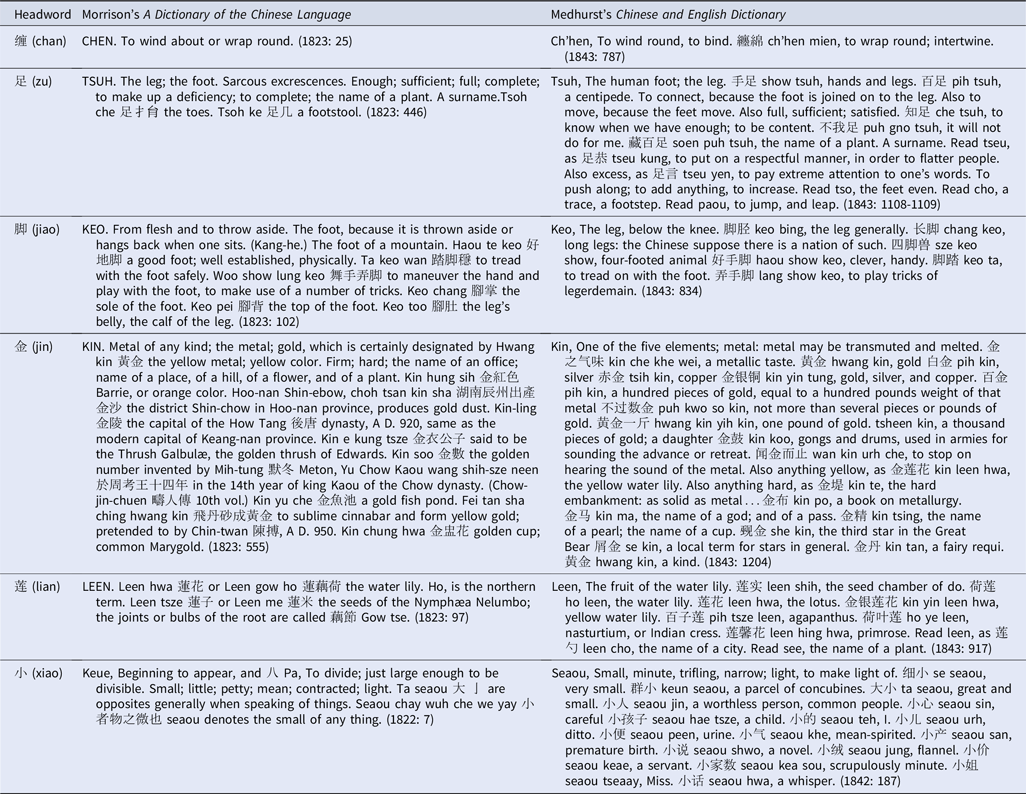
Table A1. Long description
Women-related entries in Morrison’s A Dictionary of the Chinese Language
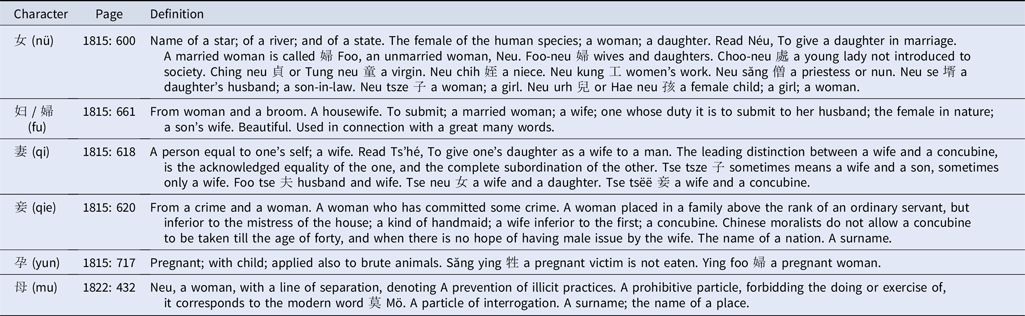
Table A2. Long description
The table has three columns: Character, Page, and Definition. It lists various Chinese characters related to women, their corresponding page numbers, and detailed definitions. The table includes 7 rows with the following data: Row 1: Character: 女 (nü), Page: 1815, 600, Definition: Name of a star; of a river; and of a state. The female of the human species; a woman; a daughter. Read Néu, To give a daughter in marriage. A married woman is called 婦 Foo, an unmarried woman, Neu. Foo-neu 婦女 wives and daughters. Choo-neu 虑女 a young lady not introduced to society. Ching neu 靜女 or Tung neu 通女 a virgin. Neu chih 妾 a niece. Neu kung 州 womenʼs work. Neu säng 孃 a priestess or nun. Neu se 婦 a daughterʼs husband; a son-in-law. Neu tszé 子 a woman; a girl. Neu uhr 兒 or Hae neu 孩 a female child; a girl; a woman. Row 2: Character: 妇 / 婦 (fu), Page: 1815, 661, Definition: From woman and a broom. A housewife. To submit; a married woman; a wife; one whose duty it is to submit to her husband; the female in nature; a sonʼs wife. Beautiful. Used in connection with a great many words. Row 3: Character: 妻 (qi), Page: 1815, 618, Definition: A person equal to oneʼs self; a wife. Read Tsʼhé, To give oneʼs daughter as a wife to a man. The leading distinction between a wife and a concubine, is the acknowledged equality of the one, and the complete subordination of the other. Tszé tsʼai 子妻 sometimes means a wife and a son, sometimes only a wife. Foo tszé 夫妻 husband and wife. Tse neu 妻女 a wife and a daughter. Tszé tsʼai 妻妾 a wife and a concubine. Row 4: Character: 妾 (qie), Page: 1815, 620, Definition: From a crime and a woman. A woman who has committed some crime. A woman placed in a family above the rank of an ordinary servant, but inferior to the mistress of the house; a kind of handmaid; a wife inferior to the first; a concubine. Chinese moralists do not allow a concubine to be taken till the age of forty, and when there is no hope of having male issue by the wife. The name of a nation. A surname. Row 5: Character: 孕 (yun), Page: 1815, 717, Definition: Pregnant; with child; applied also to brute animals. Säng ying 孕物 a pregnant victim is not eaten. Ying foo 孕婦 a pregnant woman. Row 6: Character: 娘 (niang), Page: 1822, 432, Definition: Neu, a woman, with a line of separation, denoting A prevention of illicit practices. A prohibitive particle, forbidding the doing or exercise of, it corresponds to the modern word 忌 Mó. A particle of interrogation. A surname; the name of a place. Row 7: Character: 奶 (nai), Page: 1815, 567, Definition: Milk. The milk of women. The milk of a childʼs mother. A nurse. A woman who suckles the child of another. A woman who has lately brought forth. A woman in childbed. A woman in general. A wife. A surname.

 Open access

