


Introduction
The development of early intervention for psychosis (EIP) services has been central to achieving improved outcomes in psychosis for both symptomatic remission and functional recovery. EIP services typically provide multicomponent supports (including medication, key worker support, Behavioural Family Therapy, Cognitive Behavioural Therapy, and/or Individual Placement Support) for approximately two years. In Ireland, EIP services have recently been developed to respond to the needs of approximately 1,500 individuals who experience a first episode of psychosis every year (Health Service Executive 2019), with services now available in Dublin, Cork, Sligo, Galway, and Meath, and other services planned.
While the benefits of early intervention in psychosis are widely recognised (Becker et al. Reference Becker, Correll and Galling2019; Malla and McGorry Reference Malla and McGorry2019), sustaining these gains over the longer term remains challenging (Bertelsen et al. Reference Bertelsen, Jeppesen, Petersen, Thorup, Øhlenschlæger, le Quach, Christensen, Krarup, Jørgensen and Nordentoft2008; Gafoor et al. Reference Gafoor, Nitsch, McCrone, Craig, Garety, Power and McGuire2010). Social and occupational recovery have also been identified as areas in which additional support is needed within EIP services (Frawley et al. Reference Frawley, Cowman, Lepage and Donohoe2023; Hodgekins et al. Reference Hodgekins, Birchwood, Christopher, Marshall, Coker, Everard, Lester, Jones, Amos, Singh, Sharma, Freemantle and Fowler2015). Digital interventions (mental health supports delivered through web- or mobile-based platforms) may help to extend access to care and support broader recovery goals, including social recovery, personal agency, and empowerment among people experiencing psychosis (Bond et al. Reference Bond, Mulvenna, Potts, O’Neill, Ennis and Torous2023; Dennard et al. Reference Dennard, Patel, Garety, Edwards and Gumley2025; Rus-Calafell and Schneider Reference Rus-Calafell and Schneider2020). Although the evidence remains limited, blended approaches combining digital and face-to-face care for people with psychosis or schizophrenia-spectrum disorders have shown promise (Cohen et al. Reference Cohen, Roe, Savir and Baumel2024).
One approach to improving long-term recovery in EIP is Moderated Online Social Therapy (MOST; Alvarez-Jimenez et al. Reference Alvarez-Jimenez, Koval, Schmaal, Bendall, O’Sullivan, Cagliarini, D’Alfonso, Rice, Valentine, Penn, Miles, Russon, Phillips, McEnery, Lederman, Killackey, Mihalopoulos, Gonzalez-Blanch, Gilbertson, Lal, Cotton, Herrman, McGorry and Gleeson2021). Developed by Orygen Digital in Australia, MOST provides a low-intensity, cost-effective, and engaging approach to prolonging the benefits of specialised EIP services (Alvarez-Jimenez et al. Reference Alvarez-Jimenez, Koval, Schmaal, Bendall, O’Sullivan, Cagliarini, D’Alfonso, Rice, Valentine, Penn, Miles, Russon, Phillips, McEnery, Lederman, Killackey, Mihalopoulos, Gonzalez-Blanch, Gilbertson, Lal, Cotton, Herrman, McGorry and Gleeson2021; Engel et al. Reference Engel, Alvarez-Jimenez, Cagliarini, D’Alfonso, Faller and Valentine2023). Its design and therapeutic content are strongly influenced by self-determination theory (Ryan and Deci Reference Ryan and Deci2000), a theory of motivation emphasising the processes and social environments that facilitate or hamper social functioning. MOST differs from other ‘self-help’ style digital interventions by providing access to therapeutic content online alongside therapist and peer support and an online community (a more in-depth explanation of MOST is provided below). Such features are likely to improve engagement, a recognised challenge in digital mental health interventions (Cross and Alvarez-Jimenez Reference Cross and Alvarez-Jimenez2024; Madrid-Cagigal et al. Reference Madrid-Cagigal, Kealy, Potts, Mulvenna, Byrne, Barry and Donohoe2025).
In a recent randomised controlled trial of MOST involving individuals approaching discharge from EIP services, participants who participated in MOST had greater odds of being employed or enrolled in education and made fewer emergency service visits at 18 months than those receiving treatment as usual, with evidence of a dose-response effect (Alvarez-Jimenez et al. Reference Alvarez-Jimenez, Koval, Schmaal, Bendall, O’Sullivan, Cagliarini, D’Alfonso, Rice, Valentine, Penn, Miles, Russon, Phillips, McEnery, Lederman, Killackey, Mihalopoulos, Gonzalez-Blanch, Gilbertson, Lal, Cotton, Herrman, McGorry and Gleeson2021). These promising findings provided a rationale for examining MOST within Irish EIP services, although the model of delivery was adapted to the local context. Rather than only recruiting those transitioning from EIP care, in the present study, MOST was offered as an adjunct to usual care to clinically stable service users at any stage of their engagement with services. This approach was informed by feedback from service users and clinicians and reflected the context at study commencement, when Irish EIP services were newly established and operating during the COVID-19 pandemic.
The aim of the present study was to examine the feasibility of recruiting individuals receiving care from EIP services in Ireland to participate in a study of MOST, in preparation for a definitive trial. Feasibility was assessed in terms of recruitment, retention, engagement, and completion of outcomes measures. This study was carried out as part of a funded programme of research entitled ‘Improving Psychosocial Supports in Youth Mental Health’ (The PSYcHE programme). The main study hypotheses were that (a) it will be possible to recruit n = 30 patients into the trial and (b) retain a majority of these at follow-up. Whereas retention above 80% is generally considered the ideal for randomised controlled trials, retention in digital intervention trials often falls significantly below this. Consequently, and based on our recent young adult study of MOST (Dwan-O’Reilly et al. Reference Dwan-O’Reilly, Harrington, Gavin, Godfrey, Cowman, Gleeson, O’Mahony Sinnott, McCormack, Frawley, Burke, O’Connor, Birchwood, Heary, Alvarez-Jimenez and Donohoe2025), we set 70% at 6 months as an acceptable level for retention. Finally, effect sizes of pre-post differences on outcome variables were calculated to inform future power calculations in a full trial.
Methods
Ethics approval and trial registration
This study was approved by the Galway Clinical Research Ethics Committee, Merlin Park Hospital, Galway, Ireland (ref. CA2468), the Research Ethics Committee (REC) at Sligo University Hospital (Ref. 845), and Clinical Research Ethics Committee of the Cork Teaching Hospitals (ref. ECM 4 (I) & ECM 3 (dd)). The ethics applications detailed general data protection regulation (GDPR) considerations and the proposed management of vulnerable individuals in the study. All participants provided informed written consent. The trial was registered with ISRCTN, number 10528454.
Setting and inclusion criteria
Patients were recruited from three centres, the Sligo EIP service, Cork South Lee (RISE) EIP service, and the Galway Adult Mental Health Service. Both the Sligo service and RISE service were established between 2018 and 2020 as part of the national EIP Service. Both follow a ‘hub and spoke’ model of care, receiving approximately 35–55 referrals per year from GPs, emergency departments, and community mental health teams. To meet the inclusion criteria, individuals had to be between the ages of 18 and 35, have no prior history of a head injury, a premorbid IQ of >70, be currently seeking treatment for psychosis at their respective service, be clinically stable, be able to give informed consent, and have no self-reported substance misuse in the preceding month of being screened. Recent substance misuse was an exclusion criterion as it could independently affect engagement and retention, making it difficult within this small feasibility study to determine whether patterns of engagement reflected the intervention or concurrent substance-related factors.
Feedback gathered from service users and clinicians during implementation planning indicated that MOST would be useful as an adjunct to ongoing EIP care, particularly within the context of newly established Irish EIP services during the COVID-19 pandemic. Clinically stable service users were therefore eligible to participate at any stage of their engagement with EIP services, with MOST provided alongside their usual care. Referral to the study was made by the patient’s key worker and clinical stability was confirmed by the key worker on behalf of the treating team. Once the referral was received by the research team, a research assistant completed the informed consent procedure and completed screening to confirm eligibility. Participants were then enrolled in the study and completed their baseline assessment.
Randomisation and masking
After the baseline assessment, all participants were randomised to the intervention or control arm of the study at a 2:1 intervention: control ratio using Sealed Envelope (2024), with randomisation stratified for age and gender. Researchers carrying out the baseline and follow-up assessments were blind to the participants’ intervention status.
Intervention group
MOST has been described in detail elsewhere (Alvarez-Jimenez et al. Reference Alvarez-Jimenez, Bendall, Lederman, Wadley, Chinnery, Vargas, Larkin, Killackey, McGorry and Gleeson2013, Reference Alvarez-Jimenez, Nicholas, Valentine, Liu, Mangelsdorf, Baker, Gilbertson, O’Loughlin, McEnery, McGorry, Gleeson and Cross2024; Cross et al. Reference Cross, Nicholas, Mangelsdorf, Valentine, Baker, McGorry, Gleeson and Alvarez-Jimenez2023). Participants were onboarded to the MOST platform by a researcher not involved in carrying out baseline or outcome assessments. During onboarding, participants set up an account, completed questions informing the therapy journey selection, and received a virtual platform tour. Engagement in the therapy journey (see below) was supported via fortnightly 15-minute video or telephone calls with a therapist (a trained clinical psychologist or occupational therapist), while engagement with the community (see below) was supported by fortnightly 30-minute calls with a peer support worker (PSW). Therapists and PSWs received training based on a manual and established protocol developed by Orygen Digital and also met monthly to review participant engagement.
Therapy journey
Participants were matched to one of four ‘therapy journeys’: depression, anxiety, self-esteem, and social anxiety. These topics represent some of the most common co-morbid issues for those in early intervention in psychosis services (Cowman et al. Reference Cowman, Hodgekins, Griffiths, Frawley, O’Connor, Fowler, Birchwood and Donohoe2025; McEnery et al. Reference McEnery, Lim, Tremain, Knowles and Alvarez-Jimenez2019b; Wilson et al. Reference Wilson, Yung and Morrison2020), and echo the topics covered in previous MOST studies (e.g. Alvarez-Jimenez et al. Reference Alvarez-Jimenez, Gleeson, Bendall, Penn, Yung, Ryan, Eleftheriadis, D’Alfonso, Rice, Miles, Russon, Lederman, Chambers, Gonzalez-Blanch, Lim, Killackey, McGorry and Nelson2018, Reference Alvarez-Jimenez, Koval, Schmaal, Bendall, O’Sullivan, Cagliarini, D’Alfonso, Rice, Valentine, Penn, Miles, Russon, Phillips, McEnery, Lederman, Killackey, Mihalopoulos, Gonzalez-Blanch, Gilbertson, Lal, Cotton, Herrman, McGorry and Gleeson2021; McEnery et al. Reference McEnery, Lim, Knowles, Rice, Gleeson, Howell, Russon, Miles, D’Alfonso and Alvarez-Jimenez2019a). The journeys were based on third-wave CBT-based therapy and comprised interactive, self-directed psychotherapeutic modules that users worked through in their own time. The content targeted social functioning, aiming to foster self-efficacy (through identifying personal strengths based on the strengths-based framework), positive emotion and subjective well-being (through mindfulness and self-compassion), and positive connection with others (through the development of empathy skills).
Content was delivered through several activity types designed to help participants apply therapeutic concepts in practice: Comics, Reflective Actions, Actions, Talking Points, and Pages. Comics illustrated therapeutic concepts through narrative cartoons; Reflective Actions prompted self-reflection; Actions suggested practical steps; Talking Points enabled users and PSWs to discuss the content; and Pages summarised key material. Users could also access short modules on additional mental health topics through the Explore function and save useful content to a personalised Toolkit. Participants could change journeys if their assigned content was not relevant to their needs.
Community interaction
The community comprised a peer-led online social network designed to promote social support and reduce stigma and loneliness (Alvarez-Jimenez et al. Reference Alvarez-Jimenez, Nicholas, Valentine, Liu, Mangelsdorf, Baker, Gilbertson, O’Loughlin, McEnery, McGorry, Gleeson and Cross2024). Users could post to a community feed and comment on or react to posts from other participants and PSWs. The Talk It Out function enabled users to seek advice on specific issues through moderated group discussions. All community activity was moderated by clinicians and PSWs.
Control group
Participants randomised to the control group received care as usual. After completing baseline, three-month, and six-month assessments, they were offered access to MOST. No additional study supports were provided during the six-month control period.
Outcomes assessed
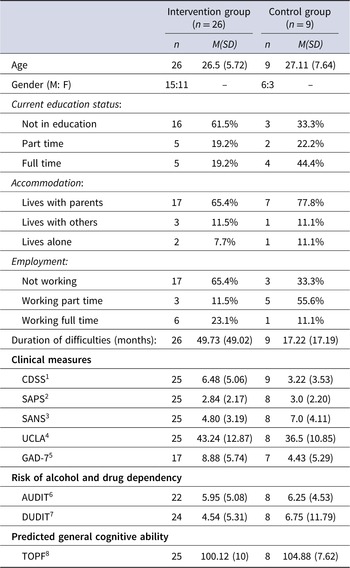
As a feasibility study, the primary outcomes of interest in this study were the number of participants recruited, retention and attrition at follow-up, and the level of engagement with MOST. This study was carried out as part of the PSYcHE research programme which focused on targeting cognitive deficits as a key predictor of social and occupational function (Cowman et al. Reference Cowman, Holleran, Lonergan, O’Connor, Birchwood and Donohoe2021; Fett et al. Reference Fett, Reichenberg and Velthorst2022). As such, this study also aimed to examine the feasibility of administering measures of social and occupational function, cognitive and social cognitive performance, and clinical symptoms (see Table 1 for list of measures administered and Table 2 for baseline measures and characteristics). While a measure of anxiety was not originally included in the trial protocol, the GAD-7 (Spitzer et al. Reference Spitzer, Kroenke, Williams and Löwe2006) was added early in the study to align with research on MOST as well as thinking around digital mental health interventions generally (Cross et al. Reference Cross, Nicholas, Mangelsdorf, Valentine, Baker, McGorry, Gleeson and Alvarez-Jimenez2023; Drissi et al. Reference Drissi, Ouhbi, Janati Idrissi and Ghogho2020; Linardon et al. Reference Linardon, Cuijpers, Carlbring, Messer and Fuller-Tyszkiewicz2019; Rice et al. Reference Rice, O’Bree, Wilson, McEnery, Lim, Hamilton, Gleeson, Bendall, D’Alfonso, Russon, Valentine, Cagliarini, Howell, Miles, Pearson, Nicholls, Garland, Mullen, McGorry and Alvarez-Jimenez2020). Measures were administered to both groups at baseline, 3 months, 6 months, and 12 months by blinded assessors. Participants were compensated €25 for their time at each assessment.
Description of outcome measures used

Table 1. Long description
A table listing various measures used in a study, categorized into social and occupational functioning, cognitive functioning, and clinical functioning. The table has four columns: Measure name, Reference, Measure description, and Score range. It includes the following rows: Row 1: Measure name: SOFAS; Reference: Goldman et al. 1992; Measure description: The SOFAS measures the clinician’s judgment of the client’s overall level of functioning; Score range: 0-100. Row 2: Measure name: TUS; Reference: Lader et al. 2006; Measure description: TUS measures the amount of time individuals spend doing various structured activities; Score range: Not specified. Row 3: Measure name: ILS; Reference: Wallace et al. 2000; Measure description: The ILS assesses the degree to which adults can care for themselves and their property, and their competency in instrumental activities of daily living; Score range: 0-66. Row 4: Measure name: MIRECC GAF; Reference: Niv et al. 2007; Measure description: The MIRECC GAF measures occupational functioning, social functioning, and symptom severity on three subscales; Score range: 0-100 each. Row 5: Measure name: RMET; Reference: Baron-Cohen et al. 2001; Measure description: The RMET is used to measure theory of mind or social cognition; Score range: 0-36. Row 6: Measure name: CANTAB ERT; Reference: Cambridge Cognition 2023; Measure description: The ERT measures the ability to identify six basic emotions in facial expressions along a continuum of expression magnitude; Score range: 0-48. Row 7: Measure name: CANTAB SWM; Reference: Cambridge Cognition 2023; Measure description: SWM provides a measure of strategy as well as working memory errors; Score range: 0-63. Row 8: Measure name: Logical memory; Reference: Wechsler 1997; Measure description: An interviewer-administered test that measures the ability of the respondent to recall words and spoken items (verbal memory); Score range: A: 0-75, B: 0-50. Row 9: Measure name: CDSS; Reference: Addington et al. 1990; Measure description: The CDSS measures the level of depression in people with psychosis/schizophrenia; Score range: 0-27. Row 10: Measure name: SAPS; Reference: Andreasen 1984; Measure description: The SAPS and SANS measure the level of existing positive symptoms and negative symptoms in schizophrenia respectively; Score range: 0-20 each. Row 11: Measure name: SANS; Reference: Andreasen 1983; Measure description: The SAPS and SANS measure the level of existing positive symptoms and negative symptoms in schizophrenia respectively; Score range: 0-20 each. Row 12: Measure name: UCLA loneliness; Reference: Russell et al. 1980; Measure description: The UCLA measures one’s subjective feelings of loneliness as well as feelings of social isolation; Score range: 0-80. Row 13: Measure name: GAD-7; Reference: Spitzer et al. 2006; Measure description: The GAD-7 measures the participant’s self-rated level of general anxiety; Score range: 0-21.
1 SOFAS = social and occupational functioning assessment.
2 TUS = time use survey.
3 ILS = independent living skills survey.
4 MIRECC GAF = mental illness research, education, and clinical centre global assessment of functioning.
5 RMET = reading the mind in the eyes test.
6 CANTAB ERT = Cambridge neuropsychological test automated battery emotion recognition task.
7 CANTAB SWM = cambridge neuropsychological test automated battery spatial working memory.
8 Logical Memory, Wechsler Logical Memory task.
9 CDSS = calgary depression scale for schizophrenia.
10 SAPS = scale for the assessment of positive symptoms.
11 SANS = scale for the assessment of negative symptoms.
12 UCLA = loneliness scale.
13 GAD-7, generalised anxiety disorder 7.
Demographic and clinical description of sample at baseline

Table 2. Long description
A table comparing demographic and clinical characteristics of two groups at baseline. The table has 26 rows and 7 columns. The columns are labeled as follows: Intervention group (n = 26), Control group (n = 9), with sub-columns n, M(SD). The rows are labeled as follows: Age, Gender (M: F), Current education status (Not in education, Part time, Full time), Accommodation (Lives with parents, Lives with others, Lives alone), Employment (Not working, Working part time, Working full time), Duration of difficulties (months), Clinical measures (CDSS, SAPS, SANS, UCLA, GAD-7), Risk of alcohol and drug dependency (AUDIT, DUDIT), Predicted general cognitive ability (TOPF). Row 1: Age, Intervention group n 26, M(SD) 26.5 (5.72), Control group n 9, M(SD) 27.11 (7.64). Row 2: Gender (M: F), Intervention group 15:11, Control group 6:3. Row 3: Current education status: Not in education, Intervention group n 16, 61.5 percent, Control group n 3, 33.3 percent. Row 4: Current education status: Part time, Intervention group n 5, 19.2 percent, Control group n 2, 22.2 percent. Row 5: Current education status: Full time, Intervention group n 5, 19.2 percent, Control group n 4, 44.4 percent. Row 6: Accommodation: Lives with parents, Intervention group n 17, 65.4 percent, Control group n 7, 77.8 percent. Row 7: Accommodation: Lives with others, Intervention group n 3, 11.5 percent, Control group n 1, 11.1 percent. Row 8: Accommodation: Lives alone, Intervention group n 2, 7.7 percent, Control group n 1, 11.1 percent. Row 9: Employment: Not working, Intervention group n 17, 65.4 percent, Control group n 3, 33.3 percent. Row 10: Employment: Working part time, Intervention group n 3, 11.5 percent, Control group n 5, 55.6 percent. Row 11: Employment: Working full time, Intervention group n 6, 23.1 percent, Control group n 1, 11.1 percent. Row 12: Duration of difficulties (months), Intervention group n 26, 49.73 (49.02), Control group n 9, 17.22 (17.19). Row 13: Clinical measures: CDSS, Intervention group n 25, 6.48 (5.06), Control group n 9, 3.22 (3.53). Row 14: Clinical measures: SAPS, Intervention group n 25, 2.84 (2.17), Control group n 8, 3.0 (2.20). Row 15: Clinical measures: SANS, Intervention group n 25, 4.80 (3.19), Control group n 8, 7.0 (4.11). Row 16: Clinical measures: UCLA, Intervention group n 25, 43.24 (12.87), Control group n 8, 36.5 (10.85). Row 17: Clinical measures: GAD-7, Intervention group n 17, 8.88 (5.74), Control group n 7, 4.43 (5.29). Row 18: Risk of alcohol and drug dependency: AUDIT, Intervention group n 22, 5.95 (5.08), Control group n 8, 6.25 (4.53). Row 19: Risk of alcohol and drug dependency: DUDIT, Intervention group n 24, 4.54 (5.31), Control group n 8, 6.75 (11.79). Row 20: Predicted general cognitive ability: TOPF, Intervention group n 25, 100.12 (10), Control group n 8, 104.88 (7.62).
1 CDSS = calgary depression scale for schizophrenia (Addington et al. Reference Addington, Addington and Schissel1990).
2 SAPS = scale for the assessment of positive symptoms (Andreasen Reference Andreasen1984).
3 SANS = scale for the assessment of negative symptoms (Andreasen Reference Andreasen1983).
4 UCLA = the university of california, Los Angeles, loneliness scale (Russell et al. Reference Russell, Peplau and Cutrona1980).
5 GAD-7 = generalised anxiety disorder 7 (Spitzer et al. Reference Spitzer, Kroenke, Williams and Löwe2006).
6 AUDIT = alcohol use disorders identification test (Babor et al. Reference Babor, Higgins-Biddle, Saunders and Monteiro2001).
7 DUDIT = drug use disorders identification test (Berman et al. Reference Berman, Bergman, Palmstierna and Schlyter2003).
8 TOPF = test of premorbid functioning (Wechsler Reference Wechsler2011).
Intervention engagement data
Engagement data were extracted from the MOST platform after each participant completed six months and included time spent on therapeutic content, activities completed, community activity (posts, comments, and reactions), and texts and calls with therapists and PSWs.
In the absence of agreed upon criteria for engagement, we adopted a pragmatic approach informed by adherence literature as well as rates of engagement in previous digital interventions (Boucher and Raiker Reference Boucher and Raiker2024; Dwan-O’Reilly et al. Reference Dwan-O’Reilly, Harrington, Gavin, Godfrey, Cowman, Gleeson, O’Mahony Sinnott, McCormack, Frawley, Burke, O’Connor, Birchwood, Heary, Alvarez-Jimenez and Donohoe2025; Elkes et al. Reference Elkes, Cro, Batchelor, O’Connor, Yu, Bell, Harris, Sin and Cornelius2024; Osterberg and Blaschke Reference Osterberg and Blaschke2005). Total engagement was calculated by combining the total number of weeks that participants logged onto MOST and engaged beyond the homepage and/or engaged in a call with their therapist or PSW. Based on MOST as a six-month intervention, we defined engagement of ≤five weeks (i.e. 20% of 6 months) as poor engagement, and ≥21 weeks (i.e. 80% of six months) as full engagement.
Statistical analysis
A target of 30 participants over 24 months was set to establish parameters for a definitive study. As a pilot study, no formal sample size calculations were performed. To inform future power calculations in a full trial, between-group effect sizes were calculated for each outcome variable, with participant data included on an intention-to-treat basis. Effect sizes were calculated using the intervention arm’s β coefficients divided by both groups’ pooled baseline standard deviation (SD) for each variable respectively using analysis of covariance (ANCOVA). These were then reported using the standard descriptors of small (d = 0.2), medium (d = 0.5), and large (d = 0.8) effects (Cohen Reference Cohen1988). Effect sizes were also calculated for the subset of participants who met the minimum threshold for engagement (≥5 weeks) and the control participants. All statistical analyses were performed using the Statistical Package for Social Sciences (SPSS) 29.0.
Results
Recruitment and sample description
A total of 35 participants were recruited, exceeding the target of 30 and meeting the recruitment feasibility criterion. Demographic and clinical characteristics are provided in Table 2. The sample had a mean age of 26.66 years, 60% identified as male, and approximately two thirds were in education, employment, or training. The mean duration of mental health difficulties was 41.37 months, ranging from 12 to 180 months. Most participants (70%) were at low risk for alcohol dependence and approximately 97% of the sample classed as probably not drug dependent.
Rates of retention
The retention criterion was ≥70% completion of the six-month assessment. Seventeen participants (48.6%) completed this assessment; therefore, the criterion was not met. By comparison, retention was 60% (n = 21) at three months (mid intervention) and 51% (n = 18) at 12-month follow-up (see Figure 1 CONSORT diagram).
Participant recruitment and retention.

Randomisation
To establish a sufficient critical mass of users on the MOST community wall and enable meaningful peer interaction from the outset, the first five participants were allocated to the intervention arm. Subsequent participants were randomised at a 2:1 ratio. Thus, n = 26 were assigned to the intervention arm and n = 9 to the control arm. No difficulties were encountered with the randomisation procedure. Assessors were blind to intervention allocation status and only guessed the participant arm correctly 36.36% of the time, indicating that blinding was maintained.
Engagement
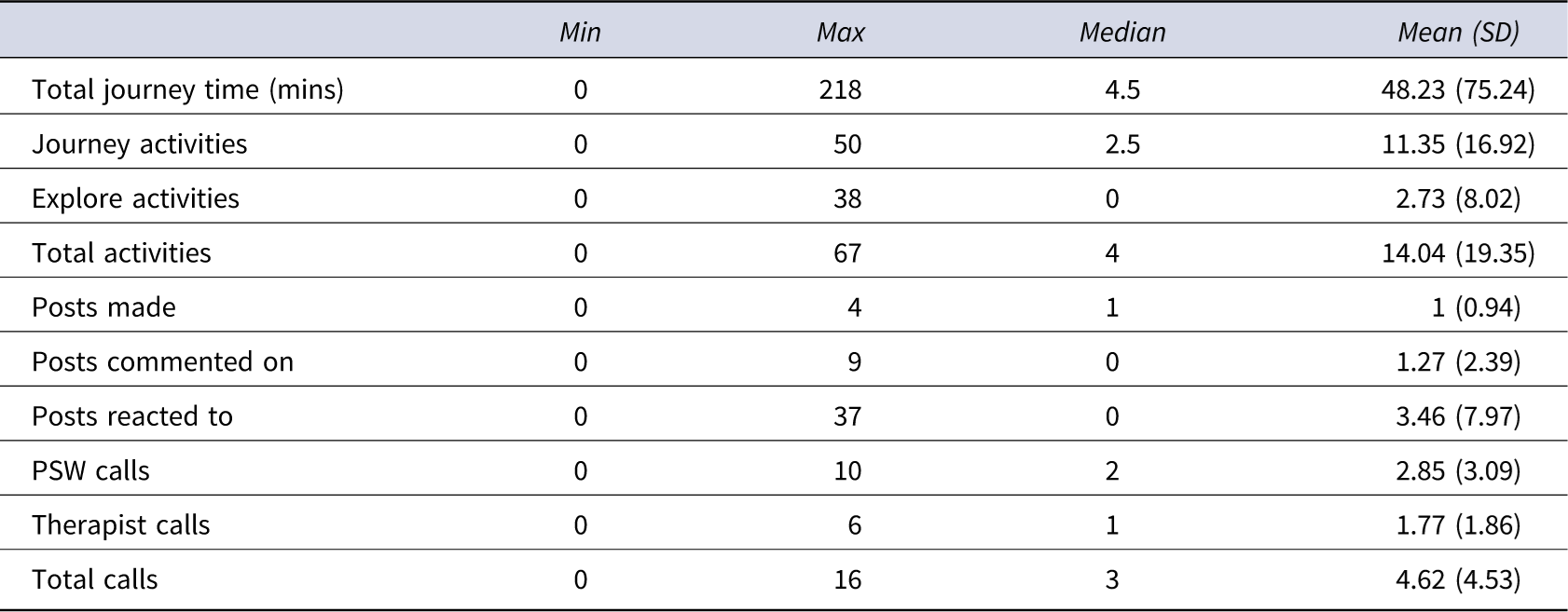
The mean number of weeks participants engaged with the MOST intervention was 10 (SD = 8.33). Seventeen of the 26 intervention participants (65.4%) engaged for 5 weeks or more, meeting our definition of minimum engagement. Ten participants (38.5%) engaged for 13 weeks or more, meeting our criteria for partial engagement (i.e., 50% of the six months). Four participants (15.4%) engaged with the MOST intervention for 21 weeks or more, meeting our criteria for full engagement. Further engagement metrics can be found in Table 3. These were generally positively skewed, indicating that a smaller subgroup engaged more intensively, particularly with journey content. Engagement with interactive community features was limited, with a median of one post made. Fortnightly calls with therapists and PSWs were offered as part of the intervention, but uptake was participant-led; participants completed a median of three support calls.
Summary of engagement on the MOST platform

Table 3. Long description
The table summarizes engagement metrics on the MOST platform, focusing on various activities and interactions. It has 10 rows and 5 columns. The columns are labeled Min, Max, Median, and Mean (SD). The rows are labeled Total journey time (mins), Journey activities, Explore activities, Total activities, Posts made, Posts commented on, Posts reacted to, PSW calls, Therapist calls, and Total calls. Each row provides the minimum, maximum, median, and mean values for the respective activity or interaction. For example, the Total journey time ranges from 0 to 218 minutes, with a median of 4.5 minutes and a mean of 48.23 minutes (SD 75.24). Journey activities range from 0 to 50, with a median of 2.5 and a mean of 11.35 (SD 16.92). Explore activities range from 0 to 38, with a median of 0 and a mean of 2.73 (SD 8.02). Total activities range from 0 to 67, with a median of 4 and a mean of 14.04 (SD 19.35). Posts made range from 0 to 4, with a median of 1 and a mean of 1 (SD 0.94). Posts commented on range from 0 to 9, with a median of 0 and a mean of 1.27 (SD 2.39). Posts reacted to range from 0 to 37, with a median of 0 and a mean of 3.46 (SD 7.97). PSW calls range from 0 to 10, with a median of 2 and a mean of 2.85 (SD 3.09). Therapist calls range from 0 to 6, with a median of 1 and a mean of 1.77 (SD 1.86). Total calls range from 0 to 16, with a median of 3 and a mean of 4.62 (SD 4.53).
Feasibility of outcome measures and calculation of effect sizes
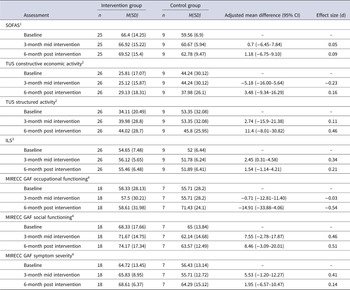
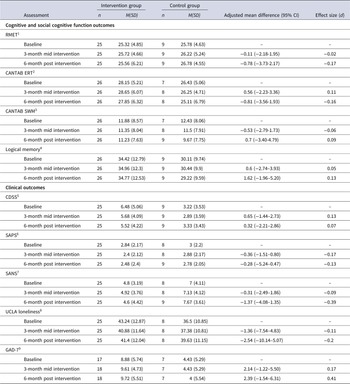
No difficulties were observed with the administration of any of the outcome variables. For the purposes of informing future trial power calculations, mean scores, standard deviations and effect size differences in follow-up data corrected for baseline differences are presented in Tables 4 and 5.
Comparison of primary outcome data: social and occupational function

Table 4. Long description
1 SOFAS = social and occupational functioning assessment (Goldman et al. Reference Goldman, Skodol and Lave1992).
2 TUS = time use survey (Lader et al. Reference Lader, Short and Gershuny2006).
3 ILS = independent living skills survey (Wallace et al. Reference Wallace, Liberman, Tauber and Wallace2000).
4 MIRECC GAF = mental illness research, education, and clinical centre global assessment of functioning (Niv et al. Reference Niv, Cohen, Sullivan and Young2007).
Comparison of secondary outcome data: cognitive and social cognitive function and clinical measures

Table 5. Long description
The table presents a comparison of cognitive and social cognitive function outcomes and clinical outcomes between intervention and control groups. It includes data for various assessments at baseline, 3-month mid intervention, and 6-month post intervention. The table has 14 rows and 8 columns. The columns are labeled as follows: Assessment, Intervention group n, Intervention group M(SD), Control group n, Control group M(SD), Adjusted mean difference (95% CI), and Effect size (d). The rows are grouped under two main categories: Cognitive and social cognitive function outcomes, and Clinical outcomes. Each row provides specific data for different assessments such as RMET, CANTAB ERT, CANTAB SWM, Logical memory, CDSS, SAPS, SANS, UCLA loneliness, and GAD-7. For example, under RMET, the baseline data for the intervention group shows n=25, M(SD)=25.32 (4.85), and for the control group, n=9, M(SD)=25.78 (4.63). The adjusted mean difference is not provided for baseline. Similar detailed data is presented for other assessments and time points. The table aims to inform future trial power calculations by presenting mean scores, standard deviations, and effect size differences in follow-up data corrected for baseline differences.
1 RMET = reading the mind in the eyes test (Baron-Cohen et al. Reference Baron-Cohen, Wheelwright, Hill, Raste and Plumb2001).
2 CANTAB ERT = cambridge neuropsychological test automated battery emotion recognition task (Cambridge Cognition 2023).
3 CANTAB SWM = cambridge neuropsychological test automated battery spatial working memory (Cambridge Cognition 2023).
4 Logical Memory, Wechsler Logical Memory task (Wechsler Reference Wechsler1997).
5 CDSS = calgary depression scale for schizophrenia (Addington et al. Reference Addington, Addington and Schissel1990).
6 SAPS = scale for the assessment of positive symptoms (Andreasen Reference Andreasen1984).
7 SANS = scale for the assessment of negative symptoms (Andreasen Reference Andreasen1983).
8 The University of California, Los Angeles, Loneliness Scale (Russell et al. Reference Russell, Peplau and Cutrona1980).
9 GAD-7 = generalised anxiety disorder 7 (Spitzer et al. Reference Spitzer, Kroenke, Williams and Löwe2006).
In terms of social and occupational function, small to medium effect sizes benefitting the intervention arm were observed on some measures of social and occupational function at six months (including the ILS [d = 0.21], MIRECC GAF – social functioning subscale [d = 0.51]) in the absence of similar changes being observed on the SOFAS. By comparison, for cognitive performance, minimal effect sizes were observed between the intervention and control group at six months. Finally, in terms of clinical measures, small effect sizes were observed for the SANS and the UCLA loneliness questionnaire in favour of the intervention group at 6 months ([d = −0.39] and [d = −0.2] respectively). We carried out an additional analysis of effect sizes comparing control participants to those intervention group participants with greater than 20% engagement (see Supplementary Material). The effect sizes observed increased marginally across the variables, with some additional variables also showing small effect size differences.
Discussion
The aim of this study was to assess the feasibility of evaluating MOST within EIP services in Ireland. Progression to a full trial was only partially supported: While recruitment targets were met and trial procedures were feasible, retention to the trial and engagement rates with MOST presented challenges. However, the successful completion of the study across newly established EIP services, together with some promising preliminary outcome signals, indicates that MOST can be implemented and evaluated in the Irish context. The findings also highlight several areas requiring refinement before any larger-scale evaluation.
We set out a recruitment target of 30 participants and exceeded this by recruiting 35 participants across EIP services. No significant difficulties were encountered with randomisation, blinding, or assessment procedures. However, recruitment took place over 24 months, longer than is typical for a feasibility study. Two contextual factors are important when considering this timeframe: first that recruitment began during the COVID-19 pandemic, and shortly after the establishment of the EIP services in Ireland. At this time, referral pathways, team structures, and intervention provision were still being embedded within these new services, and relatively few service users had yet reached the point of discharge. Other implementation challenges identified both in Ireland and internationally, including the influence of staffing pressures and the wider healthcare context, may have influenced recruitment and implementation (Darker et al. Reference Darker, Nicolson, Reddon, O’Connor, Jennings and O’Connell2023; O’Connell et al. Reference O’Connell, O’Connor, McGrath, Vagge, Mockler, Jennings and Darker2022). Although this context may have created additional complexity, it also provided an opportunity to introduce and evaluate a novel digital intervention to support people experiencing psychosis while service models were still evolving.
In terms of retention, our prespecified retention criterion was not met at six months (48.6% retained). However, retention rates were more favourable at three months (60%), although still below the 70% criterion set. One conclusion based on these data is that six months is too long an intervention period for MOST with this patient cohort. This interpretation is supported by engagement data, with 38.5% of intervention participants engaging for at least 13 weeks and only 15.4% engaging for 21 weeks or more. Although engagement with digital interventions is difficult to define (Yap et al. Reference Yap, Ennis, Mulvenna and Martinez-Carracedo2025) and lower levels of observable activity do not necessarily indicate an absence of benefit, these findings suggest that a shorter core intervention period may be more appropriate. More recent studies of MOST have been based on a shorter intervention period of 12 weeks while also allowing participants who would like further support continued access to the journey content and community beyond this time point (Alvarez-Jimenez et al. Reference Alvarez-Jimenez, Nicholas, Valentine, Liu, Mangelsdorf, Baker, Gilbertson, O’Loughlin, McEnery, McGorry, Gleeson and Cross2024).
The nature of engagement on MOST also warrants consideration. Interaction within the MOST community was limited, which may partly reflect the small number of active users and the difficulty of establishing sufficient critical mass for peer interaction. Given evidence supporting the value of peer-based approaches in psychosis (Biagianti et al. Reference Biagianti, Quraishi and Schlosser2018), this does not indicate that the peer element of MOST was inappropriate. The positioning of MOST within the EIP pathway may also have influenced engagement, as it was offered alongside existing face-to-face psychosocial interventions, unlike previous trials of MOST where MOST was positioned as a support upon discharge from specialist care (Alvarez-Jimenez et al. Reference Alvarez-Jimenez, Koval, Schmaal, Bendall, O’Sullivan, Cagliarini, D’Alfonso, Rice, Valentine, Penn, Miles, Russon, Phillips, McEnery, Lederman, Killackey, Mihalopoulos, Gonzalez-Blanch, Gilbertson, Lal, Cotton, Herrman, McGorry and Gleeson2021). As evidence on real-world blended digital and face-to-face care in psychosis remains limited (Cohen et al. Reference Cohen, Roe, Savir and Baumel2024), future research should examine how MOST can best complement existing services, particularly within newly established EIP services where intervention pathways and sequencing are still being embedded, and at what stage of recovery it should be offered.
Although the study was not powered to assess differences between groups, small to medium benefits favouring MOST were observed on some measures of social and occupational functioning. No comparable benefit was observed on the SOFAS, and all findings should be interpreted cautiously given the small sample and exploratory design. Nevertheless, given the widely reported difficulties with social functioning following psychosis (Cowman et al. Reference Cowman, Hodgekins, Griffiths, Frawley, O’Connor, Fowler, Birchwood and Donohoe2025), these exploratory results are encouraging. The study formed part of a wider research programme examining the relationship between cognitive performance and functioning, which informed the inclusion of cognitive outcomes. No comparable pattern of benefit was observed across these measures; however, the small sample and exploratory design mean that no firm conclusions can be drawn regarding whether cognitive change contributes to functional improvement. Although the wider evidence base for MOST has expanded considerably in relation to functional and clinical outcomes (Alvarez-Jimenez et al. Reference Alvarez-Jimenez, Nicholas, Valentine, Liu, Mangelsdorf, Baker, Gilbertson, O’Loughlin, McEnery, McGorry, Gleeson and Cross2024; Cross et al. Reference Cross, Nicholas, Mangelsdorf, Valentine, Baker, McGorry, Gleeson and Alvarez-Jimenez2023, Reference Cross, Mangelsdorf, Valentine, O’Sullivan, McEnery and Scott2025), evidence of its potential effects on cognition remains limited. Future evaluations may therefore be better focused on the functional and clinical outcomes most closely aligned with the intended effects of MOST.
Limitations and future directions
This study successfully recruited participants from a clinically complex population across newly established EIP services and delivered MOST within the Irish EIP context. Nevertheless, several limitations should be considered when interpreting the findings. Recruitment commenced during the COVID-19 pandemic, and associated service disruption may have affected the initial pace of recruitment as well as participants’ social and occupational functioning. The pandemic context may also have influenced engagement with MOST in different ways: increasing the accessibility of mental health supports for some participants, while prolonged exposure to online communication may have reduced its appeal for others. However, recruitment and follow-up continued beyond the period of greatest disruption, so the extent of this influence cannot be determined. Other limitations include the following: the GAD-7 was introduced after data collection had begun and was therefore unavailable for some participants. Findings from the CANTAB Emotional Recognition Task (Cambridge Cognition 2023) should also be interpreted cautiously, as variation in the equipment used across sites may have introduced measurement variability. The exclusion of participants reporting recent substance misuse limits the generalisability of the findings, particularly given the prevalence of co-occurring substance use in early psychosis populations, particularly among men (Carter et al. Reference Carter, Wootten, Archie, Terry and Anderson2022). Finally, the study did not capture sufficiently detailed information on participants’ stage within the EIP pathway or their concurrent engagement with other psychological and psychosocial interventions, limiting our ability to examine whether these factors influenced engagement with MOST.
In light of these limitations and the recommendations arising from this study, future research should refine both the delivery and evaluation of MOST within EIP services. This may include a shorter intervention period of 12 weeks and strategies to support engagement. Further work should clarify when and for whom MOST is most appropriate in the EIP context, how it can be integrated with existing face-to-face care, and whether benefits extend across functional, clinical, and cognitive outcomes. Given the expanding evidence base for MOST, and the importance of understanding its uptake and implementation under routine service conditions, the need for a conventional definitive efficacy trial in Ireland should also be considered carefully alongside alternative implementation-focused or hybrid designs (Lecomte et al. Reference Lecomte, Raugh, Caiada and Menon2026).
Conclusion
This study provides partial support for the feasibility of conducting a trial of MOST within Irish EIP services. Recruitment and study procedures were successfully completed, but retention and engagement indicate that aspects of the intervention duration, delivery model, and positioning within the care pathway may require refinement. Preliminary functional findings were encouraging, although they should be interpreted cautiously. Overall, the findings support the continued evaluation and refinement of MOST within the Irish EIP context.
Supplementary material
The supplementary material for this article can be found at https://doi.org/10.1017/ipm.2026.10222.
Acknowledgements
The authors would like to thank Emmet Godfrey, Dillon O’Reilly, Niamh O’Brien, Matthew Toher, Kyra Renaud, Lorcan O’Connor, and Jack Brody for their contributions to the completion of the trial, and to Talissa Walsh and Cathal Ó’Curraoin for their assistance with trial assessments. Our thanks to Prof. Molly Byrne for ongoing advice on trial methodologies. Our thanks to study participants, clinicians, and the Youth Advisory Panel (YAP) for their participation and input.
Funding statement
This work was generously supported by grant funding from the Health Research Board (Ireland) to GD (grant number RL-2020-007).
Competing interests
MAJ was the original developer of MOST but does not have a financial interest in the platform. All other authors confirm that they do not have any competing interests associated with the manuscript.
Ethical standards
The authors assert that all procedures contributing to this work comply with the ethical standards of the relevant national and institutional committee on human experimentation and with the Helsinki Declaration of 1975, as revised in 2008.




 Open access

