


Recent public debates over what stories should be told about the United States’ past, as well as academic scholarship that has sought to include the experiences of the enslaved, Indigenous Americans, and women, have raised questions about whether it is possible to have a shared narrative of the American Revolution that does justice to the struggles of all involved. This, along with my own current research on eighteenth-century liberalism and self-understandings incorporating same-sex desire,Footnote 1 has prompted me to ask: can we write a queer history of the American Revolution? Most scholars place the start of identities based on sexuality no earlier than the late nineteenth century. Making an argument for LGBTQ involvement in the political struggles of the late eighteenth century may thus seem irrelevant at best or, at worst, an ahistorical projection of modern forms into the past that distorts more than it illuminates. Indeed, some might argue that an LGBTQ history celebrating the American Revolution is problematic for other reasons. Given that the LGBTQ community is committed to justice for all its members—in relation to race and class, as well as gender and sexuality—celebrating the actions of wealthy white slaveholding men occupying Indigenous land seems to contradict that commitment. Yet queer and trans individuals and their allies not only can embrace the legacy of the American Revolution, we must, because the American Revolution is a key moment in the long history of queer and trans inclusion, and serves as the foundation for other movements for social justice that have shaped the modern world.
If we assume an explicitly British perspective on the American Revolution, and start the story in Britain itself during the second half of the seventeenth century, it becomes apparent that the same set of ideas that shaped new possibilities for the political and economic relationship between the individual and the state also supported a range of arguments against practices that were increasingly seen as injustices. These included taxation without representation, the legal disabilities placed on women, the enslavement of people, and also prohibiting individuals from doing as they pleased with their own bodies. This final argument—an eighteenth-century liberal argument supporting the right of the individual to engage in acts of same-sex desire—has been neglected by historians. Fully developing it, though, and integrating it into other historiographies of resistance to injustice based on gender, race, class, and citizenship, allows for new understandings of the meaning of the Declaration of Independence.
While Enlightenment philosophy and political theory created a set of unified principles that could be used to critique injustices around race, class, gender, sexual practices, and the nature of citizenship, there was no equivalence in the wrongs done in these respective areas; some were far worse than others.Footnote 2 Starting the narrative in the seventeenth century, however, allows us to see how in all of these areas, the vast majority of the laws and practices that would be publicly critiqued and politically challenged from the eighteenth century forward were endemic in the early modern state, long predating the first formation of liberal philosophies, or the tentative and partial grafting of those principles onto an otherwise unreformed British state during the Glorious Revolution.
Many current narratives of both queer history and the American Revolution are built on a critique of liberalism, in a way that creates both analytical lacunae and unnecessary divisions between academic analysis and popular understandings. By starting its narrative in the late nineteenth century, LGBTQ history defines itself in large part through resistance to the disciplinary categories of the “liberal state.” It can be difficult to find LGBTQ histories set in the late nineteenth, twentieth, or twenty-first centuries that discusses liberalism in a positive way, instead often casting liberalism as a compromised and compromising stance that distracts from more radical political positions. Likewise, many current histories that incorporate the experiences of women, Indigenous Americans, and African Americans into the narrative of the American Revolution often contrast the experiences of individuals within these groups to those of the more privileged white property-owning men, calling out as hypocritical those men's use of Enlightenment critiques of injustice in their struggles against Britain, even as they held others in enslavement. While the reasons behind academic critiques of liberalism are extensive and well supported, they are also contrary to the positive associations that many Americans have, and wish to maintain, in relation to the ideals underpinning the American Revolution. Many current popular and academic narratives can make it seem like a zero-sum game: that including some groups in the narrative of the American Revolution comes at the price of excluding or disparaging the roles of others.
There are, though, other approaches, equally intellectually sound, that might be employed to analyze such situations, including those that highlight the shared aspiration to the ideals at the heart of the American Revolution. Popular and academic critiques of the hypocrisy of slaveholders using the language of liberty are, after all, themselves an appeal to justice that is based on the liberal political values of the eighteenth-century Enlightenment. There is a shared language of values on all sides of the debate, for all those who ascribe to the radical values at the heart of the American Revolution, which continue to inspire calls for justice up to the present day. The understanding of those ideals, and how and to whom they should be applied, differs wildly from one group to the next. But engaging with that underlying unity, and analyzing the actions of all political actors using the same criteria, can be highly productive. If we begin the story of the American Revolution in the aftermath of the Glorious Revolution of 1688, we can see how from the start a whole host of individuals—from women, to people of color, to taxpayers, to individuals motivated by same-sex desire—used a new set of ideas and institutions to rethink their relationship to the state and thus their place in society.
To understand the relationship between LGBTQ history and the 1776 moment we must start with the world from which the American Revolution sprung. To do that, we have to start with slavery. While systems of enslavement have existed from the earliest times of human history, in the New World that system became tied to a form of ever-expanding capitalist production, generating enormous profits. It was common practice within the sugar-producing colonies to work an enslaved individual to death, in the space of about ten years or less, and then import their replacement, rather than allowing enslaved people the resources to raise children and have families of their own. The profits helped to build empires, and fueled recurring wars between European states, as well as between European, Indigenous, and African states, throughout the seventeenth and eighteenth centuries. It was a system that was uniquely profitable, and uniquely abhorrent in its disregard for human life.
As Seymour Drescher has argued, what eventually enabled the abolition of slavery, in those cases where it was not brought about by armed conflict, was a functioning public sphere where ideas could be debated and a political system that responded to some degree to popular pressure.Footnote 3 Neither of these was created in Britain for noble or altruistic reasons. The free press in Britain dates from the 1690s, and it was largely allowed by the state in order to fund the warfare that secured Britain's Glorious Revolution. In that revolution, a cross-section of the British elite had decided to keep the rightful heir to the British Crown away from his throne, because of his Catholic beliefs and autocratic policies. The French, because of exactly those same beliefs and policies, were determined to place that person, James II, back on the English throne. Fighting a foe three times their size, the British state fostered as much trade as possible so as to be able to tax it and fund decades of war. The first mass, sustained, and continuous free press in the world was allowed to flourish because it supported the ever-expanding commercial society that was necessary to enable the British to outspend the French.Footnote 4
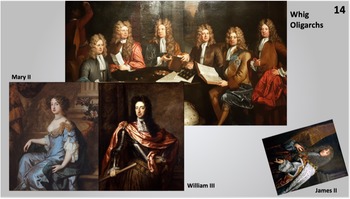
If the origins of a free press were less than glorious, so too were the origins of establishing the primacy of representative governing systems over the long-established principle that some ruled by hereditary right given by God. The Whig oligarchy that brought about the Glorious Revolution in 1688 placed the daughter of the rightful king and her husband on the English throne (Figure 1), because they all agreed that England should remain Protestant. The Whig oligarchs who did this needed a reason, largely after the fact, to justify what they had done. Men like John Locke, who was the client of one of these powerful men, constructed a reasoned argument explaining why, even though the Whig oligarchs had broken their oaths to the rightful king, everyone else in Britain should still obey them. Building on the ideas of Thomas Hobbes, Locke made an argument that bypassed the king, and argued that sovereignty was resident in the people, that they entered into a contract with one another, pooling sovereignty into the hands of the state, in a limited number of areas, for their mutual benefit.
Slide 14 from the 2025 Tallahassee Pridefest Lecture, playfully illustrating the politics of the Glorious Revolution. Centre: John James Baker, The Whig Junto, 1710, oil on canvas, Wikimedia Commons; Left: Peter Lely, Portrait of Mary II when Princess of Orange, c. 1677–1680, oil on canvas, Wikimedia Commons; Middle: Godfrey Kneller, Portrait of William III of Orange, c. 1690, oil on canvas, Wikimedia Commons; Right: School of Peter Lely, James II (1633–1701), Wearing Garter Robes, between 1650 and 1675, oil on canvas, Wikimedia Commons.

It was a wonderful set of ideas, but largely only window dressing for the Whig oligarchs in Parliament who controlled the system for their own purposes. The English people were taxed more thoroughly than any other population in Europe for the rest of the eighteenth century, to fund decade after decade of warfare with France, and to build Britain's wealth and commercial dominance. And yet, those early eighteenth-century Whig oligarchs in Britain had to at least pay lip service to the ideas of men like Locke on what the nature of government should be, to justify their own usurpation of royal authority, and they had to allow the free circulation of ideas, because information had to flow to keep commerce robust.
And it was in these spaces, in the early eighteenth century, that our revolution began to take hold. It began with the feminists—some of the first individuals to take advantage of the free circulation of ideas and underlying logic of Locke's Enlightenment political theory to argue that by the ideas that justified the government after the Glorious Revolution, women should also be included on more equal terms as citizens. When Mary Astell asked why “If all Men are born free, how is it that all Women are born slaves?,” she may not have meant exactly what we assume when we hear that question today. Indeed, the economic and social privileges she enjoyed allowed her voice to be heard while so many others were silenced. Yet her arguments were vital: they were read by others, developed, expanded, and shared.Footnote 5 These Enlightenment ideals of individual equality were also used to challenge the Atlantic slave trade. The case of James Somerset stands as the paradigmatic example as it resulted in the lord chief justice of Britain's declaration that slaves were also rights-bearing British subjects, and that Caribbean slavery was uniquely onerous to human dignity.
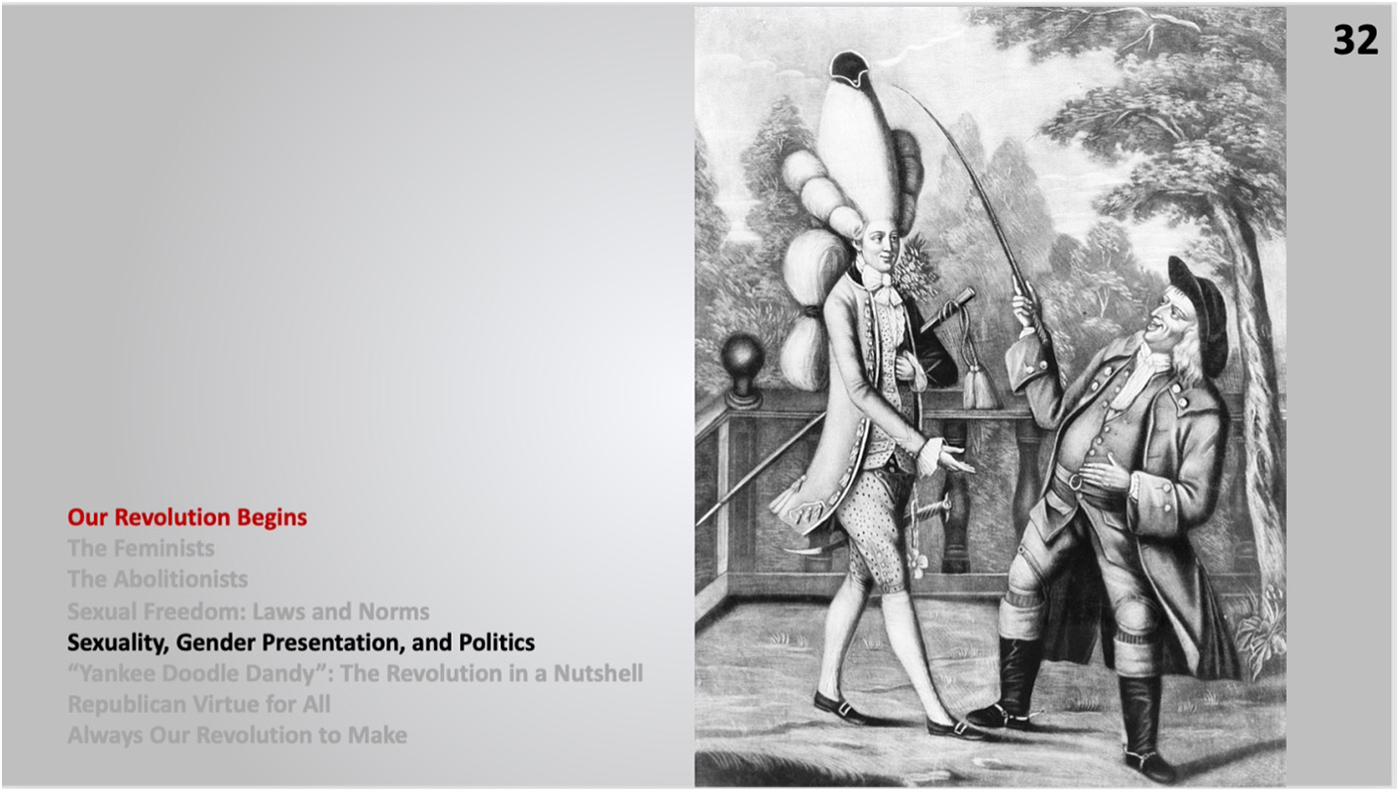
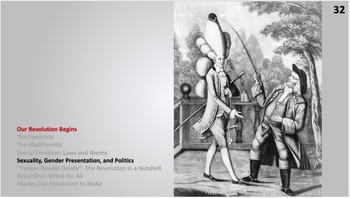
Throughout the eighteenth century, individuals used these same ideas to argue that they had the right to do as they pleased with their own bodies. Texts and images focused on same-sex desire circulated in the public sphere and provoked a range of reactions, from vitriolic hostility to sometimes only mild disdain. The macaroni style of dress (exaggerated in the depiction in Figure 2), as adopted by fashionable men in this period, could indicate refinement and class status, but also sexual ambiguity when executed in particular ways. Even when same-sex desire was not implicated, excessive attention to fashion could indicate a lack of masculine self-control, which at the time was a serious political critique. The juxtaposition of rural simplicity and courtly refinement was a central political metaphor in the mid-eighteenth century, both in Britain itself, as well as in the Thirteen Colonies. Present-day Americans are often surprised to learn that there was a significant contingent in Britain who agreed with the colonists’ critique of the British ruling class and felt that if the British government could raise revenue illegally in the colonies, then that revenue could be used to suppress liberties back in Britain itself.
Slide 32 from the 2025 Tallahassee Pridefest Lecture, illustrating the progress in the topics covered, and an exaggerated depiction of contrasting masculine styles. What is this my son Tom [mezzotint] (London: published by R. Sayer & J. Bennett, 1774). British Cartoon Prints Collection (Library of Congress).
This contest over masculine gender norms in relation to luxury had a further political component. The British upper class were aware that excess wealth could lead to decadence, corruption, and bad government, as this was the lesson they took from the fall of the Roman Republic. Many Britons feared that wealth from the Caribbean, or from newly conquered territories in India, might likewise lead to corruption and despotism, even as the state itself was fostering expanded consumption and the indulgence in luxury, for the tax revenue it brought in. The solution to this offered by the Whig oligarchs, and the reason they gave for why only they should run the state, was their virtue, which resulted from generations of breeding and privilege. A refined upper-class person, they said, from a family steeped in such privilege for generations, had the fortitude to be exposed to luxury and not be corrupted. A lower-class person, with no such experience, would be far more easily overwhelmed in similar circumstances.
Enlightenment political theory, on the other hand, held out a more democratic solution. All people were born the same, and could be educated in their lifetimes to rule themselves. Republics can only function with republicans, individuals who educate and discipline themselves to be self-governing. And every major political thinker of the period who theorized a state where people ruled themselves, also had a theory of educating individuals to forge the kind of person who could exercise the self-control that would make a republic possible. A king said it was your blood that made a ruler, an oligarch said it was your breeding, but Locke, Jean-Jacques Rousseau, and Mary Wollstonecraft said you made yourself into what you needed to be to participate in the running of the state.Footnote 6
There was, however, a flip side to the Enlightenment self-governing individual—the cautionary “other” of where all this freedom might lead: the chronic masturbator, who caused a moral panic in the eighteenth century. The freedom to pursue your own happiness, without having to defer to the laws of the king, or the morals of the Bible, it was widely feared, might lead folks to become exhausted, antisocial, self-pleasurers. As Henry Abelove has argued, this was implicit in the early British versions of “Yankee Doodle Dandy,” which critiqued unsophisticated Americans whose lack of self-control led to unseemly political rebellion, as well as sexual self-indulgence.Footnote 7 The song became so widespread because the colonists claimed the critique as a badge of honor, professing a manly vigor based on their enlightened natural simplicity that the foppish aristocrats of England could not match, which gave them more than enough vitality to both rule themselves politically and enjoy moderate natural pleasures. In this moment, in these ways, political freedom and sexual freedom were linked, interconnected components of liberal individualism.
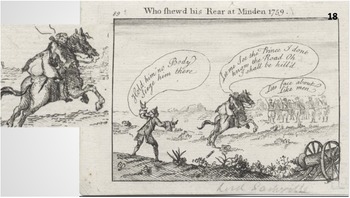
This contrast between “republican” and “courtier” styles of masculinity also played out in how individuals might express or understand same-sex desire. Two upper-class individuals on opposite sides of the conflict—Lord George Germain (1st Viscount Sackville) (Figure 3) and Friedrich Wilhelm von Steuben—were each known within elite circles for their same-sex attractions. While conclusive evidence of either man's sexual acts, or how they thought about themselves in relation to those acts, is not recorded, much can be learned from examining how the men around them understood and reacted to them.
Slide 18 from the 2026 Tallahassee Pridefest Lecture. Cartoon critiquing George Germain (Lord Sackville) with inset emphasizing his exposed buttocks. Who shewd his reaer at Minden 1759 (graphic). Caricatures and Cartoons, Satires (Visual Works) England 1759, Etchings England London 1759, Book illustrations, publisher not identified, Lewis Walpole Library.
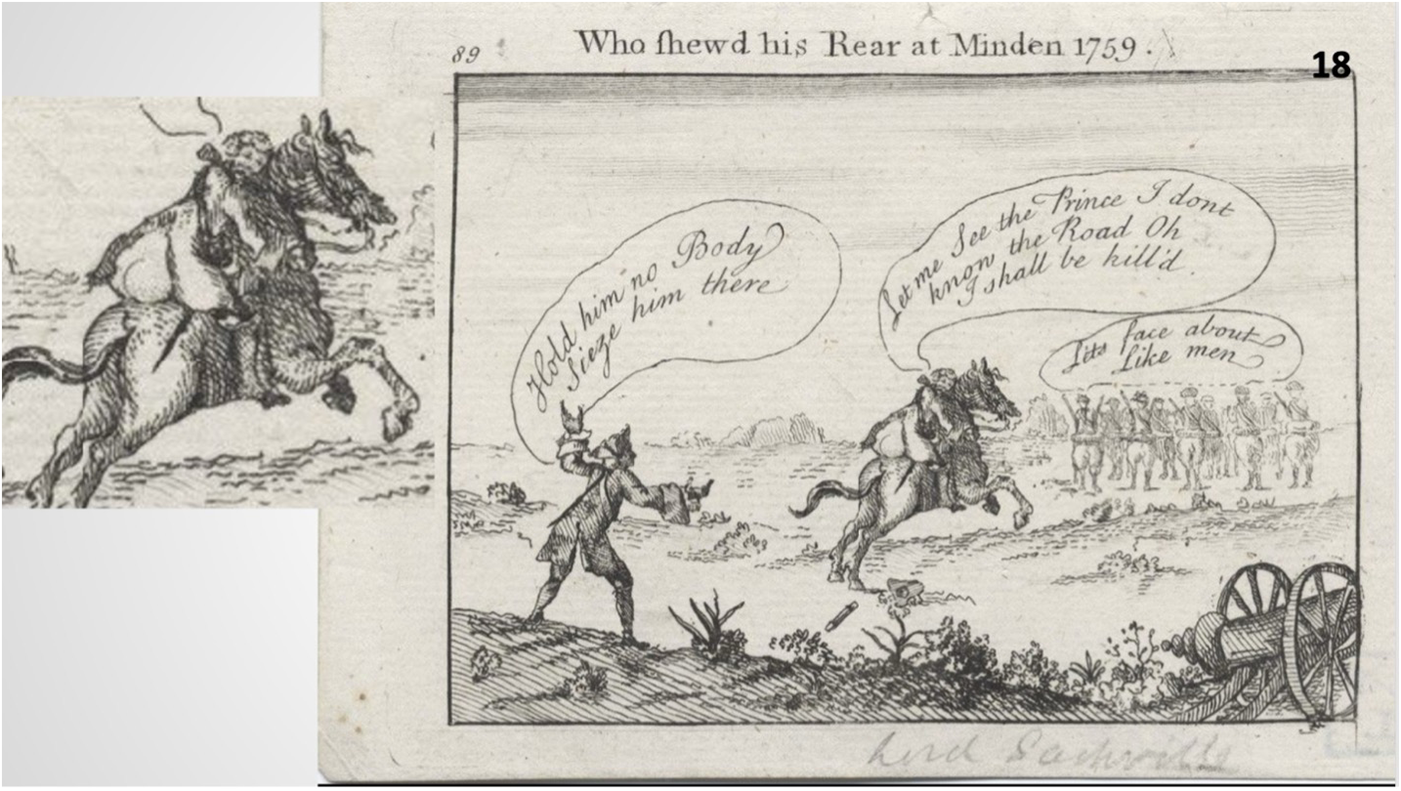
George Germain is remembered primarily for two failures: his actions at the Battle of Minden in 1759, for which some defended him and others branded him a coward, and his management of the American War of Independence, as secretary of state for the American Department, from 1775 to 1782. Although he was married and fathered five children, Germain was frequently the subject of gossip regarding his intimate relationships with men. The most explicit contemporary allegations stemmed from his time in Ireland before his marriage. But the most significant relationship defining Germain's later years was with Benjamin Thompson (later Count Rumford), an American loyalist who fled to London and quickly secured a position as Germain's under-secretary of state. The speed of Thompson's ascent and the intimacy of the two men's domestic arrangements—they lived together and reportedly ate every meal together—fueled widespread speculation. The future Marquess Wellesley derisively referred to the young American as “Sir Sodom Thompson, Lord Sackville's under Secretary,” although it is difficult to disentangle the frequent public attacks on Germain's sexual tastes (to use the eighteenth-century term) from the attacks on his competence.Footnote 8 Ultimately, Germain's story shows what might be seen as a form of courtier inclusion. So long as an individual remained loyal to the king, and in his favor, rules of convention need not be an insurmountable barrier to acting on one's desires.
Friedrich Wilhelm von Steuben's inclusion in revolutionary circles was based on different premises. He had served as an aide-de-camp to Frederick the Great in the Seven Years’ War, and was later part of a group of thirteen young officers personally trained by Frederick. More than a decade after being dismissed from the Prussian military for reasons that may have been related to his sexual tastes, von Steuben eventually arrived in Paris in search of a new commission, where he met Benjamin Franklin, the American ambassador. Franklin gave von Steuben a glowing recommendation to Washington, despite being aware of what was said about von Steuben's sexual interests being directed toward young men. At Valley Forge, in addition to reforming the Continental Army, von Steuben formed an intense bond with two young men who became his aides-de-camp: William North and Benjamin Walker. Extensive surviving correspondence between von Steuben, North, and Walker provides the strongest written evidence of the intimacy between them.Footnote 9 The three men lived together at Valley Forge and elsewhere after the war, continuing their close ties even after both Walker and North married and had children. After John Mulligan, a recent Columbia College graduate, was hired to be von Steuben's secretary and companion in his final years, Walker and North remained frequent visitors, with von Steuben adopting both men to ensure that his estate in upstate New York went to them and not his European relatives.
When analyzing the reasons for von Steuben's acceptance within the Continental Army, aside from his military skill, evidence suggests something similar to what John McCurdy found in his recent study of Robert Newburgh, an Anglican priest in the British Army stationed in Pennsylvania on the eve of the American Revolution.Footnote 10 Rumors spread that Newburgh was a sodomite. But since he was an officer, and had been accused by another officer, this was not a simple situation to resolve. As each man's honor had to be respected, a commission of inquiry was held where dozens of individuals were questioned about what they understood of Newburgh's behavior, dress, and overall character, as well as that of his accuser. One of McCurdy's most important findings was that those who were sympathetic to the Enlightenment ideals that inspired colonial rebellion were also more likely to support the right of an individual to do as they pleased with their own body. Limited government meant anything not explicitly ceded to authorities remained in the private realm of the individual, and those who accepted the political side of that argument were also, it seems, sometimes more likely to accept the personal side. While courtier inclusion allowed individuals to discreetly engage in acts widely deemed immoral, revolutionary inclusion was precisely that because it represented the beginnings of something new: a public way to argue that such behavior might not be wrong at all. What was needed was not just the argument itself, though, but also the broader cultural context wherein such an argument made logical sense to a broad proportion of the society. That context became more firmly established though the American Revolution, with succeeding generations working to expand, improve, and preserve that context.
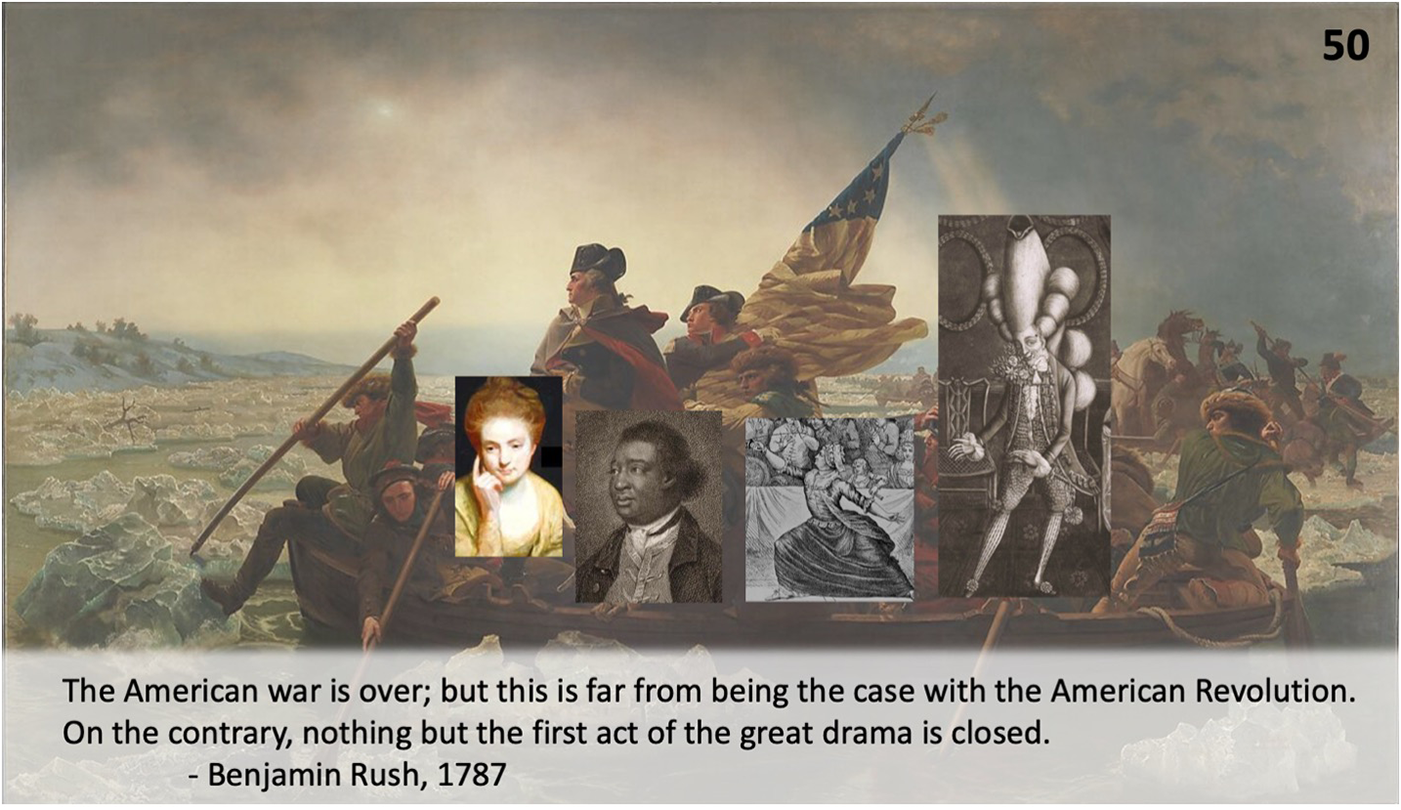
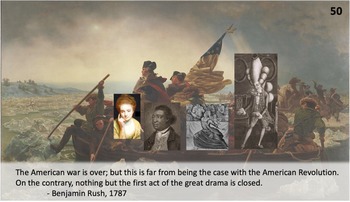
These examples do not exhaust the ways in which individuals might think of themselves in relation to their desires in this period. The most dominant way of understanding the self in relation to same-sex desire was still that propagated by the Church of England, and the challenges to this way of thinking were scattered and disconnected. The essence of the Enlightenment form of critique was that individuals might make use of the ever-increasing texts that publicly circulated to think about themselves, and their relationship to society, in new ways. Enlightenment ideas allowed individuals to imagine their internal desires as natural, and the liberal public sphere allowed inherited understandings to be questioned and subjected to the test of reason. Debate within the public sphere could shift opinions on even the most intractable issues, providing the basis for future political change. While some individuals continued to voice public support for the death penalty for sodomy throughout the eighteenth century, more moderate views were increasingly articulated as the decades progressed, especially in relation to the idea that individuals had the right to do as they pleased with their own bodies, so long as no one was hurt. Rather than looking at this in isolation, my forthcoming book “Called it Macaroni” seeks to link this critique of existing practice to the range of ways in which Enlightenment ideals were used in the public sphere, shaping critiques of unethical practices around race, gender, and taxation, as well as the intrusive regulation of sexual tastes, in the eighteenth century (Figure 4).
Slide 50 from the 2025 Tallahassee Pridefest Lecture. Images representing feminists, abolitionists, individuals who trans gender, and effeminate “macaronis,” each referenced earlier in the lecture, are placed in the same boat as George Washington and other revolutionaries. Main image: Emanuel Leutze, Washington Crossing the Delaware, 1851, oil on canvas. Wikimedia Commons; Left: Joshua Reynolds, Bildnisstudie einer jungen Dame. C. 1760–1765, oil on canvas, Wikimedia Commons; Centre left: Francesco Bartolozzi, after Thomas Gainsborough, Ignatius Sancho, 1802, print, Wikimedia Commons; Centre right: Victor Marie Picot, after a painting by Charles Jean Robineau, The Assaut, or Fencing Match, which took place at Carlton House on the 9th of April 1787, between Mademoiselle La chevalière D'EON DE Beaumont and Monsieur DE SAINT GEORGE, 1789, stipple engraving, Wikimedia Commons; Right: Philip Dawe. The Macaroni. A Real Character at the Late Masquerade, 1773, mezzotint, Wikimedia Commons; Quotation: L. H. Butterfield (ed.), The Letters of Benjamin Rush, vol. 1, 1761–1792 (Princeton, 1951), lxviii.
Rather than an attempt to queer the American Revolution, this research demonstrates how the basis for LGBTQ inclusion is inherent within the revolution itself. In the eighteenth century, the liberal critique was the radical critique. Critiques of injustice, in relation to taxation, to the legal disabilities placed on women, and to the enslavement of people and their continued unequal treatment because of race, have been and remain grounded in the same set of ideas first haltingly proposed in 1688, and more firmly established (if in a severely compromised form) in 1776. Historians need to not only trace the interconnected logics of these critiques, but also to track the emergence of the liberal political context within which such critiques might eventually catalyze meaningful change. By examining together critiques of injustice that are usually addressed separately, this work reinforces the power and importance of the liberal contexts that began to be established in the later seventeenth century, and calls attention to the investment that we all have in preserving those frameworks and contexts through which meaningful change can be, and has been, achieved.
Charles Upchurch is a Professor of British history at Florida State University. He is the author of “Beyond the Law”: The Politics of Ending the Death Penalty for Sodomy in Britain (Temple University Press, 2021) and Before Wilde: Sex Between Men in Britain's Age of Reform (University of California Press, 2009). He has served as a Distinguished Academic Patron of LGBT History Month in the UK, and as the President of the Southern Conference on British Studies. He would like to thank Nadja Durbach for her extensive comments on the initial draft of this article, and the organizers of Tallahassee Pridefest, who put together an amazing week of events every year, celebrating the vibrancy, inclusiveness, and importance of the LGBTQ+ community in Florida's capital. Thoughts or comments on any of the points raised in this article that might improve these lectures, or the book that builds from them, are greatly appreciated. Please address any correspondence to: cupchurch@fsu.edu.

 Open access

