
Hostname: page-component-8678677fb7-q5qzn Total loading time: 0 Render date: 2026-10-08T13:15:47.230Z Has data issue: false hasContentIssue false

Wettability and Lenormand's diagram

Published online by Cambridge University Press:  02 August 2021

Bauyrzhan K. Primkulov
Affiliation:
Department of Civil and Environmental Engineering, Massachusetts Institute of Technology, Cambridge, MA 02139, USA
Amir A. Pahlavan
Affiliation:
Department of Mechanical Engineering and Materials Science, Yale University, New Haven, CT 06511, USA
Xiaojing Fu
Affiliation:
Department of Mechanical and Civil Engineering, California Institute of Technology, Pasadena, CA 91125, USA
Benzhong Zhao
Affiliation:
Department of Civil Engineering, McMaster University, Hamilton, ON, L8S 4L7, Canada
Christopher W. MacMinn
Affiliation:
Department of Engineering Science, University of Oxford, Oxford OX1 3PJ, UK
Ruben Juanes*
Affiliation:
Department of Civil and Environmental Engineering, Massachusetts Institute of Technology, Cambridge, MA 02139, USA
*
†Email address for correspondence: juanes@mit.edu

Abstract

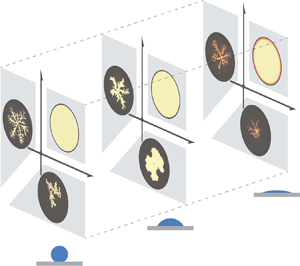
Fluid–fluid displacement in porous media has been viewed through the lens of Lenormand's phase diagram since the late 1980s. This diagram suggests that the character of the flow is controlled by two dimensionless parameters: the capillary number and the viscosity ratio. It is by now well known, however, that the wettability of the system plays a key role in determining the pore-scale displacement mechanisms and macroscopic invasion patterns. Here, we endow Lenormand's diagram with the impact of wettability using dynamic and quasi-static pore-network models. By using the fractal dimension and the ratio of characteristic viscous and capillary pressures we delineate the five principal displacement regimes within the extended phase diagram: stable displacement, viscous fingering, invasion percolation, cooperative pore filling and corner flow. We discuss the results in the context of pattern formation, displacement-front dynamics, pore-scale disorder and displacement efficiency.

Information

Type
JFM Papers
Copyright
© The Author(s), 2021. Published by Cambridge University Press

Access options

Get access to the full version of this content by using one of the access options below. (Log in options will check for institutional or personal access. Content may require purchase if you do not have access.)