




No CrossRef data available.
Article contents
Interfacial plasticity governs strain delocalization in metallic nanoglasses
Published online by Cambridge University Press: 11 April 2019
Abstract
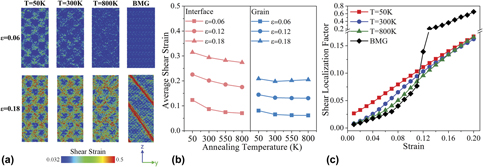
Intrinsic size effects in nanoglass plasticity have been connected to the structural length scales imposed by the interfacial network, and control over this behavior is critical to designing amorphous alloys with improved mechanical response. In this paper, atomistic simulations are employed to probe strain delocalization in nanoglasses with explicit correlation to the interfacial characteristics and length scales of the amorphous grain structure. We show that strength is independent of grain size under certain conditions, but scales with the excess free volume and degree of short-range ordering in the interfaces. Structural homogenization upon annealing of the nanoglasses increases their strength toward the value of the bulk metallic glass; however, continued partitioning of strain to the interfacial regions inhibits the formation of a primary shear band. Intrinsic size effects in nanoglass plasticity thus originate from biased plastic strain accumulation within the interfacial regions, which will ultimately govern strain delocalization and homogenous flow in nanoglasses.
Keywords
Information
- Type
- Invited Paper
- Information
- Journal of Materials Research , Volume 34 , Issue 13: Focus Issue: Intrinsic and Extrinsic Size Effects in Materials , 15 July 2019 , pp. 2325 - 2336
- Copyright
- Copyright © Materials Research Society 2019
References
Jing, J., Kramer, A., Birringer, R., Gleiter, H., and Gonser, U.: Modified atomic-structure in a Pd–Fe–Si nanoglass—A mossbauer study. J. Non-Cryst. Solids 113, 167 (1989).CrossRefGoogle Scholar
Gleiter, H.: Nanoglasses: A new kind of noncrystalline materials. Beilstein J. Nanotechnol. 4, 517 (2013).CrossRefGoogle ScholarPubMed
Fang, J.X., Vainio, U., Puff, W., Wurschum, R., Wang, X.L., Wang, D., Ghafari, M., Jiang, F., Sun, J., Hahn, H., and Gleiter, H.: Atomic structure and structural stability of Sc75Fe25 nanoglasses. Nano Lett. 12, 458 (2012).CrossRefGoogle ScholarPubMed
Chen, N., Louzguine-Luzgin, D.V., Xie, G.Q., Sharma, P., Perepezko, J.H., Esashi, M., Yavari, A.R., and Inoue, A.: Structural investigation and mechanical properties of a representative of a new class of materials: Nanograined metallic glasses. Nanotechnology 24, 045610 (2013).CrossRefGoogle ScholarPubMed
Chen, N., Frank, R., Asao, N., Louzguine-Luzgin, D.V., Sharma, P., Wang, J.Q., Xie, G.Q., Ishikawa, Y., Hatakeyama, N., Lin, Y.C., Esashi, M., Yamamoto, Y., and Inoue, A.: Formation and properties of Au-based nanograined metallic glasses. Acta Mater. 59, 6433 (2011).CrossRefGoogle Scholar
Guo, C., Fang, Y., Wu, B., Lan, S., Peng, G., Wang, X-l., Hahn, H., Gleiter, H., and Feng, T.: Ni–P nanoglass prepared by multi-phase pulsed electrodeposition. Mater. Res. Lett. 5, 293 (2017).CrossRefGoogle Scholar
Cao, Q.P., Liu, J.W., Yang, K.J., Xu, F., Yao, Z.Q., Minkow, A., Fecht, H.J., Ivanisenko, J., Chen, L.Y., Wang, X.D., Qu, S.X., and Jiang, J.Z.: Effect of pre-existing shear bands on the tensile mechanical properties of a bulk metallic glass. Acta Mater. 58, 1276 (2010).CrossRefGoogle Scholar
Shao, H., Xu, Y., Shi, B., Yu, C., Hahn, H., Gleiter, H., and Li, J.: High density of shear bands and enhanced free volume induced in Zr70Cu20Ni10 metallic glass by high-energy ball milling. J. Alloys Compd. 548, 77 (2013).CrossRefGoogle Scholar
Ritter, Y., Sopu, D., Gleiter, H., and Albe, K.: Structure, stability and mechanical properties of internal interfaces in Cu64Zr36 nanoglasses studied by MD simulations. Acta Mater. 59, 6588 (2011).CrossRefGoogle Scholar
Adjaoud, O. and Albe, K.: Interfaces and interphases in nanoglasses: Surface segregation effects and their implications on structural properties. Acta Mater. 113, 284 (2016).CrossRefGoogle Scholar
Adjaoud, O. and Albe, K.: Microstructure formation of metallic nanoglasses: Insights from molecular dynamics simulations. Acta Mater. 145, 322 (2018).CrossRefGoogle Scholar
Witte, R., Feng, T., Fang, J.X., Fischer, A., Ghafari, M., Kruk, R., Brand, R.A., Wang, D., Hahn, H., and Gleiter, H.: Evidence for enhanced ferromagnetism in an iron-based nanoglass. Appl. Phys. Lett. 103, 073106 (2013).CrossRefGoogle Scholar
Chen, N., Wang, D., Feng, T., Kruk, R., Yao, K-F., Louzguine-Luzgin, D.V., Hahn, H., and Gleiter, H.: A nanoglass alloying immiscible Fe and Cu at the nanoscale. Nanoscale 7, 6607 (2015).CrossRefGoogle ScholarPubMed
Wang, J.Q., Chen, N., Liu, P., Wang, Z., Louzguine-Luzgin, D.V., Chen, M.W., and Perepezko, J.H.: The ultrastable kinetic behavior of an Au-based nanoglass. Acta Mater. 79, 30 (2014).CrossRefGoogle Scholar
Wang, X.L., Jiang, F., Hahn, H., Li, J., Gleiter, H., Sun, J., and Fang, J.X.: Plasticity of a scandium-based nanoglass. Scr. Mater. 98, 40 (2015).CrossRefGoogle Scholar
Li, F.C., Wang, T.Y., He, Q.F., Sun, B.A., Guo, C.Y., Feng, T., and Yang, Y.: Micromechanical mechanism of yielding in dual nano-phase metallic glass. Scr. Mater. 154, 186 (2018).CrossRefGoogle Scholar
Schuh, C.A., Hufnagel, T.C., and Ramamurty, U.: Mechanical behavior of amorphous alloys. Acta Mater. 55, 4067 (2007).CrossRefGoogle Scholar
Gleiter, H., Schimmel, T., and Hahn, H.: Nanostructured solids—From nano-glasses to quantum transistors. Nano Today 9, 17 (2014).CrossRefGoogle Scholar
Schuh, C.A. and Nieh, T.G.: A nanoindentation study of serrated flow in bulk metallic glasses. Acta Mater. 51, 87 (2003).CrossRefGoogle Scholar
Sopu, D., Ritter, Y., Gleiter, H., and Albe, K.: Deformation behavior of bulk and nanostructured metallic glasses studied via molecular dynamics simulations. Phys. Rev. B 83, 100202 (2011).CrossRefGoogle Scholar
Adibi, S., Branicio, P.S., Zhang, Y-W., and Joshi, S.P.: Composition and grain size effects on the structural and mechanical properties of CuZr nanoglasses. J. Appl. Phys. 116, 043522 (2014).CrossRefGoogle Scholar
Cheng, B. and Trelewicz, J.R.: Controlling interface structure in nanoglasses produced through hydrostatic compression of amorphous nanoparticles. Phys. Rev. Mater. 3, 035602 (2019).CrossRefGoogle Scholar
Wang, C.C., Ding, J., Cheng, Y.Q., Wan, J.C., Tian, L., Sun, J., Shan, Z.W., Li, J., and Ma, E.: Sample size matters for Al88Fe7Gd5 metallic glass: Smaller is stronger. Acta Mater. 60, 5370 (2012).CrossRefGoogle Scholar
Ghidelli, M., Gravier, S., Blandin, J.J., Djemia, P., Mompiou, F., Abadias, G., Raskin, J.P., and Pardoen, T.: Extrinsic mechanical size effects in thin ZrNi metallic glass films. Acta Mater. 90, 232 (2015).CrossRefGoogle Scholar
Kumar, G., Desai, A., and Schroers, J.: Bulk metallic glass: The smaller the better. Adv. Mater. 23, 461 (2011).CrossRefGoogle Scholar
Wang, X., Jiang, F., Hahn, H., Li, J., Gleiter, H., Sun, J., and Fang, J.: Sample size effects on strength and deformation mechanism of Sc75Fe25 nanoglass and metallic glass. Scr. Mater. 116, 95 (2016).CrossRefGoogle Scholar
Şopu, D. and Albe, K.: Influence of grain size and composition, topology and excess free volume on the deformation behavior of Cu–Zr nanoglasses. Beilstein J. Nanotechnol. 6, 537 (2015).CrossRefGoogle Scholar
Adibi, S., Sha, Z-D., Branicio, P.S., Joshi, S.P., Liu, Z-S., and Zhang, Y-W.: A transition from localized shear banding to homogeneous superplastic flow in nanoglass. Appl. Phys. Lett. 103, 211905 (2013).CrossRefGoogle Scholar
Adibi, S., Branicio, P.S., and Joshi, S.P.: Suppression of shear banding and transition to necking and homogeneous flow in nanoglass nanopillars. Sci. Rep. 5, 15611 (2015).CrossRefGoogle ScholarPubMed
Franke, O., Leisen, D., Gleiter, H., and Hahn, H.: Thermal and plastic behavior of nanoglasses. J. Mater. Res. 29, 1210 (2014).CrossRefGoogle Scholar
Cubuk, E.D., Ivancic, R.J.S., Schoenholz, S.S., Strickland, D.J., Basu, A., Davidson, Z.S., Fontaine, J., Hor, J.L., Huang, Y-R., Jiang, Y., Keim, N.C., Koshigan, K.D., Lefever, J.A., Liu, T., Ma, X-G., Magagnosc, D.J., Morrow, E., Ortiz, C.P., Rieser, J.M., Shavit, A., Still, T., Xu, Y., Zhang, Y., Nordstrom, K.N., Arratia, P.E., Carpick, R.W., Durian, D.J., Fakhraai, Z., Jerolmack, D.J., Lee, D., Li, J., Riggleman, R., Turner, K.T., Yodh, A.G., Gianola, D.S., and Liu, A.J.: Structure–property relationships from universal signatures of plasticity in disordered solids. Science 358, 1033 (2017).CrossRefGoogle ScholarPubMed
Cheng, Y.Q., Cao, A.J., Sheng, H.W., and Ma, E.: Local order influences initiation of plastic flow in metallic glass: Effects of alloy composition and sample cooling history. Acta Mater. 56, 5263 (2008).CrossRefGoogle Scholar
Schiotz, J., Vegge, T., Di Tolla, F.D., and Jacobsen, K.W.: Atomic-scale simulations of the mechanical deformation of nanocrystalline metals. Phys. Rev. B 60, 11971 (1999).CrossRefGoogle Scholar
Cheng, B. and Trelewicz, J.R.: Design of crystalline-amorphous nanolaminates using deformation mechanism maps. Acta Mater. 153, 314 (2018).CrossRefGoogle Scholar
Argon, A.S.: Plastic deformation in metallic glasses. Acta Metall. 27, 47 (1979).CrossRefGoogle Scholar
Shi, Y.F. and Falk, M.L.: Atomic-scale simulations of strain localization in three-dimensional model amorphous solids. Phys. Rev. B 73, 214201 (2006).CrossRefGoogle Scholar
Plimpton, S.: Fast parallel algorithms for short-range molecular dynamics. J. Comput. Phys. 117, 1 (1995).CrossRefGoogle Scholar
Mendelev, M.I., Sordelet, D.J., and Kramer, M.J.: Using atomistic computer simulations to analyze X-ray diffraction data from metallic glasses. J. Appl. Phys. 102, 043501 (2007).CrossRefGoogle Scholar
Cheng, Y.Q., Sheng, H.W., and Ma, E.: Relationship between structure, dynamics, and mechanical properties in metallic glass-forming alloys. Phys. Rev. B 78, 014207 (2008).CrossRefGoogle Scholar
Shimizu, F., Ogata, S., and Li, J.: Theory of shear banding in metallic glasses and molecular dynamics calculations. Mater. Trans. 48, 2923 (2007).CrossRefGoogle Scholar
Cheng, Y.Q., Cao, A.J., and Ma, E.: Correlation between the elastic modulus and the intrinsic plastic behavior of metallic glasses: The roles of atomic configuration and alloy composition. Acta Mater. 57, 3253 (2009).CrossRefGoogle Scholar
Stukowski, A.: Visualization and analysis of atomistic simulation data with OVITO-the Open Visualization Tool. Modell. Simul. Mater. Sci. Eng. 18, 015012 (2010).CrossRefGoogle Scholar
- 17
- Cited by