


1 Introduction
Let
$F=F_0$
 be a number field and fix a prime
$p$
 . Consider a tower of fields

such that
$F_n/F$
 is Galois with
$\mathrm {Gal}(F_n/F)\simeq \mathbb {Z}/p^n\mathbb {Z}$
 and
$\mathrm {Gal}(F_\infty /F) \simeq \varprojlim \mathbb {Z}/p^n\mathbb {Z} = \mathbb {Z}_p$
 . K. Iwasawa proved an asymptotic formula for the growth of the
$p$
 -part of the class group in such a tower; see [Reference IwasawaIwa59, Theorem 11]. More precisely, he showed that for
$n\gg 0$
 ,

where
$\mu $
 ,
$\lambda $
 are nonnegative integers and
$\nu $
 is an integer, all of which are independent of
$n$
 . Here, we write
$\mathrm {ord}_p(\cdot )$
 to mean the
$p$
 -adic order (or the
$p$
 -adic valuation).
In the last couple of years, this theory was generalized to unramified coverings of finite connected graphs; see for example [Reference DuBose and VallièresDV23, Reference GonetGon22, Reference McGown and VallièresMV23, Reference McGown and VallièresMV24, Reference VallièresVal21] including in the non-commutative setting [Reference Kleine and MüllerKM23]. More recently, Gambheera and Vallières [Reference Gambheera and VallièresGV24] considered branched
$\mathbb {Z}_p$
 -coverings of finite connected graphs, that is, coverings where at least one of the vertices is ramified. Let

be a tower of branched coverings such that the group
$\mathbb {Z}/p^n\mathbb {Z}$
 acts without inversion on the graph
$X_n$
 . Let
$\pi _n\colon X_n\to X$
 be the covering map. We always assume that
$\pi _n\circ g=\pi _n$
 for all
$g\in \mathbb {Z}/p^n\mathbb {Z}$
 and, to simplify notation, we say that
$\mathbb {Z}/p^n\mathbb {Z}$
 acts on
$X_n$
 . Assume that all graphs
$X_n$
 are connected and denote the number of spanning trees of
$X_n$
 by
$\kappa (X_n)$
 , then (see for example, [Reference GonetGon22, Theorem 1.1] when the graph-coverings are unbranched and [Reference Gambheera and VallièresGV24, Theorem 5.6] when the graph-coverings are branched)

For a finite connected graph, the Kirchhoff matrix theorem asserts that the number of spanning trees coincides with the size of the Jacobian; see Section 2.2 for a precise definition. If a group
$G$
 acts on
$X_n$
 , it also acts naturally on the Jacobian, denoted by
$\mathrm {Jac}(X_n)$
 , and the Picard group, denoted by
$\mathrm {Pic}(X_n)$
 , turning both these groups into Iwasawa modules. Assume that
$X_\infty /X$
 is a branched covering obtained from a voltage assignment; see Section 2.4 for details on how such a graph is constructed. Each such voltage assignment also induces an unramified tower of coverings
$X_\infty ^{\mathrm {unr}}/X$
 together with an immersion

In [Reference Gambheera and VallièresGV24], the authors describe the characteristic ideal of
$\varprojlim _n \mathrm {Pic}(X_n)\otimes \mathbb {Z}_p$
 in terms of a linear operator defined on
$\varprojlim _n \mathrm {Div}(X_n)\otimes \mathbb {Z}_p$
 . In the special case when
$X_\infty = X_\infty ^{\mathrm {unr}}$
 is an unramified cover of
$X$
 , their result recovers the Iwasawa main conjecture (IMC) proved by the second-named author and S. Kleine in [Reference Kleine and MüllerKM24].
1.1 Our results
The first objective of the present article is to generalize the aforementioned theorem on branched coverings to
$\mathbb {Z}_p^d$
 -coverings of
$X$
 , where
$d\ge 1$
 ; see Theorem 4.7. By
${\mathbb Z}^d_p$
 we mean
$d$
 -many copies of
${\mathbb Z}_p$
 . If there is a need for clarification, we may also refer to this as
${\mathbb Z}^{\oplus d}_p$
 .
Theorem. Let
$X_\infty $
 denote a
$\mathbb {Z}_p^d$
 (ramified) derived graph of
$X$
 coming from a voltage assignment. Then, there exists an explicit linear operator
$\Delta $
 on
$\mathrm {Div}_\Lambda (X_\infty ^{\mathrm {unr}})$
 such that

Furthermore, we prove an asymptotic formula for the number of spanning trees of the intermediate graphs of
$\mathbb {Z}_p^d$
 -covers in Theorem 4.16 when
$d\geq 2$
 .
Theorem. Let
$X_\infty $
 be as in the previous theorem and let
$X_n/X$
 be the intermediate graphs. Then, there exist nonnegative constants
$\mu $
 and
$\lambda $
 (independent of
$n$
 ) such that

In the last section of this paper, we initiate the study of covers of dual (planar) graphs; see Theorem 5.3.
Theorem. Let
$X_\infty /X$
 be a branched
$\mathcal {G}$
 -cover, where
$\mathcal {G}$
 is a uniform pro-
$p\, p$
 -adic Lie group. Assume that all
$X_n$
 are planar. If
$X_n^\vee /X^\vee $
 is a branched covering for all
$n$
 , then
$X_\infty ^\vee /X^\vee $
 is also a
$\mathcal {G}$
 -cover.
We observe that upon taking the duals of (planar) coverings of a graph, we may not obtain a branched covering of dual graphs. In Section 5.2, we provide conditions to ensure that the hypothesis of the above theorem is satisfied. In particular, we show that
$X_\infty $
 can have at most two ramified vertices if we want the dual tower of coverings to also be a branched cover of
$X^\vee $
 .
1.2 Future directions
This topic of Iwasawa theory of graphs and, in particular, branched coverings of finite connected graphs leaves plenty of room for further investigations, including the ones proposed below.
-
• Even though the operator $\Delta $
 describing the characteristic ideal of
$\mathrm {Pic}_\Lambda (X_\infty )$
generalizes the linear operator appearing in the IMC for the unramified case, it is not clear whether this operator can be interpreted as a
$p$
-adic
$L$
-function in the branched setting as well. In other words, so far, the analytic side of an IMC does not exist in the setting of branched covers. Since the first version of our paper was made public, this question has been studied by Gambheera and Vallières in [Reference Gambheera and VallièresGV26].
-
• The asymptotic formula we prove in Theorem 4.16 for the number of spanning trees in a branched $\mathbb {Z}_p^d$
-covering involves an error term of size
$O(p^{n(d-1)})$
. This error term does not occur in the unramified setting: for an unramified
$\mathbb {Z}_p^d$
-covering, there exists a polynomial
$P(X,Y)\in \mathbb {Z}[X,Y]$
of total degree
$d$
and degree at most
$1$
in
$Y$
such that $$ \begin{align*} \mathrm{ord}_p(\kappa(X_n))=P(p^n,n). \end{align*} $$In a future project, the authors intend to investigate whether it is possible to improve the error term. Recently, Kataoka has studied this question in [Reference KataokaKat26].
-
• It would also be interesting to study a Kida-type formula for the branched $\mathbb {Z}_p^d$
-covers. In the
$d=1$
case, this has been studied by T. Kataoka [Reference KataokaKat25].





1.3 Organization
Section 2 is preliminary in nature. In this section, we collect all the definitions and notation that are used throughout the article. In Section 3, we prove our first result, which provides sufficient conditions for the derived graph of a planar graph to be planar. Section 4 concerns proving Iwasawa theory results for
$\mathbb {Z}_p^d$
 -towers of branched covers of
$X$
 . We prove an asymptotic growth formula in the general setting. We also show that it is possible to interpret the characteristic ideal of
$\mathrm {Pic}_{\Lambda }(X_\infty )$
 as an abstract determinant of an operator on
$\mathrm {Div}_{\Lambda }(X_\infty ^{\mathrm {unr}})$
 . In Section 5, we introduce the study of towers of coverings of dual graphs. Throughout this article, we elucidate our results with explicit examples.
2 Preliminaries
In this section, we collect definitions and set notation that are required for the remainder of the article. We also record some elementary lemmas in this section.
2.1 Basic definitions in graph theory
A graph
$X$
 consists of a vertex set
$V(X)$
 and a set of directed edges
$\mathbb {E}(X)$
 along with an incidence function

and an inversion function

satisfying the following conditions for all
$e \in \mathbb {E}(X)$
 :
-
(i) $\overline {e} \neq e$
; -
(ii) $\overline {\overline {e}} = e$
; -
(iii) $o(\overline {e}) = t(e)$
and
$t(\overline {e}) = o(e)$
.


The vertex
$o(e)$
 is called the origin and the vertex
$t(e)$
 is called the terminus of the directed edge
$e$
 . Given
$v \in V(X)$
 , write

The inversion map induces the bijection

Note that graphs in the above sense are undirected due to the existence of the inversion map. In the following, a graph therefore always denotes an undirected graph. The set of undirected edges is obtained by identifying
$e$
 with
$\overline {e}$
 and is denoted by
$E(X)$
 . Finally, write
$E_v(X)$
 to denote the set of all undirected edges adjacent to
$v$
 . When it is clear from the context to which graph is being referred, we often drop it from the notation of
$E$
 ,
$E_v$
 ,
$\mathbb {E}^o_v$
 ,
$\mathbb {E}^t_v$
 , and
$V$
 .
Definition 2.1. Let
$X$
 and
$Y$
 be graphs. A morphism
$f \colon Y \to X$
 of graphs consists of two functions
$f_V \colon V(Y) \to V(X)$
 and
$f_{\mathbb {E}} \colon \mathbb {E}(Y) \to \mathbb {E}(X)$
 that satisfy the following properties for all
$e \in \mathbb {E}(Y)$
 :
-
(i) $f_V(o(e)) = o(f_{\mathbb {E}}(e))$
; -
(ii) $f_V(t(e)) = t(f_{\mathbb {E}}(e))$
; -
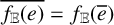
(iii) $\overline {f_{\mathbb {E}}(e)} = f_{\mathbb {E}}(\overline {e})$
.


We write
$f$
 to denote both
$f_V$
 and
$f_{\mathbb {E}}$
 when there is no chance of confusion. Given a morphism of graphs
$f \colon Y \to X$
 and any vertex
$v \in V(Y)$
 , the restriction
$f\vert _{\mathbb {E}^{o}_v(Y)}$
 induces a function

2.2 Jacobian of graphs
Definition 2.2. A divisor on a (possibly infinite) graph
$X$
 is an element of the free abelian group on the vertices
$V (X)$
 defined as

where each
$\sum _{v\in V (X)}a_v v$
 is a formal linear combination of the vertices of
$X$
 with integer coefficients and only finitely many
$a_v$
 are nonzero (when
$X$
 is an infinite graph). When we consider infinite graphs, we require that the graph is locally finite.
The degree homomorphism is defined as

The kernel of this degree map is the subgroup of divisors of degree 0 and is denoted as
$\mathrm {Div}^0(X)$
 .
Write
$\mathcal {M}(X)$
 to denote the set of
$\mathbb {Z}$
 -valued functions on
$V(X)$
 . Define the function
$\psi _v\in \mathcal {M}(X)$
 as follows:

Note that
$\psi _v$
 forms a
$\mathbb {Z}$
 -basis of
$\mathcal {M}(X)$
 as
$v$
 runs over all vertices
$v\in V(X)$
 . We can then define a group morphism

where

Definition 2.3. With notation as introduced above, define the principal divisors on X as

The Picard group of X is then defined as

The Jacobian group of X is defined as

In the literature, this is also referred to as a Picard group of degree zero and denoted by
$\mathrm {Pic}^0(X)$
 .
2.3 Group actions on graphs, Galois theory, and coverings of graphs
Write
$\mathrm {Aut}(X)$
 to denote the group of automorphisms of a graph
$X$
 .
Definition 2.4. Let
$G$
 be a group and
$X$
 be a graph. The group
$G$
 is said to act on X if
$G$
 acts on
$V(X)$
 and
$\mathbb {E}(X)$
 as follows: for
$g\in G$
 , if
$e$
 is an edge from
$v$
 to
$w$
 , then
$g\cdot e$
 is an edge from
$g\cdot v$
 to
$g\cdot w$
 . Moreover, the action is compatible with the inversion map, that is,
$g \cdot \overline {e} = \overline {g \cdot e}$
 . The group
$G$
 is said to act without inversion if for all
$e \in \mathbb {E}(X)$
 and all
$g \in G$
 , one has
$g \cdot e\neq \overline {e}$
 .
Lemma 2.5. Let
$X$
 be a locally finite graph and let
$G$
 be a group acting on
$X$
 without inversion. Then,
$\mathrm {Jac}(X)$
 is a
$\mathbb {Z}[G]$
 -module.
Proof. See [Reference Gambheera and VallièresGV24, Corollary 2.6].
Definition 2.6. Let
$f\colon Y\to X$
 be morphism of graphs that is surjective on the set of edges and on the set of vertices. The morphism
$f$
 is a branched cover if for each vertex
$v\in V(Y)$
 , the cardinality
$m_v= (f\vert _{\mathbb {E}^o_v}^{-1}(e))$
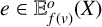
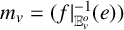 does not depend on the choice of
$e\in \mathbb {E}^o_{f(v)}(X)$
 . The cardinality
$m_v$
 is called the ramification index at
$v$
 . If
$m_v=1$
 , the morphism
$f$
 is said to be an unramified cover.
The function
$f\vert _{\mathbb {E}^o_v} \colon \mathbb {E}^o_v(Y) \to \mathbb {E}^o_{f(v)}(X)$
 is
$m_v$
 -to-
$1$
 . The graph
$Y$
 is called a d-sheeted covering of a connected graph
$X$
 if for all
$w\in V(X)$
 ,

When
$Y$
 is a
$d$
 -sheeted unramified cover of a connected graph
$X$
 , for all
${w\in V(X)}$
 ,

Definition 2.7. Let
$X,Y$
 be connected graphs such that
$Y$
 is a covering of
$X$
 with projection map
$\pi \colon Y \to X$
 .
-
(i) Galois group of unramified covering. Assume $Y/X$
is a
$d$
-sheeted unramified covering such that there are exactly
$d$
graph-automorphisms
$\sigma \colon Y \rightarrow Y$
satisfying
$\pi \circ \sigma = \pi $
; such a covering is called normal or Galois. In this case, the Galois group is
$G$
and is given by $$ \begin{align*} G = \mathrm{Gal}(Y/X) = \{\sigma \colon Y \rightarrow Y \mid \pi \circ \sigma = \pi\}. \end{align*} $$
-
(ii) Galois group of branched covering (see [Reference KataokaKat25, Definition 2.5]). Let $G$
be a finite group. A Galois covering
$Y/X$
with Galois group
$G$
is a morphism
${f : Y \to X}$
equipped with an action of
$G$
on
$Y$
satisfying the following.-
• The action of $G$
on
$Y$
respects
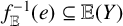
$f : Y \to X$
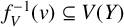
, so the fibers
$f_V^{-1}(v) \subseteq V(Y)$
and
$f_{\mathbb {E}}^{-1}(e) \subseteq \mathbb {E}(Y)$
are
$G$
-stable for each
$v \in V(X)$
and
$e \in \mathbb {E}(X)$
. -
• For each $v \in V(X)$
, the action of
$G$
on
$f_V^{-1} (v)$
is transitive. -
• For each $e \in \mathbb {E}(X)$
, the action of
$G$
on
$f_{\mathbb {E}}^{-1} (e)$
is transitive and free.
-




Remark 2.8. Another way to think about unramified Galois covers and Galois groups is by viewing them as groups of deck transformations. An unramified Galois cover of a finite (connected) graph can be obtained by starting with a finite connected graph
$X$
 and by making a finite group
$G$
 act freely on
$V(X)$
 without inversion. Note that under these hypotheses, the notion of a quotient graph
$G\backslash X$
 makes sense. The natural morphism of graphs
$X \to G\backslash X$
 is an unramified Galois cover with a group of deck transformations isomorphic to
$G$
 . The notion of branched covering relaxes the condition that the action of
$G$
 on vertices is free, but still requires that
$G$
 acts freely (and without inversion) on directed edges.
2.4 Iwasawa theory of pro-
$p$
tower of graphs obtained from a voltage assignment

We describe the construction of uniform pro-
$p\, p$
 -adic Lie extensions of connected graphs. Let
$\mathcal {G}$
 be a (possibly non-Abelian) uniform pro-
$p\, p$
 -adic Lie group of dimension
$d$
 . This means
$\mathcal {G}$
 is topologically generated by
$d$
 elements and has a filtration

such that
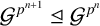
$\mathcal {G}^{p^{n+1}} \trianglelefteq \mathcal {G}^{p^n}$
 and each subsequent quotient is isomorphic to
$(\mathbb {Z}/p\mathbb {Z})^d$
 . When
$\mathcal {G}$
 is abelian, we write
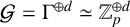
$\mathcal {G} = \Gamma ^{\oplus d} \simeq \mathbb {Z}^{\oplus d}_p$
 , where
$\Gamma $
 is a multiplicative group topologically isomorphic to
$\mathbb {Z}_p$
 .
Let
$X$
 be a finite connected graph with vertex set
$V(X)$
 and set of edges
$\mathbb {E}(X)$
 . We define a voltage assignment function as follows:

For each vertex
$v\in V(X)$
 , choose a closed subgroup
$I_v$
 of
$\mathcal {G}$
 and define the set

This gives a graph
$X_\infty = X(\mathcal {G},\mathcal {I},\alpha )$
 with vertex set equal to the disjoint union

and the collection of directed edges is given by

Let
$g\in \mathcal {G}$
 . The directed edge
$(e,g)$
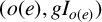
 connects the vertex
$(o(e),gI_{o(e)})$
 to the vertex
$(t(e), g \alpha (e)I_{t(e)})$
 . Finally, let
$\overline {(e, g)} = (\overline {e},g \alpha (e))$
 . This is a branched cover
$X_\infty \to X$
 . Moreover, the graph
$X_\infty $
 is infinite. Note that
$X_\infty $
 is not locally finite.
To get finite graphs, for each positive integer
$n$
 , consider the natural surjective group morphism
$\pi _n \colon \mathcal {G} \twoheadrightarrow \mathcal {G}_n$
 , where
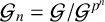
$\mathcal {G}_n = \mathcal {G}/\mathcal {G}^{p^n}$
 . Set
$\alpha _n = \pi _n \circ \alpha \colon \mathbb {E}(X) \to \mathcal {G}_n$
 and define subgroups

of
$\mathcal {G}_n$
 indexed by the vertices of
$X$
 . This gives a family of graphs
$X_n =X(\mathcal {G}_n,I_n,\alpha _n)$
 that are finite. The natural surjective group morphisms
$\mathcal {G}_{n+1} \twoheadrightarrow \mathcal {G}_n$
 induce branched covers
$X_{n+1} \to X_n$
 for each nonnegative integer
$n$
 . Therefore, we obtain a (Galois) tower of graphs

where each map
$X_{n+1} \to X_n$
 is a branched cover satisfying
$[X_{n+1} : X_n] = p^d$
 . Such a tower is referred to as a branched
$\mathcal {G}$
 -tower of finite graphs provided that all
$X_n$
 are connected.
When the closed subgroups
$I_v$
 are all trivial, the graph
$X_\infty = X(\mathcal {G},\alpha )$
 is the unramified
$\mathcal {G}$
 -tower.
We call a vertex
$v\in V(X_n)$
 ramified in
$X_\infty /X_n$
 if
$I_v\cap \mathcal {G}_n$
 is nontrivial. Otherwise, we call
$v$
 unramified.
Lemma 2.9. Let
$(X_n)_{n\in \mathbb {N}}$
 be a
$\mathcal {G}$
 -tower of graphs constructed as above and assume that all
$X_n$
 are connected. Suppose that there exists an index
$n_0$
 such that the number of ramified vertices in
$X_\infty /X_{n_0}$
 stabilizes. Let
$\mathsf {v}_r$
 be the number of ramified vertices and let
$\mathsf {v}_u$
 be the number of unramified vertices of
$X_\infty /X_{n_0}$
 . Then, the number of vertices of
$X_n$
 for
$n\ge n_0 $
 is given by

Proof. When
$n\ge n_0$
 , the vertices of
$X_n$
 ramified in
$X_\infty /X_n$
 and those ramified in
$X_\infty /X_{n_0}$
 are in one-to-one correspondence by the definition of
$n_0$
 . The pre-images of the unramified vertices are given by
$\{(v,g)\mid g\in \mathcal {G}^{p^{n_0}}/\mathcal {G}^{p^n}\}$
 . The claim follows.
2.5 Matrices associated to graphs
We now remind the reader of some matrices associated to graphs that are important throughout the discussion. We often prefer to work with a multiplicative notation, so we write
$\Gamma $
 in place of
$\mathbb {Z}_p$
 .
Definition 2.10. Let
$X$
 be a finite connected graph. Let
$\alpha $
 be a voltage assignment on
$\mathbb {E}(X)$
 with values in
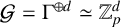
$\mathcal {G} = \Gamma ^{\oplus d} \simeq \mathbb {Z}_p^d$
 . Let
$R\subset V(X)$
 be a subset. For each vertex
$v\in R$
 , fix a nontrivial subgroup
$I_v\subset \mathcal {G}$
 . The vertices in
$R$
 are called ramified and the vertices in
$V(X)\setminus R$
 are called unramified. If
$I_v\cong \Gamma $
 , fix a topological generator
$\sigma _v$
 of
$I_v$
 and define
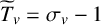
$\widetilde {T}_v=\sigma _v-1$
 . Otherwise, set
$\widetilde {T}_v=1$
 .
-
(i) The adjacency matrix $A = A_X = (a_{i,j})$
is defined as one where $$ \begin{align*} a_{i,j} = \begin{cases} \text{twice the number of undirected loops at } v_i & \text{ when }i=j,\\ \text{the number of undirected edges connecting the } v_i \text{ to } v_j & \text{ when }i\neq j. \end{cases} \end{align*} $$
-
(ii) The valency matrix $D= D^R_X = (d_{i,j})$
is a diagonal matrix where$$ \begin{align*} d_{i,j} = \begin{cases} \vert{\mathbb{E}_{v_i}^o(X)}\vert & \text{ when }i=j \text{ and } v_i \text{ is an unramified vertex},\\ 0 & \text{ when }i\neq j \text{ or } v_i \text{ is a ramified vertex}. \end{cases} \end{align*} $$
-
(iii) If $R=\emptyset $
, the matrix
$D-A$
is called the Laplacian matrix. -
(iv) Suppose that there are $s$
many vertices in
$X$
arranged such that
$v_1, \ldots , v_{r}$
are unramified vertices and
$v_{r+1}, \ldots , v_s$
are the ramified vertices. The matrix
$B = B^{R,\alpha }_{X}= (b_{i,j})\in M_{s\times s}(\mathbb {Z}_p[\![ \mathcal {G} ]\!] )$
is defined as follows: $$ \begin{align*} b_{i,j} = \begin{cases} - \widetilde{T}_{v_i} &\text{ when } r+1 \le i = j \le s,\\ \displaystyle\sum_{\substack{e\in \mathbb{E}(X) \\ \mathrm{inc}(e)=(v_j, v_i)}}{\alpha(e)} & \text{ when } 1\le i \le s \text{ and } 1\le j \le r,\\ 0 & \text{otherwise}. \end{cases} \end{align*} $$







Remark. Note that we have slightly modified the usual definition of a valency matrix.
2.6 Growth patterns in
$\mathbb {Z}_p^d$
-towers of graphs

A strong analogy between number theory and graph theory has been observed by mathematicians. This suggests that it might be possible to study the variation of the
$p$
 -part of the number of spanning trees as one goes up a
$\mathbb {Z}^d_p$
 -tower of graphs. In fact, there is a perfect analog of Iwasawa’s asymptotic class number formula in the setting of graph theory; see [Reference GonetGon22, Reference VallièresVal21]. For example, when
$d=1$
 , there exist nonnegative integers
$\mu , \lambda , n_0$
 , and
$\nu \in \mathbb {Z}$
 such that for
$n\geq n_0$
 ,

where
$\kappa (X_n)$
 is the number of spanning trees of
$X_n$
 .
In what follows, we summarize some relevant notions from [Reference Kleine and MüllerKM24]. Henceforth, let
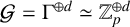
$\mathcal {G} = \Gamma ^{\oplus d} \simeq \mathbb {Z}_p^{\oplus d}$
 for some
$d\geq 1$
 . As discussed previously, to every finite connected graph
$X$
 , we can attach a finite abelian group called the Jacobian of
$X$
 . Moreover, any cover of finite connected graphs
$f \colon Y \to X$
 induces a surjective group morphism of divisor groups,

Furthermore,

which shows that
$f_*$
 maps principal divisors onto principal divisors. Therefore,
$f_*$
 factors through the Jacobian and induces a surjection

Starting with a
$\mathbb {Z}^d_p$
 -cover of a finite connected graph
$X$
 , we obtain a compatible system of maps between the Sylow-
$p$
 subgroups of the Jacobians, that is,

Recall that
$\mathrm {Jac}(X_n)[p^\infty ]$
 is a
$\mathbb {Z}_p[(\mathbb {Z}/p^n\mathbb {Z})^d]$
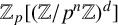 -module. Since
$X$
 is assumed to be finite and connected,

the same holds for each subsequent layer
$X_n$
 . We then define the inverse limit

this is a finitely generated torsion module over the Iwasawa algebra
$\Lambda =\mathbb {Z}_p[\![ \mathcal {G}]\!] $
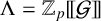 . Indeed, by [Reference Kleine and MüllerKM24, Lemma 5.2],
$\mathrm {Jac}_\Lambda (X_\infty )$
 is isomorphic to
$\mathrm {Jac}(X_\infty )\otimes _{\mathbb {Z}_p[\mathcal {G}]} \Lambda $
 . By [Reference Kleine and MüllerKM24, Lemma 3.2], we conclude that
$\mathrm {Pic}(X_\infty )\otimes _{\mathbb {Z}_p[\mathcal {G}]} \Lambda $
 is the quotient of two free
$\Lambda $
 -modules of the same rank. Thus,
$\mathrm {Pic}(X_\infty )\otimes _{\mathbb {Z}_p[\mathcal {G}]} \Lambda $
 is a finitely generated
$\Lambda $
 -torsion module and the same is true for
$\mathrm {Jac}_\Lambda (X_\infty )$
 .
It is well known [Reference GreenbergGre73] that there is a noncanonical isomorphism

where
$\gamma _1,\ldots ,\gamma _d$
 are topological generators of
$\mathcal {G} = \Gamma ^{\oplus d}$
 . Henceforth, we go between the Iwasawa algebra and its identification with the formal power series ring in
$d$
 -variables as is convenient.
A finitely generated, torsion
$\Lambda $
 -module
$M$
 is said to be pseudo-null if its annihilator
$\mathrm {Ann}_{\Lambda }(M)$
 has height at least 2. Equivalently, for a pseudo-null module
$M$
 , the annihilator
$\mathrm {Ann}_{\Lambda }(M)$
 is generated by two co-prime elements. The structure theorem of finitely generated
$\Lambda $
 -modules asserts that there is a pseudo-isomorphism (that is, homomorphism such that kernel and cokernel are pseudo-null) from
$M$
 to a (unique) module
$\bigoplus _{i=1}^t \Lambda /\langle f_i^{e_i}\rangle $
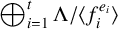 , where
$f_i\in \Lambda $
 are irreducible; see [Reference Neukirch, Schmidt and WingbergNSW08, Proposition 5.1.7].
Viewing
$\mathrm {Jac}_{\Lambda }(X_\infty )$
 as a
$\mathbb {Z}_p[\![ T_1,\ldots , T_d ]\!] $
 -module and using the structure theorem, we can define the characteristic ideal
${\mathrm {char}}_{\Lambda }(\mathrm {Jac}_{\Lambda }(X_\infty ))$
 . In other words,

where
$f_X(T_1, \ldots , T_d)$
 is an element of
$\Lambda $
 and is a generator of the characteristic ideal (determined up to a unit); it is called the characteristic element of
$\mathrm {Jac}_{\Lambda }(X_\infty )$
 .
Notation. We write
$\mathrm {Div}_{\Lambda }(X_\infty )$
 to denote
$\mathrm {Div}(X_\infty ) \otimes _{\mathbb {Z}_p[\mathcal {G}]} {\Lambda }$
 and similarly for
$\mathrm {Div}^0_{\Lambda }(X_\infty )$
 ,
$\Pr _{\Lambda }(X_\infty )$
 .
3 Planar derived graphs
We start by recalling the construction of an unramified derived graph, which is denoted by
$Y=X(G,\alpha )$
 .
3.1 Construction
Let
$X$
 be a finite and connected graph. Suppose that the voltage group
$G$
 is finite of size
$N$
 . Label the elements in
$G$
 as
$\tau _0, \ldots , \tau _{N-1}$
 .
To get the vertices of
$Y$
 , consider
$N$
 copies of each vertex
$x \in V (X)$
 and label them as
$x_{\tau _0}, \ldots , x_{\tau _{N-1}}$
 . Therefore, the derived graph
$Y$
 has
$N \vert {X}\vert $
 many vertices. Suppose that
$x \to x'$
 is a directed edge in
$X$
 with voltage assignment
$\alpha (e_{x,x'}) = \tau \in G$
 . For every
$\tau _i$
 in
$G$
 , there is an edge in
$Y$
 joining
$x_{\tau _i}$
 to
$x^{\prime }_{\tau _i \cdot \tau }$
 . This process is then repeated for every
$x\in V(X)$
 .
When
$G$
 is infinite (as it is in our case), we can repeat the same construction formally.
3.2 Intuition
A voltage graph takes
$\vert {G}\vert $
 -many copies of the base graph
$X$
 stacked vertically above each other. Then, for each directed edge
$x \to x'$
 with voltage
$\tau $
 , we do the following: for each sheet indexed by
$\sigma \in G$
 , we join the vertex
$x_{\sigma }$
 to the vertex
$x^{\prime }_{\sigma \cdot \tau }$
 . So, if we ‘look at the layer of sheets from above’, we see vertex
$x$
 joined to vertex
$x'$
 exactly
$\vert {G}\vert $
 -many times.
The main goal of this section is to provide a sufficient condition for the derived graph of a planar graph to be planar. It is easy to construct examples of planar graphs and voltage assignments such that the derived graph is not planar. We provide an example as follows.
Example 3.1. Let
$X$
 be a bouquet graph with two loops, that is, a graph consisting of a single vertex with two loops
$e_1,e_2$
 . Let
$G=(\mathbb {Z}/5\mathbb {Z},+)$
 and define
$\alpha (e_1)=1$
 ,
$\alpha (e_2)=2$
 . Let
$Y=X(G,\alpha )$
 . Then,
$Y$
 is the complete graph on
$5$
 vertices and is not planar.

Theorem 3.2. Fix a finite group
$G$
 . Let
$X$
 be a finite undirected planar graph and
$Y$
 be the undirected derived graph of
$X$
 of a single unramified voltage assignment. Then,
$Y$
 is planar.
Proof. Recall that a single unramified voltage assignment is one in which exactly one of the edges has a non-trivial voltage assignment. Let
$e_0$
 be the edge with the nontrivial voltage assignment
$\alpha $
 . Let
$v$
 and
$w$
 be the vertices joined by
$e_0$
 . It suffices to show that each connected component of
$Y$
 is planar. Therefore, we can without loss of generality assume that
$G$
 is generated by
$\alpha (e_0)$
 .
Using a stereographic projection, we can assume that
$e_0$
 lies on the outer face of
$X$
 . Let
$X'$
 be the graph obtained from
$X$
 by removing the edge
$e_0$
 . Let
$Y'$
 be
$\vert G\vert $
 copies of
$X'$
 indexed by
$\alpha (e_0)^i$
 . We call the different copies of
$X'$
 the sheets of
$Y'$
 . As
$X'$
 is planar, the same is clearly true for
$Y'$
 . The graph
$Y$
 is now obtained from
$Y'$
 by connecting the vertex
$v$
 in the
$\alpha (e_0)^i$
 sheet with the vertex
$w$
 in the
$\alpha (e_0)^{i+1}$
 -sheet. As
$e_0$
 is an edge on the outer face, this is still a planar graph.
Remark. We thank the anonymous referee for pointing out this simplified proof to us.
We explain the above theorem via two explicit examples. To make the following drawings easier to read, we draw only one half of the edges. An arrow from
$A$
 to
$B$
 marked with
$\tau $
 means that the edge from
$A$
 to
$B$
 has voltage assignment
$\tau $
 . It is understood from the context that the edge in the opposite direction has voltage assignment
$\tau ^{-1}$
 .
Example 3.3. Let the voltage group
$G=\{\mathbf {1},\tau \}$
 . Consider the finite planar graph
$X$
 where exactly one edge (namely
$AB$
 ) has a nontrivial voltage assignment
$\alpha (e_{AB}) = \tau $
 .

Here,
$e_0 = e_{AB}$
 . In this case,
$X'$
 is the following graph:

In the case where
$G=\mathbb {Z}/2\mathbb {Z}$
 , the graph
$Y'$
 has the following shape:

The derived graph
$Y=X_1 = X(\mathbb {Z}/2\mathbb {Z}, \alpha )$
 in this case is a 6-gon. We draw this graph in two ways for ease of visualization.

If we consider the group
$G=\mathbb {Z}/4\mathbb {Z}$
 instead, we obtain a 12-gon:

Example 3.4. We consider two different voltage groups
$G_1=\mathbb {Z}/2\mathbb {Z}$
 and
$G_2=\mathbb {Z}/4\mathbb {Z}$
 . Once again, there is a unique edge (which we call
$e_0$
 ) with nontrivial voltage assignment, that is,
$\alpha (e_0) = \tau $
 , where
$\tau $
 is used to denote the generator of both
$G_1$
 and
$G_2$
 . The tower of derived graphs
$Y= X_1 = X(\mathbb {Z}/2\mathbb {Z}, \alpha )$
 and
$Y=X_2 = X(\mathbb {Z}/4\mathbb {Z}, \alpha )$
 is drawn as

The next result no longer requires the voltage assignment to be unramified. In other words, the derived graph we obtain is a (ramified) branched cover.
Corollary 3.5. Let
$X$
 be a finite planar graph and let
$Y$
 be the derived graph of a single voltage assignment. Then,
$Y$
 is planar.
Proof. Let
$Y^{\mathrm {unr}}$
 be the corresponding unramified derived graph. Note that the immersion
$\iota \colon Y^{\mathrm {unr}}\to Y$
 is a contraction and that contractions of planar graphs are planar.
Example 3.6. We once again start with the same graph
$X$
 as in Example 3.3.

We no longer require that the vertices are unramified in this extension. In fact, we assume that the vertices
$B,C$
 are totally ramified, that is, the corresponding inertia groups are isomorphic to
$G$
 at each layer. The derived graph
$Y=X_1=X(\mathbb {Z}/2\mathbb {Z}, \mathcal {I}, \alpha )$
 is the following:

This is easily seen to be a contraction of the hexagon obtained in Example 3.3. The vertices
$B_1$
 and
$B_2$
 (respectively
$C_1$
 and
$C_2$
 ) have been identified.
Now, when
$G\simeq (\mathbb {Z}/2^2\mathbb {Z}) = \mathbb {Z}/4\mathbb {Z}$
 , the derived graph
$Y= X(\mathbb {Z}/4\mathbb {Z}, \mathcal {I}, \alpha )$
 we obtain is the following:

This is a contraction of the cyclic 12-gon graph above in Example 3.3.
4 Towers of derived graphs
Throughout this section, we assume that
$\mathcal {G}\cong \mathbb {Z}_p^d$
 . We write
$\gamma _1, \ldots , \gamma _d$
 to denote the topological generators of
$\mathcal {G}$
 . By [Reference DuBose and VallièresDV23, page 1336], we know that all unramified
$\mathbb {Z}_p^d$
 -covers arise as derived graphs.
Lemma 4.1. Let
$I\subset \mathcal {G}$
 be a closed subgroup and
$\sigma \in I$
 . Let
$s_n(\sigma )$
 denote the order of the image of
$\sigma $
 in
$\mathcal {G}/\mathcal {G}^{p^n}$
 . If
$s_n(\sigma )\neq 1$
 , then

Proof. For every
$1 \le i \le d$
 and
$m\geq 0$
 , there exist integers
$1 \leq a_{i,m} \leq p^m$
 such that

Set
$b_m=\min _i(\mathrm {ord}_p(a_{i,m}))$
 . By definition,
$s_m(\sigma )=p^{m-b_m}$
 .
Let
$n$
 be a fixed integer satisfying
$s_n(\sigma )>1$
 . This is equivalent to
$b_n<n$
 . This inequality, combined with the congruence condition mod
${p^{n}}$
 , ensures that
$b_{n+1}=b_n$
 ; hence,
$s_{n+1}(\sigma )=ps_n(\sigma )$
 .
Let
$I\subset \mathcal {G}$
 be a subgroup of rank
$k$
 . In other words, there are
$k$
 -many topological generators of
$I$
 , say
$\sigma _{1},\ldots , \sigma _{k}$
 . Let
$n\geq 0$
 and denote by
$I\mathcal {G}^{p^n}$
 the smallest subgroup of
$\mathcal {G}$
 containing
$\mathcal {G}^{p^n}$
 and
$I$
 . Note that
$\mathcal {G}^{p^n}$
 is a normal subgroup of
$\mathcal {G}$
 . Thus, the quotient
$I\mathcal {G}^{p^n}/\mathcal {G}^{p^n}$
 is well defined.
For an abelian group
$G$
 , we define its
$p$
 -rank to be the
$\mathbb {Z}/p\mathbb {Z}$
 -dimension of
$G[p]$
 . We denote this by
$\mathrm {rank}_p(G)$
 . Fix an integer
$n_{I}$
 such that the
$p$
 -rank of
$I\mathcal {G}^{p^{n_{I}}}/\mathcal {G}^{p^{n_{I}}}$
 is equal to
$k$
 . Lemma 4.1 now implies that the
$p$
 -rank of
$I\mathcal {G}^{p^n}/\mathcal {G}^{p^n}$
 is equal to
$k$
 for all
$n\ge n_{I}$
 . Thus, given such a group
$I\subset \mathcal {G}$
 of rank
$k$
 for all
$n\ge n_0$
 ,

where
$C_{n,t}$
 is the cyclic subgroup of
$\mathcal {G}/\mathcal {G}^{p^n}$
 generated by the image of
$\sigma _{t}$
 .
Define
$\vec {\mathbf {j}} = (j_1, \ldots , j_k)$
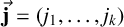 , where for each
$1 \le t \le k$
 , the entry
$j_t$
 can take all (nonnegative) integral values between 0 and
$s_n(\sigma _{t}) -1$
 (both included). For
$n\ge {n_{0}}$
 , define

Intuitively, the element
$\boldsymbol {\omega }_{I,n}$
 is the sum of all elements in
$I\mathcal {G}^{p^n}/\mathcal {G}^{p^n}$
 . Therefore, it can be interpreted as the norm of the subgroup
$I$
 in
$\mathcal {G}/\mathcal {G}^{p^n}$
 . In most cases where the above definition/notation is used, the subgroup
$I$
 is an inertia subgroup
$I_v$
 of a vertex
$v$
 in a graph. In such cases, we use the notation
$\boldsymbol {\omega }_{v,n}$
 instead of
$\boldsymbol {\omega }_{I_v,n}$
 .
Definition 4.2. Let
$X$
 be a finite graph with vertices
$v_1,\ldots ,v_s$
 and voltage assignment
$\alpha $
 . Let
$X_\infty $
 be a branched cover of
$X$
 . Label the vertices that are unramified in
$X_\infty /X$
 as
$v_1,\ldots , v_r$
 and the ones that ramify as
$v_{r+1},\ldots ,v_s$
 . For each vertex
$v$
 , define

By abuse of notation, write
$P_v$
 to denote the image of
$P_v\otimes \mathbf {1}_{\Lambda }\in \mathrm {Div}_\Lambda (X_\infty )$
 .
$\bullet $
 Define

$\bullet $
 Set

where
$n_{v_j} = n_{I_{v_j}}$
 is defined as before for the inertia group
$I_{v_j}$
 at the vertex
$v_j$
 . For each
$n\ge n_0$
 , define

Remark 4.3. For the unramified vertices, these are the generators one would expect for the principal divisors. The factors
$\boldsymbol {\omega }_{v_j,n}$
 occur for the ramified vertices due to the immersion map
$X_\infty ^{\mathrm {unr}}\to X_\infty $
 as we see in the following proof.
4.1 Picard group of ramified derived graphs
In this section, we prove the
$d$
 -dimensional analog of [Reference Gambheera and VallièresGV24, Theorem 5.4]. Let
$G$
 be any group, let
$Y=~X(G, \mathcal {I}, \alpha )$
 denote the derived graph of
$X$
 , and write
$Y^{\mathrm {unr}} = X(G,\alpha )$
 . Let

be the immersion. There is a natural surjective group morphism

Theorem 4.4. Let
$X_\infty = X(\mathbb {Z}_p^d, \mathcal {I}, \alpha )$
 denote the (ramified) derived graph of
$X$
 and
$X_\infty ^{\mathrm {unr}} = X(\mathbb {Z}_p^d, \alpha )$
 be the unramified derived graph. Denote the respective layers of the derived graph as
$X_n$
 and
$X_n^{\mathrm {unr}}$
 . Define

where
$\omega _n(T_i) = (T_i+1)^{p^n} -1$
 for
$1\le i \le d$
 . For
$n \gg 0$
 ,

Proof. Fix a layer
$X_n$
 and consider the projection map

This induces a surjective map on the divisors, namely,

To complete the proof, it is sufficient to show that
$\pi _n^{-1}(\Pr (X_n)\, \otimes \, \mathbb {Z}_p) =N_n$
 .
Consider a vertex
$v\in V(X)$
 . We fix a pre-image
$v'=(v,1)$
 of
$v$
 in
$V(X_n^{\mathrm {unr}})$
 . Associated to this
$v'$
 , define a principal divisor

Define

A similar definition can be made over
$X^{\text {unr}}_\infty $
 . To simplify notation, we write
$P_v$
 instead of
$P_{v,\infty }$
 (compare with Definition 4.2). Note that
$P^\infty _{v}\in \mathrm {Div}(X_\infty ^{\mathrm {unr}})$
 , while
$P_v = \iota _*(P_v^{\infty }) \in \mathrm {Div}(X_\infty )$
 . For each vertex
$v$
 in
$X_n$
 ,

Recall that to each ramified vertex
$v$
 , we can associate an inertia group
$I_v \subseteq \mathbb {Z}_p^d$
 of rank
$k = k(v)$
 . Let
$n\geq n_{0,v}$
 , where
$n_{0,v}$
 is a large enough integer such that
$\mathrm {rank}_p(I_v\mathcal {G}/\mathcal {G}^{p^{n_{0,v}}})=\mathrm {rank}_p(I_v)$
 . Then,

and [Reference Gambheera and VallièresGV24, Corollary 4.7] implies that
$\pi _n(N_n)=\Pr (X_n)\otimes \mathbb {Z}_p$
 . Therefore,

Write
$\text {Aug}(I_{v_l})$
 to denote the augmentation ideal of
$I_{v_l}$
 . The arguments in [Reference Gambheera and VallièresGV24, Section 5] now show

where
$s$
 is the number of vertices in
$X$
 and
$r$
 is the number of unramified vertices. Taking appropriate projections,

Therefore, for
$n\gg 0$
 ,

In particular,
$\ker (\pi _n)\subset N_n$
 and
$\pi _n^{-1}(\Pr (X_n)\otimes \mathbb {Z}_p)=N_n$
 .
Even though the module
$\Pr _n^{\mathrm {ram}}(X_\infty )$
 is necessary to describe
$\mathrm {Pic}(X_n)\otimes \mathbb {Z}_p$
 as a quotient of
$\mathrm {Div}_\Lambda (X_\infty )$
 , it does not play a role when we take projective limits as the following corollary points out. In view of the notation introduced previously,

Corollary 4.5. With notation as above,

Proof. This is analogous to [Reference Gambheera and VallièresGV24, Corollary 5.5] using Theorem 4.4 instead of [Reference Gambheera and VallièresGV24, Theorem 5.4].
Fix
$v\in V(X)$
 . Let
$w_{v,\infty }^{\mathrm {unr}}$
 denote the vertex
$(v, {\mathbf {1}}_{\mathcal {G}})$
 in
$X_\infty ^{\mathrm {unr}} = X(\mathcal {G},\alpha )$
 . Let
$\Delta $
 be the operator on
$\mathrm {Div}_\Lambda (X_\infty ^{\mathrm {unr}})$
 given by

where

In previous references, the operator
$P_v^{\mathrm {unr}}$
 is often written as
$\mathcal {L}_{\Lambda }^{\mathrm {unr}}(-)$
 and is called the Laplacian operator. This notation is consistent with how
$P_v$
 was expressed in Definition 4.2; only now,
$I_{t(e)}$
 is trivial. Note that this divisor was denoted by
$P_v^{\infty } \in ~\mathrm {Div}(X_\infty ^{\mathrm {unr}})$
 above.
Remark 4.6. If
$X$
 is a finite connected graph and
$X_\infty =X_\infty ^{\mathrm {unr}}$
 is an unramified
$\mathbb {Z}_p^d$
 -cover of
$X$
 , this operator
$\Delta $
 was already studied in [Reference Kleine and MüllerKM24] and was denoted by
$\Delta _\infty $
 .
Theorem 4.7. Let
$X_\infty = X(\mathbb {Z}_p^d, \mathcal {I}, \alpha )$
 denote the (ramified) derived graph of
$X$
 . With this notation,

Proof. As before, write
$X_\infty ^{\mathrm {unr}} = X(\mathbb {Z}_p^d, \alpha )$
 to denote the unramified derived graph. Define

We want to emphasize that
$\Pr ^{\mathrm {unr}}_\Lambda (X_\infty )$
 was defined as a
$\Lambda $
 -submodule of
$\mathrm {Div}_\Lambda (X_\infty )$
 generated by
$\{P_{v_l} \mid 1 \le l \le r\}$
 in Definition 4.2, which is different from
$\Pr ^{\prime }_\Lambda (X_\infty ^{{\mathrm {unr}}})$
 . The two definitions coincide if
$X_\infty = X_\infty ^{\mathrm {unr}}$
 . Note that the quotient
$\mathrm {Div}_\Lambda (X_\infty ^{\mathrm {unr}})/\Pr ^{\prime }_\Lambda (X_\infty ^{\mathrm {unr}})$
 has
$\Lambda $
 -rank
$s-r$
 . Also, recall we have the surjection

Under this map, the pre-image of
$\Pr _{\Lambda }^{\mathrm {unr}}(X_\infty )$
 is precisely
$\ker (\iota _*)+\text {Pr}^{\prime }_\Lambda (X_\infty ^{\mathrm {unr}})$
 . Now, it follows immediately from Corollary 4.5 that

Thus, it suffices to compute the characteristic ideal of
$\mathrm {Div}_\Lambda (X_\infty ^{\mathrm {unr}})/\ker (\iota _*)+\text {Pr}^{\prime }_\Lambda (X_\infty ^{\mathrm {unr}})$
 . Consider the exact sequence

To prove the theorem, we show that the first term is pseudo-null and that the characteristic ideal of the last term is indeed
$\det (\Delta )$
 . We first prove the latter assertion. Note that
$\mathrm {Div}_\Lambda (X^{\mathrm {unr}})$
 is a free
$\Lambda $
 -module and
$\Delta $
 is a square (quadratic) matrix of the same dimension. Thus,
$\mathrm {Div}_\Lambda (X^{\mathrm {unr}}_{\infty })/\mathrm {Im}(\Delta )$
 is quadratically represented. Thus, its fitting ideal is given by
$\det (\Delta )$
 . Furthermore, for quadratically represented modules, the characteristic ideal and the fitting ideal coincide. Thus,

It remains to show that the first term of the above short exact sequence is pseudo-null. By definition,
$\mathrm {Im}(\Delta )$
 is generated by

The last two sets are contained in
$\ker (\iota _*)+\Pr ^{\prime }_\Lambda (X_\infty ^{\mathrm {unr}})$
 . Thus, the quotient
$\mathrm {Im}(\Delta )/\ker (\iota _*)+ \text {Pr}^{\prime }_\Lambda (X_\infty ^{\mathrm {unr}})$
 is generated by

Each
$w^{\text {unr}}_{v,\infty }$
 is annihilated by
$\text {Aug}(I_v)$
 . As
$\mathrm {rank}(I_v)\ge 2$
 , the ideal
$\text {Aug}(I_v)$
 has height at least
$2$
 . In particular, the module
$\Lambda /\text {Aug}(I_v)$
 is pseudo-null and the result follows; see Section 2.6 for the definition of pseudo-null modules.
Remark 4.8. If
$X_\infty = X_\infty ^{\mathrm {unr}}$
 , the above theorem asserts that

However, it was proven in [Reference Kleine and MüllerKM24, Theorem 5.2] that if
$X_\infty /X$
 is an unramified
$\mathbb {Z}_p^d$
 -extension of
$X$
 (obtained as a derived graph of
$X$
 ), then

Therefore, we conclude

Compare also with [Reference Kleine and MüllerKM24, Remark 5.4].
Example 4.9. We give an example of an unramified cover of
$X$
 that can also be found in [Reference Kleine and MüllerKM24]. Here, the dashed line between
$A$
 and
$B$
 in the graph at the bottom layer has nontrivial voltage assignment, say
$\tau $
 .

For convenience of the reader, we draw another way to interpret the 18-gon in the third diagram above:

The characteristic polynomial of
$\mathrm {Pic}_{\Lambda }(X_\infty )$
 is
$T^2$
 for this unramified tower of coverings.
For ramified branched
$\mathbb {Z}_p$
 -covers
$X_\infty $
 , it has been pointed out [Reference Gambheera and VallièresGV24, Section 6] that
$\det (\Delta ) = \det (D-B)$
 , where
$D, B$
 were matrices introduced in Definition 2.10. We now provide examples of the same.
Example 4.10. Reconsider the branched covering from Example 3.6. We calculate the matrices

It follows that

Example 4.11. In this example,
$G=(\mathbb {Z}/3\mathbb {Z}, +)$
 for each subsequent layer, and the vertex
$R\in V(X)$
 is totally ramified whereas the vertex
$U\in V(X)$
 is unramified. The dashed edge has nontrivial voltage assignment.

We calculate the two matrices
$D$
 and
$B$
 using Definition 2.10,

It follows that the characteristic ideal

This example can be generalized in the following manner.
Example 4.12. Let
$X$
 be a cycle graph with
$m$
 vertices. Let
$\alpha $
 be a single voltage assignment with image in
$\mathbb {Z}_p$
 . Let
$I_{v}=\mathbb {Z}_p$
 for exactly one vertex
$v$
 and set
$I_{v'}=1$
 for all
$v'\neq v$
 . Let
$X_\infty =X(\mathbb {Z}_p, \mathcal {I}, \alpha )$
 and let
$X_n$
 be the intermediate covers. Assume that the image of
$\alpha $
 generates
$\mathbb {Z}_p$
 topologically. Then,

Indeed,
$X_n$
 looks similar to the flower graph above. Instead of leaves consisting of one vertex and two edges, the leaves have
$(m-1)$
 vertices and
$m$
 edges. To count the spanning trees, we need to choose a spanning tree for each leaf, that is, we have to choose one edge that we ‘delete’. That leaves
$m$
 choices per leaf. As there are
$p^n$
 leaves, the claim follows.
In the following picture, we choose
$p=3$
 and draw the base graph and the first layer.

We calculate the two matrices
$D$
 and
$B(T)$
 using Definition 2.10,

Therefore,

Example 4.13. In the subsequent example, we consider the case when
$\mathcal {G} = \mathbb {Z}_3^2$
 , that is, the first layer is a
$\mathbb {Z}/3\mathbb {Z}\times \mathbb {Z}/3\mathbb {Z}$
 covering. We assume that the vertex
$U$
 is unramified and that the vertex
$R$
 is totally ramified. Recall that the voltage assignment
$\alpha : \mathbb {E}(X) \to \mathbb {Z}_3 \times \mathbb {Z}_3$
 . Let us denote the generators of
$\mathcal {G}$
 by
$\sigma , \tau $
 . The voltage assignment for the dashed edge is prescribed to be
$\tau $
 and that for the solid edge is
$\sigma $
 .

In the next step, we get a flower with
$27$
 leaves. Thus, for
$X_n$
 ,

If we compute the characteristic ideal using the matrices

we obtain that the characteristic ideal is given by

If we let
$R$
 only ramify at the group generated by
$\tau $
 , that is,
$\langle \tau \rangle $
 ,

In this case, the characteristic ideal is given by
$2T$
 . Here, we are identifying the variable
$T$
 with
$\tau - 1$
 .
4.2 Growth formula
In this section, the aim is to prove an analog of Iwasawa’s growth number formula for the number of spanning trees at the
$n$
 th layer of the
$\mathbb {Z}_p^d$
 -cover. For this, we need to appeal to the theory of ‘structures’ discussed in [Reference Cuoco and MonskyCM81]. For the convenience of the reader, we have included some details and repeated some proofs, but at various places, we refer the reader to the original text.
4.2.1 Abstract results on
$\Lambda $
-modules

We first need to obtain some results on general
$\Lambda $
 -modules.
Definition 4.14. Let
$M$
 be a
$\Lambda $
 -module. A structure on
$M$
 consists of an integer
$z$
 and tuples
$(I_j,M_j)\, 1\le j\le z$
 , where the
$M_j$
 are submodules of
$M$
 and the
$I_j$
 are subgroups of
$\mathcal {G}$
 . For all
$n$
 , set

where
$\boldsymbol {\omega }_{j,n}$
 is defined as in (4-1) with respect to the subgroup
$I_j$
 . With this notation, define
$\mathcal {M}_n=M/A_n$
 .
Lemma 4.15. There is a constant
$c$
 such that
$p^{2dn+c}\mathcal {M}_n[p^\infty ]=0$
 .
Proof. Even though our definition of structures differs from that given in [Reference Cuoco and MonskyCM81], the proof of Theorem 4.5 there carries over almost verbatim. We repeat it for the convenience of the reader.
Let
$N$
 be the submodule generated by all the
$M_{j}$
 . Let
$W=\Omega ^d$
 , where
$\Omega $
 is the group of
$p$
 -power roots of unity. For each
$\zeta \in W$
 , there is a natural map
$M/N\to (M/N)\otimes \mathbb {Z}_p[\zeta ]$
 induced by the valuation
$\Lambda \to \mathbb {Z}_p[\zeta ]$
 .
For any
$\Lambda $
 -module
$X$
 , we set the notation
$X_{\zeta } = X \otimes \mathbb {Z}_p[\zeta ]$
 .
By [Reference Cuoco and MonskyCM81, Lemma 2.6], there exists a constant
$c$
 such that
$p^cx$
 annihilates
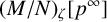
$(M/N)_\zeta [p^\infty ]$
 and
$M_\zeta [p^\infty ]$
 for all choices of
$\zeta $
 . Let
$n_0$
 be the index such that the rank of
$I_{j}$
 in
$\mathcal {G}/\mathcal {G}^{p^n}$
 is stable for all
$n\ge n_0$
 and all
$j$
 . First, consider an element
$\zeta \in W$
 such that
$\mathrm {ord}(\zeta )>p^{n_0}$
 . The evaluation
$\Lambda \to \mathbb {Z}_p[\zeta ]$
 sends
$\boldsymbol {\omega }_{j,n}$
 to zero in this case for all
$j$
 . Thus,

is annihilated by
$p^c$
 .
It remains to estimate the contribution of those
$\zeta \in W$
 with
$\mathrm {ord}(\zeta )\le p^{n_0}$
 . For all
$n\ge n_0$
 , we define

Note that
$\boldsymbol {\omega }_n$
 describes the trace from
$\mathcal {G}/\mathcal {G}^{p^n}$
 to
$\mathcal {G}/\mathcal {G}^{p^{n_0}}.$

Let
$N'$
 be the image of
$N$
 in
$M_\zeta $
 . (We emphasize that
$N'$
 is not
$N_\zeta $
 because taking tensor product is not left exact.) Then, the image of
$\boldsymbol {\omega }_n N$
 in
$M_\zeta $
 is
$p^{(n-n_0)d}N'$
 . It follows that
$(M/\boldsymbol {\omega }_n N)_\zeta $
 and
$(M/N)_\zeta $
 have the same
$\mathbb {Z}_p$
 -rank. Furthermore,
$(M/\boldsymbol {\omega } _n N)_\zeta [p^\infty ]$
 is annihilated by
$p^{nd+c}$
 . Additionally, we have a natural surjection

where all three terms have the same
$\mathbb {Z}_p$
 -rank. Therefore,
$(M/A_n)_\zeta [p^\infty ]$
 is annihilated by
$p^{nd+2c}$
 .
Summing over all
$\zeta $
 of order at most
$p^n$
 , we obtain that

is annihilated by
$p^{nd+2c}$
 . It now follows from [Reference Cuoco and MonskyCM81, Lemma 2.7] that
$\mathcal {M}_n[p^\infty ]$
 is annihilated by
$p^{2dn+2c}$
 .
4.2.2 Applications
We apply the previous result to the following module arising from our graph theoretic setting. Write

where we proved the isomorphism in Corollary 4.5. Set
$z=s-r$
 and write
$(I_j,M_j)=(I_{v_{j+r}},\Lambda P_{v_{j+r}})$
 for
$1 \le j \le s-r$
 . Note that as
$1\le j\le s-r$
 , the vertices
$v_{j+r}$
 are the ramified ones in
$X_\infty /X$
 . This defines a structure in the above sense; by Theorem 4.4,

Theorem 4.16. Fix
$d\geq 2$
 . Let
$X_\infty $
 denote the derived graph
$X(\mathbb {Z}_p^d,\mathcal {I},\alpha )$
 and
$X_\infty ^{{\mathrm {unr}}}$
 denote the derived graph
$X(\mathbb {Z}_p^d,\alpha )$
 . Assume that all intermediate
$X_n$
 are connected. Let
$f$
 be a generator of the characteristic ideal of
$\mathrm {Jac}_\Lambda (X_\infty )$
 . Then,

Remark 4.17. Recall that the number of spanning trees of a graph
$X$
 is equal to the size of the Jacobian of
$X$
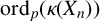
 . The above statement can hence be rewritten in terms of
$\mathrm {ord}_p(\kappa (X_n))$
 .
Proof. As before, let
$I_v$
 be the inertia subgroup associated with the vertex
$v$
 . We arrange the ramified vertices in increasing order of the ranks of the corresponding subgroups
$I_v$
 . In other words, we assume that
$\mathrm {rank}(I_{v_j})\le \mathrm {rank}(I_{v_{j+1}})$
 for
$r+1\le j\le s$
 . Let
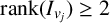
$s'\ge r+1$
 be the smallest index such that
$\mathrm {rank}(I_{v_{j}})\ge 2$
 for all
$j\ge s'$
 . For ramified vertices
$v_j$
 with inertia rank 1, we denote the topological generator of
$I_{v_j}$
 by
$\sigma _{v_j}$
 and define

Note that
$\widetilde {T}_j$
 and
$T_i$
 are not related to each other per se, except that they lie in the same Iwasawa algebra. Decompose
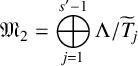
$\mathrm {Div}_\Lambda (X_\infty )$
 as follows:

where:
-
• $\mathfrak {M}_1$
is
$\Lambda $
-free and the contribution to
$\mathfrak {M}_1$
comes from the unramified vertices; -
• $\mathfrak {M}_2= \displaystyle \bigoplus _{j=1}^{s'-1}\Lambda /\widetilde {T}_j$
and the contribution to
$\mathfrak {M}_2$
comes from those ramified vertices for which the rank of
$I_v$
is 1; -
• $\mathfrak {M}_3$
is pseudo-null and
$\mathbb {Z}_p$
-free.




For
$1\le i\le 3$
 , we denote by
$\overline {\mathfrak {M}_i}$
 the image of
$\mathfrak {M}_i$
 in
$\mathrm {Pic}_\Lambda (X_\infty )$
 . Clearly (by definition/construction),
$\overline {\mathfrak {M}_3}$
 is pseudo-null. By [Reference Cuoco and MonskyCM81, Lemma 3.1],

By Lemma 4.15, we conclude that

Set
$M'=M/\overline {\mathfrak {M}_3}$
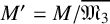 , where
$M$
 is defined as in (4-2). Define
$M^{\prime }_j$
 as the image of the submodule
$M_j = \Lambda P_{v_{j+r}}$
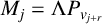 in
$M'$
 . Set
$z'=s'-r-1$
 ; the tuples
$(I_{v_{j+r}}, M^{\prime }_j)$
 for
$1\le j\le z'$
 define a structure on
$M'$
 . Let
$\mathcal {M}^{\prime }_n$
 be the module constructed in Definition 4.14 associated to this structure. The structure defined on
$M'$
 is an admissible structure in the sense of [Reference Cuoco and MonskyCM81, Definitions 4.1 and 4.6]. Writing
$f$
 to denote a generator of the characteristic ideal of
$M = \mathrm {Pic}_{\Lambda }(X_\infty )$
 , it follows from [Reference Cuoco and MonskyCM81, Theorems 4.12 and 4.13] and using the estimate for the contribution of
$\overline {\mathfrak {M}_3}$
 that

We have
$\mathrm {char}_{\Lambda }(\mathrm {Pic}_{\Lambda }(X_\infty )) = \mathrm {char}_{\Lambda }(\mathrm {Jac}_{\Lambda }(X_\infty ))$
 since
$d\geq 2$
 . Indeed, there is a short exact sequence

For
$d\ge 2$
 , a free
$\mathbb {Z}_p$
 -module of finite rank is always pseudo-null. The result follows since
$M$
 and
$M'$
 have the same characteristic ideal (because
$\overline {\mathfrak {M}_3}$
 is pseudo-null).
Remark 4.18. The second-named author and Kleine obtained a growth formula for unramified
$\mathbb {Z}_p^d$
 -covers in [Reference Kleine and MüllerKM24]. In contrast to the above result, the result in loc. cit. does not involve an error term. The main difference is that the situation of branched coverings requires the use of structures in the above sense. For unramified coverings, this difficulty does not occur which allows the authors of loc. cit. to derive an explicit formula without an error term.
5 Results on dual graphs
Definition 5.1. Let
$X$
 be a planar graph. A dual graph of
$X$
 , denoted by
$X^\vee $
 , is a graph that has a vertex for each face of
$X$
 and an edge for each pair of faces in
$X$
 that are separated from each other by an edge, and a self-loop when the same face appears on both sides of an edge.
Each edge
$e$
 of
$X$
 has a corresponding dual edge, with endpoints the dual vertices corresponding to the faces on either side of
$e$
 . Recall that the notion of a dual graph is not unique and depends on the choice of embedding. In what follows, whenever we start with a planar graph
$X$
 , we fix a choice of embedding even if we do not explicitly mention it. Therefore, we talk about ‘the’ dual graph (with respect to this choice of embedding). In the same vein, when we construct a (planar) covering
$Y$
 of
$X$
 , we again choose an embedding of
$Y$
 and talk about ‘the’ dual of
$Y$
 .
5.1 Jacobian of dual graphs
Let
$\mathcal {G}$
 be any uniform pro-
$p\, p$
 -adic Lie extension. We first observe that the dual graphs of each layer of a
$\mathcal {G}$
 -cover of planar graphs need not be
$\mathcal {G}$
 -covers. All
$\mathcal {G}$
 -covers are still assumed to come from a voltage assignment.
Non-example 5.2. Recall the tower of graphs in Example 3.6.

We now draw the respective dual graphs. The vertex called
$O$
 is the one corresponding to the ‘outer face’. The other vertices are labeled as
$I_{?}$
 .

It is clear from the picture that the second and third graphs are not (branched) coverings of the first one. Indeed, consider the vertex
$I_3$
 in the second graph and let
$f$
 be the projection to the base graph. Then,
$f(I_3)=I$
 . However,

while

where
 and
 stand for the red and black edges in the base graph. For the third graph, a similar argument works.
Later on, we see examples where the dual graphs are actually coverings of the base graph. The following theorem describes the Galois structure in this case. Given a
$\mathcal {G}$
 -cover
$(X_n)_{n\in \mathbb {N}}$
 of a planar graph
$X=X_0$
 , we fix (once and for all) a planar representation of the graphs
$X_n$
 . As we have seen in the above example, the corresponding dual graphs need not necessarily form a branched covering again. In the following theorem, we consider the case where the dual graphs actually give rise to a branched covering.
Let
$Y/X$
 be a covering of graphs. We fix planar embeddings of
$Y$
 and
$X$
 . These embeddings fix planar embeddings of
$Y^\vee $
 and
$X^\vee $
 . Let
$\pi \colon Y\to X$
 be the covering map. We want to turn this map into a map from
$Y^\vee \to X^\vee $
 . Let
$f$
 be a vertex of
$Y^\vee $
 . Such a vertex is a face of the fixed planar embedding of
$Y$
 . Let
$e_1,\ldots , e_s$
 be the edges building the border of this face in a clockwise orientation. If the edges
$\pi (e_1)\cdots , \pi (e_s)$
 form the border of a face of the fixed embedding of
$X$
 , we call
$\pi $
 a ‘good’ map for
$f$
 . If
$\pi $
 is ‘good’ for all vertices of
$Y$
 , we proceed to define
$\pi ^\vee (f)$
 to be the face surrounded by
$\pi (e_1),\ldots , \pi (e_s)$
 . In this case, we define
$\pi ^\vee (e)$
 for the edges of
$Y^\vee $
 as follows. Let
$e^\vee $
 be an edge between
$f_1$
 and
$f_2$
 intersecting the edge
$e$
 of
$Y$
 , then we define
$\pi ^\vee (e)$
 as the edge intersecting
$\pi (e)$
 in the chosen embedding of
$X$
 (and
$X^\vee $
 ). If this is the case, we say
$Y^\vee $
 is a branched covering of
$X^\vee $
 . In the following proof, we, in addition to the above construction, need to fix orientations on the edges
$e^\vee $
 .
Theorem 5.3. Let
$X_\infty /X$
 be a
$\mathcal {G}$
 -cover of planar connected graphs with intermediate layers denoted by
$X_n$
 . Fix a planar embedding for each
$X_n$
 and consider the dual graph
$X^\vee _n$
 at each layer. Suppose that
$X_n^\vee /X^\vee $
 is a branched covering. Then,
$X_\infty ^\vee /X^\vee $
 is also a
$\mathcal {G}$
 -cover of planar graphs with intermediate layers
$X_n^\vee $
 and the Galois action can be chosen to be compatible with the process of taking duals.
Proof. We fix a planar representation of
$X$
 and let
$\pi _n\colon X_n\to X$
 be the natural projection. Given a directed edge
$e_{n}$
 of
$X_n$
 , there are exactly two directed edges
$e_{n}^1$
 and
$e_{n}^2$
 in
$X_n^\vee $
 that intersect
$e_{n}$
 . We wish to choose one of them (as the dual edge) depending on the orientation of
$e_{n}$
 . We fix once and for all a choice
$e^\vee $
 for each edge
$e$
 on
$X_0$
 and define
$e_{n}^i=e_{n}^\vee $
 if
$\pi _n(e_{n})^\vee =\pi _n(e_{n}^i)$
 .
Define the action of
$\mathcal {G}_n$
 on the set of directed edges
$\mathbb {E}(X_n^\vee )$
 by

We extend the action to the vertices of
$X_n^\vee $
 by defining
$g\cdot o(e^\vee )=o(g\cdot e^\vee )$
 and
$g \cdot t(e^\vee )=t(g\cdot e^\vee )$
 . Thus,
$g$
 extends naturally to a morphism of graphs. This defines a free action without inversion, because the action of
$\mathcal {G}_n$
 on
$\mathbb {E}(X_n)$
 is a free action without inversion.
Claim. This action is compatible with the tower.
Justification: Let
$e\in \mathbb {E}(X_n^\vee )$
 and let
$\pi _{n,n-1}\colon X_n^\vee \to X_{n-1}^\vee $
 be the natural projection. By abuse of notation, we also denote the projection
$X_n\to X_{n-1}$
 by
$\pi _{n,n-1}$
 . Let
$\psi _{n,n-1}\colon \mathcal {G}_n\to \mathcal {G}_{n-1}$
 be the corresponding projection on the groups. We need to show

By construction,

This completes the proof of the claim and the theorem.
We elucidate this via an example.
Example 5.4. Let
$X$
 be the following graph with
$4$
 vertices:

Let
$\tau $
 be a topological generator of
$\mathbb {Z}_p$
 . Let
$X_\infty $
 be the derived graph of this voltage assignment and let
$X_n$
 be the intermediate coverings. By Theorem 3.2, all
$X_n$
 are planar. The graph
$X_n$
 has the following form (picture for
$p=2$
 and
$n=1$
 ):

The dual graphs of the base graph have the following shape:

If we look at the dual of the first layer for
$p=2$
 , we obtain

The second graph is a branched covering of the first one, where the voltage assignment with values in
$\mathbb {Z}/2\mathbb {Z}$
 is trivial on all black edges and
$\tau $
 on the red one. The ramified vertices in this case are
$I_1$
 and
$I_2$
 , while
$O$
 is unramified. For higher
$n$
 , the graph
$X_n$
 consists of
$p^n$
 squares connected by red edges as drawn in the example for
$p=2$
 and
$n=1$
 as above. The dual graph has one vertex for each square denoted by
$O_1, \ldots ,O_{p^n}$
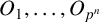 and two additional vertices created by the red edges of
$X_n$
 . We denote these vertices by
$I_1$
 and
$I_2$
 . Each
$O_i$
 is connected to each
$I_j$
 by two black edges. Furthermore, there are
$p^n$
 red edges connecting
$I_1$
 to
$I_2$
 . Thus,
$X_n^\vee $
 is the derived graph of the voltage assignment that is totally ramified in
$I_1$
 and
$I_2$
 , and assigns
$\tau $
 to the red edge in
$X_0^\vee $
 and
$1$
 to all other edges.
The following result gives a necessary condition for the dual graphs to indeed form a branched covering.
Corollary 5.5. Let
$(X_n)_{n\in \mathbb {N}}$
 be a
$\mathbb {Z}_p$
 -cover of planar graphs and fix the planar embeddings of
$X_n$
 . Assume that
$(X^\vee _n)$
 also builds a
$\mathbb {Z}_p$
 -cover. Let
$n_0$
 be an index such that the number of ramified vertices stabilizes for
$X_\infty /X_{n_0}$
 and
$X_\infty ^\vee /X_{n_0}^\vee $
 . Let
$\mathsf {v}_r$
 and
$\overline {\mathsf {v}}_r$
 be the number of ramified vertices in
$X_\infty /X_{n_0}$
 and
$X_\infty ^\vee /X_{n_0}^\vee $
 , respectively. Then,
$0\leq \mathsf {v}_r\leq 2$
 and
$\overline {\mathsf {v}}_r = 2 - \mathsf {v}_r$
 .
Proof. Consider the
$n$
 th layer of the
$\mathbb {Z}_p$
 -cover of planar graphs. Let
$\mathsf {v}_n$
 be the number of vertices,
$\mathsf {e}_n$
 be the number of edges, and
$\mathsf {f}_n$
 be the number of faces. As
$X_n$
 is planar,

For all
$n\ge n_0$
 , it follows from an application of Lemma 2.9 that

As
$\mathsf {f}_n$
 is the number of vertices of
$X_n^\vee $
 , we obtain that for
$n \ge n_0$
 ,

This implies that
$\overline {\mathsf {v}}_u = \mathsf {e}_0 - \mathsf {v}_u$
 and
$2-\mathsf {v}_r=\overline {\mathsf {v}}_r$
 . As both sides of the equation have to be nonnegative, the claim follows.
Definition 5.6. Let
$X=(V,\mathbb {E})$
 be an undirected graph. A dart assignment is a function

such that
$\phi (e)+\phi (\overline {e})=0$
 , where
$\overline {e}$
 denotes the inverse of
$e$
 . Set
$F(X)$
 to denote the faces of
$X$
 and
$f^\circ (X)$
 to denote the boundary of
$F(X)$
 in a counterclockwise orientation. For any dart-assignment
$\phi $
 , define the associated vertex-configuration and face-configuration as follows:

Theorem 5.7. Keep the notation introduced above and assume that
$(X_n^\vee )_{n\in \mathbb {N}}$
 is a cover as well. Then, as Galois modules,

Proof. As abstract groups, the isomorphism of the Jacobian groups is proven in [Reference Cori and RossinCR00, Theorem 2]. Let
$u$
 be an element in
${\mathrm {Div}}^0(X)$
 . By [Reference Cori and RossinCR00, Proposition 3.2], there exists a dart assignment
$\phi $
 such that
$\partial \phi =u$
 . It follows that
$\partial ^*(\phi )\in {\mathrm {Div}}^0(X^\vee )$
 . By [Reference Cori and RossinCR00, proof of Theorem 2], this assignment induces a well-defined bijective homomorphism

It remains to check that
$\theta $
 is a
$G$
 -homomorphism. Let
$x\in \mathrm {Jac}(X)$
 and let
$u$
 be a lift in
${\mathrm {Div}}^0(X)$
 . Then,

Therefore,

Furthermore,

Therefore,

Remark 5.8. It is crucial that we work with the Jacobian group here and not with the whole Picard group. For Picard groups, the above statement is in general not true. Indeed, consider a graph
$X$
 with
$1$
 vertex and
$1$
 loop. Let
$X_\infty /X$
 be an unramified
$\mathbb {Z}_p$
 -cover of
$X$
 with intermediate layers
$X_n$
 . In this case,
$\mathrm {Pic}(X_n)\cong \Lambda /(T^2,\omega _n)$
 , where
$\omega _n = \omega _n(T)=(T_i+1)^{p^n} -1$
 was defined previously in Theorem 4.4. We define
${\nu _{n,0}= \omega _n/T}$
 . For
$n>0$
 , the dual graph
$X_n^\vee $
 has
$2$
 vertices and
$p^n$
 edges between these vertices. In this case,

These two modules are certainly not isomorphic as
$\Lambda $
 -modules. However,

Recall that if
$X$
 and
$X^\vee $
 are dual planar graphs and
$\mathcal {T}$
 is a spanning tree for
$X$
 , then the complement of the edges dual to
$\mathcal {T}$
 is a spanning tree for
$X^\vee $
 ; see [Reference BiggsBig71]. It now follows that

In other words, the generalized Iwasawa invariants associated with the finite layers above the graph
$X$
 and
$X^\vee $
 must coincide. Another way to see the above equality is to recall the fact that
$\kappa (X_n) = \# \mathrm {Jac}(X_n)$
 ; the equality is immediate from Theorem 5.7.
By Theorem 5.7, we can conclude that
$\mathrm {Jac}_{\Lambda }(X_\infty ) \simeq \mathrm {Jac}_{\Lambda }(X_\infty ^\vee )$
 as
$\Lambda $
 -modules. Therefore,

Example 5.9. Revisiting Example 5.4, we can now compute the characteristic ideal of
$\mathrm {Jac}(X_\infty )$
 by computing the characteristic ideal of
$\mathrm {Jac}(X_\infty ^\vee )$
 . While the computation of
$\mathrm {Jac}(X_\infty )$
 involves the computation of a
$5\times 5$
 matrix, the computation of the characteristic ideal of
$\mathrm {Jac}(X_\infty ^\vee )$
 only involves the computation of the determinant of the following
$3\times 3$
 matrix:

5.2 Applications
Corollary 5.10. Let
$X$
 be a finite connected graph. Assume that
$(X_n)_{n\in \mathbb {N}}$
 is an unramified
$\mathbb {Z}_p$
 -cover of planar graphs. Assume that for each
$n$
 ,
$X_n^\vee /X^\vee $
 is a branched covering. Then,
$T\mid \mathrm {char}_\Lambda ({\mathrm {Jac}}_\Lambda (X_\infty ))$
 .
Proof. Let
$\mathsf {e}_n$
 be the number of undirected edges,
$\mathsf {v}_n$
 be the number of vertices, and
$\mathsf {f}_n$
 be the number of faces of
$X_n$
 . As all graphs are planar, the Euler characteristic formula asserts that for all
$n$
 ,

Rearranging the terms,

By Lemma 2.9, we know that
$X_n^\vee $
 has exactly two totally ramified vertices and that all other vertices are unramified. By construction, the matrix
$D-B$
 has the form

The determinant of this matrix is clearly divisible by
$T^2$
 . The claim follows from [Reference Gambheera and VallièresGV24, Theorem 5.9] and the fact that
${\mathrm {char}}_{\Lambda }(\mathrm {Jac}_{\Lambda }(X_\infty )) = {\mathrm {char}}_{\Lambda }(\mathrm {Jac}_{\Lambda }(X_\infty ^\vee ))$
 .
Example 5.11. The above corollary can be applied to the unramified cover given in Example 5.4. Indeed, if one computes the characteristic ideal of
$\mathrm {Jac}_{\Lambda }(X_\infty )$
 , one obtains
$4T$
 s, which is clearly divisible by
$T$
 .
Corollary 5.12. Let
$X$
 be a finite connected graph and let
$\alpha $
 be a single voltage assignment. Let
$(X_n)_{n\in \mathbb {N}}$
 be the unramified
$\mathbb {Z}_p$
 -cover obtained from
$\alpha $
 . Then,
${T\mid \mathrm {char}_\Lambda (\mathrm {Jac}_\Lambda (X_\infty ))}$
 .
Proof. Let
$e_0$
 be the edge of
$X$
 having a nontrivial voltage assignment. We fix an embedding of
$X$
 such that
$e_0$
 lies on the outer face.
By Theorem 3.2, all graphs
$X_n$
 are planar. For each
$X_n$
 , we fix an embedding in the plane. Let
$X_n^\vee $
 be the corresponding dual graph for each
$n$
 . If we can show that
$X_n^\vee /X^\vee $
 is a branched covering, the claim follows from Corollary 5.10.
Let
$X'$
 be the graph obtained from
$X$
 by deleting the edge
$e_0$
 . Then,
$X_n$
 consists of
$p^n$
 copies of
$X'$
 (the different sheets) and the additional edges that restrict to
$e_0$
 . We draw
$X_n$
 as
$p^n$
 -copies of
$X'$
 next to each other and then add the additional edges. The graph
$X_n$
 has three different types of faces:
-
(1) faces that lie completely in one sheet of $X_n$
; -
(2) one outer face;
-
(3) one face that is neither of the first two.

Let

be the covering of graphs. This induces a surjective map of graphs

Consider a face
$F_n$
 of
$X_n$
 of type (1), and fix a path
$\mathsf {P}_{F_n}$
 around its boundary counterclockwise. Note that then
$\pi _n(\mathsf {P}_{F_n})=\mathsf {P}_{F'}$
 , where
$F'$
 is a face of
$X'$
 (and can also be viewed as a face of
$X$
 ). Every edge of
$F_n$
 has a corresponding edge in
$X_n^\vee $
 by construction of the dual graph. Note that each edge starting or ending in
$F_{n}$
 corresponds to (projects to) exactly one edge in
$X^\vee $
 . In particular, the edges of a fixed face
$F_{n}$
 of type (1) and edges of
$F'$
 are in one-to-one correspondence. We further note that the face
$F'$
 is a vertex in
$X^\vee $
 .
Now, consider a face
$F_{n}$
 of
$X_n$
 type (2). Observe that
$\pi _n(\mathsf {P}_{F_{n}})=p^n \mathsf {P}_O$
 , where
$O$
 is the outer face of
$X$
 . If
$F_n$
 is a face of type (3), then
$\pi _n(\mathsf {P}_{F_n})=p^n \mathsf {P}_{F_0}$
 , where
$F_0$
 is the face of
$X$
 having
$e_0$
 on its boundary, but is not the outer face. Thus, there is a
$p^n$
 -to-1 correspondence between edges starting/ending at
$F_{n}$
 , and edges starting and ending at
$O$
 . Thus,
$\pi ^\vee _n$
 is indeed a branched covering.
Acknowledgements
The authors thank Rusiru Gambheera, Antonio Lei, and Daniel Vallières for comments on an earlier draft of the paper and for helpful discussions. We thank Karen Maeghar for answering our questions. We thank the referee for their comments and suggestions, which helped improve the exposition and simplify the proof of Theorem 3.2.


 Open access

