



No CrossRef data available.
Article contents
Cooper–Hirschhorn type identities for three or more squares. III
Part of:Forms and linear algebraic groupsDiophantine equationsAdditive number theory; partitionsCombinatorics
Published online by Cambridge University Press: 22 May 2026
Abstract
Let  $r_s(n)$ denote the number of representations of $n$ as a sum of $s$ squares. Hurwitz established eleven identities expressing the generating function of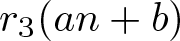 $r_3(an+b)$ as a simple infinite product. Cooper and Hirschhorn (Discrete Math 274 (1-3):9–24, 2004) proved that for any $k\geq0$, the generating functions $\sum_{n=0}^\infty r_3\big(3^{2k}n\big)q^n$ and $\sum_{n=0}^\infty r_3\big(3^{2k+1}n\big)q^n$ can be written as linear combinations of two specified generalized eta-quotients. In this paper, we substantially extend these results to high dimensions. Specifically, we prove that for any $k\geq0$ and $3\leq s\leq 100$, the generating functions $\sum_{n=0}^\infty r_s\big(3^{2k+1}n\big)q^n$ and $\sum_{n=0}^\infty r_s\big(3^{2k+2}n\big)q^n$ can also be expressed as linear combinations of certain generalized eta-quotients. Motivated by these results, we conjecture that this phenomenon holds for $r_s(n)$ for all $s\geq3$, and further that $r_s(n)$ satisfies an infinite family of internal congruences modulo high powers of $3$.
Keywords
Information
- Type
- Research Article
- Information
- Proceedings of the Edinburgh Mathematical Society , Volume 69 , Issue 4 , November 2026, pp. 1183 - 1204
- Copyright
- © The Author(s), 2026. Published by Cambridge University Press on Behalf of The Edinburgh Mathematical Society
References
Andrews, G. E. and Berndt, B. C., Ramanujan’s lost notebook. Part I (Springer, New York, 2005).CrossRefGoogle Scholar
Barrucand, P., Cooper, S. and Hirschhorn, M. D., Results of Hurwitz type for five or more squares, Ramanujan J. 6(3): (2002), 347–367.CrossRefGoogle Scholar
Berndt, B. C., Ramanujan’s notebooks. Part III, (Springer-Verlag, New York, 1991).CrossRefGoogle Scholar
Cooper, S. and Hirschhorn, M. D., Results of Hurwitz type for three squares, Discrete Math. 274(1-3): (2004), 9–24.CrossRefGoogle Scholar
Du, J. Q. D. and Tang, D., Proofs of some conjectural Hurwitz type identities for three squares due to Cooper and Hirschhorn, J. Math. Anal. Appl. 539 (1, part 1, Paper No. 128525): (2024), 20.CrossRefGoogle Scholar
Du, J. Q. D. and Tang, D., Cooper–Hirschhorn type identities for three or more squares. IV, in preparation.Google Scholar
Hirschhorn, M. D., The power of q. A personal journey, developments in mathematics, 49. (Springer, Cham, 2017).CrossRefGoogle Scholar
Hirschhorn, M. D. and McGowan, J. A., Algebraic consequences of Jacobi’s two- and four-square theorems. in Symbolic computation, number theory, special functions, physics and combinatorics (F.G.) (eds. Garvan, F.G. and Ismail, M.E.H.), pp. 107–132 (Kluwer Academic Publishers, Dordrecht, 2001).CrossRefGoogle Scholar
Hirschhorn, M. D. and Sellers, J. A., Arithmetic relations for overpartitions, J. Combin. Math. Combin. Comput. 53 (2005), 65–73.Google Scholar
Hirschhorn, M. D. and Sellers, J. A., Arithmetic properties of partitions with odd parts distinct, Ramanujan J. 22(3) (2010), 273–284.CrossRefGoogle Scholar
Hurwitz, A., Ueber die Anzahl der Classen Quadratischer Formen von Negativer Determinante, Mathematische Werke, pp. 68–71. Band II, Birkhauser, Basel, (1933).Google Scholar
Robins, S., Generalized Dedekind η-products. in The Rademacher Legacy to Mathematics (University Park, PA, 1992), Contemp. Math., 166 (Amer. Math. Soc., Providence, RI, 1994)Google Scholar
Tang, D., Cooper–Hirschhorn type identities for three or more squares, Int. J. Number Theory 21(4) (2025), 837–856.CrossRefGoogle Scholar
Tang, D., Cooper–Hirschhorn type identities for three or more squares. II, Period. Math. Hung. (in press). https://doi.org/10.1007/s10998-025-00697-3.Google Scholar