


Introduction
Although most individuals with serious mental illnesses (SMI) are not violent, the onset and early phase of psychosis represents a clinically important period when aggressive or violent behaviour may first emerge for some individuals, particularly in the context of untreated symptoms (Brucato et al., Reference Brucato, Appelbaum, Lieberman, Wall, Feng, Masucci, Altschuler and Girgis2018; Langeveld et al., Reference Langeveld, Bjørkly, Auestad, Barder, Evensen, Ten Velden Hegelstad, Joa, Johannessen, Larsen, Melle, Opjordsmoen, Røssberg, Rund, Simonsen, Vaglum, McGlashan and Friis2014; Large and Nielssen, Reference Large and Nielssen2011). Even when infrequent, such behaviours can have profound consequences including harm to others, criminal justice involvement (Kooyman et al., Reference Kooyman, Dean, Harvey and Walsh2007; Wallace et al., Reference Wallace, Mullen and Burgess2004), treatment disengagement (Rolin et al., Reference Rolin, Dambreville, Flores, Taylor, Nossel, Bello, Pope, Ford, Compton, Dixon, Appelbaum and Wall2025b), and exacerbation of public stigma (Pescosolido et al., Reference Pescosolido, Manago and Monahan2019). These outcomes not only worsen individual recovery trajectories but also strain families, clinical teams, and service systems.
Decades of research suggest two broad subgroups among people with psychosis who engage in violence: those with longstanding anti-social behaviour predating illness onset and those whose violence develops only after the onset of psychosis (Goethals et al., Reference Goethals, Willigenburg, Buitelaar and Van Marle2008; Hodgins and Klein, Reference Hodgins and Klein2017). The second group, which comprises the majority, appears driven by dynamic, illness-related mechanisms rather than stable anti-social traits (Hodgins, Reference Hodgins2008; Swanson et al., Reference Swanson, Van Dorn, Swartz, Smith, Elbogen and Monahan2008b). For example, findings from the Clinical Antipsychotic Trials of Intervention Effectiveness (CATIE) trial showed that consistent anti-psychotic use reduced violence among individuals whose aggression was linked to psychotic symptoms but had little effect on those with pre-existing anti-social tendencies (Swanson et al., Reference Swanson, Swartz, Van Dorn, Volavka, Monahan, Stroup, McEvoy, Wagner, Elbogen and Lieberman2008a). These findings support the need for mechanism-focused interventions targeting modifiable contributors to violence, including impulsivity and psychosis-related factors such as paranoia and emotional arousal (Adams and Yanos, Reference Adams and Yanos2020; Volavka and Citrome, Reference Volavka and Citrome2011).
The Fluid Vulnerability Theory (FVT) provides a conceptual model for understanding how such risk fluctuates over time (Rolin, Reference Rolin2025). Originally developed to describe dynamic changes in suicide risk, FVT posits that risk arises from the interaction of stable vulnerabilities (e.g. enduring cognitive or behavioural tendencies) with acute triggers (e.g. symptom exacerbation), which fluctuate across multiple domains (affective, cognitive, behavioural, and physiological) (Rudd, Reference Rudd2006). A qualitative analysis of violent episodes in young adults with early psychosis supports this view, revealing patterns of multi-domain activation, consistent with FVT: affective (e.g. anger, fear); cognitive (e.g. interpretations of psychotic experiences such as voices or delusional beliefs); behavioural (e.g. substance use); and physiological (e.g. disrupted sleep) (Rolin et al., Reference Rolin, Flores, Caffrey, Mootz, Dixon, Appelbaum, Stanley and Pope2025c). These findings suggest that violence risk in early psychosis reflects a fluctuating, state-dependent process, consistent with FVT’s emphasis on the dynamic interplay of vulnerability and situational triggers.
This dynamic risk process highlights the importance of early intervention approaches that can identify and modify mechanisms to prevent violence and its long-term consequences. For many young adults, this is the first sustained contact with mental health services, and engagement with early intervention services (EIS) for young people with early psychosis has been shown to improve quality of life, increase participation in work and school, enhance engagement in treatment, reduce hospitalizations, and lessen symptom severity (Dixon et al., Reference Dixon, Goldman, Srihari and Kane2018; Kane et al., Reference Kane, Robinson, Schooler, Mueser, Penn, Rosenheck, Addington, Brunette, Correll, Estroff, Marcy, Robinson, Meyer-Kalos, Gottlieb, Glynn, Lynde, Pipes, Kurian, Miller and Heinssen2016; Lieberman et al., Reference Lieberman, Dixon and Goldman2013). Targeting violence prevention during this formative stage could have lasting benefits, reducing the likelihood of criminal justice involvement and promoting recovery-oriented trajectories.
Cognitive behavioural therapy (CBT) provides a well-suited, mechanism-targeted approach for addressing the dynamic risk processes described by FVT. As a structured, skills-based intervention, CBT helps individuals understand the interaction between thoughts, emotions, and behaviours, and develop strategies for managing distress and improving adaptive coping (American Psychological Association, 2017). Within EIS programs, CBT-based interventions have demonstrated efficacy in reducing impairment, improving functioning, and enhancing coping skills among young adults with early psychosis (Perry et al., Reference Perry, Murrihy, Varlow, Dedousis-Wallace, Ellis, Langdon and Kidman2015; Tarrier et al., Reference Tarrier, Lewis, Haddock, Bentall, Drake, Kinderman, Kingdon, Siddle, Everitt, Leadley, Benn, Grazebrook, Haley, Akhtar, Davies, Palmer and Dunn2004). Beyond symptom management, CBT has also demonstrated promise in reducing violent or aggressive behaviour across diverse clinical and forensic populations (Chen et al., Reference Chen, Li, Wang, Ou, Zhou and Wang2014; Chermack et al., Reference Chermack, Bonar, Goldstick, Winters, Blow, Friday, Ilgen, Rauch, Perron, Ngo and Walton2019; Nesset et al., Reference Nesset, Lara-Cabrera, Bjørngaard, Whittington and Palmstierna2020). However, few studies have directly examined CBT interventions designed specifically to reduce violence in psychosis. One notable example of such a CBT-based intervention is the PICASSO model, developed by Haddock and colleagues. PICASSO is a CBT designed to address violence, anger, and psychotic symptoms among individuals with schizophrenia-spectrum disorders. In a randomized, controlled trial comparing PICASSO (n=38) with a control condition (social activity therapy; n=39), participants in the CBT group showed significantly less physical aggression over 12 months (Haddock et al., Reference Haddock, Barrowclough, Shaw, Dunn, Novaco and Tarrier2009). However, this study was conducted primarily among forensic in-patients with chronic and longstanding aggression, limiting generalizability to individuals in the early stages of psychosis.
To help adapt this approach for use in EIS programs, we conducted formative qualitative research within an early psychosis network (OnTrackNY). This work suggested that interventions to reduce violence risk are viewed as both acceptable and urgently needed, particularly when framed in a non-judgemental, recovery-oriented manner (Rolin et al., Reference Rolin, Caffrey, Flores, Mootz, Bello, Nossel, Compton, Stanley, Wainberg, Dixon, Appelbaum and Pope2025a). In subsequent qualitative work applying the FVT as a guiding framework, we found that violence in early psychosis was typically impulsive, emotionally driven, and closely linked to psychotic symptoms, highlighting opportunities to target dynamic, modifiable mechanisms such as substance use and self-control (Rolin et al., Reference Rolin, Flores, Caffrey, Mootz, Dixon, Appelbaum, Stanley and Pope2025c). These insights informed the development of BRAVE (Behavioral Response Against Violence Engagement), a brief, CBT-based intervention adapted from the PICASSO model for use in early psychosis programs. BRAVE retains PICASSO’s core cognitive-behavioural elements but incorporates FVT-informed psychoeducation and self-regulation strategies tailored to the early phase of psychosis. The present study describes an open pilot trial of BRAVE conducted with clinician–client dyads within EIS programs to evaluate its feasibility, acceptability, and preliminary target engagement. This research was guided by an Advisory Council on Violence Prevention, which was convened for this grant and composed of people with lived experience, family members, and clinicians.
Method
The full protocol for the current study has been published previously (Rolin et al., Reference Rolin, Caffrey, Flores, Pope, Mootz, Bello, Nossel, Compton, Stanley, Wainberg, Dixon and Appelbaum2024). Consistent with the protocol’s iterative adaptation plan, BRAVE was further refined during the pilot using insights from formative qualitative work and the FVT-informed model of psychosis-related violence (Rolin et al., Reference Rolin, Flores, Caffrey, Mootz, Dixon, Appelbaum, Stanley and Pope2025c), which examined anticipated acceptability of the BRAVE concept prior to implementation.
Setting
The study took place within OnTrackNY, a network of EIS clinics that provide co-ordinated specialty care for young adults with early psychosis. OnTrackNY includes 30 co-ordinated specialty care teams across New York State, all offering multi-disciplinary services, including psychiatric care, psychotherapy, supported employment and education, peer support, health and wellness interventions, care management, and family support, with a focus on recovery and community integration.
Participants
Clinician–client dyads were recruited from participating clinics in the OnTrackNY network via an email to an OnTrackNY-wide clinician listserv. OnTrackNY clinicians were master’s- or doctoral-level mental health providers currently delivering therapy within their OnTrackNY clinic. OnTrackNY clinicians were recruited first and, upon providing written informed consent, each identified one or two clients from their current careload who they believed would benefit from participation in the BRAVE behavioural intervention. No formal violence screening was conducted; instead, enrolment was based on clinical judgement and collaborative discussion with OnTrackNY clients regarding appropriateness and interest. This proactive, non-stigmatizing approach was recommended by the study’s Advisory Council.
OnTrackNY clients were eligible if they were between 18 and 30 years old; receiving treatment at a participating OnTrackNY clinic with a participating clinician; and able to provide informed consent. Exclusion criteria included longstanding anti-social behaviour, as determined by six screening items from the CATIE trial that assess major conduct problems before age 15 (Swanson et al., Reference Swanson, Swartz, Van Dorn, Volavka, Monahan, Stroup, McEvoy, Wagner, Elbogen and Lieberman2008a).
All OnTrackNY clients provided written informed consent. Clinician–client dyads delivered the BRAVE intervention as part of routine therapy sessions, typically occupying most of the session while allowing flexibility for clinicians to address other clinical needs as appropriate. Clinician-participants were required to remain employed at their OnTrackNY site, and clients were required to remain in treatment, to continue participation in the study. BRAVE was delivered within routine EIS care and did not modify other components of treatment; medication management and other clinical decisions remained under the direction of participants’ treatment team. Client-participants were informed during consent about the limits of confidentiality and circumstances requiring mandated reporting, and clinician-participants followed standard clinical risk management procedures during BRAVE sessions.
Intervention
The adaptation of BRAVE from the PICASSO model (Haddock et al., Reference Haddock, Barrowclough, Shaw, Dunn, Novaco and Tarrier2009) was informed by qualitative interviews with clinicians and clients at OnTrackNY (Rolin et al., Reference Rolin, Caffrey, Flores, Mootz, Bello, Nossel, Compton, Stanley, Wainberg, Dixon, Appelbaum and Pope2025a; Rolin et al., Reference Rolin, Flores, Caffrey, Mootz, Dixon, Appelbaum, Stanley and Pope2025c) and focused on tailoring the intervention for out-patient EIS settings. These included simplifying session structure to fit shorter visits, integrating language and examples relevant to early psychosis recovery, and adding psychoeducation and self-regulation strategies aligned with the FVT framework to address psychosis-related triggers, anger, and trauma-related stress. BRAVE was structured as a 12-session intervention, with sessions lasting approximately 45 minutes. Sessions were delivered within routine clinician appointments and scheduled flexibly to accommodate clinic workflows and participant needs, following clinic policies for cancellations and rescheduling.
The BRAVE intervention consisted of five modules:
-
(1) Engagement: building rapport; exploring motivation for BRAVE; introducing the CBT model in a collaborative way.
-
(2) Assessment: identifying key problems, triggers, and coping strategies.
-
(3) Formulation: developing a shared understanding of how symptoms, stress, and impulsive reactions interact.
-
(4) Intervention: content of intervention guided by priorities identified in formulation and could include applying targeted strategies (i.e. attention-switching, belief modification) or focus on substance use, anger, or trauma.
-
(5) Wellness Plan (relapse prevention): consolidation of progress; creation of a personalized plan for ongoing safety.
The BRAVE clinician manual emphasizes a structured assessment and formulation process focused on drivers of violence risk. The manual supports clinicians in guiding clients to reflect on and discuss their own violence risk, using guided discovery to identify factors such as anger, substance use, or trauma-related stress that may contribute to harmful behaviours. Intervention strategies are then selected to directly target the processes identified in the formulation. The number of sessions devoted to each module was flexible and guided by the needs and pacing of the clinician–client dyad. All participating clinicians were already trained in CBT for psychosis as part of their OnTrackNY clinical role. Prior to implementation, the study team conducted a 1-hour refresher training in CBT for psychosis and a 1-hour training focused on the BRAVE manual for all participating clinicians. Weekly supervision was available throughout the pilot to review implementation challenges, ensure fidelity to the intervention model, and guide iterative refinements, and all clinicians chose to participate. Three clinicians attended weekly supervision sessions and two attended every few weeks while delivering the intervention.
To assess fidelity, clinician- and client-participants were asked to provide consent for audio recording of randomly selected sessions to be evaluated using the Cognitive Therapy Scale for Psychosis (Haddock et al., Reference Haddock, Devane, Bradshaw, McGovern, Tarrier, Kinderman, Baguley, Lancashire and Harris2001) (CTS-Psy). Given the sensitive nature of discussions about violence, consent for audio recordings of sessions was not required for participation in the study. After several participants declined audio recording, the study team consulted the Advisory Council, which advised against requiring recording given concerns that it might discourage open discussion of violent thoughts or behaviours. In response, the study team developed and implemented a fidelity checklist derived from the CTS-Psy midway through the pilot. Checklist items were grouped into CTS-Psy domains reflecting agenda setting, feedback, understanding, interpersonal effectiveness, collaboration, guided discovery, cognitive focus, cognitive-behavioural intervention delivery, and homework/action planning. Each domain was scored on a 0–1 scale, where 1 indicated full adherence to the intended intervention component. Both clinician- and client-participants who completed the intervention filled out the checklist after the final session to assess adherence to key components.
Measures
The current study evaluated the feasibility of delivering BRAVE within routine EIS care, the acceptability of the intervention, and target engagement among clinician–client dyads. Target engagement was defined as change in the hypothesized mechanistic targets of the intervention, consistent with the experimental therapeutics framework used in NIMH-supported intervention development (Raghavan et al., Reference Raghavan, Munson and Le2019). Measures were selected to capture both the proximal mechanistic target (impulsivity) and related domains (negative emotions, cognitive processes related to psychosis, and behavioural risk factors) consistent with the conceptual model described in the published protocol (Rolin et al., Reference Rolin, Caffrey, Flores, Pope, Mootz, Bello, Nossel, Compton, Stanley, Wainberg, Dixon and Appelbaum2024). During iterative refinement of BRAVE, these domains were mapped onto the FVT framework to improve conceptual coherence and inform future mechanistic hypotheses.
Clinicians completed the Feasibility of Intervention Measure (FIM) (Weiner et al., Reference Weiner, Lewis, Stanick, Powell, Dorsey, Clary, Boynton and Halko2017) and the Acceptability of Intervention Measure (AIM) (Weiner et al., Reference Weiner, Lewis, Stanick, Powell, Dorsey, Clary, Boynton and Halko2017) after each session. These measures use 5-point Likert scales, with 5 indicating the highest rating. Clinicians also participated in brief semi-structured qualitative interviews after sessions 4, 8 and 12 to describe their experiences with implementation, barriers to delivery, and perceived client response. In addition, clinicians completed the COMPASS-10 (Robinson et al., Reference Robinson, John, Miller, Schooler and Kane2024), a brief structured assessment of core symptom domains in psychosis, for each client at baseline and following sessions 4, 8 and 12.
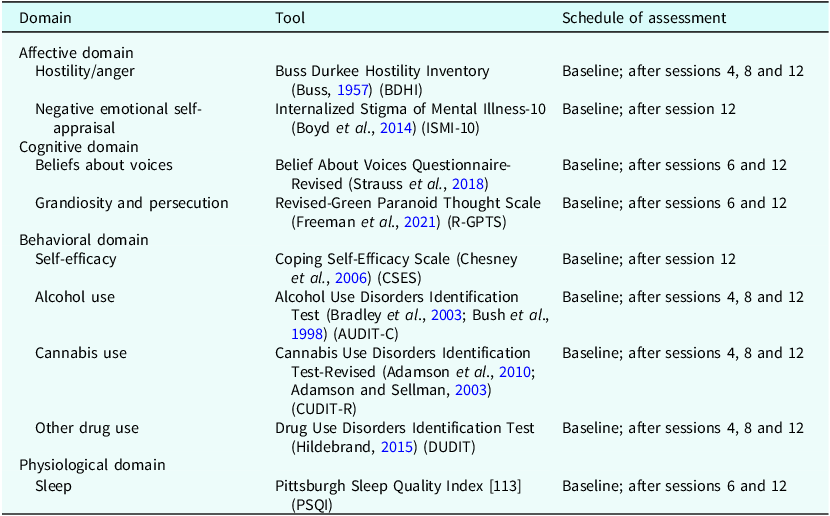
Clients completed study measures across scheduled assessment points throughout the intervention. Feasibility and acceptability were assessed with a brief post-session cognitive interview completed by the research team to gather feedback on clarity, comfort, and relevance of session material. The primary target (impulsivity) was selected based on robust evidence linking impulsivity to violence in early psychosis cohorts (Adams and Yanos, Reference Adams and Yanos2020; Moulin et al., Reference Moulin, Golay, Palix, Baumann, Gholamrezaee, Azzola, Gasser, Do, Alameda and Conus2018; Rolin et al., Reference Rolin, Scodes, Dambreville, Nossel, Bello, Wall, Scott Stroup, Dixon and Appelbaum2022) and measured using the Barratt Impulsiveness Scale-11 (BIS-11) at baseline and after sessions 4, 8 and 12. In addition, the short-form of the UPPS Impulsive Behavior Scale was used to assess more state-sensitive facets of impulsivity (Cyders et al., Reference Cyders, Littlefield, Coffey and Karyadi2014). Secondary outcomes reflected mechanistic domains and can also be conceptualized by the affective, cognitive, behavioural, and physiological systems described by the FVT (see Table 1 for assessments). To minimize fatigue and maintain engagement, measures were staggered across assessment points. Measures expected to change more rapidly (e.g. substance use) were administered more frequently, whereas more stable or cognitively demanding measures (e.g. paranoid beliefs) were collected less frequently. This approach reduced participant burden while aiming to capture meaningful change across the FVT domains.
Secondary mechanistic outcome measures by domain

Table 1. Long description
A table with four columns and multiple rows, detailing secondary mechanistic outcome measures by domain, tools, and schedule of assessment. The columns are labeled Domain, Tool, and Schedule of assessment. The table is divided into different domains: Affective domain, Cognitive domain, Behavioral domain, and Physiological domain. Each domain lists specific measures, the tools used for assessment, and the schedule of assessment points. The Affective domain includes measures like Hostility/anger assessed using the Buss Durkee Hostility Inventory and Negative emotional self-appraisal assessed using the Internalized Stigma of Mental Illness-10. The Cognitive domain includes measures like Beliefs about voices assessed using the Belief About Voices Questionnaire-Revised and Grandiosity and persecution assessed using the Revised-Green Paranoid Thought Scale. The Behavioral domain includes measures like Self-efficacy assessed using the Coping Self-Efficacy Scale, Alcohol use assessed using the Alcohol Use Disorders Identification Test, Cannabis use assessed using the Cannabis Use Disorders Identification Test-Revised, and Other drug use assessed using the Drug Use Disorders Identification Test. The Physiological domain includes measures like Sleep assessed using the Pittsburgh Sleep Quality Index. Each measure lists the specific tool used and the schedule of assessment points, such as baseline, after sessions 4, 8, and 12.
Violence-related thoughts and behaviours were assessed using the Columbia Initial Screen for Violence (CIS-V) at baseline, which captured thoughts and behaviours occurring from symptom onset up to the start of BRAVE. The CIS-V is a structured interview modelled after the MacArthur Community Violence Interview (Steadman et al., Reference Steadman, Mulvey, Monahan, Robbins, Appelbaum, Grisso, Roth and Silver1998) and was designed to assess both violent ideation and behaviours across a range of severity. Subsequent CIS-V assessments (after sessions 4, 8 and 12) captured thoughts and behaviors occurring since the previous assessment (Masucci et al., Reference Masucci, Wall, Califano, Hesson, Brucato, Cohen-Romano, Bornico, Sommerich, Provenzano, Snyder, Lieberman, Appelbaum and Girgisunpublished).
Analysis
Analyses were primarily descriptive and designed to assess feasibility, acceptability, and target engagement. Given the small sample size, quantitative analyses were exploratory and intended to characterize patterns rather than evaluate intervention effectiveness. Quantitative data were analyzed using SPSS 29.0. Means, standard deviations, and completion rates were calculated for all measures. Within-participant change from baseline to end-of-treatment (session 12 or the client’s final session) was examined to explore potential trends. Patterns of change across mechanistic domains (affective, cognitive, behavioural, and physiological) were reviewed descriptively to examine whether changes were directionally consistent with BRAVE’s mechanistic model.
Qualitative interviews with clinicians and clients were reviewed to identify illustrative experiences related to feasibility, acceptability, and perceived mechanisms of change. Quantitative and qualitative findings were considered together during interpretation to highlight areas of convergence that may inform refinement of the BRAVE manual and future trial design. Consistent with the exploratory pilot design, statistical significance testing was not conducted.
Results
Recruitment and participation
Recruitment followed a clinician-first approach in which EIS clinicians were initially approached regarding interest in participating in the study. Eight clinicians across five sites consented. Three sites were able to complete regulatory approvals and initiate the study, while two sites were unable to complete required research approvals during the study period.
Five clinicians accounting for seven clinician–client dyads were enrolled across participating OnTrackNY sites between March 2024 and June 2025. Of these, five dyads completed the BRAVE intervention while two discontinued participation (one dyad discontinued when the client left treatment at OnTrackNY after one session; one dyad discontinued prior to beginning the intervention when their clinic withdrew from the study due to funding constraints). Three clinicians worked with one client each and two worked with two clients each. Among the five dyads who completed the intervention, the mean number of sessions delivered was 11.4 sessions (range: 8–13 sessions).
Participant characteristics
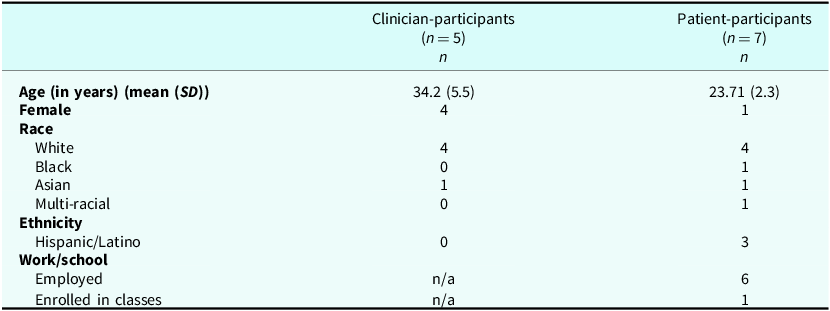
A total of five clinician-participants delivered the intervention; clinician-participants were master’s- (n=4) or doctoral-level (n=1) mental health providers. Client-participants (n=7) had a mean age of 23.7 years (SD=2.3 years); the majority 71.4% (n=5) identified as male and 57.1% (n=4) identified as White, two of whom also identified as Hispanic or Latino. At baseline, 85.7% (n=6) were employed and 14.3% (n=1) were in school. Table 2 summarizes demographic and clinical characteristics of clinician- and client-participants.
Participant characteristics
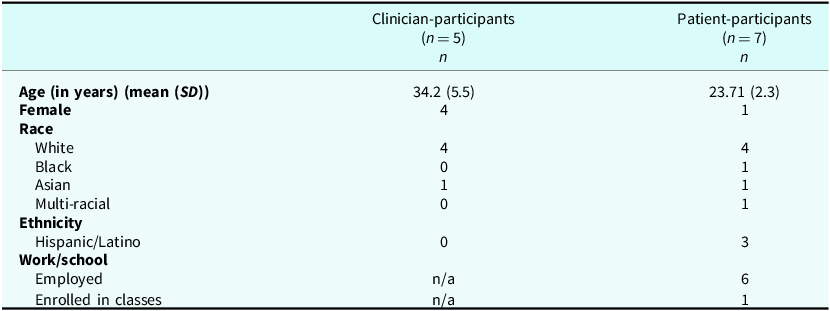
Table 2. Long description
A table comparing characteristics of clinician and patient participants. The table has 5 rows and 3 columns. The columns are labeled ‘Clinician-participants (n=5)’, ‘n’, and ‘Patient-participants (n=7)’. The rows are labeled ‘Age (in years) (mean (SD))’, ‘Female’, ‘Race’, ‘Ethnicity’, and ‘Work/school’. Row 1: Age (in years) (mean (SD)), Clinician-participants (n=5), 34.2 (5.5); Patient-participants (n=7), 23.71 (2.3). Row 2: Female, Clinician-participants (n=5), 4; Patient-participants (n=7), 1. Row 3: Race, Clinician-participants (n=5), White 4, Black 0, Asian 1, Multi-racial 0; Patient-participants (n=7), White 4, Black 1, Asian 1, Multi-racial 1. Row 4: Ethnicity, Clinician-participants (n=5), Hispanic/Latino 0; Patient-participants (n=7), Hispanic/Latino 3. Row 5: Work/school, Clinician-participants (n=5), Employed n/a, Enrolled in classes n/a; Patient-participants (n=7), Employed 6, Enrolled in classes 1.
Implementation outcomes
All clinics that opted to participate and established IRB agreements successfully recruited at least one clinician–client dyad during the enrolment period. Session scheduling and delivery were accommodated within standard clinical operations, supporting the feasibility of implementing BRAVE in routine care settings. Clinician ratings on the AIM indicated high acceptability (mean=4.69, SD=0.65) and ratings on the FIM indicated high feasibility (mean=4.65, SD=0.65).
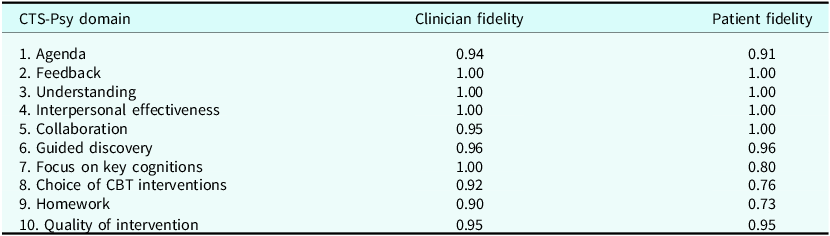
Fidelity to BRAVE was high across both clinician- and client-participants (see Table 3 for ratings). Clinician-reported fidelity was uniformly high across domains (range 0.90–1.00), with strongest performance in Feedback, Understanding, Interpersonal Effectiveness, and Focus on Key Cognitions. Client-reported fidelity was similarly high (range 0.73–1.00), with slightly lower ratings in Choice of CBT Intervention and Homework. Across all domains, mean clinical fidelity was 0.956 and mean client fidelity was 0.920, indicating strong attention to core CBT processes and consistent delivery of BRAVE components.
Domain-level fidelity

Table 3. Long description
A table titled ‘Domain-level fidelity’ compares clinician fidelity and patient fidelity across ten CTS-Psy domains. The table has three columns: CTS-Psy domain, Clinician fidelity, and Patient fidelity. It contains ten rows, each representing a different domain. Row 1: Agenda, Clinician fidelity 0.94, Patient fidelity 0.91. Row 2: Feedback, Clinician fidelity 1.00, Patient fidelity 1.00. Row 3: Understanding, Clinician fidelity 1.00, Patient fidelity 1.00. Row 4: Interpersonal effectiveness, Clinician fidelity 1.00, Patient fidelity 1.00. Row 5: Collaboration, Clinician fidelity 0.95, Patient fidelity 1.00. Row 6: Guided discovery, Clinician fidelity 0.96, Patient fidelity 0.96. Row 7: Focus on key cognitions, Clinician fidelity 1.00, Patient fidelity 0.80. Row 8: Choice of CBT interventions, Clinician fidelity 0.92, Patient fidelity 0.76. Row 9: Homework, Clinician fidelity 0.90, Patient fidelity 0.73. Row 10: Quality of intervention, Clinician fidelity 0.95, Patient fidelity 0.95.
Each domain was scored on a 0–1 scale, where 1 indicated full adherence to the intended intervention component.
Throughout the pilot, clinician and client feedback guided iterative refinements to enhance fit and usability. Early in the study, clinicians emphasized the need for a client-facing manual to support between-session review and skill practice; this was introduced mid-pilot. Subsequent dyads reported improved engagement, comprehension, and recall of session material. Additional feedback from clinician- and client-participants highlighted the need for more structured worksheets and expanded content addressing trauma and its relationship to impulsivity and aggression. Modules were revised to incorporate additional examples and case illustrations to support flexible delivery across a range of clinical presentations. All refinements were incorporated into the updated BRAVE manual and fidelity materials for future implementation.
Clinical outcomes
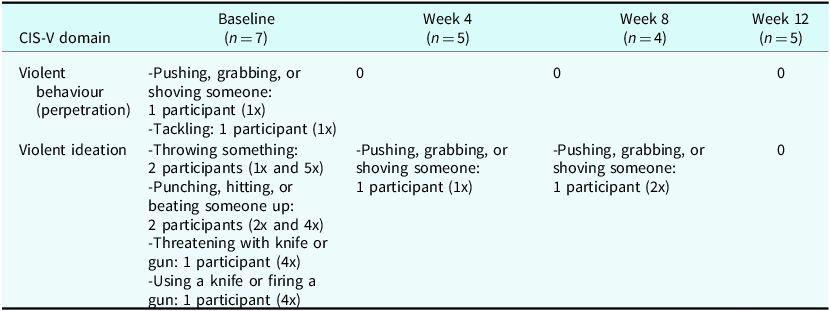
Violence perpetration was infrequent (see Table 4 for clinical outcomes). Two participants reported minor acts of physical aggression at baseline. No participant reported violent behaviour at any follow-up assessment. Violent ideation, which was more common at baseline, decreased over time and was not reported by any participant at the final assessment.
Clinical outcomes

Table 4. Long description
A table comparing violent behavior and ideation across different time points. The table has four columns and two rows, with the columns labeled as Baseline (n=7), Week 4 (n=5), Week 8 (n=4), and Week 12 (n=5). The rows are labeled as Violent behaviour (perpetration) and Violent ideation. Row 1: Violent behaviour (perpetration): Pushing, grabbing, or shoving someone: 1 participant at Baseline, 0 at Week 4, 0 at Week 8, 0 at Week 12. Tackling: 1 participant at Baseline, 0 at Week 4, 0 at Week 8, 0 at Week 12. Row 2: Violent ideation: Throwing something: 2 participants at Baseline (1x and 5x), 0 at Week 4, 0 at Week 8, 0 at Week 12. Punching, hitting, or beating someone up: 2 participants at Baseline (2x and 4x), 0 at Week 4, 0 at Week 8, 0 at Week 12. Threatening with knife or gun: 1 participant at Baseline (4x), 0 at Week 4, 0 at Week 8, 0 at Week 12. Using a knife or firing a gun: 1 participant at Baseline (4x), 0 at Week 4, 0 at Week 8, 0 at Week 12. Pushing, grabbing, or shoving someone: 1 participant at Week 4 (1x), 1 participant at Week 8 (2x), 0 at Week 12.
Sample size varies as two dyads discontinued early and one dyad completed the intervention in 8 sessions (end-of-treatment measures collected at final session).
Clinician-rated symptoms
Clinician ratings on the COMPASS showed small shifts in symptoms over the course of treatment. Depressed mood decreased from two participants at baseline to one at the end of treatment, with reduced severity. Anxiety decreased from five participants to three, shifting towards very mild to mild levels. Suicidal ideation, present for one participant at baseline, was not reported for any participants at the end of treatment. Suspiciousness decreased from four participants to two, with resolution of moderately severe symptoms. Hallucinations decreased from two participants to one, with the remaining participant rated as moderate at both time points. Avolition increased slightly (one very mild rating at follow-up) and asociality improved, decreasing from three participants to one very mild rating.
Target engagement
Primary mechanistic target: impulsivity
Impulsivity, the primary mechanistic target for BRAVE, was measured with the BIS-11. Among the five participants who completed the intervention, total impulsivity scores remained relatively stable from baseline (mean=57.4, SD=3.2) to end of treatment (mean=57.2, SD=5.5), consistent with BIS-11’s characterization as a trait-level measure. However, one state-sensitive facet of impulsivity, lack of pre-meditation on the UPPS scale, showed a modest reduction over the course of the intervention (mean=12.2, SD=0.8 at baseline to mean=11.8, SD=0.8 at end of treatment), suggesting potential improvement in the ability to pause and consider consequences before acting.
Secondary mechanistic outcomes
Secondary mechanistic outcomes reflected changes across the affective, cognitive, behavioural, and physiological domains assessed during the pilot. These findings are presented descriptively to characterize potential mechanistic signals for future testing.
Affective domain. Scores on the BDHI indicated a modest reduction in overall anger and hostility (baseline: mean=51.0, SD=18.7; end of treatment: mean=47.2, SD=16.0). The clearest change was observed in the Physical Aggression subscale, which decreased from 16.4 (SD=6.3) to 13.8 (SD=4.2). Verbal aggression, anger, and hostility subscales showed minimal changes. Internalized stigma, measured with the ISMI-10, also decreased from 19.6 (SD=4.8) to 17.8 (SD=4.0), reflecting an improvement in negative emotional self-appraisal.
Cognitive domain. Changes were also observed in cognitive processes related to psychosis. Mean scores on the R-GPTS Persecution subscale decreased from 10.2 (SD=12.5) at baseline to 5.8 (SD=8.6) at end of treatment, while scores on the Ideas of Reference subscale remained relatively stable (baseline: mean=8.8, SD=10.5; end of treatment: mean=8.2, SD=7.5).
Among the four participants who reported auditory hallucinations and completed the BAVQ-R, several subscales showed shifts over the course of the intervention. Malevolence (perceived harmful intent of the voices) scores decreased slightly (mean=5.8, SD=7.0 to mean=5.5, SD=6.6) and Benevolence (perceived supportive or kind intent) scores increased modestly (mean=4.4, SD=5.9 to mean=5.3, SD=4.0), indicating improvement. Mean omnipotence (perceived power or control of the voices) scores increased from 6.2 (SD=6.3) to 8.3 (SD=5.6). Resistance (active efforts to push back against the voices) mean scores rose from 11.8 (SD=11.5) to 17.0 (SD=6.8), indicating greater resistance towards the voices, a response pattern generally associated with more active coping. Engagement (behavioural or emotional involvement with the voices) scores decreased slightly from a mean of 5.6 (SD=9.4) to 5.3 (SD=5.7), reflecting a small reduction in behavioural or emotional involvement with the voices.
Behavioral domain. Coping self-efficacy increased from a mean of 185.2 (SD=22.7) at baseline to 202.4 (SD=27.9) at end of treatment. Alcohol use remained relatively stable during the trial. Cannabis use decreased for one participant over the course of the intervention, with two participants reporting use at baseline and one at the end of treatment. Use of other drugs also declined, with the participant who reported frequent use at baseline describing much less frequent use at follow-up.
Physiological domain. Sleep quality, assessed with the PSQI, showed a modest improvement over the course of intervention with mean total scores decreasing from 8.2 (SD=4.9) at baseline to 6.8 (SD=2.6) at end of treatment.
Discussion
This open pilot trial examined the feasibility, acceptability, and preliminary target engagement of BRAVE, a CBT-based intervention to reduce violence risk among young adults with early psychosis receiving care in EIS programs. Within a small sample of clinician–client dyads, BRAVE was integrated into routine services, delivered with high clinician- and client-rated fidelity, and received strong ratings for feasibility and acceptability. These findings suggest that a structured, violence-focused CBT intervention can be readily integrated and delivered within existing workflows in out-patient early psychosis settings.
Recruitment experiences also highlighted logistical challenges in launching multi-site intervention studies within EIS programs. Although clinicians across multiple sites expressed interest in participating, not all sites were able to complete required research approvals during the study period. EIS programs operate within diverse organizational settings, including academic medical centers, community mental health clinics, and public-sector systems, and research oversight requirements may vary across sites, even within the same service network. Future trials may benefit from research oversight processes that better accommodate community-based programs with limited research infrastructure.
Once IRB agreements were in place, implementation outcomes were encouraging. All participating sites with IRB agreements successfully recruited at least one dyad, and clinicians were able to schedule BRAVE sessions within standard visit structures. Clinicians rated the intervention as both highly acceptable and feasible, and all elected to participate in supervision, with most attending regularly while delivering the intervention. This pattern is consistent with prior work indicating that EIS teams are motivated to address violence risk when provided with concrete tools and support (Rolin et al., Reference Rolin, Caffrey, Flores, Mootz, Bello, Nossel, Compton, Stanley, Wainberg, Dixon, Appelbaum and Pope2025a; Rolin et al., Reference Rolin, Flores, Caffrey, Mootz, Dixon, Appelbaum, Stanley and Pope2025c; Whiting et al., Reference Whiting, Glogowska, Fazel and Lennox2024). The introduction of a patient-facing manual mid-pilot appeared particularly helpful; clinicians and clients reported that having written materials to review improved continuity and engagement. These findings indicate that BRAVE can be adopted within routine EIS sessions using standard visit structures, suggesting that clinicians can incorporate violence-focused CBT strategies without altering their existing workflows.
Fidelity assessment posed both a challenge and an opportunity. Although audio-recorded sessions were initially planned as the primary fidelity metric, most clients declined recording to maintain privacy in therapy sessions. This mirrors clinician concerns (Rolin et al., Reference Rolin, Flores, Caffrey, Mootz, Dixon, Appelbaum, Stanley and Pope2025c; Whiting et al., Reference Whiting, Glogowska, Fazel and Lennox2024) and suggests that audio-based fidelity monitoring may not be feasible in clinical treatment settings with this population. In response, a fidelity checklist derived from the CTS-Psy was introduced midway through the pilot. While clinician and client ratings on this checklist were uniformly high, the tool was lengthy and burdensome. In future iterations, we plan to create a briefer, BRAVE-specific fidelity tool that can be embedded directly into routine workflow. For routine practice, embedding brief fidelity prompts into a standardized worksheet that guides agenda-setting and documents skills practice could offer a pragmatic method of supporting treatment quality without imposing additional burden.
Target engagement findings, although exploratory, provide insight into BRAVE’s mechanistic profile. Impulsivity was identified a priori as the primary mechanistic target (Rolin et al., Reference Rolin, Caffrey, Flores, Pope, Mootz, Bello, Nossel, Compton, Stanley, Wainberg, Dixon and Appelbaum2024) based on literature indicating that most violence in early psychosis is reactive and emotionally driven (Adams and Yanos, Reference Adams and Yanos2020; Moulin et al., Reference Moulin, Golay, Palix, Baumann, Gholamrezaee, Azzola, Gasser, Do, Alameda and Conus2018; Rolin et al., Reference Rolin, Scodes, Dambreville, Nossel, Bello, Wall, Scott Stroup, Dixon and Appelbaum2022). Consistent with this rationale, improvement on the BIS-11 was anticipated. However, in this small pilot, BIS-11 total scores remained relatively stable from baseline to end of treatment, a pattern that may reflect the trait-like nature of the measure (Mathias et al., Reference Mathias, Stanford, Liang, Goros, Charles, Sheftall, Mullen, Hill-Kapturczak, Acheson, Olvera and Dougherty2018; Meule et al., Reference Meule, Mayerhofer, Gründel, Berker, Beck Teran and Platte2015) rather than a lack of meaningful change. Notably, the UPPS Lack of Premeditation subscale, a more state-sensitive facet of impulsivity (Carlson et al., Reference Carlson, Pritchard and Dominelli2013; Peckham et al., Reference Peckham, Forgeard, Hsu, Beard and Björgvinsson2019), showed modest improvement, aligning with BRAVE’s emphasis on slowing down and considering consequences before acting. These findings suggest that impulsivity remains an empirically supported and clinically relevant mechanism, but that future trials may benefit from using state-based or behaviourally anchored measures better suited for capturing short-term change.
Secondary mechanistic outcomes showed small, directionally positive changes across the affective, cognitive, behavioural, and physiological domains of the FVT framework. Reductions in hostility, negative self-appraisal, persecutory thinking, substance use, and sleep disturbances, combined with increased coping self-efficacy, indicate movement across several processes that are theoretically linked to dynamic violence risk. The largest change in the affective domain occurred in the Physical Aggression subscale of the Buss-Durkee Hostility Inventory. This subscale reflects aggressive urges or readiness for aggression rather than only actual violent acts, so improvement may indicate reduced aggressive impulses even though no violent incidents occurred in the sample. Although these findings cannot be attributed to BRAVE without a comparison group, the cross-domain pattern is consistent with the intervention’s mechanistic model and highlights potential targets for a larger trial. Overall, these findings indicate that impulsivity can remain part of BRAVE’s mechanistic model, but future trials may benefit from broadening the mechanistic focus to include additional dynamic processes, such as emotional arousal or coping self-efficacy, which demonstrated greater change in this pilot.
Clinical outcomes related to violence were limited by floor effects. Violent behaviour was rare at baseline, and no violent acts were reported during follow-up. Participants nevertheless demonstrated active psychotic symptoms and dynamic risk processes targeted by the intervention (e.g. impulsivity and threat-related cognitive patterns), supporting the relevance of BRAVE for this population despite the low frequency of violent incidents. Violent ideation, which was more common at entry, decreased over time and was absent at the final assessment among treatment completers. Because these observations derive from a small, non-random sample receiving concurrent EIS care, no conclusion can be drawn regarding BRAVE’s impact on violence. However, the absence of adverse events supports BRAVE’s safety and appropriateness for out-patient use.
Several limitations should be considered. The sample size was small: only five dyads completed the full intervention, and there was no comparison group. Clinician-participants were self-selected and may have been more motivated or experienced with CBT than typical EIS clinicians. Because participants were identified through clinician referral rather than formal screening to minimize stigmatization, selection bias is possible, including the potential influence of clinician perceptions when identifying clients who might benefit from the intervention, which could introduce bias related to race or other demographic characteristics. Fidelity was assessed retrospectively rather than session-by-session, as most client participants declined audio recording of sessions due to discussion of sensitive topics such as violent thoughts and behaviours. This reflects a tension between rigorous fidelity assessment and client participants’ desire for privacy in discussing these experiences. Future research should explore approaches to better balance these priorities, including participant-informed approaches to session recording and alternative fidelity strategies when recording is not feasible. Two of the seven dyads discontinued participation during the study: one when the client left treatment within the EIS program and one when a participating clinic withdrew from the study due to funding uncertainty affecting the program. Disengagement rates of approximately 30% have been reported in early psychosis services (Doyle et al., Reference Doyle, Turner, Fanning, Brennan, Renwick, Lawlor and Clarke2014), suggesting that the observed rate in this pilot is consistent with engagement patterns commonly encountered in this population.
Despite these limitations, this pilot provides an important foundation for a larger evaluation of BRAVE. In this pilot, BRAVE was feasible to deliver, acceptable to clinicians and clients, and aligned with hypothesized mechanistic pathways derived from the FVT model. This pilot also identified concrete, practice-relevant strategies to strengthen clinical delivery of BRAVE, such as patient-facing materials and session-embedded fidelity supports. We plan to use these findings to inform the design of an upcoming stepped-wedge trial, which will test BRAVE across multiple EIS sites, evaluate changes in dynamic risk processes over time, and examine implementation strategies that support sustainability. Future work will focus on refining BRAVE’s mechanistic targets, strengthening trauma-informed components, and developing a pragmatic, session-embedded fidelity tool to support high-quality implementation at scale.
Key practice points
-
(1) A violence-focused CBT intervention (BRAVE) may be feasible to deliver within routine EIS care, with clinicians integrating it into standard visits and reporting high acceptability.
-
(2) Patient-facing materials, including a structured manual, may enhance engagement and continuity.
-
(3) Traditional fidelity monitoring via audio recording may be difficult to implement with young adults with early psychosis, underscoring the need for alternative fidelity strategies such as brief, session-embedded fidelity tools.
Data availability statement
The data that support the findings of this study are available from the first author, S.A.R., upon reasonable request.
Acknowledgements
We are grateful to the clinicians and participants of OnTrackNY for their involvement in this project. We also thank the Advisory Council on Violence Prevention for their guidance throughout the development and refinement of BRAVE. The authors used ChatGPT (OpenAI) to assist with grammar and language editing. All scientific content and conclusions were developed and verified by the authors, and the paper adheres to the journal’s authorship policy.
Author contributions
Stephanie Alexia Rolin: Conceptualization (lead), Methodology (lead), Writing - original draft (lead); Samantha E Jankowski: Formal analysis (lead), Methodology (supporting), Software (supporting), Writing - original draft (supporting), Writing - review & editing-Equal; Megan G Flores: Formal analysis (supporting), Methodology (supporting), Software (lead); Ilana Nossel: Conceptualization (supporting), Investigation (supporting), Supervision (supporting), Writing - review & editing (supporting); Iruma Bello: Conceptualization (supporting), Investigation (supporting), Supervision (supporting), Writing - review & editing (supporting); Milton L Wainberg: Conceptualization (supporting), Investigation (supporting), Supervision (supporting), Writing - review & editing (supporting); Leah G Pope: Conceptualization (supporting), Investigation (supporting), Resources (supporting), Supervision (supporting), Writing - review & editing (supporting); Michael T Compton: Conceptualization (supporting), Investigation (supporting), Supervision (supporting), Writing - review & editing (supporting); Lisa B Dixon: Conceptualization (supporting), Writing - original draft (supporting), Writing - review & editing (supporting); Paul S Appelbaum: Conceptualization (supporting), Funding acquisition (supporting), Writing - original draft (supporting), Writing - review & editing (supporting).
Financial support
This work was supported by the National Institute of Mental Health (K23MH126312) to the first author. The content is solely the responsibility of the authors and does not necessarily represent the official views of the National Institute of Mental Health or the National Institutes of Health.
Competing interests
The authors declare none.
Ethical standards
The study received ethical approval from the New York State Psychiatric Institute IRB (#8451) and the Columbia University Irving Medical Center IRB (AAAU8528) and was registered with clinicaltrials.gov (NCT05756855). All study procedures were conducted according to the Declaration of Helsinki. The study intervention was conducted between April 2024 and October 2025.

 Open access


Comments
No Comments have been published for this article.