
In the last chapter of Franz Kafka’s Amerika, Karl Rossman arrives at the racetrack where the Nature Theater of Oklahoma is holding its auditions. Suddenly he sees a low stage with “hun-dreds of women dressed as angels in white robes and with great wings on their shoulders […] blowing on long trumpets that glittered like gold” (Kafka [Reference Kafka1927] Reference Kafka, Brod, Muir and Muir1974:274). The performers perch awkwardly on high pedestals that are hidden by their flowing robes: “[T]hese women looked gigantic, except that the smallness of their heads spoiled a little the impression of size, and their loose hair looked too short and almost absurd hanging between the great wings and framing their faces” (274).
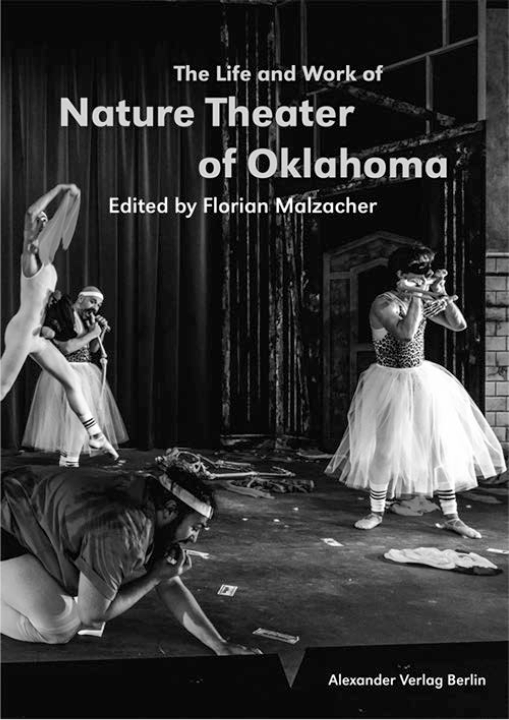
This “almost absurd” scene could function as a mini-manifesto for Pavol Liška and Kelly Copper’s New York–based performance company, whose name is borrowed from Kafka’s messianic theatre. Just like their namesake, Liška and Copper’s Nature Theater of Oklahoma (NTOK) revels in bizarre disproportions, precarious balances, haircuts gone inexplicably wrong. And if it takes a small head to star in Kafka’s Nature Theater, then Liška and Copper’s onstage figures may have the smallest of them all. Walter Benjamin invoked this small-headedness to yoke Kafka together with a mode of theatricality unique to Western modernity stretching back to the 17th century. Since the time of the German baroque, he claimed, characters in modern theatre have been strangely lacking in “sovereignty”; rather, they appear tossed about in “the sheer arbitrariness of a constantly shifting emotional storm” and recall “the figures of El Greco in the smallness of their heads, if we understand this in a metaphorical sense” (Benjamin [1928] Reference Benjamin and Osborne1998:71).
If this description paints Kafka as a baroque figure of sorts, one also hears in it a quiet prophecy of a future postdramatic stage that NTOK would come to embody. For Benjamin, that is, Amerika’s Nature Theater of Oklahoma held extreme philosophical significance. Calling Kafka’s world “a world theatre” (Benjamin [1934] Reference Benjamin, Arendt and Zohn1968:124), he remarked of the Oklahoma company:
What the standards for admission are cannot be determined. Dramatic talent, the most obvious criterion, seems to be of no importance. But this can be expressed in another way: all that is expected of the applicants is the ability to play themselves. It is no longer within the realm of possibility that they could, if necessary, be what they claim to be. (71)
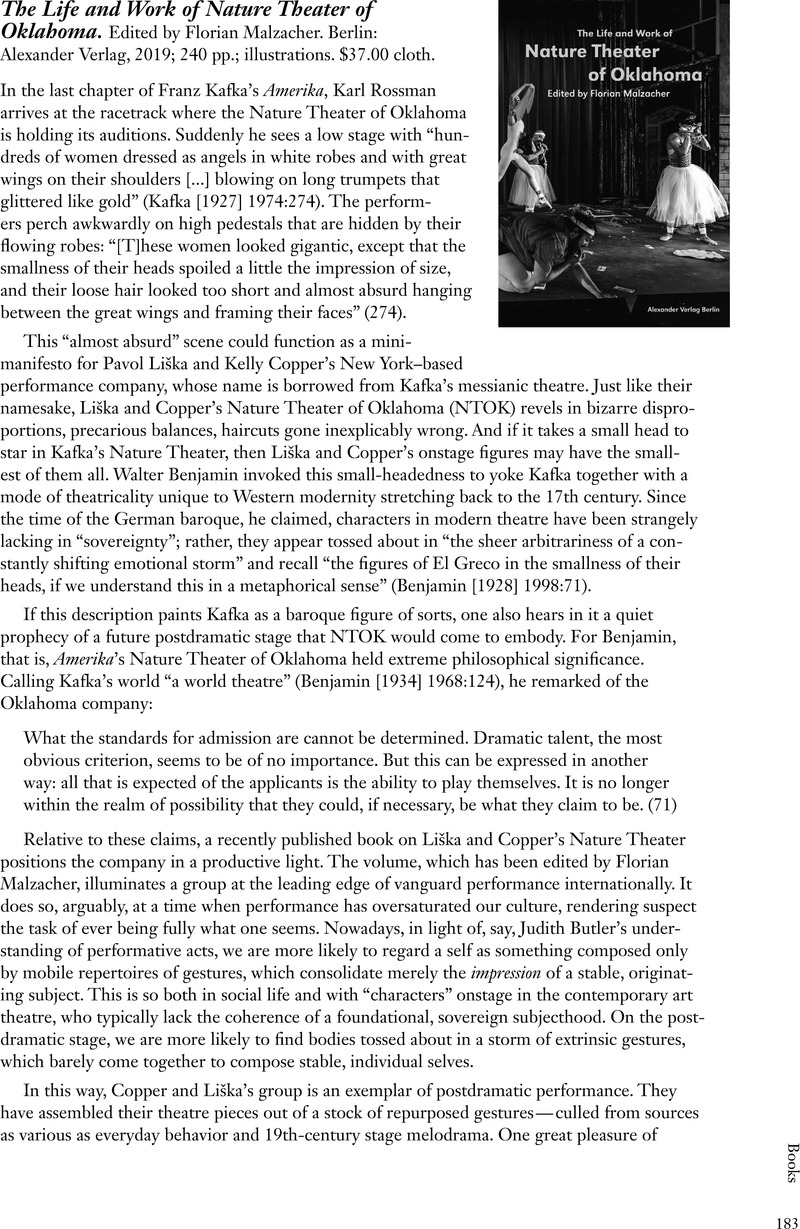
Relative to these claims, a recently published book on Liška and Copper’s Nature Theater positions the company in a productive light. The volume, which has been edited by Florian Malzacher, illuminates a group at the leading edge of vanguard performance internationally. It does so, arguably, at a time when performance has oversaturated our culture, rendering suspect the task of ever being fully what one seems. Nowadays, in light of, say, Judith Butler’s understanding of performative acts, we are more likely to regard a self as something composed only by mobile repertoires of gestures, which consolidate merely the impression of a stable, originating subject. This is so both in social life and with “characters” onstage in the contemporary art theatre, who typically lack the coherence of a foundational, sovereign subjecthood. On the postdramatic stage, we are more likely to find bodies tossed about in a storm of extrinsic gestures, which barely come together to compose stable, individual selves.
In this way, Copper and Liška’s group is an exemplar of postdramatic performance. They have assembled their theatre pieces out of a stock of repurposed gestures—culled from sources as various as everyday behavior and 19th-century stage melodrama. One great pleasure of
Malzacher’s volume is seeing, in rich detail, through photos and vivid descriptions, how their work has thus helped further dismantle the performer’s body as a site of fixed meaning, transforming it into a play of theatrical attributes.
Malzacher’s handsome, lavishly illustrated text is structured less like a typical monograph and more like an exhibition catalogue. In his introduction, the editor details the duo’s history and working methods, especially their fascination with ready-mades, phone recordings, alea-toric procedures, amateur actors, and obstacles. The ensuing essays and interviews approach the group’s work from a host of angles. Joris Lacoste and Pieter T’Jonck offer fruitful analyses of the group’s projects in performance, while Copper and Liška’s publisher, Karinne Keithley Syers, provides reflections on their writing praxis. The Austrian critic Claus Philipp examines NTOK’s films in the context of US American Underground and European cinema, including their recent Die Kinder der Toten (2019), based (loosely) on Elfriede Jelinek’s 666-page novel of the same name. Philipp’s essay is particularly useful for delineating NTOK’s relationship to the 1970s queer performance artist Jack Smith. (In light of this connection, the group’s love of campy mugging, pseudo-expressionistic gestures, elaborate pranks, trash of all kinds, and viewing life as art takes on new meaning.) Meanwhile, Theater magazine editor Tom Sellar situates the group amid New York’s downtown theatre scene, a useful move given its semi-international status. And a phone interview with PAJ’s editor Bonnie Marranca, unaware she was being recorded, makes an entertaining exploration of the group’s approach to text-making, “ridiculous realism,” and its enduring fascination with what Marranca calls “unloveable jerks” and “losers.” The book concludes with a “glossary” of terms (“amateurs,” “chance,” “moustache,” “talent”) that each introduce snippets of conversations from the NTOK podcast, putting Liška and Copper into short dialogues with artists like Jérôme Bel and Romeo Castellucci.
A pair of particularly wonderful contributions deserves attention here. In a wide-ranging essay, Nikolaus Müller-Schöll examines the politics of aesthetic form in NTOK’s performances, describing the productions not as “dramas” (or even “postdramatic”) but as being based in “scripts,” drawing on Florence Dupont’s, Ric Knowles’s, and Ludwig Jäger’s scholarship. Because a script determines and organizes performers’ tasks (rather than inserting performers into a fictive or represented drama), it makes possible imprecisions, alterations, and failures from one performance to the next. For Müller-Schöll, Copper and Liška’s theatre is most political in those moments when these scripts break down, producing “an artfully staged inability or incapacity that allows something to become visible or audible at the moment when the greatest possible obstacles are not entirely successfully overcome” (156). Such moments of failure—Benjamin might say, those moments when the performers can least of all be what they seem—make possible the irruption of a different, more expressly political kind of gesture. Borrowing a phrase from Liška, Müller-Schöll describes these instances of failed performance as “human resistance” (156) and as models for combatting those forms of power that script and conscript modern life.
In her own inclusion, Jelinek reminisces poetically on a visit Liška and Copper paid her while they were filming Die Kinder der Toten in the Austrian Alps. In terms that rhyme with Kafka and Benjamin’s messianic languages, she describes the two theatre makers as angelic figures “who want to hold everything together […]. The two angels say: Everything must come in, first the tablecloths on the garden tables, because the deluge is upon us” (141– 43). Now as ever, a storm is blowing from paradise. As Philipp points out in his essay, a sentence in Jelinek’s 1995 novel Die Kinder der Toten strangely echoes Kafka, as though Jelinek were already presciently aware 25 years ago that two representatives of the Oklahoman Nature Theater would one day appear to adapt the book: “On this natural stage all performers are amateurs” (123).

