

A mass of facts tells us that if corruption becomes increasingly serious, it will inevitably doom the party and the state. We must be vigilant. In recent years, there have been cases of grave violations of disciplinary rules and laws within the party that have been extremely malign in nature and utterly destructive politically, shocking people to the core.
In 2012, the Chinese Communist Party (CCP) faced its biggest political scandal in a generation: Bo Xilai, one of the Party’s most senior leaders, was arrested on charges of graft and abuse of power. When Xi Jinping was named China’s paramount leader later that year, he warned that corruption would “doom the Party and the nation,”Footnote 1 and, soon afterward, launched the most vigorous anti-corruption crackdown in the Party’s history. Decades before Xi, China observers had pointed to the country’s serious corruption problem.Footnote 2
According to conventional wisdom, corruption hurts economic growth.Footnote 3 Cross-national regressions show a strong correlation between corruption and poverty. For development agencies and many academics, eradicating corruption is a prerequisite for economic development.Footnote 4 In recent years, corruption has stoked popular discontent and led to the toppling of authoritarian regimes, including those in Egypt and Tunisia.Footnote 5
China, however, presents a paradox. Since opening markets in 1978, China has achieved “the fastest sustained expansion by a major economy in history,” according to the World Bank.Footnote 6 Why has China’s economy grown so fast for so long despite vast corruption?
This book shows that, in fact, China is not as exceptional as we think it is – the closest parallel is the United States in the late nineteenth century, a period characterized by both feverish growth and glaring inequality, conniving plutocrats and corrupt politicians. What we have witnessed since 1978 is China’s Gilded Age in the making. The assumption that all corruption hampers growth is over-simplistic. To explain China, we must fundamentally revise our beliefs about the relationship between corruption and capitalism.
What Makes China an Outlier?
The most widely used indicator of corruption is the Corruption Perception Index (CPI), which Transparency International (TI) releases every year. According to the CPI, in 2012, the year Xi declared corruption an existential threat to the Party, China was ranked 80th out of 174 countries, with a score of 39 out of 100 (where 100 is cleanest).Footnote 7 Other countries in this category include El Salvador, Malawi, Jamaica, Serbia, and Sri Lanka – all of which have far weaker economies. This cursory comparison has led many commentators to cast China as a “gigantic outlier.”Footnote 8
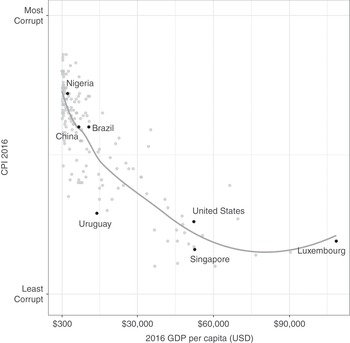
China is a “gigantic outlier” – but not in the ways most analysts assume. In fact, at China’s level of GDP per capita, it is not unusual to have moderately high corruption,Footnote 9 as Figure 1.1 shows.Footnote 10 Nor is China an outlier when corruption levels are plotted against GDP growth rates (see the Appendix).Footnote 11 Corrupt countries tend to be poor, and poor countries usually have higher growth rates than rich countries.Footnote 12

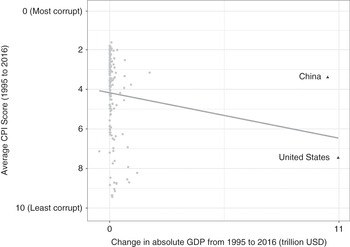
What’s truly extraordinary about China is that no similarly corrupt country has come anywhere close to reaching its scale of economic expansion. As Figure 1.2 shows, only two countries in the world achieved nearly 11 trillion US dollars in absolute GDP growth from 1995 to 2016: China and the United States. The popular image of the Chinese anomaly reflects the stark difference between the two superpowers: the United States is rated as one of the world’s cleanest countries, whereas China is corrupt. Equally remarkable is China’s rare distinction of sustaining four decades of rapid growth, whereas other developing countries typically lurch back and forth.Footnote 13 This implies that Chinese growth was not a temporary fluke, made possible by luck or a commodity boom, as seen in countries such as Nigeria and Russia.Footnote 14

The durability and gigantic scale of Chinese economic expansion, juxtaposed with reports of “rising” and “explosive” corruption,Footnote 15 cannot simply be brushed away by assertions of imminent collapse, even amid the current slowdown.Footnote 16 How China has come this far – from an impoverished communist regime to a capitalist superpower rivaling the United States, despite a crisis of corruption that its leadership sees as “grave” and “shocking” – must be explained. This is the task of my book.
The Limits of Existing Accounts
Studies on Chinese corruption are voluminous enough to fill a library. Many books on the subject describe the evolving forms and severity of corruption in the reform era.Footnote 17 By exposing corrupt practices, this line of work presents a necessary counter-narrative to positive accounts of Chinese officials as “developmental” and “entrepreneurial.”Footnote 18 Yet it does not explain how China has prospered in the midst of endemic corruption.
One popular argument is that the Chinese economy and regime will soon collapse due to rampant corruption.Footnote 19 Casting the CCP state as “incapacitated” and “predatory,” Minxin Pei warned in 2006: “The international community should start preparing … for the unpleasant prospect that China may … descend into long-term stagnation.” A decade later, he repeated his prognosis: “The inevitable consequence of crony capitalism is the decay of the Leninist regime.”Footnote 20 But Pei’s dark portrayal only deepens the puzzle – if things are so bad, why hasn’t China already collapsed?
Others argue that following market reform, China’s economy grew so fast that corruption could not dent it. Wedeman, whose account is the most comprehensive to date, explains with an analogy: “In China the hen was increasingly robust and capable of laying more eggs than the Chinese foxes [officials] could grab.” But there is no reason to believe that rapid growth immunizes countries against graft and theft, especially given Wedeman’s insistence that China suffered “very significant levels of overtly predatory corruption.”Footnote 21 Indeed, many thriving economies tanked under corrupt governments; the Philippines under Ferdinand Marcos is a case in point.Footnote 22
A third explanation, also from Wedeman, is that the Party’s anti-corruption campaigns “prevented corruption from reaching even higher levels or spinning out of control.”Footnote 23 But this is contradicted by President Xi’s emphatic statement in 2012 that weak checks allowed corruption to fester to an alarming level. Other studies concur that crackdowns prior to Xi’s arrival in office were episodic and ineffective.Footnote 24
A final set of accounts imply that Chinese corruption did not impede rapid growth because it was “less destructive” than corruption in other countries. According to Sun, “corruption tends to be somewhat less costly in China than in Russia,” as big bang reforms unleashed lawless corruption in Russia, whereas Chinese “arrangements of profit-sharing … [turned] potential opponents of reform into participants.”Footnote 25
This theory is plausible but suffers from a few crucial flaws. First, Sun uses the term “profit-sharing” only as an analogy; she does not spell out the mechanisms or demonstrate how such arrangements work. Second, comparative arguments about the nature of corruption in China are based on subjective impressions, which are often contradictory.Footnote 26 Without systematic data, we cannot tell who is right or wrong. Third, Sun’s claim that China’s corruption is of a less destructive variety is not supported by evidence. Instead, throughout her book, she proves the opposite – “the weakening of state institutions and capacities” resulted in “worsening corruption”Footnote 27 – which takes us back to square one: if corruption is indeed bad and getting worse, why has China prospered?
In short, despite an abundant literature, the paradox remains unresolved. To advance a satisfactory explanation, this book offers a different approach centered on “unbundling corruption,” and it has four key features. First, rather than accept the conventional wisdom that all corruption retards growth, I unpack and revise this assumption. Second, rather than assert that China’s structure of corruption is of a certain type on the basis of anecdotes or subjective impressions, I establish objective standards and collect data to compare corruption structures in China and other countries. Third, rather than lump more than 50 million functionaries in China’s gigantic bureaucracy into one homogeneous group, my theory distinguishes between political elites and rank-and-file bureaucrats, who engage in different forms of corruption.Footnote 28 Fourth, my study deploys a range of data, both qualitative and quantitative, within China and across countries, to support my explanation.
Unbundling Corruption
Corruption is conventionally defined as the abuse of public office for private gain. This broad definition encompasses many varieties of corruption, but global indices, including the CPI and the World Bank’s Control of Corruption Index, present bundled scores – one number for every country. This approach obscures the fact that not all corruption is equally damaging. Indeed, I contend that certain kinds of corruption may stimulate growth in the short term yet produce serious risks and distortions.
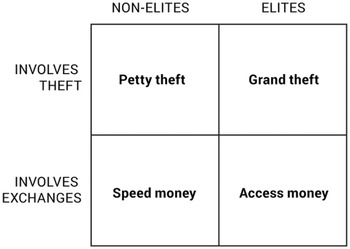
To revisit the relationship between corruption and capitalism, we must first unbundle corruption into qualitatively distinct types. Any useful typology must strike a balance between nuance and parsimony, that is, neither too few nor too many categories. Keeping this in mind, I propose a typology along two dimensions: (i) corruption with exchanges vs. theft, and (ii) corruption involving elites vs. non-elites.
Two Dimensions
First, I distinguish between corruption involving two-way exchanges between officials and social actorsFootnote 29 – including but not limited to bribery – and corruption involving theft, such as embezzlement or extortion. Classic models of corruption focus on bribery.Footnote 30 To give two examples from a long list, Shleifer and Vishny’s seminal article on corruption considers only bribery,Footnote 31 and Fisman and Golden’s primer on corruption opens with the problem of “whether to pay a bribe to receive a government benefit or service.”Footnote 32 But this omits an important form of corruption: state actors who steal from public coffers, or who extort without providing any benefit in return.Footnote 33
Second, I highlight the difference between corruption involving elite political actors, such as politicians and leaders, and non-elites: regular civil servants, police officers, inspectors, customs officers, and front-line providers of public services. This dimension captures corruption that occurs among high- and low-level actors, which some term “grand” and “petty” corruption, respectively.Footnote 34 Political elites can grant special deals, block access, or control public coffers. This kind of corruption, therefore, involves high monetary stakes and the allocation of valuable resources such as land and legislations. Conversely, rank-and-file bureaucrats exercise discretion only within their limited job scope, for example, processing permits or assigning school enrollment slots.
Four varieties of corruption
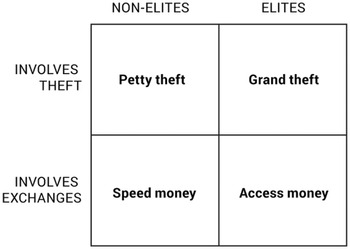
Dividing corruption along these two dimensions generates a matrix of four categories, as shown in Figure 1.3.
To illustrate each of the four categories, consider these distinct acts of corruption.
Petty theft: In Bangkok, Thailand, complaints about police shakedowns are on the rise. As an anti-corruption politician puts it, “If you go to Sukhumvit Road, you can see the police looking for tourists who are smoking or drop a cigarette butt, then they ask for their passport and make them pay 2000 baht [just over US$60].”Footnote 35
Grand theft: Sani Abacha, the military dictator of Nigeria, siphoned an estimated US$4 billion from the central bank into his overseas accounts, which is nearly 10 percent of the country’s entire GDP of $55 billion in 1998, the year he left office. Recently, Swiss authorities recovered and returned US$300 million of the “Abacha loot” to the Nigerian government.Footnote 36
Speed money: In India small shops shutter despite a booming retail market because, as one retailer lamented, “It’s not possible to do business without greasing palms, without paying bribes.” A typical supermarket must obtain a daunting list of 40 permits, forcing retailers to bribe many officers in order to get these permits faster, which cuts into their thin profit margins.Footnote 37
Access money: Turning to China, Ji Jianye, former Party secretary of Yangzhou city, received hefty gifts, bribes, and company shares from his long-time cronies in exchange for near-monopoly access to government construction and renovation projects. Within six years of Ji’s tenure, their company’s profits multiplied 15-fold. But as soon as Ji was investigated for corruption, its share price fell.Footnote 38
From these examples, it’s clear that corruption manifests itself in extremely diverse ways, which makes lumping them into a single category or score misleading. Generically described, each of the four categories in Figure 1.3 encompasses the following.
Petty theft refers to acts of stealing, misuse of public funds, or extortion among street-level bureaucrats.
Grand theft refers to embezzlement or misappropriation of large sums of public monies by political elites who control state finances.
Speed money means petty bribes that businesses or citizens pay to bureaucrats to get around hurdles or speed things up.
Access money encompasses high-stakes rewards extended by business actors to powerful officials, not just for speed, but to access exclusive, valuable privileges.
Whereas petty theft, grand theft, and speed money are almost always illegal, access money can encompass both illegal and legal actions. Illegal forms of access money entail large bribes and kickbacks – which are common in China – but they can also include ambiguously or completely legal exchanges that omit cash bribes, for example, cultivating political connections, campaign finance, “revolving door” practices (moving between leadership posts in private and public sectors), and influence peddling.Footnote 39
Much of the literature on bribery centers on “speed money” but neglects “access money.”Footnote 40 The popular analogy of “greasing the wheels” implies overcoming friction or cumbersome regulations, which is equivalent to speed money in my typology.Footnote 41 Access money, on the other hand, buys special deals and lucrative rights, making it more sludge than grease.
As Max Weber said, ideal-types are “border cases … of indispensable analytical value, and bracket historical reality which almost always appears in mixed forms.”Footnote 42 Indeed, the four categories in my framework often mix and overlap. For example, corruption schemes among Chinese political elites may combine grand bribery, forged loan agreements, insider trading, and collusion with thugs. But precisely because reality is messy, we need to highlight the dimensions that matter most to our inquiry.Footnote 43
Not All Corruption Harms in the Same Way
While corruption is never good, not all forms of corruption are equally bad for the economy, nor do they cause the same kind of harm. The best analogy is drugs (Table 1.1). Within my typology, petty theft and grand theft are equivalent to toxic drugs – they are the most economically damaging as they drain public and private wealth.Footnote 44 Even worse, such corruption subverts law and order, deterring investors, tourists, and even foreign aid donors.Footnote 45
The effects of exchange-based corruption are more ambiguous. Some argue that speed money (petty bribery) enhances efficiency by allowing citizens to overcome administrative hurdles and delays.Footnote 46 As Huntington wrote, “Corruption may be one way of surmounting traditional laws or bureaucratic regulations which hamper economic expansion.”Footnote 47 But this kind of corruption still imposes a cost – and thus constitutes a tax – on citizens and businesses.Footnote 48 Particularly for the poor, even small bribes are crushing burdens. So, although speed money is not as debilitating as petty and grand theft, it does not spur growth. Alternatively, think of speed money as painkillers: although they lessen pain, they don’t give health benefits, and consuming them in excess is harmful.
Access money, on the other hand, is the steroids of capitalism. Steroids are known as “growth-enhancing” drugs, but they come with serious side effects. And countries both rich and poor, in the West and the East, can fall prey to its temptation. From a businessperson’s point of view, access money is less a tax than an investment. For example, Chinese entrepreneurs are willing to bribe their way into legislative congresses because the benefits of networking with Party-state bosses more than offset the expense.Footnote 49 Likewise, in the United States, big corporations sink billions of dollars into lobbying every year because returns exceed costs.Footnote 50 By enriching capitalists who pay for privileges and by rewarding politicians who serve capitalist interests, access money can perversely stimulate commercial transactions and investment, which translates into GDP growth.
Yet this does not mean that access money is “good” for the economy – on the contrary, it distorts the allocation of resources, breeds systemic risks, and exacerbates inequality. For example, in China, bank loans are disproportionately allocated to politically connected companies,Footnote 51 forcing cash-strapped entrepreneurs to borrow from shadow banks at usurious rates, while connected companies, flush with excess credit, spend irresponsibly and speculate in real estate. Such distortions, however, are not captured in standard linear regressions that examine only annual income levels or growth rates.Footnote 52
The harm of access money blows up only in the event of a crisis. The Chinese leadership is aware that such a danger is real and is struggling to keep its balance.Footnote 53 Elsewhere, the eruption of crises linked to corruption was preceded by euphoria: America’s first great depression of 1839 (triggered by risky public financing and state-bank collusion),Footnote 54 the 1997 East Asia financial crisis, and the 2008 US financial crisis.Footnote 55
Through an “unbundled” approach, my study draws a clear distinction between the quantity and quality of corruption. Wealthy economies may have low quantities of aggregate corruption, as measured by standard cross-national indices, but it doesn’t mean that they have no corruption; rather, their corruption may be of a different quality – concentrated in access money, which is difficult to capture and not immediately growth-retarding. Contrary to popular beliefs, the rise of capitalism was not accompanied by the eradication of corruption, but rather by the evolution of the quality of corruption from thuggery and theft toward sophisticated exchanges of power and profit. Compared with countries that prospered earlier, China is still a relative newcomer on this evolutionary path.
Explaining the Paradox
Why has China prospered alongside vast corruption? I offer a four-part explanation. First, the dominant type of corruption in China is access money – elite exchanges of power and wealth – rather than petty bribery or outright theft, as I will show in Chapter 2. The standard argument for how corruption impedes growth, in Mauro’s words, is that “corruption … lowers private investment, thereby reducing economic growth.”Footnote 56 What this argument misses is that access money may actually raise private investmentFootnote 57 – and even spur over-investment, as seen in China’s real estate sector – thereby increasing growth, at least until the onset of a crisis.
Why has corruption in China primarily taken the form of access money, rather than outright looting? Since market opening, China’s political system has followed a profit-sharing logic, where both elites and non-elites benefit from wealth creation in their jurisdictions. The entire Chinese bureaucracy is incentivized to promote development, even as officials engage in rampant deal-making. To understand how this works, we must distinguish between the mechanisms of profit-sharing among political elites, a corps of about 500,000 high-ranking officials who are directly appointed by the Party, and rank-and-file employees in the bureaucracy, numbering about 50 million in total.Footnote 58
Political elites have both career and financial incentives to enthusiastically foster development. It is often said that the promotion of local leaders is tied to economic growth,Footnote 59 but in reality, the small number of seats for promotion means that not all leaders may aspire to higher office.Footnote 60 The surer incentive, therefore, is financial: the more prosperous the local economy, the more local leaders will profit.Footnote 61 Successful Chinese politicians typically kill two birds with one stone: by spurring development and awarding projects to favored businesses, they achieve political targets and garner bribes (Chapter 5). And, unlike democratically elected politicians, authoritarian local leaders can bulldoze old properties, order new projects, and mobilize vast amounts of resources at will.
Among rank-and-file bureaucrats, profit-sharing operates through remuneration. Although their formal salaries are standardized at abysmally low rates, they are supplemented by an array of fringe benefits, such as allowances, bonuses, gifts, and free meals, which, as Chapter 4 shows, comprise about three-quarters of bureaucratic compensation. These fringe components are pegged to financial performance: the more tax revenue a local government generates and the more non-tax revenue (such as fees and service charges) individual offices collect, the more fringe benefits they can provide to their staff members. To borrow a term from economics, fringe compensation in the Chinese bureaucracy functions as an “efficiency wage”Footnote 62 – it not only incentivizes revenue-making effort but also deters bureaucrats from resorting to petty corruption.
Why did profit-sharing take root in the Chinese government but not in other poor, predatory states? I would point to Deng Xiaoping’s historic decision to open markets while maintaining the Party’s monopoly rule and giving communist officials a personal stake in capitalist growth.Footnote 63 Corruption (rents) rewards their effort and participation.Footnote 64 This stood in sharp contrast to the former Soviet Union, where sudden political and economic liberalization (Perestroika and Glasnost) prompted the apparatchiks to defect en masse.Footnote 65 To use Olson’s famous analogy of banditry, profit-sharing arrangements made Chinese officials “stationary bandits” who are invested in promoting collective welfare, as they can fleece off a percentage of gains, rather than “roving bandits” who just rob and flee.Footnote 66
A third explanation is that the government has curtailed forms of corruption that directly inhibit entrepreneurial growth. This is a crucial part of the story that abundant accounts of “crony capitalism” and “rising corruption” missed.Footnote 67 Corruption may induce communist officials to enthusiastically embrace market reforms, but the central government has to steer them away from corruption that damages growth and undermines state performance – theft and extortion.Footnote 68 In Chapter 3, I show that although bribery has indeed exploded since 2000, embezzlement and misappropriation of public funds – which constitutes “corruption with theft” in my framework – has simultaneously declined. Arbitrary extortion of fees and fines, which had been rampant during the 1980s and 1990s, became less frequent than before. In addition, my survey in Chapter 2 shows that speed money (petty bribery) is less prevalent in China than in highly corrupt countries such as India and Russia.Footnote 69
These forms of corruption – petty theft, grand theft, and speed money – were brought under control through an ambitious program of capacity building, which began in 1998 under Premier Zhu Rongji and is still being expanded.Footnote 70 The program includes establishing a Civil Service Law, standardizing tax rates, strengthening oversight through budgeting and accounting reforms, replacing cash payments of fees and fines with direct electronic deposit, consolidating public bank accounts, and more. Because these reforms are dry and unsensational, the media and even much of the academic literature ignores them. Yet their practical effects are real: they have increased state capacity to monitor and penalize non-transactional forms of corruption and “speed money” payments.
Fourth, in China regional competition substitutes for electoral competition in checking predatory corruption. Facing fierce contestation for projects and investors, local leaders are motivated to curb “grabbing hands” among rank-and-file bureaucrats. Such efforts sometimes reached a point of religious fervor, as reflected in the leadership’s slogan in a county of Hubei: “Investors are Gods, prospectors of investors are heroes, bureaucrats are humble servants, and those who harm corporate interests are sinners.”Footnote 71 That’s not all – deal-making is part of fervent growth promotion, too. Leaders compete to offer “preferential policies” (a common policy term) to selected businesses. To stay ahead, they must also project competence and upgrade their development strategies by strategically positioning their locales, crafting commercial niches, and branding, as Chapter 5 shows.
To summarize, my explanation for the Chinese paradox boils down to four elements.
The dominant type of corruption in China today is access money, which stimulates growth but generates distortions and risks.
Access money dominates because China’s political system runs on a profit-sharing model, where the rewards of leaders and bureaucrats are linked to economic performance.
Beginning in the Reference He2000s, capacity-building reforms have curtailed corruption with theft and speed money.
Regional competition checks predatory corruption, spurs developmental efforts, and ratchets up deals.
Together, these elements not only explain the Chinese paradox, but also help to reconcile contradictions in China’s political economy. Chinese growth is impressive yet imbalanced and risky. Local officials are corrupt yet worship the pursuit of development. China’s regime is authoritarian and politically centralized, yet its regions are economically decentralized and highly competitive.
Two Gilded Ages
Many of the features outlined above could also describe nineteenth-century America. As the economic historians Glaeser and Goldin remind us, “The irony [of the period] may be that corruption was large as a fraction of government … but that economy prospered nationally and locally.”Footnote 72 Bribing legislators, insider trading, political patronage, and so on, were all rampant. And yet America’s economy soared for reasons quite similar to China.
American state governments were fiscally independent and eager to promote development, both to win elections and to get rich. Access money intertwined with the financing of major infrastructure projects that paved the way for economic boom while vastly enriching a handful of tycoons.Footnote 73 Ultimately, the risks inherent in such corruption erupted in the Crisis of 1893, leaving banks insolvent and forcing reforms.Footnote 74 From there, America continued to evolve. By the Progressive Era (1890–1920), as one historian noted, “The most striking aspect of embezzlement is how little it occurred.”Footnote 75
To say that contemporary China and nineteenth-century America are similar does not mean that they are identical. China is a single-party autocracy whereas the United States is a democracy. As Menes underscores, in the United States, “even during the most corrupt periods, the corrupt mayors and council members could be voted out of office.”Footnote 76 Transparency mandates, muck-raking journalists, and crusading prosecutors were central ingredients in America’s battle against graft in the Progressive Era. Xi, on the other hand, spurns bottom-up measures, opting instead to stamp out corruption through the strong arm of the Party apparatus,Footnote 77 while expanding the state sector and tightening political control.Footnote 78
Although the threats facing China today – over-investment and excessive debt, fueled by access money – recall America’s Gilded Age, this doesn’t mean the country will inevitably collapse. This is because, unlike the obliviousness preceding the American or East Asian financial crises, the dangers in China are widely known and under the constant glare of scrutiny. Long-standing Western expectations of Chinese failure have perhaps unintendedly kept the regime alert.Footnote 79
At present, the Chinese leadership is desperately trying to “derisk” the economic and financial system while maintaining economic growth. This is a high-wire act, made all the more precarious by the United States–China trade war. Whether the leadership can keep its balance will determine not only China’s fate but the global balance of power in the twenty-first century.
Data
Existing books on Chinese corruption often rely on a single source: ethnography in one location,Footnote 80 prosecutorial statistics and cases,Footnote 81 various news reports and secondary literature,Footnote 82 and, most commonly, scandals reported in the Chinese media.Footnote 83 This is understandable – corruption is difficult to study in any setting, even more so in an authoritarian regime. Nevertheless, because the data we use shapes the conclusions we get, we must be particularly cautious about relying solely on media stories of corruption.Footnote 84 Using only scandals paints a skewed picture, as I show in Chapter 5.
This book strives to deploy mixed methods and a wide variety of data to shed light on the paradox of prosperity and corruption. Each chapter of my book will address a different research question with a different and appropriate data source, including the first expert survey that measures perceptions of distinct types of corruption across 15 countries including China (Chapter 2), official statistics on investigated corruption cases (Chapter 3), text analysis of media mentions (Chapters 3, 5, and 7), in-depth profiles of fallen leaders over the course of their careers (Chapter 5), an original dataset on county-level bureaucratic compensation and incentive structure (Chapter 4), and another original dataset on the downfall of city leaders during Xi’s anti-corruption campaign (Chapter 6). Last but not least, by incorporating more than 400 interviews that I conducted with Chinese bureaucrats and businesses, my study delivers voices on the ground to readers.
Roadmap
The rest of China’s Gilded Age is divided into six chapters. Chapter 2, “Unbundling Corruption across Countries,” critiques conventional bundled measures of corruption and presents an alternative – the Unbundled Corruption Index (UCI). This is an original expert survey that measures the prevalence of the four categories of corruption in my framework: petty theft, grand theft, speed money, and access money. It provides preliminary but systematically collected evidence that China’s corruption is indeed distinct from other typically predatory states.
Chapter 3, “Unbundling Corruption over Time,” examines how access money came to dominate China’s structure of corruption. Contrary to popular claims of “rising” corruption, I show that since the Reference He2000s, only bribery has exploded, both in frequency and in scale, while embezzlement, misappropriation of public funds, and bureaucratic extortion have declined. Two forces drove this evolution: the expansion of markets after 1993 and the central government’s rollout of capacity-building measures in 1998.
In Chapter 4, “Profit-Sharing, Chinese-Style,” I explain the little-understood mechanisms of profit-sharing within China’s vast bureaucracy, which are frequently dismissed as “organizational corruption.” Drawing on extensive interviews and an original dataset, I show that in the Chinese bureaucracy, fringe compensation is pegged to financial performance, making it an unusual variant of profit-sharing in the public sector. Furthermore, I demonstrate that the golden goose maxim – restraint today yields long-term benefits – is not just a parable but a reality, thus distinguishing China’s bureaucracy from myopic, predatory states elsewhere. For the global development community, this chapter sheds light on how poor-and-weak countries can escape the vicious cycle of poverty and corruption through what I term “transitional administrative institutions.”
Moving up the hierarchy, Chapter 5, “Corrupt and Competent,” turns to national and local leaders. Profit-sharing among leaders follows a different logic: the more economically prosperous the locality, the more personal rents they can collect as massive graft. By unpacking the career paths of two infamously fallen officials – Bo Xilai (provincial Party secretary of Chongqing) and Ji Jianye (city mayor of Nanjing) – this chapter reveals why deal-making corruption was compatible with aggressive growth promotion. It also fleshes out the structural distortions and risks brought about by access money.
Since its launch in 2012, Xi’s anti-corruption campaign has gripped the world’s attention. How will this crackdown affect China’s economic and political prospects? Chapter 6, “All the King’s Men,” examines the determinants of downfall among city-level leaders during Xi’s campaign. My analysis finds a remarkably high turnover rate, indicating extraordinarily stressful conditions and heightened political risks for local leaders. In addition, I find that patronage, not performance, predicts the likelihood of downfall. Facing harsh scrutiny, volatility, and mounting demands, bureaucrats feel paralyzed, precipitating a new problem in Chinese politics – inaction.
In Chapter 7, “Rethinking Nine Big Questions,” I review my key arguments and revisit the comparison of reform-era China to America’s Gilded Age using historical data on reported corruption to highlight their similarities and differences. Finally, I explore the implications of this book for big questions in Chinese political economy and in corruption and capitalism more broadly.

 Open access