

Mr. Fu won a fabulous deal. Stuffing suitcases full of company shares, he lavished bribes upon influential officials in exchange for subsidizing his railway projects with cheap loans and land grants. The policymakers in charge of infrastructure and budgets were not only Fu’s pals, but his indirect business associates: their family members ran businesses in the steel industry, which would benefit from a construction boom. As ties between capitalists and politicians grew closer, the deals got better. The government subsequently doubled land grants and loans to Fu’s venture, while turning a blind eye to his inflated costs and risk of losses. Fu even convinced national leaders to change geological definitions so that he could profit from the higher value of land grants in mountainous areas. Through craftiness and connections, he successfully “moved mountains” to the tune of a staggering fortune.
Stories like this seem to expose the gravity of corruption in China: businessmen colluding with officials to exploit development projects for personal enrichment, cronyism seeping into central and local levels of government, and abundant graft. Economic expansion alongside such corruption has mystified observers, leading some to insist since the 1990s that the economy and regime will soon collapse.Footnote 1
But, in fact, Mr. Fu is not Chinese – he’s American.Footnote 2 In Chinese, Mr. Leland Stanford’s last name translates into Si Tan Fu. A corporate titan and philanthropist, he founded a university at the height of America’s Gilded Age in the late nineteenth century, which today ranks among the best in the world.
The Gilded Age was an era of crony capitalism, but these were also years of extraordinary growth and transformation. Millions of Americans moved from fields to factories, standards of living rose to unprecedented levels for large swathes of the population, new industries sprouted, capital markets expanded, railways opened up long-distance commerce, and super-magnates – such as Stanford, J. P. Morgan, and John D. Rockefeller – emerged triumphant. In this century, the United States overtook the United Kingdom to become the factory of the world, even as corruption flourished.
Today, China is passing through something similar – but not identical – to America’s Gilded Age. Reformers under Deng held together a delicate political union and rebuilt from the debris of Mao’s disastrous rule, just as American leaders reconstructed the nation after the devastation of the Civil War. China’s market reform lifted 850 million people out of poverty yet produced stark inequality, as America also experienced in the nineteenth century. And, like in the United States, the corruption that prevails in China is of a particular type – access money – the purchase of privileges by capitalists from those in power. Yet, despite these parallels, the two nations’ political systems could not be more different: China is an autocracy whereas America is a democracy.
This book demystified the Chinese paradox of growth with corruption by unbundling corruption and by placing China in comparative-historical perspective. In this concluding chapter, I recap my key arguments, revisit the comparison of the Chinese and American Gilded Ages in depth, and discuss the implications of this book for nine big questions about corruption and China’s political economy.
Why China Prospered with Corruption
The assumption that corruption always hurts economic growth is over-simplistic. Its effect on capitalist activities depends on the type of corruption. By unbundling corruption, I reveal four explanations for why China prospered amid corruption.
Access Money Dominates
To be sure, China has all forms of corruption, but the dominant type today is access money. Rather than merely assert this claim on the basis of subjective judgement or anecdotes,Footnote 3 my study presents a range of evidence to demonstrate and compare corruption structures, both across countries (Chapter 2) and within China (Chapter 3). Given that access money dominates in China, it’s no surprise that corruption has gone hand in hand with rapid growth. Functioning like the steroids of capitalism, this type of corruption spurs investment and transactions in the short term, but it also generates risks and misallocates resources toward super-profitable, speculative sectors (Chapter 5). On top of that, access money exacerbates inequality by enriching a club of corrupt officials and politically connected capitalists. These are all clear echoes of nineteenth-century America.
China’s Political System Operates on a Profit-Sharing Model
Why does access money, rather than other forms of corruption, dominate? Put differently, how did China evolve a more growth-friendly structure of corruption? China’s political system operates on a profit-sharing model. Among political elites, their career and financial rewards – graft in exchange for deals – are linked to economic prosperity. Hence, rather than “grab” from businesses through extortion, local leaders are typically eager to extend “helping” hands to favored investors by offering special deals, cheap land, regulatory exemptions, and other perks (Chapter 5). State–business relations in China are not “extractive,” as Acemoglu and Robinson assert, but rather transactional.Footnote 4
What about the millions of Chinese street-level bureaucrats who are poorly paid and lack the power to benefit from deal-making? As Chapter 4 explains, they also operate in a profit-sharing mode – through compensation practices. Even though formal public wages are standardized at “capitulation” (below subsistence) rates, the fringe benefits and pay of public employees are pegged to the financial performance of local governments and the agencies within them. In this way, their fringe compensation acts as an efficiency wage, incentivizing low-level bureaucrats to generate revenue and to avoid extortion and theft.
Capacity-Building Reforms Have Curtailed Damaging Forms of Corruption
Yet no profit-sharing arrangement could work without state monitoring and punishment of those who engage in growth-damaging forms of corruption. Aiming to create a modern bureaucracy suited to a globalized market economy, the central government has advanced a host of capacity-building reforms since 1998 (Chapter 3). Local leaders were on board with these reforms as they constrained theft and predatory practices among their subordinates. Indeed, some devised and added their own control measures on top of centrally mandated reforms (Chapter 4). The consequent pattern since 2000 is that, while grand bribery exploded, embezzlement, misuse of public funds, petty bribery, and extortive practices visibly declined (Chapter 3). Simply put, to channel corruption away from its most destructive forms, incentives and penalties must go hand in hand; neither is sufficient on its own.
Regional Competition Checks Predatory Corruption, Spurs on Developmental Efforts, and Ratchets Up Deals
Although there is no electoral contestation, intense regional competition takes place within China’s politically centralized autocracy. To stand out from competitors, apart from curbing “grabbing hands,” the most able leaders such as Bo Xilai and Ji Jianye go much further by positioning and branding their locales, experimenting with policies, and fostering niches (Chapter 5), strategies that enhance the overall commercial appeal of their locales. Simultaneously, they also offer privileged access for selected capitalists, whose bribes sponsor their personal consumption and wealth accumulation. To win political patrons and corporate clients, leaders must demonstrate competence and career potential (Chapter 5 and Appendix: Chapter 5). In short, in China, both development and corruption are competitive.
Two Gilded Ages
American cities present us with a puzzle. Between 1880 and 1930 the cities were notorious for corruption. Corruption generally undermines government performance and cripples economic growth, but American cities prospered.Footnote 5
Once we unbundle corruption and recognize that access money is growth-enhancing yet distorting, China’s combination of corruption and growth is not a paradox. Nor is it exceptional – Menes’ description of the United States from the Gilded Age to the Progressive Era, quoted above, seems to apply just as aptly to China today.Footnote 6 But how alike are the two cases?
Comparative-Historical Data
Although there is no data on unbundled corruption available over extended periods in the United States and China, we can nevertheless explore overall levels of corruption reported in the media. The data I employ for comparison are newspaper reports of corruption in the United States for a 70-year period from the 1870s to the 1940s, and in China, for a seven-year period from 1999 to 2016. As shown in Table 7.1, in these two separate time periods, the United States and China are at equivalent levels of GDP per capita. In other words, between 1999 and 2016, China’s economy traveled a distance comparable to what its American counterpart achieved from the beginning of the Gilded Age to World War II. Immediately, one difference jumps out: China’s economic transformation is 10 times more compressed.Footnote 7
| GDP per capita (US$) | Year in China | Year in the United States |
|---|---|---|
| 3,500 | 1999 | 1873 |
| 3,925 | 2000 | 1879 |
| 4,185 | 2001 | 1880 |
| 4,575 | 2002 | 1881 |
| 4,910 | 2003 | 1887 |
| 5,365 | 2004 | 1890 |
| 5,755 | 2005 | 1898 |
| 6,555 | 2006 | 1903 |
| 7,230 | 2007 | 1918 |
| 7,845 | 2008 | 1923 |
| 8,500 | 2009 | 1936 |
| 9,070 | 2010 | 1937 |
| 9,325 | 2011 | 1939 |
| 10,065 | 2012 | 1940 |
| 11,465 | 2013 | 1941 |
| 12,125 | 2014 | 1942 |
| 12,530 | 2015 | 1942 |
| 12,960 | 2016 | 1942 |
a Figures on GDP per capita are from the Penn World Tables, www.measuringworth.com/datasets/usgdp (accessed 10 December 2019).
Following Glaeser and Goldin,Footnote 8 I take media coverage of corruption as a proxy for overall levels of corruption. Granted, this is an imperfect measure, but it is the best available indicator for comparing long historical periods, and media mentions reflect the significance of corruption in public discourse. In the case of the United States, I search for articles in a bundle of newspapers that contain the word “corruption” and then adjust this figure by the total number of articles in a given year.Footnote 9 In the case of China, I repeat the same procedure using the People’s Daily, which is the official press (see Appendix: Chapter 7).
A prior study by Ramirez compared mentions of corruption in the United States and China in an identical bundle of US newspapers, which is problematic as American media will likely report a lot more on corruption at home than in China.Footnote 10 For a more rigorous comparison, I compare mentions of corruption in indigenous news sources. Therefore, when interpreting the results that follow, note that the levels of corruption in the United States and China are not directly comparable (unlike in Ramirez, as he uses the same media source); instead, my goal is to compare longitudinal trends in each case.Footnote 11
From Gilded to Progressive
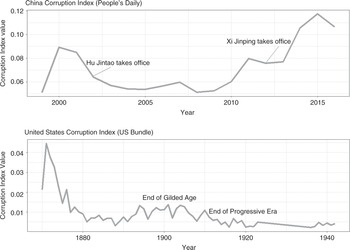
Figure 7.1 shows the corruption trends in China and the United States at comparable levels of economic development. In the US context, the timing of the Gilded Age (1870–1900) and Progressive Era (1890–1920) is well established in the historical literature. On the other hand, when did China’s Gilded Age begin and end? This has not been established by historians, as it is a recent event. Judging from Figure 7.1, we may extrapolate two different timelines for the Chinese equivalent of the Gilded Age and the Progressive Era.
Comparing corruption in China’s and America’s Gilded Ages.
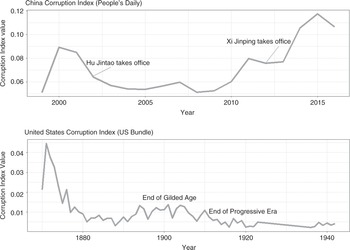
The simpler method is to identify comparable periods using GDP per capita. Following this method, the Gilded Age and Progressive Era in the United States stretched over an approximately 50-year period from the 1870s to the 1920s, while the corresponding period in China is extremely short, from 1999 to 2011, a 12-year period that encompasses the Jiang–Zhu and Hu–Wen administrations. Yet, judging by Xi’s declaration of a corruption crisis in 2012, China clearly hasn’t graduated from the Progressive Era – indeed, it appears to have only recently entered it.
A better measure, therefore, should take into account the defining political–economic transformations of the eras: the Gilded Age featured rapid economic take-off, rampant corruption, and sharp inequalities, whereas the Progressive Era was distinguished by a host of administrative and political reforms to correct the excesses of the preceding period. From this structural perspective, the 35-year period from market opening in 1978 to 2012 may be characterized as China’s Gilded Age.
Demarcating the Chinese Progressive Era is a lot trickier and open to interpretation. As I documented in Chapter 3, in 1998, the Jiang–Zhu administration rolled out a sweeping program of administrative reforms to curtail petty corruption and fiscal malfeasance. If this period of reform is considered a Progressive Era, it would overlap with China’s Gilded Age (1978–2012). More than a decade later, in 2012, Xi launched the most sweeping anti-corruption campaign in the Party’s history, focusing on arresting numerous corrupt officials, though it also has some norm-correcting features. This may be considered a second stage of progressivism. In either case, it’s reasonable to conclude that China in 2019 – now a superpower and middle-income economy – has entered the Progressive Era.
With that in mind, let’s first take a look at corruption trends in the United States from the 1870s to 1940. The overall pattern is clear: corruption peaked at the beginning of the Gilded Age but rapidly declined and stabilized afterward. The height of corruption was the 1870s, centered on the scandal-ridden Grant administration. The most notorious scandal involved Crédit Mobilier, a railway company whose owners gave influential congressmen company shares in exchange for approval of federal subsidies and disregard of the company’s financial risks. But, following this peak, corruption reports fell sharply. The twentieth century ushered in the Progressive Era, during which corruption reports picked up again marginally, a reflection of the financial crisis of 1893 and the spread of muck-raking journalism. By the end of this period, the incidence of corruption reports had dwindled, and it remained flat through World War I.
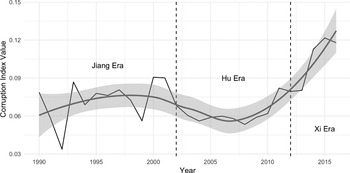
China’s corruption trends are less straightforward. If we identify comparable periods simply using GDP per capita, then China from 1998 to 2010 would display patterns similar to America’s Gilded Age through the Progressive Era: a sharp rise in corruption at the beginning, followed by a steady decline. But if we take 1978–2011 to be China’s Gilded Age (my dataset does not include years prior to 1999) and 2012 as the beginning of a Progressive Era, then it appears that, unlike the US historical experience, China does not display a steady decline of corruption reports after an initial peak. Instead, it saw two spikes: first in 1998, when the Jiang–Zhu government launched administrative reforms nationwide, then again in 2015, when the number of fallen officials peaked (Chapter 6).
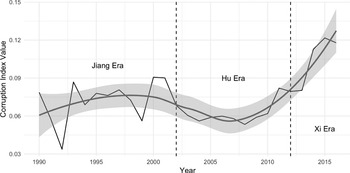
Compared with the United States, another distinction in China is that coverage of corruption is highly sensitive to leaders’ policies. Figure 7.2 shows the amount of corruption reports in China from 1990 to 2016, covering three administrations (Jiang–Zhu, Hu–Wen, and Xi–Li) using a smoothed curve that can better represent trends. The amount of corruption reports fluctuated within a narrow band from the Jiang–Zhu era to the Hu–Wen era, dipping to its lowest point during the latter. This, however, does not mean that the amount of corruption was actually low; rather, as Walder describes, it was a period of “drift and delay under an amorphous collective leadership that has let structural problems like corruption fester” (see also Chapter 3).Footnote 12 Xi’s personal campaign against graft pushed media reports on corruption to unprecedented heights.
Corruption reports in China from 1990 to 2016.
Modifying Earlier Comparisons
Although my analysis is not the first to draw parallels between America’s and China’s Gilded Ages, it modifies the conclusions of earlier studies. In Double Paradox, Wedeman argues that post-Mao China is similar to America’s Gilded Age because both saw the coexistence of localized corruption and rapid economic growth, both underwent structural transformations, and the spread of corruption motivated anti-corruption efforts.Footnote 13 However, while Wedeman is right in pointing out these similarities, he lacks data for systematically comparing the two cases and therefore misses some key differences.
My data highlights a divergence in longitudinal trends between the two Gilded Ages. The United States followed a clear evolutionary sequence: corruption was most rampant during the Gilded Age, which prompted political and administrative reforms during the Progressive Era,Footnote 14 such that, by 1940, corruption no longer dominated news headlines. In China, on the other hand, the sequence is less clear-cut. Anti-corruption measures through administrative reforms began in 1998, preceding Xi’s sweeping crackdown in 2012 by more than a decade. At present, corruption reports are at their highest level since 1999.
In addition, determining the start and end points of China’s Gilded Age is tricky even when comparative data on corruption reports is available. Ramirez’s analysis employed only US news reports and used GDP per capita to identify comparable periods in nineteenth-century America and post-1978 China. On the basis of this method, he concluded that “while corruption in China is an issue that merits attention, it is not at alarmingly high levels, compared to the US historical experience.”Footnote 15 My analysis, however, questions his choice of data and his demarcation of “comparable stages” by GDP per capita alone. Employing a revised methodology, I arrived at a different set of observations: corruption in China’s Gilded Age did not appear to be less serious than its American counterpart. In addition, we should take into account that corruption reports in authoritarian China are primarily influenced by top leaders’ policies rather than by independent journalism.
From Thugs and Thieves to Influence Peddlers
My comparative-historical exercise prompts a rethinking of Huntington’s “life cycle” theory of corruption,Footnote 16 which argues that corruption rises steeply during stages of modernization and then decreases as countries grow richer and acquire state capabilities. This evolutionary pattern appears to manifest itself in eighteenth-century Britain, in the nineteenth-century United States, and, according to Ramirez, in China in the Reference He2000s as well.Footnote 17 Yet this argument considers only the decline of illegal corruption, such as bribery, as captured by media reports in Figure 7.1. Crucially, it overlooks the qualitative evolution of corruption toward legalized exchanges – access money – as countries grow richer and more sophisticated.
Although present-day first-world economies are not overrun by thugs and thieves, they do have corruption. As Whyte observes in the context of the United Kingdom, “We are not Afghanistan or Russia,” but “it is the pursuit of institutional interests that characterizes British corruption.”Footnote 18 Similarly, the historian White underscores continuities in the money politics of the nineteenth-century Gilded Age and the 2008 financial crisis: “As in the nineteenth century, highly leveraged corporations, marketing dubious securities that were more inventive than comprehensible even to their creators, precipitated massive losses, receivership, government rescues, and severe economic downturns. The present seems so nineteenth century.”Footnote 19 One striking difference, however, is that whereas influence peddling entailed bribes during the Gilded Age, no bribes were exchanged and few individuals were indictable in the present day.
How did access money in the United States become institutionalized and legal? The Progressive Era laid a foundation for this process by clearly demarcating certain forms of corruption – including bribery and embezzlement – as illegal and morally unacceptable. Progressives dismantled the spoils system and gradually instituted a professional and adequately paid civil service that no longer relied upon petty bribes and fees for income.Footnote 20 They also passed laws that broke up powerful monopolies, banned corporate contributions to political campaigns, and required the disclosure of campaign finance. Rules-based budgeting and accounting, meanwhile, replaced arbitrary collection and spending of public monies.
Yet this did not spell the end of corruption. To circumvent campaign finance restrictions, lobbyists and interest groups formed political action committees. As the twentieth century went on, campaign contributions soared. Lobbyists found creative ways to purchase influence without cash bribes. As Jack Abramoff, an infamous K-street lobbyist, reveals, these strategies include plying politicians with plush vacations and tickets to expensive sports games, free flow of food and alcohol at designated restaurants, and, most effective of all, enticing staffers with lucrative positions in the private sector. In an interview on 60 Minutes, Abramoff baldly stated, “We owned them [members of Congress]. What does that mean? Every request of our client, everything that we want, they are going to do. Not only that, they’re going to think of things we can’t think of to do.”Footnote 21
Over time, the expanding menu of legal access money rendered bribery unnecessary and indeed undesirable. Moving into the twenty-first century, money politics metastasized in an increasingly complex financial system, obfuscated by technicalities and contorted leveraging schemes that few can decipher. Meanwhile, financial institutions aggressively lobby for lax regulations that enable their risk-taking behavior. According to the United States Financial Crisis Inquiry Commission, “From 1999 to 2008, the financial sector expended $2.7 billion in reported federal lobbying expenses; individuals and political action committees in the sector made more than $1 billion in campaign contributions.”Footnote 22 Regulatory capture in a supersized black box led up indirectly but eventually to the 2008 financial crisis.Footnote 23 Indeed, lenders who lobbied engaged in more risk-taking, faced higher delinquency rates, and were more likely to be bailed out, as one study finds.Footnote 24
Comparing China’s trajectory with the West, the two appear similar in their evolution of corruption toward access money. Yet China’s style of access money still remains crude and personal, whereas it became sophisticated and institutionalized in Western politics (see Chapter 2). In addition, to curb crony capitalism, Xi deploys a top-down disciplinary apparatus to hunt down individual corrupt politicians and capitalists, while rejecting democratic checks.Footnote 25 The American Progressive Era, on the other hand, successfully mitigated illegal forms of corruption through democratic means: investigative journalism, electoral competition, secret ballots, and transparency policies.
Will China under the CCP one day evolve an institutional, legal style of access money, as seen in Washington’s K-Street? I do not think so. Institutional corruption is a perversion of formal political representation, which lies at the heart of democracy. The First Amendment of the US Constitution enshrines “the right of the people … to petition the government for a redress of grievances.” In Lessig’s words, this right becomes corrupted when political institutions are “systematically responsive to the wrong influence.”Footnote 26 Given Xi’s centralization of power in both the Party leadership and himself, elite corruption in China will remain highly personal and dyadic. Indeed, as Chapter 6 finds, under his anti-corruption campaign, patronage has become more central to the rise and fall of Chinese politicians than before, exceeding the importance of performance.
What’s Different about This Book?
There is a wealth of excellent literature on corruption, including on typologies of corruption, elite rent-seeking, and micro studies of petty corruption and bribery. Although my book builds on this rich foundation, it is distinct from prior studies in at least four main ways.
First, I challenge an implicit assumption in seminal theories of political economy that rich nations are non-corrupt and became successful by erecting “good” institutions early on in their development process. As Acemoglu and Robinson famously argued, economic prosperity requires “non-extractive” and “inclusive” institutions, which they illustrated with England’s introduction of parliamentary institutions after the Glorious Revolution of 1688. Likewise, North, Wallis, and Weingast stated that in order for societies to transition from “limited” to “open access order,” certain doorstep conditions, including the rule of law, must be in place.Footnote 27 A common implication of these theories is that corruption impedes growth, as corruption is an “extractive” activity that both threatens private property rights and undermines the rule of law.
This influential literature forms an intellectual basis for conventional wisdom about the growth-dampening effects of corruption. It inspired the push for “good governance” – with control of corruption being a key aspect – among international development agencies such as the World Bank. In The Quest for Good Governance, Mungiu-Pippidi posited the core challenge of anti-corruption as changing social norms from “particularism to one of ethical universalism,” with universalism meaning “equal treatment applies to everyone.”Footnote 28 The assumption is that OECD countries have reached the end state of “good governance,” a view that global metrics, which rank these countries at the top, affirm.
My book suggests that rich nations are not all free of corruption, nor does equal treatment in fact apply to everyone, even though clientelism, kinship-based patronage, embezzlement, and extortion have successfully been abolished. Corruption among the modern is of a different type – access money – which is usually legal, institutionalized, and hard to measure. Furthermore, the process of arriving at this outcome is not “first, get institutions right” and then all good things will follow. Rather, as some historians remind us, the emergence and spread of democracy, the rule of law, and meritocracy in Western societies coincided with rampant deal-making at home and the extraction of resources from colonies abroad.Footnote 29 The rise of the West was by no means just the result of good institutions and “a culture of innovation” – undeniably, it went hand in hand with corruption, exploitation, and inequality. An honest evaluation of Western history,Footnote 30 warts and all, helps us better understand the process of economic and political modernization in developing countries today. Corruption does not necessarily disappear with affluence and modern institutions; rather, it evolves toward impersonal exchanges and sophistication. Post-communist China underwent a similar process of structural transformation on a tightly compressed time scale, and it is still ongoing.
Second, my book demonstrated the mechanisms of profit-sharing in the Chinese political system, rather than merely asserting the existence of this system. The idea of political elites having a share in economic growth is expressed in many prior studies, beginning with Olson’s famous analogy of the “stationary bandit.”Footnote 31 Khan’s framework on “political settlements” and that of Pritchett, Sen and Werker on “deals space” spells out the variety of elite deals on rents-sharing that either foster or block economic development.Footnote 32 Similarly, the literature on the “East Asian Paradox” argues that East Asian economies flourished despite corruption because their corruption took the form of “stable and mutually beneficial exchanges of government promotional privileges for bribes and kickbacks.” Sun’s labeling of Chinese corruption as “profit-sharing” also falls under this rubric.Footnote 33 Although this literature maintains that “stable exchanges” and “profit-sharing” can be growth-enhancing, it does not explain how such arrangements arise or work. How do numerous parties, apart from a handful of top elites, “share” the gains of growth?
My book fills the crucial gaps on how, not only among political elites but also among non-elite actors in the bureaucracy. Several scholars earlier pointed out that the reformist leadership laid the foundation for capitalist growth by allowing party apparatchiks to benefit from promoting it. For elite officials, this benefit came in the form of enhanced career prospects, as well as bribes and kickbacks they can personally collect from aiding favored companies in an economy that is thriving overall (see the case of Ji Jianye in Chapter 5). But that is not all: my study reveals that profit-sharing also operates among rank-and-file bureaucrats through compensation practices. Cumulatively, these institutions made the reform-era Chinese bureaucracy distinctly profit-oriented, which spurred on revenue-generating activities along with corruption.
Third, I provided an integrated account of corruption at both macro and micro levels. With only some exceptions, the analyses of elite rent-sharing and bureaucratic capacity building tend to proceed on separate tracks. Those who study rents and cronyism focus exclusively on political elites for a good reason: unless the most powerful state actors agree to share rents and restrain themselves from looting, they will not make welfare-enhancing policies. The literature on “state capability,” on the other hand, features street-level bureaucrats and strategies that enable them to deliver public services and enforce rules.Footnote 34 Yet neither perspective on its own is sufficient. Good policies will not be implemented effectively if the public administration is underpaid, bloated, and corrupt, and competent bureaucrats cannot make a transformative difference if leaders at the helm fail to get their act together.
My framework on unbundling corruption considers both elites and non-elites, transactional and non-transactional corruption, which I apply to the analysis of an important case – China. At the macro level, I traced the Chinese leadership’s decision to open markets and to restructure the economy and governance at critical turning points (Chapter 3), which changed state-business relations as the economy grew (Chapter 5). The second half of my story turned to the dry, technical work of building administrative capacity and creating bureaucratic incentives, which served to reduce petty corruption and theft (Chapters 3 and 4). This integrated perspective should and can be applied to analyzing development and corruption in any country.
Fourth, my book rejects simplistic conclusions about corruption being either “good” or “bad” for growth. It maintains that all corruption is harmful, but that the harms of different forms of corruption manifest themselves in different ways. Access money is like steroids, a growth-enhancing drug that comes with serious side effects. Cross-national correlations are not able to capture the accumulative risks that result from crony capitalism and regulatory capture. Observers were therefore stunned when the financial boom in East Asia and that in the United States crashed in 1997 and 2008, respectively. In assessing the economic effects of corruption, we must look beyond annual GDP figures and qualitatively examine its indirect distortionary consequences. My account warns about the dangers linked to corruption in China’s near future, as well as its potential mutations (see the next section).
Four Big Questions on China
Having explained China’s paradox and placed it in comparative-historical perspective with America’s experience in the nineteenth century, I now move on to revisit four big questions on Chinese political economy, on the basis of findings in this book.
Popular Accounts Paint a Conflicting Picture of China, as Either a Confucian-Style Meritocracy or a Festering Regime That Will Soon Crumble: Who Is Right?
Accounts of the Chinese political system are sharply divided. One camp, represented by Eric Li and Daniel Bell, portrays China as a Confucian-style meritocracy where officials are selected top-down “in accordance with ability and virtue,” rather than by elections.Footnote 35 They argue that Chinese meritocracy presents a superior alternative to democracy. Making strong recommendations for action, Bell states, “the Chinese government can play a more active role promoting its model abroad,” though he later claims to defend only “an ideal.”Footnote 36 On the other end are naysayers, including Minxin Pei and Gordon Chang, who have insisted for decades that the regime is decaying and on the verge of collapse.Footnote 37
This book shows that neither view is correct. As Chapter 5 detailed, corruption and competence can coexist – and even mutually reinforce – in China’s political system.Footnote 38 Chapter 6 provided another supporting sign: in my dataset of city Party secretaries, 40 percent of the leaders who were netted for corruption had been promoted prior to or in the year they fell.
Champions of Chinese meritocracy admit the existence of patronage and corruption, “but merit remains the fundamental driver,” Li maintains.Footnote 39 In fact, my book shows that corruption is not an occasional glitch; it is endemic to the system. The ruling Party controls valuable resources such as land, finance, and procurement contracts, and individual leaders command immense personal power. This is why they are constantly inundated with requests for their intervention and favors, often accompanied by graft (Chapter 5).Footnote 40
The meritocracy school also fails to address the problem of who guards the guardians. Li praises the Party’s Organization Department, which appoints officials, as a “human resource engine that would be the envy of some of the most successful corporations.” But this department, too, can be corrupted, and indeed is especially corruptible because it controls appointments and promotion. Lo and behold, in 2018, 68 officials at the Central Organization Department were punished for corruption.Footnote 41
Naysayers, on the other hand, err in the opposite direction: they magnify stories of Chinese corruption but ignore vigorous growth-promotion efforts among corrupt officials (Chapter 5). The current slowing economy does not validate their predictions of collapse, which were made as early as the 1990s. Part of the slowdown results from the fact that most countries, not only China, experience slower growth as they reach middle income.Footnote 42 More importantly, assertions of decay provide no explanation for why China has sustained four decades of transformative development despite massive corruption.
While it is commonly assumed that patronage is in opposition to meritocracy, under the CCP, they go together. In most patronage-ridden systems, political patrons appoint unqualified clients into offices; Geddes’ study of Latin American bureaucracies is a case in point.Footnote 43 Chinese political patrons, on the other hand, spot promising clients and nurture their competence over the course of their careers. As one Party school leader explained to me, “It is their patrons who strategically arrange positions for [officials at lower levels], giving them an opportunity to prove themselves.” In other words, while we normally think of “merit” as intrinsic to individuals, in the Chinese political system, it is cultivated by political patrons. He added, “We are after all a top-down system, not elected by the people, so it is those on top who decide who gets to move along and ahead.”Footnote 44
In short, readers should be skeptical of any argument that either hails or bashes China. Paradoxes are the most consistent trait of the reform-era Chinese political economy. Understanding it requires that we underscore and grasp these paradoxes.
How Has Authoritarian Capitalism Shaped Chinese Corruption?
“Xi Jinping’s China seeks to be rich and communist,” reads the headline of a Martin Wolf op-ed in The Financial Times.Footnote 45 The title is scintillating, but Wolf gets a fact wrong: China is not communist. Far from egalitarian, China has seen widening inequality, at a level exceeding even capitalist America.Footnote 46 In practice, Chinese political economy operates not according to Marx’s exhortation of “each according to his needs” but rather by the principle of “each according to his ability and connections” (Chapters 4 and 5). From this perspective, China is better understood as a capitalist dictatorship disguised as communist.
When the CCP regime’s concentration of power meets capitalist open markets, the result is a distinctive mix of competitive corruption and growth promotion. Access money easily dominates in China because authoritarian officials can make unilateral decisions and grant exclusive access to profit, in contrast to fragmented democracies such as India, where, as Bardhan aptly expressed, officials can “stop a file immediately,” but they cannot “move a file faster” (Chapter 2). Unimpeded by opposition and consultation, Chinese officials also command extraordinary capacity to “bulldoze” (Chapter 5). They make big changes fast, which can spur growth but also bring about costly blunders, even disasters.
For political economists, my account of a single yet important case – China – indicates that classifying entire countries as “inclusive or non-inclusive,” “extractive or non-extractive,” and “open or limited access” may be more confusing than clarifying when it fails to capture mixed realities.Footnote 47 Conventionally, China is automatically classified as “non-inclusive,” “extractive,” and “limited access” because it is a single-party autocracy. Yet, as my book shows, within this autocracy, there can still be plenty of decentralization, competition, and private sector participation, elements normally associated with democracies.Footnote 48
Will Corruption in China Lead to Regime Collapse?
There is no doubt that China has a serious corruption problem – the Chinese President himself stated that it poses an existential threat to the Party. But Xi is most concerned with a certain type of corruption: grand transactional corruption enmeshed with patron–client relations among political elites, particularly powerful “red” families (of senior Party leaders), princelings like Bo Xilai, and vested interests among powerful sectors of the state-owned economy (for example, Zhou Yongkang’s control of the oil sector).Footnote 49
Such corruption is unlikely to topple the regime by directly slowing the economy or provoking mass protests. As I show throughout this book, even though Chinese officials engage in widespread collusion and deal-making, they do deliver social and economic development. Thus it is misleading to label the Chinese state overall as “extractive” or “predatory.”Footnote 50 Evans defines predatory states as those that “extract large amounts of surplus and provide little in the way of collective goods,”Footnote 51 which he illustrates with the quintessential case of Zaire under Mobutu Sese Seko. China is not Zaire.
Nor is China similar to Egypt, where citizens took to the streets out of desperation and frustration with predatory corruption. Dickson’s surveys of Chinese urban residents found that although many view corruption as widespread, considerably more think the situation has improved since Xi launched his anti-corruption campaign.Footnote 52 In addition, his survey found generally strong levels of political trust and support for the ruling government, despite complaints about corruption and other problems.
Rather, Chinese corruption undermines regime stability in other ways. Graft at the highest level intensifies factional rivalry and battles for political succession, as the Bo Xilai scandal displayed. As each fiefdom amasses astronomical rents, it grows ambitious and defiant of the top leadership. Walder compares the current dangers facing the CCP to the Guomindang in the 1930s and 1940s, which was torn apart from within, in Chiang Kai-Shek’s words, by “a special class struggling for power and self-interests, alienating the masses.”Footnote 53 Corruption may also trigger collapse in one particular scenario: when the structural risks linked to crony capitalism implode in a sudden meltdown, triggering cascading effects that lie beyond the leadership’s control.Footnote 54 That is why Xi declared financial risks a matter of national security and made deleveraging a policy imperative.Footnote 55
Notably, while many have been betting on China’s collapse for years,Footnote 56 few ever question why the “regime” in the United States stayed resilient despite repeated crises linked to corruption over the course of US history, from the first great recession of 1839 to the crisis of 2008. Perhaps America is resilient because citizens can vote politicians or a political party out of office without losing faith in democracy.Footnote 57 The CCP, on the other hand, is inseparable from the administration and the economy. Hence, if massive failure occurs, the people may reject not just the Party’s paramount leader but its entire authoritarian apparatus.
Will Xi’s Anti-corruption Campaign Smother Growth?
To his credit, Xi has boldly taken on the brewing crisis of corruption, while previous leaders have swept it under the rug. His anti-corruption campaign benefits China’s long-term growth if it is able to rein in crony capitalism and create an even, transparent business environment. The problem is that the crackdown has gone beyond policing corruption and has expanded to emphasize conformity to the Party line and personal loyalty. Making matters worse, his demands for airtight discipline conflict with his calls for “daring” officials. Facing unusually harsh scrutiny and unrealistic expectations to “do it all,” bureaucrats feel paralyzed, compromising their ability to adapt and innovate (Chapter 6).Footnote 58
Although Xi’s sustained campaign has placed officials in a state of high alert, it will not eradicate corruption in the form of access money unless his leadership tackles the root cause: the state’s enormous power in the economy. So long as officials control valuable resources and their personal power is unchecked, there will be continuous demand for their favors. In this respect, Xi has worrisomely done the opposite: in the past few years, he has expanded the state sector and imposed more political control.Footnote 59
A better question to ask, therefore, is not whether corruption will disappear but whether it could manifest itself in new forms and through new avenues. While access money was traditionally concentrated in land and real estate transactions (Chapter 5), in the near future, it could possibly migrate to technology and innovation sectors, which are powered by a formidable platform: government guiding funds (GGFs). As Wei et al. explain, a GGF is “a new form of industrial policy that aims to use public funds as seed money to increase public and private investment in high-tech and emerging industries.” Most GGFs hire venture capital and private equity firms, including foreign companies, to manage and invest the funds. By the end of 2017, the total target capital size of roughly 1,500 GGFs across China was a mind-boggling sum – RMB 9.5 trillion (US$1.4 trillion), roughly three times the US trade deficit with China in 2018.Footnote 60
While GGFs present a novel financial instrument for industrial and innovation promotion, they may be susceptible to corruption, as it is unclear how funds are distributed, by and to whom, and for what goals. Furthermore, as investment in emerging sectors is inherently risky and prone to failure, it is difficult to hold fund managers accountable for their financial decisions. Some GGFs are also involved in overseas projects under the Belt and Road Initiative (BRI),Footnote 61 Xi’s signature foreign policy, which has drawn global criticism for corruption.Footnote 62 This combination of mega transactions, complex financial instruments, and the lack of transparency and accountability may present fertile soil for an advanced mode of access money, despite Xi’s crackdown.
Five Big Questions on Corruption
Although centered on China’s experience, my approach of unbundling corruption is relevant to all academics and practitioners working on corruption and governance. In this final section, I highlight what my book says on five key questions about corruption.
What Is Corruption?
Corruption is commonly defined as the abuse of public office for private gain.Footnote 63 Most global indicators and academic studies interpret this to mean illegal abuses of power, including bribery, embezzlement, and vote-buying, which are most prevalent in poor countries. Such a definition excludes “undue influence,” defined by Issacharoff as “a distortion of political outcomes as the result of the undue influence of wealth,”Footnote 64 which exists in wealthy economies.Footnote 65
In this book, however, the concept of “access money” encompasses legal actions aimed at buying influence, for example, revolving door practices, inviting politicians’ family members to serve on corporate boards, and winning over staffers with promises of lucrative jobs. This broad scope may be controversial. As legal scholar Lessig acknowledges, the notion that “our Congress is corrupt as an institution, while none of the members of Congress is corrupt individually” is “hard … for many to accept.”Footnote 66 Some prefer “money politics” or “buying access” to describe systemic efforts at influencing policies to one’s advantage – perhaps because corruption connotes backwardness. “To most Americans,” as Glaeser and Goldin point out, “corruption is something that happens to less fortunate people in poor nations.”Footnote 67 For others, calling out corruption in rich nations may appear to denigrate a “self-imagined national heritage … [of] fairness and democracy,” as Whyte observes.Footnote 68
I see it differently: those who value democracy should be all the more vigilant about the potential perversion of formal political representation. The great challenge lies in pinning down money politics in the first world, which is often legal, institutional, and ambiguous. Consider lobbying in the United States: lobbyists are registered, campaign donations are mostly public,Footnote 69 and lobbying is legitimate and even necessary for the functioning of democratic representation. It is only “corrupt” when this influence is excessive, murky, or employed to advance narrow interests at the expense of society. In practice, however, with only a few exceptions,Footnote 70 it is impossible to determine when lobbying has crossed the line into corruption, so all of it is accepted as normal. Bribery, on the other hand, gets everyone’s attention because it is unambiguously corrupt.Footnote 71
Failure to include access money in theories and measures of corruption reinforces the misleading perception that only poor countries are racked by corruption, whereas wealthy democracies are free of it, which contributes to apathy or complacency in the latter. When the perversion of formal institutions for the benefit of narrow interest groups is not recognized as corruption, it reduces public pressure for necessary reforms to address urgent problems: campaign finance, financial regulation, and climate action.
How Should We Measure Corruption?
Corruption is hard to measure; no single approach, therefore, can be “perfect.” For cross-national comparisons, expert perception-based measures of corruption remain the most influential approach. In Chapter 2, I present a first step in measuring unbundled perceptions of corruption. Only by first systematically measuring different types of corruption across countries can we test whether certain forms of corruption are more damaging, and why. In particular, more efforts are needed to capture the elusive category of access money. While there are many country-specific studies on political connections, including in China,Footnote 72 cross-national measures in this area remain scarce.Footnote 73
Specifically on measurements of bribery, my study highlights the need to distinguish between “speed” and “access” money – in other words, bribes paid for different purposes: the former to overcome harassment and delays and the latter to buy privileges. Firm-level surveys that include questions on bribes almost certainly capture only speed money,Footnote 74 as companies are unlikely to admit to buying influence, or even, if they were honest, may not see their influence-peddling actions as bribery. This literature on speed money should be integrated with work on political connections for a full picture.
Apart from improving quantitative measures, scholars of corruption also need to rethink the way we classify the structures of corruption across countries qualitatively. Existing typologies of corruption assign entire countries to a single category on the basis of the analyst’s personal judgement of where cases fit.Footnote 75 This approach is subjective, and, more significantly, it gives the false impression that each country has only one type of corruption. In fact, as I show through the visualization of my survey results in UCI (Chapter 2), all countries have a combination of multiple types of corruption but in varying degrees.
Does Corruption Impede Economic Growth?
According to conventional wisdom, corruption impedes economic growth, an assumption that seems consistent with casual observations and has strong backing in cross-national regression analyses.Footnote 76
Yet the belief that corruption always impairs growth is flawed both in its conceptualization of “corruption” and of “economic growth.” Cross-national indices do not unbundle corruption and routinely under-capture access money (Chapter 2).Footnote 77 And growth, typically measured as GDP per capita, is a woefully inadequate measure of the economic impact of corruption.
On the effects of access money, take the example in my opening anecdote: the construction of railways during America’s Gilded Age. Money politics and lobbying induced politicians to grant enormous subsidies, ignore inflated cost and financial risks, and then step in to bail out the robber barons when a crisis erupted, always at the expense of the public. Corporate friendships with the government also licensed the abuse of construction workers, the forced removal of Native Americans, and ecological damage.Footnote 78 Yet although these social costs may be staggering, “measuring them is near impossible,” as Glaeser and Goldin state.Footnote 79 The result, as another economist, Jain, notes, is “a dearth of research on the link between corruption and the cost of misdirected public policies.”Footnote 80
In principle, we should measure what we value – yet in reality, we’ve valued what we can measure. Datasets that are easily downloaded and plugged into regressions have shaped concepts, theories, and policies more profoundly than we’d like to admit. Our understanding of corruption and capitalism can be immensely enhanced by developing unbundled measures of corruption and measures of economic impact that go beyond GDP.
Quantitative studies should also be integrated with historical-qualitative studies that examine the effects of corruption structures on economic development, and in particular, the political tactics for channeling such structures toward less growth-damaging forms. In Without a Map, Shleifer and Treisman show that some Russian reforms were successful when leaders “exchange more socially costly rents for less socially costly ones.”Footnote 81 China’s story is similarly one about the selective abolition of certain types of corruption that directly impair growth (Chapter 3), even as access money exploded.
How Does Corruption Affect Inequality?
Corruption impacts not just growth but especially inequality, both economic and political. The two types of inequality are inseparable, although the literature and popular discourse tend to focus only on income inequality.Footnote 82 The super-rich are not only far wealthier, they are also more powerful and can manipulate political and legal systems to their advantage, through means defined in this book as “access money.”Footnote 83 No study of political inequality can be complete, therefore, without examining corruption.Footnote 84
It is worth paying close attention to the Human Development Index (HDI), first developed and released by the United Nations Development Programme in 1990, which promises in 2019 to go “beyond income” and focus on “inequalities in other dimensions such as health, education, access to technologies, and exposure to shocks.”Footnote 85 This expanded conception of inequality is crucial. My study suggests that future extensions of this measure should confront inequality in access to political influence, which is inextricably linked to corruption.
Such inequality takes varied forms across countries. In China, where the rule of law is weak compared with the West, it manifests itself as “political connections,” ties that private entrepreneurs cultivate with individual elite officials for profit-making privileges. In advanced capitalist economies, with strong formal institutions and rule of law, unequal access to political influence is found in lobbying systems, through which big corporations and interest groups can legally exercise overwhelming influence on policymaking. Because unequal access to political influence profoundly shapes the making of laws and policies, it affects inequality in all other realms: income, access to public services, exposure to risks. To track this form of inequality, we need better measures of access money.
What Can Be Done to Combat Corruption?
The vast research on corruption has offered surprisingly few practical insights on fighting corruption. As Mark Pyman, former Commissioner of the Afghanistan Joint Independent Anti-corruption Monitoring Committee, laments, “Why is it that people working and researching in corruption seem only to enjoy showing how bad it all is? They seem to like nothing more than to ‘admire the problem.’”Footnote 86 While I won’t hazard a “solution,” I will highlight a few implications of this study for anti-corruption efforts.
One-size-fits-all won’t work in anti-corruption. My work on unbundling corruption underscores the need for tailoring solutions to the four categories (and sub-categories): petty theft, grand theft, speed money, and access money. This disaggregated approach is aligned with recent proposals for “micro,” “sector-specific,” and “project-specific” strategies that target corruption in particular contexts, rather than treating it as a homogeneous scourge.Footnote 87 My framework offers a balance between binary divisions, which are too coarse, and specific approaches, which are too diverse. This balance is essential for context-sensitive approaches to be widely applied in theory and in practice.
China’s experience provides three key lessons for anti-corruption. First, in poor countries where public employees are paid below subsistence, preaching about first-world “best practices” and imposing “zero tolerance” laws on corruption are not realistic. Public sector reforms in poor-and-weak states should explore other varieties of “transitional administrative institutions” tailored to their national contexts, taking lessons from China but never blindly copying.Footnote 88
Second, mitigating corruption with theft and petty bribery requires incentive-compatible, capacity-building reforms. While political economists tend to ignore technical policies,Footnote 89 technocrats often neglect the alignment of political incentives as a precondition for successfully implementing capacity-building reforms. Chinese politicians are committed to modernizing the administration and fighting growth-damaging corruption because they have a share in local prosperity and face tough competition from their peers. Without such incentives, reforming countries routinely adopt the formality of capacity-building reforms but fail to follow through.Footnote 90
Third, combating access money calls for a different and deeper set of solutions. Although Xi’s campaign has netted numerous corrupt officials, it sidesteps the root causes of access money: state control over the economy and leaders’ personal power. Worse, Xi has clamped down on the press, the Internet, NGOs, lawyers, and civil society. His administration also cut back on local experiments in government transparency and consultative decision-making.Footnote 91 In an extremely large administration, top-down inspectors face sharp limits in detecting malfeasance – they need to enlist the aid of civil society.
But citizens’ ability to effectively monitor corruption is not automatic. It is conditional upon norms of civic responsibility, which are cultivated through practice and professional NGOs.Footnote 92 By smothering bottom-up initiatives, Xi is not only cutting off society’s role in monitoring corruption but also crippling the formation of civic qualities. This sharply distinguishes China’s path of anti-corruption since 2012 from the American Progressive Era.
A Final Thought
Anthropologist Ruth Benedict, author of an enduringly insightful book on Japanese society, The Chrysanthemum and the Sword, wrote, “One of the handicaps of the twentieth century is that we still have the vaguest and most biased notions, not only of what makes Japan a nation of Japanese, but of what makes the United States a nation of Americans.”Footnote 93 This handicap continues to persist in the twenty-first century, despite the ease of international travel and spread of information. At the height of Japan’s rise in the 1980s, many Americans saw Japan as the principal “civilizational” threat from Asia. Today, China takes its place as perceived Enemy No. 1 – with far greater consequences for the world.
It seems that China and the United States are hurtling toward a new “cold war” shrouded in cultural terms. It is increasingly popular in Washington to frame the competition between the two superpowers as a “clash of civilizations.”Footnote 94 Meanwhile, in Beijing, cultural arguments invoking Confucianism to justify authoritarianism are just as fashionable. But the insistence that China is exceptional and opposed to the West in every respect dooms understanding from the beginning. Understanding China requires that we consider both its differences from the West and their similarities. We should also revisit popular narratives that Western societies hold about our own history. As Benedict’s quote underscores, we cannot understand others without first understanding ourselves.
The pairing of rampant corruption and rapid growth in China finds its clearest parallel in America during the Gilded Age, but this history is often forgotten. Of course, in terms of political freedom, the role of the government in the economy, and each country’s historical conditions, their differences are stark. Yet the two Gilded Ages share certain similarities: the rise of a nouveau riche, big businesses in bed with government, poverty amid plenty, and pushback against corruption and unbridled capitalism, to name a few.
Fundamentally, whether in China, the United States, or anywhere else, the study of corruption requires revising our basic concepts and theories. This book provided evidence for two core insights. First, while corruption is never good, not all forms of corruption are equally bad for the economy, nor do they cause the same kind of harm. Second, the rise of capitalism is accompanied not by the eradication of corruption, but rather by the evolution of the quality of corruption from thuggery and theft to influence peddling. To elevate our understanding of the relationship between corruption and capitalism, we must first unbundle corruption and then distinguish its effects on GDP from hard-to-measure social and economic costs. I’ve taken the first step and hope others will join in.

 Open access