

Deb Olin Unferth’s graphic novel, I, Parrot (2017), skilfully illustrated by Elizabeth Haidle, comically critiques the various self-help discourses that enter into the protagonist’s life. Daphne is stuck in a cycle of precarious ‘stupid jobs’, including taking care of parrots for a famous self-help author, within a system marked by ‘foreclosures, falling stocks, houses underwater, the populace on unemployment’. She and her partner are nonetheless expected to find a way to ‘change all aspects of our lives’; this is a society, Unferth tells us, where the onus is placed on individuals to overcome deep-rooted societal constraints and inequities.1
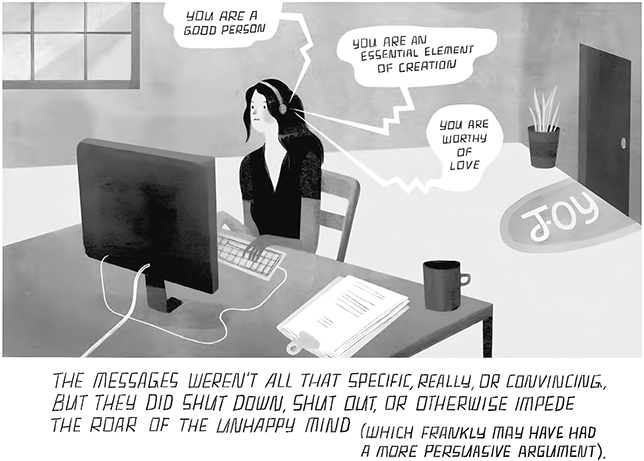
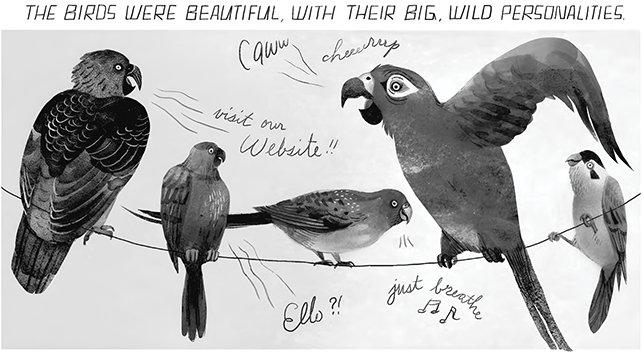
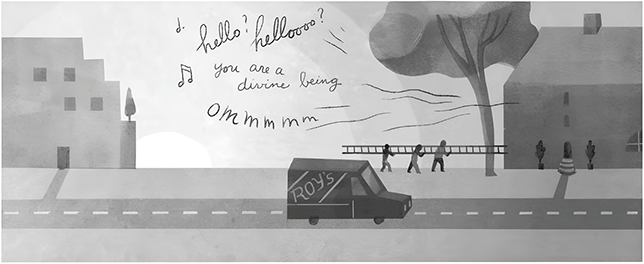
Echoing this philosophy, Daphne’s boss produces ‘positive thought crap’ that asks its audience to uncritically ‘parrot’ her ideas but also, somewhat incongruously, conceive of themselves as individuals with a unique essence. The other self-help discourses encountered by Unferth’s protagonist are similarly troubling. Even a seemingly prosaic how-to guide on parrot care, which Daphne turns to when caring for the author’s birds, advances self-help’s victim-blaming and individualist tendencies, insisting that bird mites emerge only in ‘dirty, poor, morally questionable households’ and, perhaps most bizarrely, encouraging the dissolution of parrot communities: ‘Our advice? Scatter.’ Both pragmatic and therapeutic forms of advice are reduced to ‘messages for people to listen to and embrace while running relentless errands over a churning earth’, a mere distraction from the social and environmental crisis evinced by the ‘relentless’ growth ethos of late capitalism. In Unferth’s hands, self-help registers as an absurdist farce, one which allows her to articulate a scathing, satirical social critique. But it also becomes something stranger: an ambivalent force that inspires unlikely acts of personal, social, and imaginative agency. Daphne’s self-help-author boss attempts to position herself as a singular, authoritative voice, but Unferth and Haidle delight in showing how her advice circulates in unpredictable and unlikely ways, overflowing the bounds of its objects and leaking out into the wider world through Daphne’s sceptical transcriptions (Figure 1) and, especially, the screeching chorus of the parrots under her care (Figures 2 and 3).
I, Parrot (New York: Black Balloon, 2017).
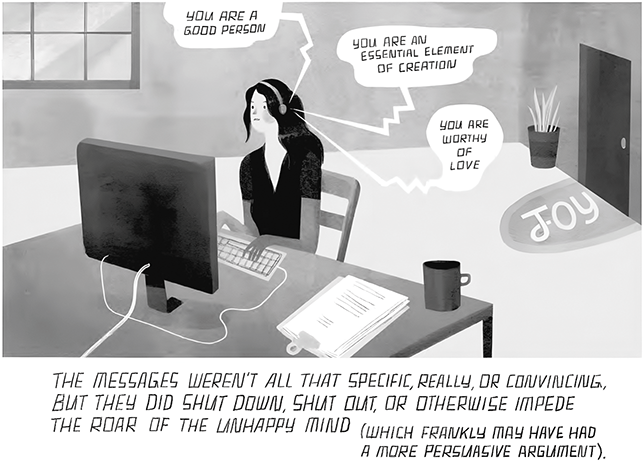
Figure 1 Long description
The affirmation speech bubbles read 1. You are a good person, 2. You are an essential element of creation, and 3. You are worthy of love. The floor mat near a door reads Joy. The caption below reads: the messages weren’t all that specific, really, or convincing, but they did shut down, shut out, or otherwise impede the roar of the unhappy mind (which frankly may have had a more persuasive argument).
I, Parrot.
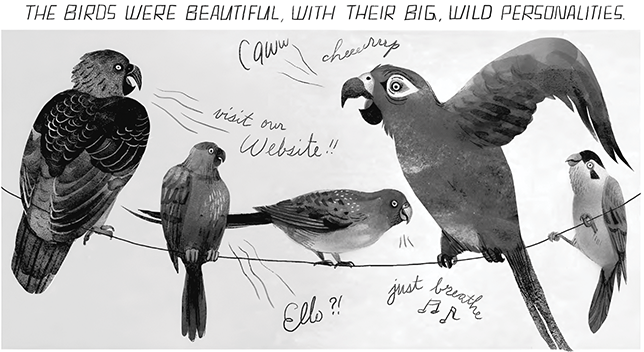
Figure 2 Long description
Surrounding them are various text fragments showing the phrases they screech, such as Ello?!, Caw, Cheer up, Just breathe, and Visit our website. A caption at the top reads The birds were beautiful, each with their own bold and wild personality.
I, Parrot.
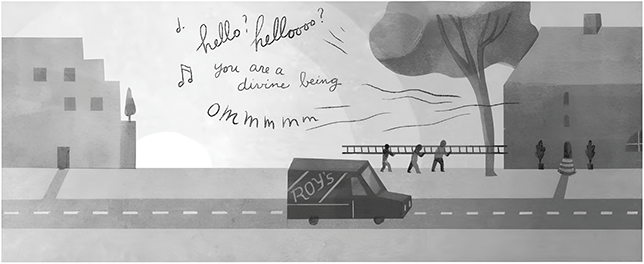
Figure 3 Long description
Floating text coming from the window represents parrots‘ speech fragments, saying hello? hellooo? You are a divine being and Ommmmmm. The text on the delivery van reads Roy’s.
Haidler strips this first panel of depth, evoking the banal emptiness of Daphne’s work life and workspace even as she transcribes positive-thought affirmations appealing to joy, love, and moral goodness. Yet Figures 2 and 3 show how, in the mouth of the ‘big, wild’ birds, generic self-help platitudes become vibrant, dynamic, and unruly affirmations of life, energizing the dull grey landscape. The three-dimensional, richly textured representations of the parrots as they screech, ‘you are a divine being’, ‘just breathe’, ‘cheer up’, and ‘visit our website’, contrasts with the flat, blank faces and constrained architectural forms of the human work world.
The advice within the parrot manual also becomes a source of charged, if ambiguous, surrealism: it is based on ‘a simple how-to book’ Unferth once read and interpreted as expressing a submerged ‘Kafkaesque’ critique of domesticated birds.2 I, Parrot stretches how-to-ism to its most ridiculous limits, but it also suggests that it is possible to tune in to resistant potential within the cacophony of self-help voices. Based on a dream vision, Unferth’s protagonist eventually decides to free the parrots, who are in danger of extinction, to ‘repopulate the earth’. The birds embody and enact several paradoxes of life and self-help: they perform rote repetition yet express uniqueness; fly free but come together in kinship. Inspired by ‘parrots escaped from cages, finding one another, and making a home’, Daphne leaves town herself to build a new life and community – ‘like a team, or a gang’; ‘like a family?’ – with her son and partner. In one sense, this seems like a simple individual escape narrative, whereby self-determination and personal choice are offered up as unsatisfactory solutions to intractable socio-environmental problems. But I, Parrot turns self-help towards a more conflicted and recalcitrant form of agency by casting personal change as a matter of survival rather than optimization, by situating self-liberation within broader efforts to liberate others, and by decentring the human self as the privileged object of improvement. The stylized, often fabular form of the graphic novel is an ideal space for Unferth to interrogate the symbolism of different kinds of self-help media. Her narrative visibilizes but never resolves core tensions between the personal and social, assimilation and change, and freedom and determinism within the language and practices of self-improvement.
I begin with I, Parrot because, in its juxtaposition of multiple forms of self-help and its urge to both critique and creatively recuperate cultures of advice, Unferth’s work exemplifies several broader tendencies within contemporary North American fiction. My central argument, in this book, is that North American writing of the past twenty-five years stages encounters between many different self-help practices and ideas as a way of evoking productive frictions between various contemporary conceptions of authorship, selfhood, and society. I, Parrot points to various conventions and mediums associated with self-help: we see seemingly straightforward instruction manuals that slide between imperatives, digressions, and generalizations; audio recordings aimed at invoking or manifesting self-love and acceptance; and AA meetings that offer a ritualized, social, and practice-led path to recovery. Self-help takes multiple shapes, each with its own conceptual and formal baggage: it can be a patchwork of loosely gathered-together advice, anecdotes, and recollections; a tightly shaped narrative of upward mobility; a circular, chronic framework of repeated mantras and ongoing self-work; or a shared practice of community discussions and individual actions. Recent new formalist thought, such as that of Caroline Levine, contemplates how rhetorical and literary forms overlap and interact as forces of ‘ordering, patterning, or shaping’, with specific ‘affordances’ that enable specific possibilities and responses.3 The forms of self-help seem doubly charged, on these terms, as organized principles that themselves seek to organize, explicitly claiming the potential to reshape, reorder, and re-form the self and its circumstances. As will become clear, neither this book nor the literary works it examines regard self-help as a singular entity that imposes its powers and promises in any one particular way. Instead, it is conceived of as an interconnected field with multiple, crisscrossing principles and practices compelling not only for their commonalities but also for their divergent structures, logics, and visions of the good life.
One central claim of this book is that contemporary authors move beyond simplistic understandings of a unified therapeutic culture: they are particularly drawn to the clashes between competing self-help philosophies and what they might reveal. Like Unferth, the authors I examine throughout this book mount a range of responses to self-help texts and techniques, at times modelling their precepts while at others pushing their philosophies to absurd extremes or pitting different wisdom traditions against one other. Hortatory, didactic, and therapeutic texts and practices offer a rich archive of form and thought, showcasing a range of clashing paradigms for living well today. If self-help is typically linked with contemporary fiction in its most obviously therapeutic and didactic forms – through confessional writing, progress-focused Bildungsromane, and sentimental-moral realism – this book considers how a wider range of advice texts and theories enter into a wider range of literary works, whose authors, like Unferth, are situated somewhere between experimental and mainstream traditions. This study focuses on eight US authors – David Foster Wallace, Paul Beatty, Tao Lin, Myriam Gurba, Benjamin Kunkel, Miranda July, Alexandra Kleeman, and Ben Lerner – alongside one Canadian author, Sheila Heti. This may seem a somewhat eclectic cohort, covering a range of styles, identities, and levels of recognition, but these writers are united through their investment in working out broader literary and social concerns through the multiple and contradictory practices of self-help, from commencement speeches, motivational talks, and African-American mutual aid traditions to productivity manuals, trauma recovery texts, makeover cultures, and popular guides to neuroplasticity. The writers I survey engage with self-help in ways as complex and multiple as the genre itself, drawn to advice cultures as often for their potential to evoke subversive critique or strange, esoteric aesthetics as for their centring of communicative pragmatism or emotional identification. In some cases, self-help practices themselves suggest unusual possibilities for shaping life and art; this will be evident, for instance, in Heti’s use of chance counsel as compositional method, and in July’s New Age allusions, which make her characters at once transcendent archetypes and unique, peculiar individuals. In other cases, contemporary writers exaggerate or transform even the most stereotypical mainstream self-help cultures to offer fresh perspectives – as when Kleeman turns skincare and makeover practices towards an aesthetics of sensitivity, or Kunkel rewrites the clichéd self-discovery travel narrative. By combining close and comparative readings with socio-historical contextualization, archival research, and author interviews, I seek to unravel the complex ways in which the practices and legacies of self-help are put to use in recent writing that contemplates different ways of shaping and navigating contemporary literature and life.
Specifically, this book argues that the diverse discourses of self-help become a generative site for contemporary writers to negotiate anxieties around individual, social, and writerly agency. Several scholars have pointed to a ‘crisis of agency’, understood both personally and politically, from the 1980s onwards, within cultural and literary thought and production. The deconstructive and poststructuralist theory of Jacques Derrida, Michel Foucault, Gayatri Spivak, Roland Barthes, Deleuze and Guattari, and others dismantled the myths of the essential, authentic self; the autonomous author; and the free, self-constituting agent, leading to fears that if ‘the subject is a decentred site where social and linguistic forces converge, there can be no constructing ethical subject but only a constructed political subject’, one incapable of setting forth any positive theory of the good life’.4 Sociologically speaking, the failures of several 1960s and 1970s social movements to effect lasting transformation, and the seeming totality of systemic power dynamics with the operations of capital increasingly unchecked by government, produced what Gabriel Winant terms ‘one big crisis of agency’ in left-wing thought: ‘antihumanist pessimism was triumphant’, Winant claims, stifling imaginaries of both individual and societal change.5 In our contemporary moment, the enormity of climate change, the determining forces of new technologies, and our globalized awareness of injustices and crises worldwide can further seem to obliterate any faith in a subject capable of exercising power and control.
Contemporary writing has given voice to such impasses through what has been called ‘the novel of passivity’ – in some ways a new iteration of the Generation X Slacker novel of disaffected youth – by authors such as Ottessa Moshfegh, Ben Lerner, Jenny Offill, Rachel Cusk, and others. Lynn Steger Strong notes that much recent fiction and autofiction by women in particular features protagonists ‘fully cognizant of their ineffectuality’ who passively opt out of the realms of social and interpersonal action, allowing themselves to be buffeted along by fate and circumstance.6 This can give rise to a resistant, refusenik aesthetics, what has been called a ‘radical passivity’ in queer studies, and described more stoically as an emphasis on ‘giving way’, ‘restraint, inhibition, forbearance, acquiescence, eschewal’ by Steven Connor.7 And yet, it also brings about a conundrum whereby the writer, by virtue of writing, experiences themselves as ‘a subject – who has power and control, and makes choices’, while writing about characters and selves who are merely ‘acted upon’ as objects.8 The stubborn, visceral residues of agency and action, however limited, need to be reckoned with.
Thus, the self-help genre, with its implicit faith in the power of words, practices, actions to inspire change, becomes a fascinating site for recent writers to work out which forms of agency and authorship remain possible in our contemporary literary world. As Beth Blum affirms, ‘self-help models a mobility and textual agency that has been relegated to the margins of professional literary criticism’.9 Riven with internal contradictions, though, the field of self-help does not walk entirely in lockstep with ideas of a sovereign, entrepreneurial self, and the authors I consider in this book often juxtapose practices of individual control against self-help traditions that centre around submission to chance and fate, ego transcendence, and even the idealization of non-human forms of life. Indeed, many critics have sought to question false dichotomies between fully sovereign selfhood and hard forms of social determinism which emphasize the impossibility of deliberate action. New and compelling accounts of distributed, relational, embodied, and qualified agency include Deleuzian repetition with a difference, Sharon Krause’s ‘non-sovereignty of individual agency’, and Béatrice Han-Pile’s phenomenological ‘medio-passive’ agency, where actions – especially affective acts such as hope, prayer, and planning – emerge alongside, or even through, a recognition of the agent’s ultimate powerlessness.10 In parallel ways, this book holds that contemporary authors mediate new stories of volition, choice, change, and acceptance by turning to distinct self-help traditions that are suffused to different extents with fantasies of hope, transcendent action, and resignation.
And as we saw in I, Parrot, agency and transformation are ineluctably social, as well as personal, issues. This book suggests that contemporary writing is deeply concerned with the possibilities and impossibilities of getting, being, and living better, where ‘better’ can mean ethical, therapeutic, and/or didactic improvement. In what follows, we will see writers and protagonists anxious about their focus on the self, looking to test the interpersonal and societal effects of individualist self-help ideologies even as they wonder whether self-help blocks or enables communal action. As early as the Victorian novel, as Rebecca Richardson argues, writers felt compelled to dramatize how self-help agency and ambition affected the relationship between the individual and the collective, staging scenarios in which bettering one’s life entails worsening another’s as well as those in which personal improvement contributes to the social good.11 In a contemporary moment where the meaning of individualism, collectivism, and agency are subject to continual revision, self-help is a useful and relevant discourse to think with.
The Porous Practices of Contemporary American Self-Help
As a key site for ‘technologies of the self’ or ‘anthropotechnics’ that aim to sculpt the self and life, formalized advice has taken various shapes across different societies and eras.12 These range from collected folk wisdom to conduct and etiquette manuals, ancient philosophy, religious wisdom texts, adult education lectures, mutual-aid structures, transcendentalist ideas of ‘self-culture’, popularized psychoanalytic and psychological literature, grassroots counter-cultural groups, and the mass cultural industry known as ‘self-help’ today.13 This phenomenon ranges far beyond the borders of the United States, but it is undeniable that North America remains a central and influential site of self-help production and reception. The novels I consider both extend and trouble the genre’s links with age-old ‘American dream’ myths of democratic individualism and success for all, as well as more recent associations with neoliberalism. In the United States, Puritan tracts, lectures, and confessional self-accounting practices, Benjamin-Franklin-esque secular almanacs of self-making, and Indigenous wisdom and healing traditions all precede today’s self-help culture. Despite these significant precursors, the Anglo-American self-help industry as a discrete, modern genre and set of practices is generally considered to have begun in the mid-nineteenth century with the publication and mass global dissemination of Samuel Smiles’s Self-Help (1859), which emerged from Smiles’s engagement with UK working men’s clubs and education and health reform movements, and counselled a bootstrap ethos of hard work, self-discipline, and moral character, embodied in the exemplary life stories of successful men.14 Across the Atlantic, Smiles’s work fit into a burgeoning American self-help tradition based on rational striving, self-control, and moral rectitude as a means to success in worldly callings, in line with Max Weber’s generalized Protestant ethic. This tradition encompassed works such as Henry Ward Beecher’s Lectures to Young Men (1844) and Freeman Hunt’s Worth and Wealth (1856), as well as Franklin’s earlier The Way to Wealth (1758), which epitomized, as Micki McGee terms it, the figure of the ‘self-made gentleman-citizen’.15 This hardline – and often masculine-coded – focus on willpower, labour, and self-mastery remains evident in several of the contemporary self-help cultures that make their way into my study, from David Foster Wallace’s interest in the stern fatherly guidance of Alcoholics Anonymous speakers and other advisors to Tao Lin’s investment in the disciplined management of time and work. In many ways, these traditions contrast with another major strand of the American self-help industry: a softer, more therapeutic, Romantic, and spiritual ethos. Since the mid-to-late 1800s, the self-culture of Ralph Waldo Emerson and other Transcendentalists, and the New Thought and mind-cure movement promoted by Ralph Waldo Trine and Mary Baker Eddy, have emphasized self-fulfilment, individual expression, and attunement to flows of infinite energy as the key to creating abundance and personal growth. Throughout this book, the legacy of this softer self-help is evident in the concepts of creative flow, healing and recovery, and New Age philosophies explored in the writing of Myriam Gurba, Sheila Heti, Miranda July, and others.
If there are clear distinctions between these strands of self-help, Micki McGee wisely cautions us not to draw the lines too clearly. Even the archetypal representatives of each school of thought – Smiles, Franklin, Emerson, Trine – incorporated aspects of hard and soft. McGee argues that in our contemporary age, ‘Franklin’s orderly, reasoned, and self-disciplined approach to the accumulation of wealth’ or ‘the frugal, calculating asceticism of the Protestant ethic’ are not necessarily ‘opposed to the indulgent sentimentality and sensation-seeking of the Romantic ethos’; rather, ‘life under capitalism contains complementary, mutually reinforcing elements’.16 Many of the authors I consider here seek to understand how instrumental, disciplinary self-regimes interact with therapeutic, expressive approaches to self-care. Slower, softer, and more spiritual self-practices can expose fault lines in contemporary hustle culture, seed alternatives to extractive capitalist growth, and push towards more holistic forms of self-improvement – or they can simply prop up the status quo, offering temporary recovery only as a means of creating new products and markets and promoting greater productivity long term.
The industry has both grown and diversified since these origin moments, adapting to meet new needs. A new working world that required soft skills and organizational relationship building gave rise to interpersonal guides such as Dale Carnegie’s classic How to Win Friends and Influence People (1936); a post-1960s countercultural bent popularized practices that offered alternatives to Protestant American ethics, including psychedelic consciousness expansion, human potential movements, often exoticized Eastern traditions, and the holistic mind-body-spirit New Age; an increasingly precarious neoliberal post-1980s labour market has seen a rise in self-help guides to flexible entrepreneurialism and productivity, from Richard Bolles’s What Color Is Your Parachute? (1970; regularly revised and reissued) to Tim Ferriss’s The 4-Hour Workweek (2007) and Cal Newport’s Deep Work (2016).17 The US self-help ‘boom’ of the late twentieth century has been marked not only by higher rates of production and consumption (the industry was worth $13.44 billion in 2022) but also by an increased diversification of media forms (eBooks, apps, audio guides, talk shows, YouTube courses) and a proliferation and segmentation of sub-genres (including New Age, trauma recovery, high-end philosophical self-improvement, and pop-science neuroplasticity).18 Specific, specialized self-help media are thriving, but contemporary self-help is also notable for its dissemination into the broader culture. In digital contexts, the figure of the advice giver often diffuses into a vaguely therapeutic field of decontextualized advice, circulated, in part, through quotes and memes, though online channels have also enabled the rise of charismatic and famous self-help authorities from Esther Perel, Brené Brown, and Nicole LePera to Andrew Huberman and Jordan Peterson.19 Self-help infuses broader popular, political, and personal discourses; as Patricia Neville notes, ‘self-help books have become integrated into our daily lives, whether we purposely seek these products out or not’, often in ways inseparable from wider therapeutic discourses. 20 In 2021, the New Yorker published a much-discussed piece entitled ‘The Rise of Therapy Speak’, which interrogated the ways clinical psychology, popular psychology, and self-help rhetorics together structure ‘our idea of the good life’; in 2023, they devoted an entire digital issue, The Therapy Issue, to ‘therapy as a distinguishing feature of contemporary life’.21
This diffuse contemporary iteration of therapeutic-didactic culture is both historically specific and impossible to separate fully from older, cross-cultural traditions of wisdom, instruction, and psychological guidance. It is notoriously difficult to demarcate the capacious and slippery set of practices that comprise self-help: as one group of critics put it, ‘the boundaries between self-help and other advice genres – in particular philosophical ethics, theological ethics, medical advice, and how-to guides for narrow practical tasks – often blur’.22 While several critics have attempted to propose a single common ideological essence running through the genre – most often its reliance on individualism – others signal a network of overlapping, loosely united practices roughly akin to a Wittgensteinian ‘family resemblance’.23
As this book explicitly investigates the productive antagonism between fictional depictions of distinct, even contradictory practices, I rely upon a similarly flexible understanding of self-help as indicating an expansive range of texts and activities jointly invested in signalling problems within the current life situation of their reader or audience and in proposing solutions. I also consider self-help across a broad range of media and traditions, beyond the terms of the self-help book alone. Peter Sloterdijk, drawing on Rilke’s affirmation, ‘You must change your life!’ – curiously echoed in the pressure felt by the I, Parrot protagonists to ‘change all aspects of our lives’ – describes how the modern imperative for change, development, and becoming is borne out in the ‘practising life’, in which ‘education, etiquette, custom, habit formation, training and exercise’ undergird both religious and secular wisdom and selfhood.24 In line with this thinking, I emphasize the role of self-help practices as well as self-help books. Self-help is a fundamentally action-oriented discourse; as Kenneth Burke has pointed out, regardless of whether its prescribed practical exercises and tips are put to use, the genre’s very rhetoric already places the reader in the terrain of mental and affective change and volition as they engage in acts of planning, hoping, imagining, and feeling.25
The post-1980s self-help landscape, and in particular the period after 2000, where I focus, serves as a particularly germane context for my inquiry into self-help texts and practices within contemporary literature. The industry’s growth and dissemination into popular language and life in the late twentieth century make it a significant cultural force to be reckoned with – already by 1989, Steven Starker claimed that self-help occupies a space in American life ‘too pervasive and influential to be ignored’, and it has only expanded in the decades since.26 Critics have suggested several explanatory factors for the increased contemporary popularity of self-help. Some point to the declining influence of spaces such as the church, workplace, local community, family, and state institutions in our precarious, hyper-mobile, hyper-connected era. Zygmunt Bauman articulates the modern predicament as a ‘liquid’ contemporary ‘marked by an incurable fragility of social positions and sources of living, a brittleness of interhuman bonds, a chameleon-like mutability of coveted values’; this places subjects in a ‘state of permanent transformation’ even as the institutions and social relationships that would normally guide such transformation are emptied out.27 Others consider the role of new media, from makeover reality television and talk shows such as Oprah to interactive forms of social media. Theorists suggest that these sites often produce new forms of self-help-guru worship and individual discipline but also offer some limited hopes for democratized and even politically savvy forms of collective self-help, such as the ‘Occupy Yourself’ site founded through the Occupy social movement.28 Above all, though, self-help seems to be thriving because of the genre’s remarkable malleability. Increased diversification means that the contemporary self-help field is particularly ‘marked by eclecticism’, as Anna Maria Schaffner puts it: self-help cultures perpetually evolve in order to respond to, and create, new needs.29 Thus, contemporary subjects, faced with demands to continually adapt to changing neoliberal marketplaces and visions of the good life, turn to self-help. And yet the culture and media of self-help are simultaneously responsible for creating and propagating new vocabularies and images of self, life, and work that individuals must adapt to. As Aubry puts it, the industry ‘has become increasingly adept at constituting and inventing the problems that it claims to solve’, often encouraging identification with ‘new pathological identities’ that encompass both diagnosed mental illnesses and popular psychology concepts such as ‘codependency’.30
The typical US audience for the mainstream self-help industry has traditionally skewed middle-class, educated, and white, with more female than male participants, though only a few of the authors I consider here – specifically Sheila Heti and Miranda July – fall within this demographic. In fact, self-help texts increasingly seek to appeal to other populations; Chicken Soup for the Latino Soul (2005) and The Black Girl’s Guide to Self-Care (2018) are just two recent examples. As Micki McGee notes, though this boom may be partially explained by market-driven segmentation or profit-oriented attempts ‘to open up new audiences’. It also indicates a genuine need for advice that resonates with ‘the varied social expectations we each face in a highly differentiated social world’ and addresses readers across a range of gendered, racial, ethnic, and sexual identities.31 Furthermore, many scholars have also signalled the long-standing importance of both commercial and grassroots self-help practices to Latinx, African-American, Indigenous, working-class, and disabled communities, to both conservative and progressive ends.32 On this latter end of the spectrum, Alyson K. Spurgas and Zoë Meleo-Erwin trace mutual-aid, self-help, and wellness ‘projects which emerge squarely out of working class, Black, Brown, Indigenous, immigrant, disabled, and queer and trans communities’ and which connect self-care with activism, ranging from the Disability Justice Collective to the Movement for Black Lives and the Black Panther Party.33 Some recent fiction writers also expand our typical understanding of self-help’s readership and reception, depicting non-bourgeois audiences who seek strategies for survival that will affirm their existence in hostile socio-economic environments. Here, self-help is envisioned as ‘self-preservation’ rather than ‘self-indulgence’, to use Audre Lorde’s famous distinction.34 Importantly, though, while this quote has been misused to justify all (and often the most privileged) self-care practices as inherently liberatory, Lorde also decries discourses that cast wellness as an individual issue and responsibility rather than a shared, structural, and social problem, exclaiming ironically: ‘Let us seek “joy” rather than real food and clean air and a saner future on a liveable earth!’35 Lorde reminds us that the desire for personal transformation is not exclusive to privileged subjects seeking to optimize already comfortable lives, but also stems from conditions of marginalization, injustice, suffering, and desperation in a society where few structural solutions present themselves. In her book, Who Is Wellness For?, Fariha Róisín eloquently parses the paradox of ‘needing wellness’ all the more, as a woman of colour and abuse survivor, while remaining sceptical of ‘the wellness industrial complex and its failures’.36
Certain writers show less privileged self-help audiences turning the genre to multiple uses. In addition to Unferth’s precarious gig worker protagonist in I, Parrot we might think, here, of Chris Kraus’s Latinx convict character Paul, in Summer of Hate (2012), who selects Melody Beattie’s bestseller Codependent No More (1986) alongside the Bible from the library cart at his prison, or of the protagonist-narrator in Mateo Askaripour’s Black Buck (2021), who both narrates a cautionary tale and offers a collection of how-to tips ‘to help other Black men and women’ to manoeuvre in corporate America.37 In the non-fiction domain, Cowlitz writer Elissa Washuta’s recent essay collection White Magic extends a tradition of self-writing by women of colour, including Lorde and Gloria Anzaldúa, that seeks to both critique and recuperate the possibilities of self-help. Washuta expresses frustration with several manifestations of the contemporary self-care industry practices: traditional occult practices and New Age exploitations of Indigeneity ‘sold as self-help’ as well as a ‘self-help book for wounded singles’ that suggests she must do ‘sequential self-exploration exercises’ to find love.38 And yet, realising ‘I need to get better and I’m out of ideas’, she draws on a fusion of Native and non-Native spiritual practices and even ends up engaging deeply with the self-help love workbook, using as well as refusing its prompts in her writing.39
In recent decades, as the personal improvement industry has both evolved and expanded, a particularly complex and charged relationship has developed between self-help and literary fiction. If didacticism and personal improvement were once understood as core features of literary writing – from the sentimental novel to the exemplary moral narrative and young adult instructional, in the tradition of Horatio Alger – modern fiction has often sought to distinguish itself from the perceived simplicity and status-quo complicity of advice genres. Jonathan Franzen expresses a sense that ‘literature has always stood outside that … idea of the perfectibility of species, and found comedy and tragedy in the failure of those projects’, invested in the tragicomic fatalist ‘notion that people can’t change’ rather than the earnest optimism of the self-improvement or self-transformation story.40 Beth Blum describes how ‘[n]ovels and success manuals have been competing for readers’ attention at least since the late nineteenth century, when they vied for space on the same early best-seller lists’, though she also cautions against understanding the relationship as pure rivalry, noting that ‘today the two industries appear to court and even encourage their mutual conflation’.41 Within academic as well as literary landscapes, ideas of ‘bibliotherapy’ are used to claim relevance for books within a competitive media ecology and to defend literary value in the culturally relativist post–‘Death of the Author’ humanities department. In our modern marketplace, where self-help sells, and in postmodern literary traditions, where distinctions between high and low culture are consciously blurred, publishers, marketers, and authors themselves often emphasize the overlaps between literature and life advice. Blum explores how contemporary writers use the conceit of the ‘how-to’ text, in works like Charles Yu’s How to Live Safely in a Science Fictional Universe and Sheila Heti’s How Should a Person Be?, and some recent writers self-consciously dramatize the interactions of advice and literary forms. Consider how easily Selin, the protagonist of Elif Batuman’s Either/Or (2022), slips between reading Ellen Fein and Sherrie Schneider’s 1990s bestseller The Rules: Time-Tested Secrets for Capturing the Heart of Mr. Right and Alexander Pushkin’s Eugene Onegin, playing the two texts against each other and finding in each related and relevant strategies for managing her romantic life.42
Authors are also increasingly asked to act as authorities on creativity and general life experience outside of their writing. In the wake of the period of creative writing institutionalization dubbed the ‘Program Era’, many writers occupy teaching and mentorship roles within the university – but they are also expected to informally share secrets of the craft, motivation for young writers, and thoughts on the creative life as part of a burgeoning literary advice field that encompasses Paris Review–style interviews and craft memoirs.43 America’s current ‘creative economy’ or ‘creative class’ – where creativity is increasingly valued not only as a source of corporate innovation but as a therapeutic good or ‘road to personal growth’ – has generated enormous interest in writers’ life advice.44 Contemporary authors feature as popular commencement ceremony speakers and podcast interviewees, called upon to offer practical guidance not only to the growing ranks of aspiring writer-creative-entrepreneurs but also to the wider public.
At a moment in which the fundamental literariness of the literary industry is imagined to be in crisis, there remains a residual desire to distinguish literary fiction from self-help in order to vouchsafe distinct forms of authorship and public intellectualism.45 Already in 1984, the introduction of a new ‘Advice, How-to and Miscellaneous’ category within the New York Times bestseller list spoke to a dual urge to cordon off the genre while recognizing its growing market share.46 For many writers themselves, the urge to define literary texts against increasingly prevalent utilitarian and therapeutic paradigms persists, and not only for self-conscious advocates of literary traditionalism like Jonathan Franzen, who suggests that literature’s role should be to critique ‘the therapeutic society’ rather than participate in it.47 Maggie Nelson, less prone to conventional high/low distinctions, nonetheless evokes the lingering shame associated with the mass cultural self-help object in Bluets (2009), where the speaker picks up a book called The Deepest Blue in a bookshop, expecting an aesthetic or cultural treatise on the colour blue, only to realise it is a self-help book on depression. ‘Embarrassed’, she secretly orders the book online, setting up a classic distinction between aesthetic nuance and practical reductionism in describing how, ‘like many self-help books’, its ‘horrifyingly simplistic language’ sits alongside ‘some admittedly good advice’.48 But the binary her speaker draws between linguistic and conceptual sophistication on the one hand and practical knowledge on the other does not hold: she finds value in the book, clearly philosophically intrigued by the strange, detached sense of self at the heart of the book. By 2022, in her non-fiction work On Freedom, Nelson recommends a ‘self-help book for artists’ as a source of collective ‘solace’; certain forms of self-help have now come to stand for creative personal and communitarian interest.49
More generally, the past twenty-five years have seen reconfigurations of the relationship between self-help cultures and political and public life that are especially relevant to the questions of selfhood, society, and authorship at the heart of this book. Throughout the twentieth-century, self-help has been critiqued for turning citizens towards themselves and away from community and politics, but worries have grown that therapeutic self-help discourses are not confined to an inward-looking, apolitical sphere but rather infiltrating political and public discourse.50 In the 1990s, Bill Clinton was dubbed ‘the therapeutic president’ for his confessional style; in 2021, alternative health advisor and Oprah favourite Dr Oz campaigned for the Senate; and in both 2020 and 2024, New Age author Marianne Williamson ran for president.51 The perceived interpenetration of these discourses, of course, runs deeper. The political context of post-1980s late capitalism, with its free-market ideologies and dismantling of state support systems, is generally thought of as particularly amenable to the dual legacies of personal discipline and healing that cohere within contemporary self-help traditions. This ethos draws on much older ideas of self-sufficiency to construct citizens as individuals who take entrepreneurial ‘bootstrap’ responsibility for improving their lives.
These harsh norms are increasingly accompanied – especially following US political and financial crises from the early 2000s – by a softer public discourse of happiness and healing that is both governmental and individualistic. This makes itself known in the renewed importance placed on concepts of emotional intelligence or feelings management; on happiness and well-being indexes; and on ‘nudge’ theories of psycho-political behavioural change to public policy.52 Ben Marcus’s speculative post-9/11 story ‘Blueprints for St. Louis’ (2017) explores these contexts, depicting architects who design a biopharmaceutically enhanced monument to the victims of a terrorist attack and contemplate their role as public ‘therapists’: ‘We try to make people feel better.’53 This story’s anxieties around the reconfiguration of public space and citizenship signal a particularly acute awareness of the shifting and porous dichotomies of private and public, personal and political, in contemporary life. It is worth noting, though, that entanglements with different forms of politics are evident throughout the long history of self-help; Foucault signals the ways in which, from late antiquity onwards, ‘techniques of the self’ have been concerned with civic as well as ‘personal conduct’ – ‘one takes care of oneself and the city’ – while Robert Bellah notes that many late eighteenth-century US ideals of ‘self-improvement’ held that ‘the social good would automatically emerge’ through pursuit of personal betterment.54
For Marcus and many others, self-help’s mix of complexity and cultural dominance offer a particularly fertile ground from which to interrogate broader questions of selfhood and society. Most of the books included here were written prior to the COVID-19 pandemic, but the pandemic only served to underscore the ways self-help, individualism, and social action seep into one another. Theorists have rightly pointed to how an explosion in demand for self-help during the COVID crisis promoted new forms of ‘carewashing’ – dressing up self-care and consumer cultures as forms of civic and community care.55 And yet, it ‘has newly insisted on our interconnections and dependencies not only across societies and economies but also across larger ecological systems’, as Rebecca Richardson terms it; pandemic self-care practices brought together self-protection with consideration of social contagion and risks, and urged us to focus on small individual actions even as we were continually reminded of our individual powerlessness against the virus and its consequences.
Over the last quarter of a century, a certain self-consciousness around the social and cultural effects of personal development literature has also emerged. If our culture is saturated by self-help’s methods and precepts, self-help has also been reified as a cultural object for appraisal and critique. We might think, for instance, of the regularity with which opinion pieces of the past decade judiciously remind us of the radical roots of the ‘self-care’ concept in order to question its current commercial degradations.56 By now, public-intellectual polemics against self-help are a genre unto themselves, and the novelists I will discuss are generally just as familiar with critiques of self-help as with its doctrines. This book is interested in interrogating the complex mix of aversion and attraction that characterizes literary engagements with self-help, often evident in a joint impulse to deconstruct therapeutic discourses while reconstructing certain self-help precepts in order to produce new understandings of life and art.
Critique and Counter-critique
Eva Illouz describes how myriad critics ‘agree’ that therapy culture represents ‘what is most disquieting about modernity’.57 Yet what they find disquieting – and indeed, what they understand as modern – varies according to their particular concerns; Timothy Aubry and Trysh Travis suggest that commentators project onto such critiques a ‘dystopian image’ of ‘the critic’s own historical moment’.58 In the wake of suspicions around mass culture industries, from the Frankfurt critics and others, the self-help genre has often been equated with the false promises of capitalist consumer culture as a whole. As Mark McGurl glosses, ‘the leftist rejoinder to the rise of consumerism has been to argue that its satisfactions are illusory because they are predicated on a larger insatiability, a never-ending itch to further optimize’.59 Thus, a genre that centres on the cultivation of dissatisfaction and the deferred promise of an optimized life often rendered impossible by socio-economic conditions seems a capitalist object par excellence, and self-help has come to represent salesmanship, hucksterism, and a kind of society-wide false advertising that epitomizes Lauren Berlant’s sense of ‘cruel optimism’.60
However, scholars disagree on how the urge towards consumption and personal optimization plays out within self-help and its relationship to the wider culture: the robust tradition of self-help critique comes at the question from distinct angles. Aubry and Travis describe a series of ‘canonical critics’, mid-to-late twentieth-century liberal public intellectuals who see therapy and self-help cultures as harbingers of a decline in ‘authenticity’, ‘community’, ‘true religiosity’, and ‘meaningful work’; Philip Rieff’s The Triumph of the Therapeutic (1966), Christopher Lasch’s The Culture of Narcissism (1979), T. J. Jackson Lears’s No Place of Grace (1981), and Wendy Kaminer’s I’m Dysfunctional, You’re Dysfunctional (1993) all fall into this category.61 A subsequent wave of post-Foucauldian critics extended communitarian concerns to late capitalist contexts, targeting neoliberal creative entrepreneurialism, performative self-construction, and biopharmaceutical forms of self-improvement.62 As such, in different contexts, critics have assumed self-help to represent governmental ‘nudges’ and inference but also the declining role of the state; atomized, individualistic selves, but also overly assimilated conformist selves; discourses that ascribe the individual too much responsibility and power, but also rhetorics that enfeeble the self as vulnerable, helpless, and in need of others’ guidance. Where Micki McGee recoils from what she perceives as the disciplinarian capitalist ethic of ‘continuous and never-ending work on the self’, Barbara Ehrenreich decries the ‘brash entitlement’ of the self-indulgent shirkers who seek self-help shortcuts to happiness.63 Self-help has been seen by some as the genre of self-obsessed individualists, anxious to stand out from the crowd, but by others as the source of willing automatons, all too eager to ‘give authority to texts’.64 The flexible diversity of this field of critique speaks to the myriad ways in which critics have projected shifting forms of cultural dissatisfaction onto self-help but also serves to remind us of the differences, conflicts, and contradictions that inhere across therapeutic-didactic forms.
Indeed, the fact that many of these accounts attribute socio-communitarian decline only to certain aspects or types of advice culture suggests that they are principally opposed to specific iterations of self-help. There is a submerged reconstructive impulse here, in which the act of critique brings about a recuperation of alternative forms of self and life wisdom. Christopher Lasch, for instance, is famously scathing about therapeutic self-improvement, but he seeks to rescue ‘older traditions of self-help’ based on civic discipline as well as self-sufficiency, and has no qualms about using popularized psychoanalytic terms, most notably ‘narcissism’.65 Lasch’s daughter, Elisabeth Lasch-Quinn, excoriates New Age sensitivity and confessional self-improvement for eroding a civil rights focus in social justice politics, but she approves of self-help and etiquette discourses that uphold a universalized ‘single standard of conduct’.66 Even critiques stemming from a more radical refusal of the traditional terms of selfhood suggest alternatives that are not entirely separable from self-help culture in its broadest sense. Consider Ann Cvetkovich, who problematizes the privatizing of emotions by ‘self-help experts’ but envisions an alternative, collaborative ‘advice manual’, or Sara Ahmed, who writes against ‘instructions on how to be happy’ but promotes chance-based practices of ‘hap’.67 It is this impulse that leads Courtney Bender to understand such criticism as essentially prescriptive in nature and argue that ‘the critique of therapeutic culture’ acts ‘as its own form of self-help therapy’, an implicit or explicit corrective articulating ‘a way to live better within the system’.68
If critique does not necessarily eschew self-help prescriptivism, neither is self-help devoid of critical tendencies, for all its associations with straightforward sentimental naïveté. Self-help texts often exhibit an overlooked socially critical impulse, which often lingers even when they provide an ultimately individual solution to the structural problems they identify. Before offering their advice, many texts attempt to deconstruct both social and personal causes of suffering (what Jeremy Koay describes as the ‘presenting the problem move’).69 This is perhaps most evident in a recent wave of micropolitically savvy instructive essays, including adrienne maree brown’s Pleasure Activism (2019) and Dear Black Girl: Letters from Your Sisters on Stepping into Your Power (2021), which extend the radical self-help mandates of grassroots women-of-colour collectives and authors such as Audre Lorde and bell hooks. But even less overtly political self-help books offer what has been called ‘proto-sociology’, and Sandra Dolby outlines how ‘the problem or “lack” to which each self-help book is offered as a solution is formulated as a critique of the existing culture’.70 Thus, self-compassion advocate Brené Brown describes ‘watching scarcity ride roughshod over our families, organizations, and communities’; ‘inner child’ guide John Bradshaw condemns a society marked by ‘patriarchy’ and ‘authoritarianism’ and hopes better family relationships can produce an ‘internalization of democracy’; and neo-stoic business guru Ryan Holiday blames ‘decaying institutions, rising unemployment, skyrocketing costs of education, and technological disruption’ for many contemporary dissatisfactions, even if he does subsequently counsel a personal change in ‘attitude and approach’ as the best means of confronting these ills.71 In fact, criticizing one form of self-help in order to propose another is a move that often unites self-help authors with their critics. If these tendencies signal a growing market demand for social awareness on the part of self-help authors, they also trouble the lines of demarcation that critics often wish to erect between socially and aesthetically desirable forms of self-help – those attuned to politics, civic citizenship, and ancient wisdom, for instance – and its more commercial or individualist iterations.
A new wave of self-help scholarship is more alert to the blurred boundaries between self-help individualism, critical commentary, and social awareness. In part owing to renewed interest in the work of ‘everyday life’ theorists like Michel de Certeau, who argues that small-scale tactical resistance can be enacted within and through dominant cultural strategies, such thinkers emphasize the micropolitical potential of self and life practices.72 They may be critical of particular aspects of the genre, but they are nonetheless attuned to the multiple and unpredictable ways its theories can be turned towards desirable ends, by encouraging ‘pleasure and passion’, as well as labour (Maasen and Duttweiler); by offering ‘useful tools’ for navigating ‘daily life’ (Illouz); by acting as a precursor to demanding ‘sufficiency for each and all’ (McGee); or by supporting energies directed ‘toward other people and toward creative projects’ (Schaffner).73 Recent work on the flexible, sceptical, and inventive reading practices of actual self-help readers – no longer imagined in the binary terms of earnest cultural dupes or resistant radicals – has reminded us that self-help always operates ‘in ongoing relation to other frameworks for situating personal selfhood in a social context’, as Paul Lichterman puts it.74
In short, in the contemporary landscape, a singular perspective on self-help seems impossible, given the sheer range of its cultural objects and the varied and paradoxical ideas of selfhood they evoke. If the term ‘self-help’ has always encompassed a varied discourse, the growth and segmentation of the industry make its distinct manifestations hyper-visible as they tussle for space in the same publishing categories, bestseller lists, and online markets – sometimes even in the same books. Thus, while many self-help discourses rely on grand narratives of authentic self-discovery, closure, and wholeness, others suggest an oppositional postmodern ethic of flexible self-construction.75 Notions of the self as a site of control, discipline, and mastery are counterbalanced, in the genre, by appeals to a ‘wild’, unruly, and expansive sense of psyche and selfhood: Schaffner notes that ‘the more corporate we became, the more we longed for wildness’, citing Clarissa Pinkola Estés’s self-help classic, Women Who Run with the Wolves (1992), as just one example of a self-help response to rational, productivity culture.76 Self-help offers deeply pragmatic discourses that shore up the personal agency of the acting subject, as well as others that suggest esoteric, spiritual forms of self-transcendence. While charismatic self-help gurus continue to promise dazzling results with little effort, other advisors have swapped magical thinking and drastic transformations for a more moderate self-help ethos: Dan Harris’s 10% Happier (2014), James Clear’s Atomic Habits (2018), and B. J. Fogg’s Tiny Habits (2019) counsel small, incremental changes, often through the formation of micro-habits. The self-help field is more segmented than ever, and yet the transcendent, universalizing self-help ‘you’ that hails readers across social lines remains crucial to many texts. In such a varied field, the ‘self’ in self-help is anything but self-evident, describing multiple stances towards individual agency that range from disciplined to infantilized selfhood, from socially situated to independent selfhood, and from intense self-focus to renunciation of the self altogether. Sandra Dolby catalogues ‘the obligated self, the social self, the wounded self, the detached self’ interpellated in self-help, while Eva Illouz argues that contemporary therapeutic cultures simultaneously demand a ‘disengaged self’ and ‘sociable self’.77
Paradox might be said to be the fundamental operating condition of self-help more generally. The narrator of Sheila Heti’s How Should a Person Be? (2010) expresses her frustration with self-help texts that ask the reader to at once accept and reform themselves in exasperated rhyme: ‘I have read all the books, and I know what they say: You – but better in every way!’ (Of course, Carl Rogers famously described this conflict as central to any project of personal transformation: ‘The curious paradox is that when I accept myself just as I am, then I can change.’78) Yet Heti’s very next line complicates any sense that ‘all the books’ have a simple or single message, signalling the sheer diversity of options: ‘And yet there are so many ways of being better, and these ways can contradict each other!’79 If the terms of cultural commentary often lead critics of self-improvement to understand ‘all the books’ in a particular ‘way’ that is amenable to their broader arguments, literary fiction – responsive to changing social conditions yet under less pressure to formulate a coherent position – is ideally positioned to offer a more nuanced and ambivalent picture of the messy and multiple strands of self-help culture. Familiar, to varying extents, with distinct self-help manifestations as well as the web of critique and counter-critique that surrounds the genre, the writers I examine throughout this book perform both critical and creative interrogations of self-help practices that allow them to grapple with ‘many ways of being better’ in both ethical and aesthetic terms.
Conversations between Self-Help and Literature
In recent years, connections between literary writing and self-help have become an increasingly popular topic of study. Several critics have considered the ways in which writing might be therapeutic for the author, as well as the reader, through explorations of the confessional impulses of literary memoirs and autofiction as well as networks of blogs and self-publishing.80 Various studies have taken a more reader-centric approach, exploring how literary writing fulfils ‘bibliotherapeutic’ functions of emotional or ethical healing.81 Other scholars have interrogated discourses of literary utility and emotional well-being as a symptom of contemporary socio-economic conditions; Mark McGurl considers how, in the age of Amazon, the author is increasingly asked to act as ‘a kind of entrepreneur and service provider’ who offers a ‘program of self-care’ to a ‘reader-customer’, while Rachel Greenwald Smith argues that an increased focus on ‘emotional connection’ as a form of literary ‘self-improvement’ is a kind of affective neoliberalism.82 In the introduction to their 2023 edited collection, Literary Studies and Human Flourishing, James English and Heather Love neatly encapsulate disciplinary frictions around understanding literature as fundamentally curative or salutary. Literary studies was established on ‘a foundational antagonism toward modern technocratic, business-oriented society and toward that society’s undergirding by scientific, technical, and professional fields of higher education’, they say, and thus the field naturally rebels against positive and popular psychology, with its emphasis on productivity as well as flourishing.83 And still, at a cultural moment when ‘practically everyone believes that, one way or another, reading is good for them, and good for us all … literary studies plays a major role in maintaining this positive view of books, reading, and literary art’.84
This book is particularly indebted to two excellent monographs which skilfully navigate these tensions: Timothy Aubry’s Reading as Therapy (2011) and Beth Blum’s The Self-Help Compulsion (2020). Aubry’s study of post-war ‘middlebrow’ US fiction as ‘a practical dispenser of advice’ that contributes to ‘the development of a common therapeutic vocabulary’ offers important insights into how contemporary writers and readers envisage themselves in relation to the discourses of self-help; his sense of the ‘heterogenous and complex’ functions of such ways of reading has been especially useful.85 Blum’s wide-ranging scholarship focuses on the fraught international relationship between self-help and modernist as well as contemporary literature, as well as self-help’s global reception history. I take up her claim that the genres interact in complex and often unexpected ways, ‘marked by negotiation, strife, influence, and imitation’ beyond ‘polemical opposition’, and her sense that literary authors engage with a ‘twofold understanding’ of self-help as both a specific industry and a transcultural impulse towards learning and wisdom.86
However, my project diverges from these scholars in emphasis as well as historical and geographical scope, and selection of authors. Firstly, where Aubry primarily concentrates on therapeutic and affective aspects of literature, and Blum on the didacticism and pragmatism of advice literature as ‘an alternate pedagogy’ rather than as ‘a form of therapy’, I read therapeutic and didactic self-help discourses as mutually entwined.87 If the writers I study do sometimes pit emotional healing practices against self-education, within the broad and porous field of contemporary literary and guidance practices, the pedagogic and therapeutic often blend or overlap. I also depart from their focus on self-help as a way of reading. Much of the scholarship suggests that the relationship between self-help and literary writing is primarily of interest for showing literature itself to offer a therapeutic-didactic payoff, and I will consider how literary interrogations of self-help can emphasise forms of continuity between the genres and motivate utilitarian theories of literary value. But I also hold that this is only one of the many ways that self-help texts enter into relationship with contemporary writing. For the authors I study, certain forms of self-help act as opportunities to engage in ideological dissent, aesthetic experiment, new forms of speech, and even speculative imagination; indeed, as Blum suggests elsewhere, self-help can act as a form of ‘fantasy fiction’ or ‘wishful thinking’.88 In particular, transcendentally oriented spiritual and ‘self cultures’, psychedelic countercultures, and grassroots micropolitical DIY traditions emerge as attractive counter-currents to more mainstream, commercial, or rational self-help practices, even as the authors I explore also find themselves drawn to strategic and pragmatic mass-market self-help media. I am inspired, here, by Amy Hungerford’s sense that postmodern linguistic experiment is often undergirded by an interest in a diffuse, post-religious form of spiritual authority, but while Hungerford makes a point of distinguishing the spiritual and aesthetic imagination from the ‘therapeutic’, this book draws no such clear lines between the concepts.89
I also seek to complicate another recent critical picture that is concerned with mapping writing and reading practices after postmodernism in terms of a presumed ‘return’ to earlier forms of sentiment, ethics, or realist representation. These accounts often reify postmodern literature and poststructuralist theory alike as affectless, abstract discourses, overly concerned with deconstructing systems of language, meaning, and selfhood, and thus detached from ‘real life’ – which is understood as a field of positive, emotional, humanist, and historical currents. Designations like ‘New Sincerity’, ‘metamodernism’, ‘post-irony’, and ‘post-theory’ abound, used to describe a tendency whereby many contemporary writers – such as David Foster Wallace, Dave Eggers, Zadie Smith, and Jennifer Egan – are seen to eschew aloof straightforward critique, satire, and parody for ethically reconstructive techniques.90 Literary criticism has followed suit, proposing parallel models of ‘reparative’ or ‘uncritical’ reading as opposed to what Stephen Best and Sharon Marcus gloss as ‘deconstruction, ideology critique, and the hermeneutics of suspicion’; Maggie Nelson connects many of these tendencies with a renewed ‘interest in care’ which encompasses the scholarly ‘reparative turn’, a creative ‘aesthetics of care’, and activist, feminist care ethics.91 Literary interactions with self-help might seem most obviously tied to these restorative impulses, where self-help comes to signify possibilities for direct authorial address, emotional immediacy, and practical concerns with life rather than language. It is, perhaps, for this reason that the literary genres most associated with self-help, in the contemporary moment, are middlebrow realism, life writing, and the New Sincerity canon.92
While some of the texts I study are indeed invested in signalling their interest in sentimentality or communicative pragmatism by drawing on self-help texts or conventions, they also exceed these terms. Indeed, some scholars have begun to question any narrative in which contemporary writers ‘imagine themselves to have rediscovered affect after its long absence from favor’.93 Lee Konstantinou argues that the ironic, parodic, and deconstructive modes of writing and thinking associated with poststructuralist and deconstructionist philosophies are hardly devoid of emotional, social, or ‘real life’ concerns, but rather ‘laden with moral prepositions, thick with affect’.94 Throughout this book, I suggest that contemporary literary engagements with self-help practices indicate that the subversive energies of – linguistic and systemic – critique are not necessarily opposed to reparative impulses; as Rita Felski puts it, ‘suspicion turns out to be not so very far removed from love’.95 Rachel Greenwald Smith’s account of early 2000s literature as entangled with economic, cultural, environmental and literary crises also points to writers’ ongoing attempts to reconcile socio-emotional relevance, urgency, and immediacy with an interest in deconstructive parody and experiment.96 For this reason, I have chosen to consider a mix of authors who are neither straightforwardly mainstream nor avant-garde. In a sense, they engage in what Greenwald Smith elsewhere calls ‘compromise aesthetics’, caught between the distinct literary traditions and forms that are associated with social commentary, emotional realism, and experimental aesthetics.97 While I don’t share Greenwald Smith’s understanding of such compromise as corrupted radicalism, neither do I wish to suggest that hybrid formal tendencies are inherently ethically or aesthetically progressive. Instead, I have selected a group of writers whose work dramatizes tensions between different ways of living and writing – and who are highly attuned to the complexities of self-help as a means of interrogating the complexities of contemporary culture.
This book is structured to highlight three core thematic concerns: authority and public address; time management and productivity cultures; and what might be called the self-help of bodies and brains. In each of these contexts, I suggest, self-help discourses become a conflicted and generative repository of ideas for literary fiction, allowing contemporary writers to model and test different possibilities for personal and social agency. The first two chapters use contexts of authoritative vocality, institutional and inspirational advice, and the literary commencement speech to read the work of David Foster Wallace and Paul Beatty. Chapter 1 considers Wallace as writer and public advice giver, focusing on his posthumously published novel, The Pale King (2011), his 2005 commencement address at Kenyon College, and manuscripts from the Wallace archives, including an unpublished and unstudied letter composed in 1990 for James Harmon’s edited collection, Take My Advice: Recommendations for the Next Generation. I focus on Wallace’s lifelong engagement with self-help as a troubled but productive engine driving his explorations of public and private life, generational and gendered communications, and the transition to adult citizenship. I suggest that Wallace’s fantasies of advisory authority emerge, in part, as a response to the social fragmentation and individualism he attributes to post-1960s self-help. In Chapter 2, I continue my focus on public speech and cultural authority but turn to the work of Paul Beatty, in particular his early novel, Tuff (2000), and later work, The Sellout, published in 2015, the same year Beatty also gave a commencement address. I explore Beatty’s ambivalent engagement with multiple discourses of self-help, from his burlesques of assimilationist ‘racial uplift’ leadership to his depictions of Black women’s empowerment cultures and uses of African-American social psychology frameworks. I argue that while Beatty satirizes the booming voices of self-help speakers, the reductiveness of self-help mottos, and the individualizing effects of ‘self-esteem’ culture, he also finds aesthetically and ethically generative possibilities in grassroots self-help praxis and the clash of lived, communitarian forms of wisdom.
The next two chapters shift to another set of authorial concerns, centred around the self-help of time management, productivity, and creative timeflow. In Chapter 3, I place the work of Tao Lin and Myriam Gurba in conversation. First, I consider Lin’s autofictional novels, especially Taipei (2013), exploring how his relationship with time management evolves through ideas of micromanaged self-control, a self-tracking ‘virtual self’, and romantic, aleatory, and New Age time therapies. Then, by attending to Gurba’s memoir Mean (2017), as well as the self-help advice podcast she co-hosted, I show how her sense of therapeutic ‘trauma time’ and queer Chicanx asynchronic time combine to produce a kind of writer’s block that challenges the notion of literary production as a rational, controllable activity. In Chapter 4, I extend my exploration of time management by looking at Sheila Heti’s novel-from-life, Motherhood (2018), reflecting on how Heti’s engagement with contrasting models of time management allows her to consider questions of everyday time use within broader negotiations of socially normative lifecycles and the ‘infinity’ time she associates with art-making.
Finally, in Chapter 5, I offer a comparative reading of novels by Benjamin Kunkel (Indecision), Miranda July (The First Bad Man), and Alexandra Kleeman (You Too Can Have a Body Like Mine), which, in distinct ways, engage in aesthetic fantasies produced by the narratives of neuroscience, New Age pseudoscience, and countercultural aesthetics. From a range of perspectives, each writer critiques contemporary demands for biomedicalized self-transformation. Instead, they grapple with a vision of embodied psychology and nervous feeling that decentres humanist verities and transcends the limits of identity, but also blurs the lines of bodily particularity.
In conclusion, as a coda, I turn to contexts of speculative fictional responses to planetary crises, as a way of bringing together the varied dialogues between literature, self-help, and agency at the heart of this study. In these final reflections, I consider several stories of climate apocalypse as well as Ben Lerner’s autofiction trilogy (Leaving the Atocha Station, 10:04, and The Topeka School) and his dialogic textual interactions with the work of his mother, bestselling feminist self-help author Harriet Lerner. This will illuminate submerged utopian and dystopian fantasies around personal and political change at the heart of this book, evident in the ways Lerner and other contemporary writers suggest that possible forms of authorship and agency are at once enabled and foreclosed by self-help and its practices.