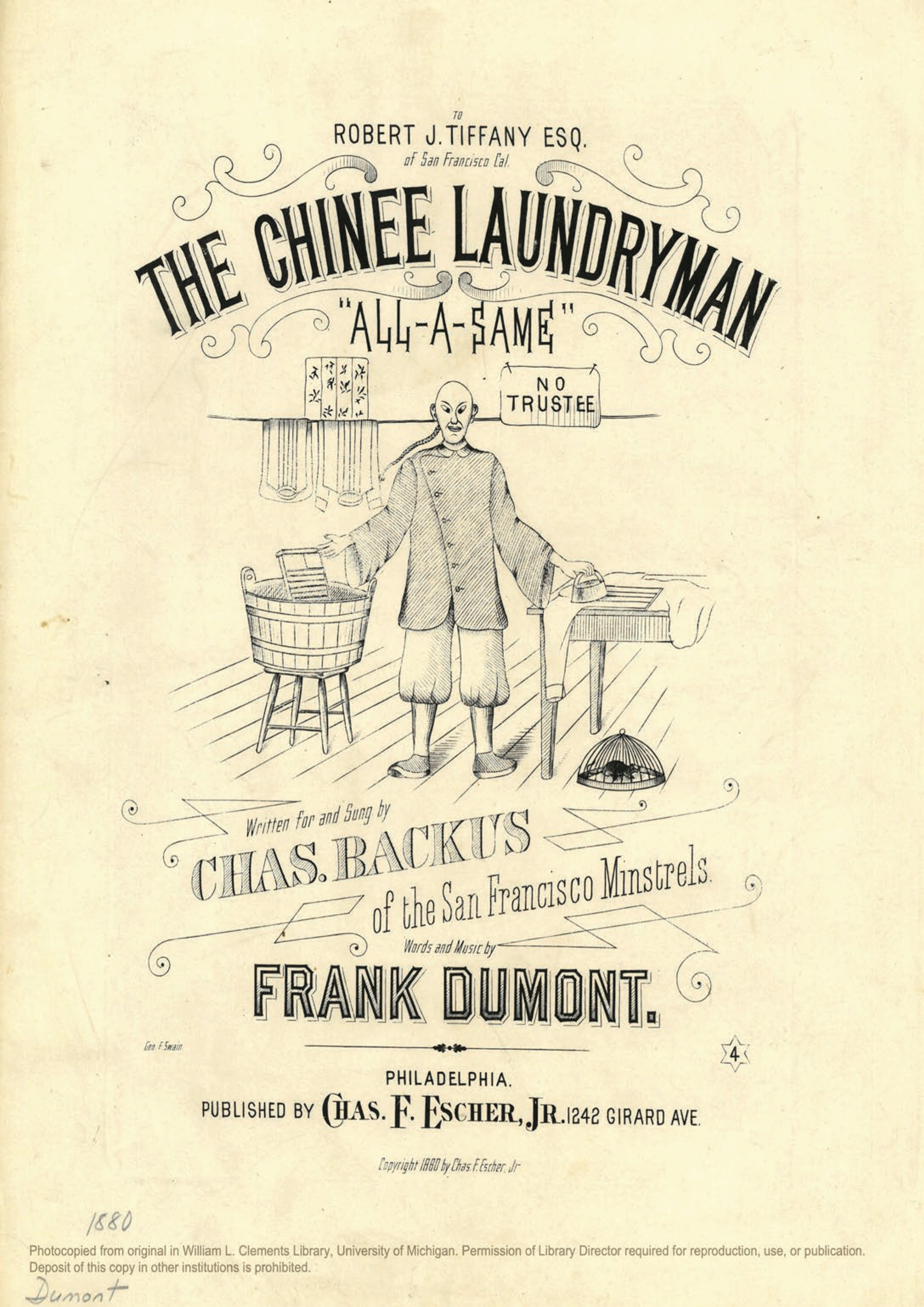


“All-A-Same, or The Chinee Laundryman.” Words and Music by Frank Dumont. Philadelphia: Chas. F. Escher, Jr., 1880. (Courtesy of the University of Michigan)

In the epilog of his Representing China on the Historical London Stage, Dongshin Chang recounts his experience of attending various pantomime performances of Aladdin in and around London between 2012 and 2014. He writes that all the performances he viewed were “set in China and depict Aladdin as a carefree Chinese boy living with his mother Widow Twankey, who operates a laundry, and his younger brother Wishee-Washee” (2015:180). While many in the United States might associate Aladdin in popular culture with Disney’s 1992 adaptation set in a fictional Arabian city called Agrabah, the story of Aladdin that would become the basis for British pantomime and other stage adaptations (the French writer Antoine Galland’s 1704 translation of One Thousand and One Nights) was originally set in China. The first stage version of Aladdin debuted in London in 1813 to tremendous success, and today the show is still produced, more than 200 years later. In the performances that Chang attended, he writes that those involving Widow Twankey’s laundry garnered the most laughter, with the widow character dressed in a “Chinese takeaway box” in one performance and the character of Wishee-Washee accidentally getting placed into “the dryer and [coming] out as a shrunken, tiny figure played by a child performer” in another (2015:186). None of the “Chinese” characters were performed by Chinese or otherwise Asian actors. With the exception of a performance in Hackney, which has a sizeable Black population, Chang notes that the audiences and performers were predominantly white. In short, in 21st-century London, yellowface performances of Aladdin have become a beloved British tradition, particularly around Christmas. Viewing these performances as a Chinese American scholar of theatre, Chang ends his critique on a note of optimism, prompted by the “Hackney Empire production [which] stands out as the only one that employed a cast with black performers in many leading roles” (2015:188). Chang commends the production for incorporating a performance of the Chinese lion dance to commemorate the Lunar New Year. Praising the “authentic design of the lion,” Chang hypothesizes that the production received help from the local Chinese community, which he views as an auspicious sign of possible future collaborations and “welcom[ing of] the Chinese into the panto world” (2015:189).
Yet, of all the pantomime performances that Chang describes, the Hackney Empire production is notable for a different reason. Chang states that the production’s “backdrop for a few scenes contained signs for Starbucks, TK Maxx, and ToysAmWe, references to contemporary brand-name shops, with the name of the last comically distorted” (2015:185). As a scholar who has written about connections between blackface minstrelsy and representations of Chinese workers in the United States during and after Reconstruction, I am particularly struck by the practice of using the verb “am” with non-“I” nouns and pronouns, which signals the 21st-century pantomime’s debt to 19th-century minstrel repertoires. For instance, the Christy Minstrels’ 1853 adaptation of Harriet Beecher Stowe’s novel, Uncle Tom’s Cabin (1852), features a character who sings, “We am de boys from Old Kentucky,” and declares of the show, “Dis am not de version of Mrs. Stowe” (in Toll Reference Toll1978:102). That a predominantly Black production of Aladdin in England imagines the streets of China as containing signs that reproduce tropes from US American blackface minstrelsy demonstrates what might be called the “peculiar” as well as global afterlives of the minstrel form, through which we can see a glimpse of an often-overlooked convergence of yellowface performance and blackface minstrelsy.
My use of the word “peculiar” is deliberate, referencing not only the US euphemism for slavery as the “peculiar institution,” but also the minstrelized comic Chinese figure of the “heathen Chinee” that made possible the comic Chinese characters of Aladdin. A literary invention of Bret Harte in his poem, “Plain Language from Truthful James,” the “heathen Chinee” was described in the widely circulated opening and closing stanzas: “For ways that are dark / And for tricks that are vain, / The heathen Chinee is peculiar” (Harte Reference Harte1870:287). The poem went viral, to use today’s vocabulary, when it was published in 1870. Featuring a Chinese worker who tries to cheat two white miners who had intended to swindle him in a card game, it was almost immediately renamed as the “heathen Chinee” poem and quickly became “one of the most popular poems ever published” in the United States (Scharnhorst Reference Scharnhorst1995:377). The gusto with which US and international readers consumed the poem could be explained by the fact that it carries evident traces of blackface minstrelsy, ubiquitously present not only in US popular performance culture but also in literature (Yang Reference Yang2020; Yang Reference Yang2021a). Most notably, Harte’s Chinese character Ah Sin, which could be read as “I sin,” shares discernable similarities with the character of Topsy from Stowe’s Uncle Tom’s Cabin, who became a stock comical character in the minstrelized versions of the novel, and her catchphrase, “I’s so wicked” (Stowe [Reference Stowe1852] 2009:324). In this way, the poem relied deeply on blackface minstrelsy in the creation of its Chinese character. The remarkably popular reception of the poem therefore demonstrates the deep-seated belief in the fungibility of both the Black-ened minstrel form and blackness. Not merely a strictly anti-Chinese caricature, the minstrelized “heathen Chinee” reveals that one of the ways that antiblackness endured in what Saidiya Hartman calls “the afterlife of slavery” is through the circulation and reanimation of the minstrel form across literature, performance, and popular culture in and beyond the United States—including in the “peculiar” yellowface figure of the “heathen Chinee” (2008:6).
Designating both the minstrel form and the “heathen Chinee” as peculiar puts pressure on the term “global” to highlight a connection between the yellowface of the “heathen Chinee” and racial slavery and its attendant antiblackness. In particular, the figure of the “heathen Chinee” necessitates an analytical framework in contradistinction from the national—one that not only is transnational but also brings into view the workings of the United States as an empire-state, which, as Moon-Kie Jung writes, is racially constituted by the “hierarchical differentiation of spaces and of peoples,” and not a nation-state composed of “politically homogeneous populations of citizens, or state members” (2015:57, 58). We might understand the United States, then, as part of what Amitav Ghosh labels as the Anglophone empire: “English-speaking countries whose allegiances are rooted not just in a shared culture and common institutions but also in a shared history of territorial expansion” (2003:46). More specifically, the “heathen Chinee” figure brings to view a tight connection between the material, theatre, and literary cultures of the United States and Britain during and after slavery. In this way, the “heathen Chinee” was an unambiguously transimperial phenomenon that circulated across the US and British empires. How, then, did this “peculiar” figure serve both to reanimate the minstrel form and the enduring traces of transatlantic racial slavery while simultaneously deferring and deflecting a racial reckoning with the peculiar institution of US slavery? We see a glimpse of this process in the performances of Henry B. Farnie’s Bluebeard (1874) in the United States and Britain, which can be read as an example of how the “heathen Chinee” figure masked and obscured the antiblackness of the minstrel form as the figure became racialized as distinctly “Oriental.”Footnote 1 Studying the transimperial processes of Asian racialization in late 19th-century US and British popular cultures is therefore instrumental to tracing how minstrelsy and its afterlives in yellowface performance served to mute the significance of racial slavery and antiblackness within and beyond the geographies of US slavery.
The Transimperial Form of Minstrelsy and the “Heathen Chinee”
The figure of the “heathen Chinee” in Farnie’s Bluebeard is unquestionably a minstrel character, though importantly it was not strictly tied to performances of blackface as a theatrical practice. Instead, its performance genealogy drew from diverse repertoires of racialized performance. Esther Kim Lee identifies one such repertoire in Made-Up Asians, noting that yellowface “can be traced to early representations of ‘Oriental’ or ‘barbarian’ characters on European stages, and costumes identified as ‘Chinese’ or ‘Tartar’ have commonly appeared in European plays since at least the sixteenth century” (2022:1). Succinctly put, “yellowface originated in Europe” and not on the US American minstrel stage (17). In contrast, the figure of “heathen Chinee” as popularized by Harte’s poem embodies the minstrel form born of the US political economy of slavery. As Saidiya Hartman writes, specifically in the context of the United States, “The ability to put on blackness must be considered in the context of chattel slavery and the economy of enjoyment founded thereupon”—an economy predicated on the “fungibility” of the enslaved as a commodity, “specifically its abstractness and immateriality” (1997:26). Popular investments in viewing enslaved people as commodities were central to what Douglas Jones calls the US “proslavery imagination” founded on blackface minstrelsy (2014:7). The “heathen Chinee” revivified this national proslavery imagination through its citations of blackface minstrelsy and its repertoires of racial abjection.
Yet, minstrelsy was not limited to the United States, and the minstrel form was fundamentally transnational and transimperial. As Kellen Hoxworth writes, “It is necessary to reevaluate blackface beyond the ubiquitous framework of the ‘nation’ and to interpret its racial politics beyond the boundaries of any singular national politics, particularly those of the United States” (2024:6). Countering the prevailing tendency to locate the origin of blackface minstrelsy in the Jacksonian United States, Hoxworth instead points to the earlier 18th-century blackface practices of British empire. What is crucial to note about this important intervention is that the relocation of the origin of blackface minstrelsy to the British empire instead of the US empire does not deny or diminish the antiblackness associated with the minstrel form. Rather, the early British blackface performances, Hoxworth states, “abjected blackness in the colonial racial orders of the Anglophone empire” in the context of racial slavery and “consolidated around tropes of blackness as inherently servile” (2024:33). These early British representations of blackness, in comedies such as James Townley’s High Life Below Stairs (1759), which features “the earliest known Black comic servant character in the Anglophone repertoire” (34), reified blackness as antithetical to freedom. Townley’s High Life Below Stairs was staged throughout the British colonies, including the United States, where the earliest known performance was in Philadelphia in 1767 (Hoxworth Reference Hoxworth2024:32). As such, the antiblack minstrel form had been circulating in what is now the United States prior to the American War of Independence, and it was continually reanimated across both the US and British empires for decades prior to what is incorrectly identified as the “origin” of blackface minstrelsy, particularly in the figure of Jim Crow popularized by Thomas D. Rice and first performed in 1830.Footnote 2 While these early British blackface plays “did not fall neatly into a pro- and antislavery binary,” according to Hoxworth, they nonetheless “figured unfree Black characters within a proliferating array of antiblack articulations of Anglophone racial discourses” (2024:41). The politically ambivalent but resolutely antiblack performances of early blackface plays were integral to the transimperial racial politics of Britain and the United States.
The endurance of the minstrel form’s transnationality and transimperiality is epitomized by the figure of the “heathen Chinee.” The derogatory term “Chinee” cites the practice of adding “ee” at the end of a word to mock “Black” English in early minstrel songs in the United States and Britain. For instance, in the 1833 song “Sambo’s ’Dress to He Bredren,” every one of the verses has words ending with “ee” or “e,” such as “lack-e,” “black-e,” “lad-ee,” “grad-ee” (Sambo’s 1833). The song centers on an enslaved Black man who proposes to take a boat to Haiti to flee his bondage and includes this refrain:
Chinger ring, ringer, ching, ching,
Ho ah ding, ding, ah kum darkee;
Chinger ring, ringer, ching, chaw,
Ho ah ding, kum darkee. (Sambo’s 1833)
Attesting to the transferability of the minstrel form and its transoceanic circulation, the line “Chinger ring, ringer, ching, chaw”—imitating a steamboat engine sound—originated from British comic actor Charles Dibdin’s 18th-century performance of a song containing the word “chingaring,” “a nonsense phrase of Black speech that doubles as an approximation of the sound of a banjo” (Hoxworth Reference Hoxworth2024:41). The line from Dibdin’s blackface song was then incorporated into other popular minstrel songs in the 19th-century US, including “Oh! I’se So Wicked” (1854), in which a minstrelized Topsy sings “Ching a ring a ring a ricked,” with “ricked” rhyming with “wicked.” Three years after Topsy’s song, the refrain was adapted to mock “Chinese” English in an 1857 song called “A Chinaman’s Tail” with the lines “Ching ring wow, ricken chicken, a chew. Chinaman loves big bow wow and little puppies too” (Buckley’s Ethiopian Melodies 1857:66). In the 1870s, after the success of Harte’s poem, the refrain appeared again in the song “Artful Chinee” by Frank Curtis, as a more faithful rendition of Topsy’s song: “Chingaring chi, and chingaring chee, / Chingaring chi for the young Chinee” (in Moon Reference Moon2005:42). Harte would also take up the refrain “Ching a ring a ring chaw” in his 1874 short story, “Wan Lee, the Pagan” (Harte Reference Harte1874:552), showing how a refrain popularized by a blackface minstrel song would become associated mostly with Chinese speech, thanks to the incorporation of Chineseness on the minstrel stage as well as the popularization of the “heathen Chinee” character in popular literature.
The entanglements between the “heathen Chinee” and the minstrel form extended beyond popular blackface and yellowface songs. The minstrelized representation of Chinese men who worked in the Californian mines and on the railroads was also densely intertwined with the history of racial slavery in the United States. Harte’s poem, published in September 1870 at the height of Reconstruction and just two months after the congressional debates on citizenship by naturalization, was complicit in the linkage of Chinese workers with slavery. Through the repeated labels of “heathen” and “peculiar,” the poem displaces the word “peculiar” from the institution of slavery to the figure of the Chinese worker. Doing so not only marked the Chinese worker as slave-like and worthy of exclusion but also furthered the proslavery logic that justified the dehumanization and enslavement of Black people by asserting that Black people were unfit for freedom. Retracing the interconnections between the “heathen Chinee” figure and the minstrel form thus reveals how the figure repurposed the minstrel form to deflect away from critical reevaluations of slavery. Instead, in its extension to indentured, “heathen” Chinese workers, the system of slavery was naturalized and rendered above reproach by linking it to particular racialized figures. Harte’s “heathen Chinee” quickly inspired imitations, citations, and adaptations that circulated the popular, transimperial proslavery logic that some “peculiar” people were fit for slavery, or something like it. One such explicit citation arose in Henry B. Farnie’s Bluebeard and its widespread popularization of the “heathen Chinee” figure.
Henry B. Farnie’s Bluebeard and the Minstrel Form of the “Heathenest Chinee”
First performed in New York in 1871, Farnie’s Bluebeard was written exclusively for Lydia Thompson’s British troupe of burlesque performers, who made their US debut in 1868. The play actively engaged with the wider culture of Anglophone transimperiality through its citations of burlesque and minstrel forms, and it was a central piece in the Thompson Troupe’s repertoire in the United States and Britain in the 1870s. Better known in the United States as the British Blondes, Thompson and her troupe were one of the most successful acts in burlesque in both the UK and the US. “A kind of entertainment that parodied or burlesqued the subject and characters of its target tale or play” (Gänzl Reference Gänzl2002:86), which was “grounded in the aesthetics of transgression, inversion, and the grotesque” (Allen Reference Allen1991:26), burlesque came out of Britain in the 1850s, and Thompson made her debut on the London stage in 1853. After enjoying phenomenal success, her troupe crossed the Atlantic to tap into the much more lucrative US theatre market. The Thompson troupe quickly became the most successful burlesque act in the United States. Within just one week of its 1868 debut, the troupe’s performance of Ixion played to sold-out crowds. According to Robert Allen, “The theater took in more than $46,000 in October, nearly twice its gross the previous month and more than any other New York theater for the month, outpacing the second-place theater by nearly $15,000” (1991:13). (For reference, $46,000 in 1868 is worth over $1,000,000 today.) From the very start, the troupe tightly embraced the minstrel form, as Ixion “contained jigs, hornpipes, and parodies of minstrel show numbers” (12). Thompson herself sang songs written by minstrel songwriters, notably Bobby Newcomb’s “The Blonde That Never Dyes,” and the troupe shared the stage with the famed San Francisco Minstrels in 1871 (Odell Reference Odell1937:32).Footnote 3
However, the Thompson Troupe’s most successful incorporation of the minstrel form into their repertoire did not involve blackface but rather took up Harte’s “heathen Chinee.” The troupe’s lucrative US tour coincided with the wildfire popularity of Harte’s “heathen Chinee” character as a ubiquitous presence across US popular culture and as a novel figure that could be transposed onto existing cultural forms across the Anglophone empire. In 1871, mere months after the publication of Harte’s poem, Farnie, who moved to New York to capitalize on the fortune of the US theatre market, wrote a farcical version of the French fairy tale Bluebeard (1697) by Charles Perrault specifically for the Thompson Troupe.Footnote 4 The plot of Farnie’s Bluebeard deviates from Perrault’s original story, which has the murderous Bluebeard marry a new bride who is rescued by her sister and brothers. Farnie’s version has the bride’s former lover, Selim, attempt the rescue with the help of his friends. They decide to enter Bluebeard’s castle by disguising themselves, and Corporal Zoug-Zoug, one of Selim’s friends, announces that he will go “as the heathenest Chinee” (Farnie Reference Farnie1874:8). In response to Zoug-Zoug’s decision to dress up as the “heathenest Chinee,” Selim states, “Brave heart,” to which Zoug-Zoug replies, “No, Bret,” in a moment of burlesque wordplay by which Zoug facetiously interprets “brave heart” as “brave Harte,” in homage to Bret Harte. Here, a British troupe touring the United States playfully cited a popular yellowface figure fashioned in the mode of the minstrel form, thereby tracing the transimperial traffics of the “heathen Chinee” in its elaboration into the “heathenest Chinee.”
Bluebeard’s Transimperial Orientalist Roots
Bluebeard’s yellowface “heathenest Chinee” character proved to be the Thompson Troupe’s most enduring performance of the minstrel form—though, despite the play’s explicit citation of Harte and his popular poem, it obscured its connection to blackface minstrelsy. The presentation of the Chinese character in Bluebeard does not directly invoke the minstrel form that Harte’s “heathen Chinee” poem invokes (e.g., Topsy, “Ching a ring a ring chaw,” etc.), largely because Farnie drew upon a separate but related transimperial performance genealogy of racialized performance. Farnie’s “heathenest Chinee” more readily calls to mind the Chinese clown figure in British theatre history. This figure was first introduced to the British audience in 1812 in Whang-Fong; or, the Clown of China, featuring the comic actor Joseph Grimaldi, who, according to Esther Kim Lee, established the hair and makeup that would endure as part of the comical yellowface role (2022:31). The immense popularity of Whang-Fong prompted the British playwright Charles Farley to write a version of Aladdin; or, The Wonderful Lamp, with Grimaldi specifically in mind to play the role of Kazrac as a mute Chinese clown figure. Grimaldi’s performance as Kazrac established the Chinese clown as an enduring figure on the British stage, continuing even to this day in productions of Aladdin.
As previously noted, the setting of the original translation of Aladdin was in China. A stage production debuted in London in 1813, followed closely by a New York City premiere in 1815. The latter was billed as the “oriental spectacle for which the London production was known” (Lee Reference Lee2022:38). In fact, unlike the British performances of Aladdin, which were frequently changed to draw in new audiences, the US productions stuck closely to Farley’s version for much of the 19th century. Indeed, when the Thompson Troupe was touring the United States in the 1870s, Farley’s Aladdin was also performed in nearby theatres. This faithfulness of the US productions of Aladdin to Farley’s 1813 version likely presents as a case of US mimicry of British imperial culture—including British Orientalism—particularly considering that the introduction of the Chinese clown figure in US popular culture was an emulation of British theatrical practice. If, as Lee argues, “the history of yellowface in the US cannot be told without Aladdin” (2022:21), that history is also one of US-British transimperiality through and through.
Moreover, the popularization of the Chinese clown occurred amid an epochal shift in the transimperial history of transatlantic slavery. In Intimacies of Four Continents, Lisa Lowe connects the histories of “colonialism, slavery, capitalism, and empire”:
In 1807, as Britain moved from mercantilist plantation production toward an expanded international trade in diversified manufactured goods, the Chinese “coolie” appeared in colonial and parliamentary papers as a figure introducing this alleged transition from slavery to freedom. (2015:2, 24)
Just as Chinese workers would later come to be racialized as “coolies” in the United States, as “liminal subjects […] in the age of emancipation,” in Britain, “coolies” were seen as malleable figures onto whose bodies contradictory meanings of enslavement and freedom would be written (Jung Reference Jung2006:38). This malleability was at the heart of Farley’s Aladdin, which included both Chinese and Black “slaves”—and therefore both yellowface and blackface caricatures (Farley Reference Farley1859:2, 3).Footnote 5 But how does Farley’s Aladdin relate to Farnie’s Bluebeard?
According to an advertisement for Bluebeard performed at Wallack’s Theatre, the 1871 version of the play was set in the Village of Bishmillah. The word “bishmillah” could be referring to bismillah, an Arabic word that opens the Qur’an and means “in the name of God.” The 1874 version of the play changed the setting to a more geographically factual “Village of Latakia,” an actual port city in Syria. The changed 1874 setting is significant because it more explicitly aligns Bluebeard with Aladdin. Even in the Wallack’s advertisement for the play in 1871, we can see an attempt at Orientalizing the play, as Bluebeard’s new wife is named Fatima and is described as “an orient pearl” (Wallack’s 1871). Importantly, this Orientalization draws upon a distinctly British discourse specifically linked to British theatre. Though Charles Perrault’s 1697 original Bluebeard did not identify the specific locale of the story and the characters had European names, the narrative was Orientalized in the 1798 stage production of Blue-Beard, or Female Curiosity! by George Colman and Michael Kelly. As Casie Hermansson writes, “By firmly orientalizing Bluebeard as Abomelique, naming his wife Fatima, in love with Selim, and setting the drama in Turkey, the Colman-Kelly production indelibly stamped the Bluebeard story with an oriental countenance” (2009:57). Even before the Colman-Kelly production, the story of Bluebeard was closely linked to the Orient in the UK, as it arrived in England soon after Aladdin did in the early 18th century via The Thousand and One Arabian Nights. By the time Colman and Kelly staged their version of Bluebeard, “chapbook illustrations for Bluebeard and for Arabian Nights were literally interchangeable” (Hermansson Reference Hermansson2009:58). Capitalizing on this connection, the Colman-Kelly production established Bluebeard as an Oriental tyrant, a characterization that would endure for more than half a century not only on the stage but also in popular chapbooks.
It was not until 1866 that another British stage version of Bluebeard was seen as a worthy rival to the Colman-Kelly production. That version, called Bluebeard Re-Paired: A Worn-Out Subject Done-Up Anew, An Operatic Extravaganza in One Act, was another French import—an opera bouffe by Henri Meilhac and Ludovic Halévy, with music by Jacques Offenbach. Adapted in English by Henry Bellingham, it erased all traces of the Orient. The Bellingham opera bouffe version premiered in the United States in 1868, and “as in London, it remained popular throughout the last decades of the century, thriving in a climate encouraging to operetta” (Hermansson Reference Hermansson2009:86). Given this history and geographies of Bluebeard in the transimperial cultures of Britain and the United States—as well as France—Farnie’s 1871 burlesque appears to have returned the play to the Orientalist mold of Colman and Kelly. But it did much more than that. In addition to invoking the Oriental setting of Colman and Kelly’s Bluebeard, it situated the “heathenest Chinee” in the lineage of Grimaldi’s performance of Kazrac as a Chinese clown while also relying on the minstrel form for comic effect.
Yellowface, Minstrelsy, and the “Heathenest Chinee”
Turning the plot of Perrault’s Bluebeard into a farce, Farnie’s version incorporates both the Orientalized elements of Aladdin and the aspects of the “heathen Chinee” as a minstrel figure. As previously stated, Selim, the man interested in Fatima, dresses up as a shepherd, and his friend Zoug-Zoug states that he will go “as the heathenest Chinee” (Farnie Reference Farnie1874:8). Amid a scene of back-and-forth repartee, Selim asserts, “My motto’s Sans souci,” and Zoug replies, “Mine John Souchong” (8). Zoug’s nonsensical response to Selim, sounding like a Chinese tea name and playing on the phonetic sound of “sans souci,” is typical of the play’s—and the burlesque form’s—practice of wordplay. This exchange also calls to mind the stage version of Aladdin with which Farnie would have been familiar. Though US stage productions of Aladdin followed Farley’s 1813 staging, the UK productions in the 1860s and 1870s mostly followed H.J. Byron’s burlesque, Aladdin; or, The Wonderful Scamp!, which was first performed in London in 1861. This latter version proved to be a lasting hit, and Byron’s and Farley’s versions are the sources from which “all modern Aladdins are descended” (Clinton-Baddeley Reference Clinton-Baddeley1963:31). Byron’s Aladdin was especially influential in its changing of Aladdin’s mother’s name from the nonspecific “Widow Ching Mustapha” (after Aladdin’s deceased father, Ching Mustapha) to Widow Twankay, named for a Chinese port known for tea. Byron extended the joke to name another character Pekoe (Clinton-Baddeley Reference Clinton-Baddeley1963:32). Bluebeard’s invocation of tea in “John Souchong” follows this tradition. Another of the most popular and widely cited elements of Farnie’s Bluebeard was the “heathenest Chinee’s” pet phrase, “me washee-washee,” which was rhymed with “me poor heathen Chinee” (Farnie Reference Farnie1874:12), both of which harked back to the practice of adding “ee” at the end of a word in blackface minstrelsy.
Bluebeard’s catchphrase of “washee washee,” which would go on to become just as infectious as the figure of the “heathen Chinee,” marks a convergence between the British theatre history of Aladdin pantomimes and US blackface minstrelsy. As V.C. Clinton-Baddeley writes, Aladdin’s mother was associated with laundry in the UK as early as 1844, when she was described as “a washerwoman with mangled feelings” (1963:34). In this iteration, her occupation is reflective of the fact that “The laundry, the shop, the law, were ancient delights of the commedia dell’arte and of the old pantomime” (35). Meanwhile, in the United States, Chinese workers were associated with the laundry “since the early days of the Gold Rush,” as Joan Wang states, and the “first Chinese laundries were established at mining sites in western states due to the special frontier atmosphere” (2004:59). In fact, according to Krystyn Moon, the first US impersonation of Chinese people on the theatre stage was a “Chinese laundryman skit, produced first in California in 1854 and then in New York City” (2005:43) as part of a minstrel show by Charles Backus of the San Francisco Minstrels, who, as mentioned previously, shared a stage with the Thompson Troupe on occasion. Hoxworth has shown that Backus’s performance was praised by a contemporary review: “There is no single Ethiopian Minstrel in California who can be compared with the great Backus. His ‘China Washerman’ is immense” (in Hoxworth Reference Hoxworth2024:159).Footnote 6 While I was unable to find the playscript of Backus’s 1854 skit, I located a song called “All-A-Same, or The Chinee Laundryman,” written for Backus by Frank Dumont and published in 1880 (see fig. 1).Footnote 7 Since this song has a “Chinese” worker singing, “Me come from Hong Kong Chinee” and “Me cheatee all mel-i-can gambler” (Dumont Reference Dumont1880:3, 4), it seems to have been written after the popularization of Harte’s “heathen Chinee.” Nevertheless, the association of Chinese labor on the US minstrel stage with laundry work makes it probable that Farnie’s use of the phrase is influenced by this practice as well as the mention of laundry in Aladdin.
Coupled with minstrel tropes of Chinese washermen and the minstrel form of adding “ee” at the end of a word to denote racialized speech, “washee washee” became the catchiest phrase of the “heathenest Chinee” across a transimperial geography that extended well beyond the United States and Britain. In 1875, for example, the actor playing the “heathen Chinee” with the Thompson Troupe, Willie Edouin, sent the script of Farnie’s Bluebeard to his sister Rose Lewis, who was also a stage actor, in South Asia (Colligan Reference Colligan2013:119). She and her husband George Lewis renamed the play Harlequin Bluebeard or, the Heathen Chinee and the Fairy of the Rippling Waters, elevating the “heathen Chinee” part to a titular role, and debuted it in Kolkata, India, in December 1875. Their production was regularly reviewed in The Times of India, which praised the actor playing the “heathen Chinee” character as “inimitable” in one review (1876b:3) and noted how the theatre was “filled from floor to ceiling, and hardly a disengaged place was to be seen in dress circle, stalls, pit or gallery” in another (The Times of India 1876a:3). Even after the Lewises departed for Australia in 1876, the figure of the “heathen Chinee” proved to be so popular that it continued to appear on the minstrel stage in Kolkata, particularly alongside the famed minstrel actor Thomas (“Tommy”) Hudson. As reported in The Times of India in January 1877, “After Mr. Comerford [the same actor who played the part in Bluebeard with the Lewises] had sung the ‘Heathen Chinee,’ Mr. Hudson appeared in a negro sketch” (The Times of India 1877:3). Across the Indian Ocean, when the Lewises arrived in Melbourne, “Rose’s greatest triumph in this first season was as Selim in the Christmas pantomime Harlequin Bluebeard with Fred Thorne in her brother Willie’s famous role as the ‘Heathen Chinee’” (Colligan Reference Colligan2013:136). In a review of one of those shows, the Melbourne Punch lauded Thorne’s performance, stating, “The oftener we witness Fred Thorne’s Heathen the better we like the play” (Melbourne Punch 1877:3). The review underscored the character’s “Me washee washee you” catchphrase, stating that it “savours of the true celestial ring.” The reviewer goes on at length about other actors but closes with “Me washee washee you,” showing just how global the phrase became (1877:3).
Indeed, the phrase “washee washee” has continued to enjoy a long afterlife beyond that of the “heathen Chinee.” Even Bret Harte later used the phrase to have a Chinese character say, “five dollee fo washee, washee” ([1898] 1914:146) in a short story that was only published in England in 1898 but not in the United States until it was included in his posthumous collected writings in 1914. Also in the 1890s, British productions of Aladdin began to include a comical character named “Washee-Washee” as Aladdin’s brother and the second son of Widow Twankey (the spelling of the name changed gradually from Twankay to Twankey). This character, along with Widow Twankey, continues to appear in present-day stage productions of Aladdin in the UK.
The “Heathen Chinee” and the Transimperial Afterlife of Slavery
As for the British Blondes, the smashing success of Bluebeard led them to tour all over the United States. The troupe capitalized on their British origin, as Bluebeard was advertised as part of the “Latest Musical Novelties, from Europe” (Wallack’s 1871). Receiving the troupe with open arms, the various US cities seem to have treated the troupe as honorable foreign guests. The performances were thus almost friendly diplomatic exchanges between Britain and the United States, mirroring the transimperial intimacy of the two empires.
No other city’s reception of the Thompson Troupe better demonstrates their close ties and the ways that dominant cultural productions work in tandem with empire than that of Savannah, Georgia. Savannah’s over-the-top reception of the Thompson Troupe was reported in multiple newspapers throughout the United States. The New York Dispatch stated, “Miss Lydia Thompson, on the occasion of her last appearance in Savannah, was presented by the citizens with a bale of cotton weighing, 240 pounds, the largest ever compressed in that city” (New York Dispatch 1872:5). This gift of cotton from Savannah to a British performer—a white British woman, perhaps as a stand-in for the British empire—is noteworthy given the tight economic entanglements between the United States and England in the production of cotton. Sven Beckert writes that by 1860, British factories were “home to two-thirds of the world’s cotton spindles” (2014:ix). Walter Johnson likewise states that during slavery:
Between 85 and 90 percent of the American crop was annually sent to Liverpool for sale. For most of the period before the Civil War, the United States was the source of close to 80 percent of the cotton imported by British manufacturers. The fortunes of cotton planters in Louisiana and cotton brokers in Liverpool, of the plantations of the Mississippi Valley and the textile mills of Manchester, were tied together through the cotton trade—the largest single sector of the global economy in the first half of the nineteenth century. (2013:10)
The presence of cotton cannot but call to mind slavery, as “of course cotton and slavery went together” (256). As a commodity, the cotton bale obfuscates the violent history of enslaved labor, or the process of turning “lashes into labor into bales into dollars into pounds sterling” (244). Seven years after the end of the Civil War, the presentation of an enormous cotton bale to Lydia Thompson and her burlesque troupe—particularly during a tour that featured a yellowface caricature that reanimated blackface minstrel tropes—obfuscates the enduring afterlives of slavery by making it seem that Savannah was just as much if not more than ever capable of producing cotton, even after emancipation. This obfuscation may have been a conscious attempt to address the anxiety that emancipation augured the end of the cotton industry in the United States. For example, Captain William Hickens of the British Royal Engineers traveled to the US South in 1865 to report on the status of the cotton industry. He concluded that there was a labor shortage leading to a decrease in cotton production, “So completely has the system of labour been disorganized by the emancipation of the slaves” (in Beckert Reference Beckert2014:274). This concern compounded anxieties over the increasing presence of Chinese labor in the United States, as the shortage of labor caused by emancipation meant that “a scattered group of planters appealed ‘to see German and Chinese Immigrants’ brought to the South” (290). Savannah’s presentation of cotton to the Thompson Troupe, which had just performed the minstrel figure of the “heathen Chinee,” both highlights and obscures that figure as entrenched in the history of racial slavery in the United States and its transimperial connection to Britain.
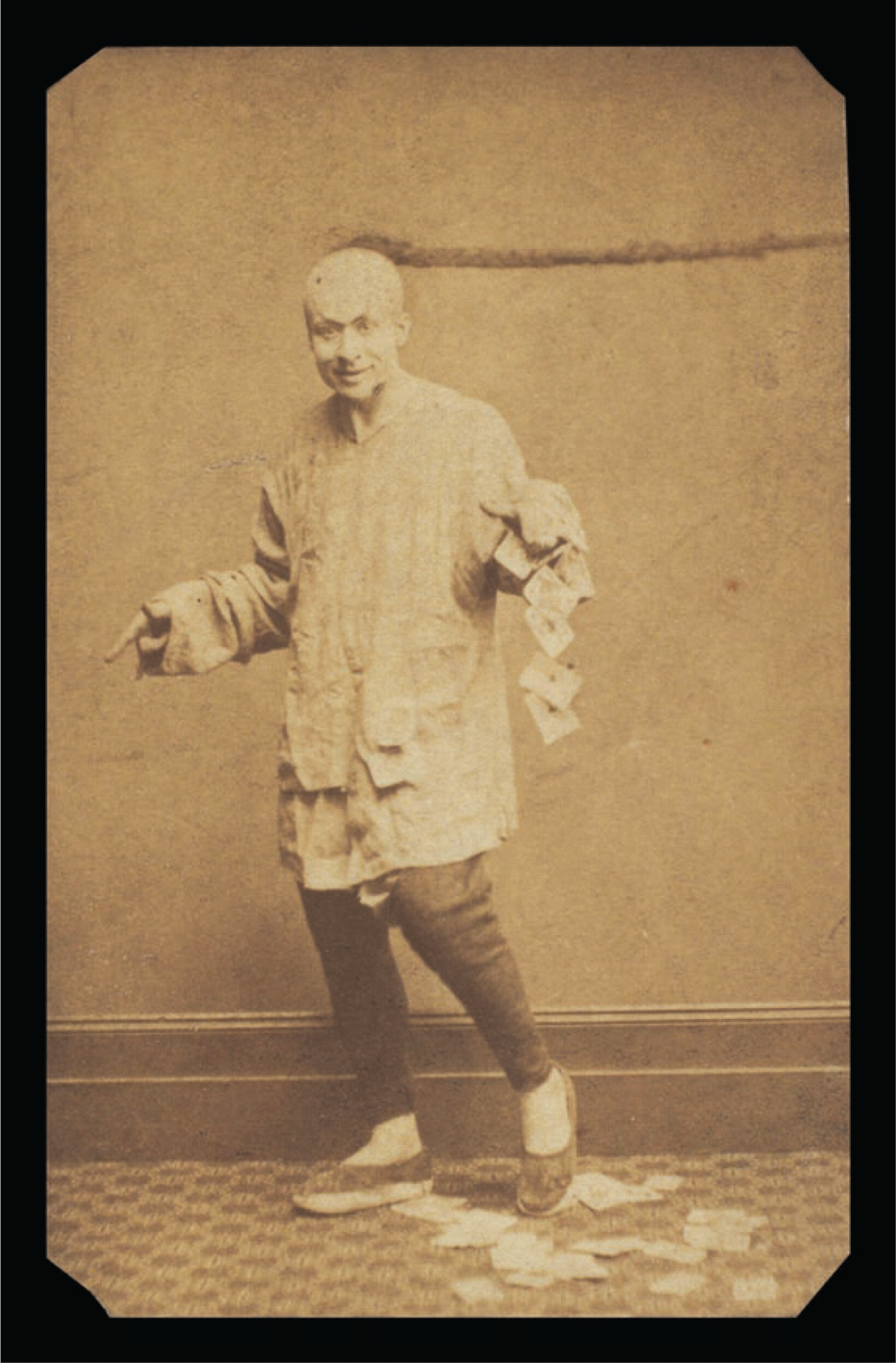
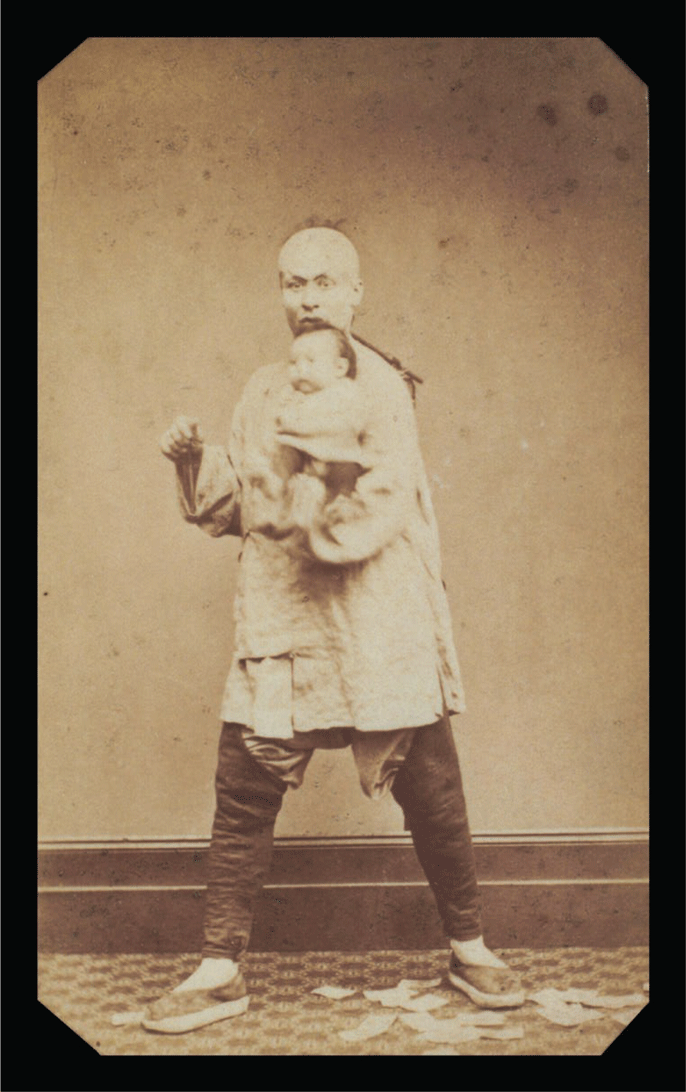
Buoyed by the wild success of Bluebeard in the United States and evidencing “the extent to which people, productions, and theatrical practices have regularly moved from Britain and the Continent to the United States and back again,” Lydia Thompson and her troupe returned to England to perform the play there (J. Lee Reference Lee2022:15). Bluebeard premiered in London in 1874, three years after its premiere in New York, and Willie Edouin, the English actor who played the “heathenest Chinee,” continued to enjoy his fame as an international star (fig. 2). In the United States, Edouin had been consistently named as a standout in the play. For instance, the Daily Dispatch of Richmond, Virginia, stated in 1872, “Mr. Edouin’s rendition of the Heathen Chinee was a masterpiece in its way” (Daily Dispatch 1872:1). The New York Clipper raved that “Willie Edouin’s make-up for the Heathen Chinee is in itself a picture, and his performance throughout was in the highest degree diverting and one of the features of the burlesque” (New York Clipper 1872:46). Almost every review of Bluebeard mentioned Edouin’s performance. As Kurt Gänzl writes, “Willie Edouin had some four decades of career and vast international stardom before him, but his performance as the Heathen Chinee remained, throughout that long career, the one performance that people remembered the best” (2002:148). Edouin himself “would remain all his life identified with this role” (Gänzl Reference Gänzl2002:149). He even went as far as bringing his newborn daughter on the stage and introducing her as the “little heathen Chinee” (fig. 3).Footnote 8 Years before Bret Harte and Mark Twain would write a play together called Ah Sin (1877), which gave the US-based blackface minstrel actor Charles Parsloe his lifelong role as the eponymous Chinese character (see Metzger Reference Metzger2014:31–59), Edouin epitomized the yellowface figure on US and British stages.Footnote 9
Willie Edouin (1846–1908) as Corporal Zoug-Zoug in the guise of “The Heathen Chinee” when appearing in H.B. Farnie’s burlesque Bluebeard at the Globe Theatre, 1875. (S.146:314–2007. Guy Little Collection at Victoria & Albert Museum)

Willie Edouin holding a baby who is probably his first daughter, May (b. 1875). (S.146:314-2007. Guy Little Collection at Victoria & Albert Museum)

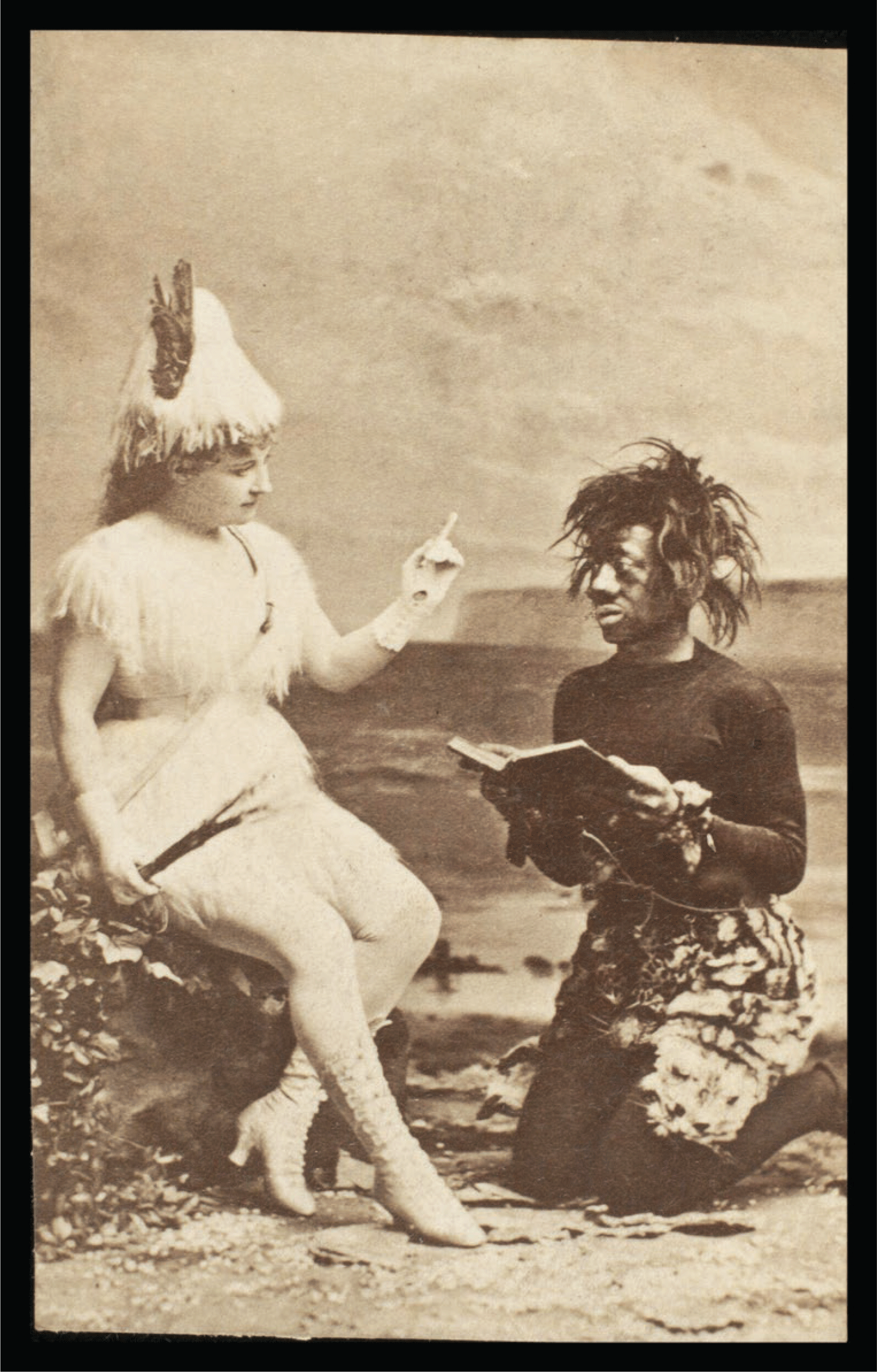
When Farnie decided to write another play that might follow the success of Bluebeard, he chose to burlesque Daniel Defoe’s 1719 novel Robinson Crusoe, labeling the play The Very Latest Edition of Robinson Crusoe (1876). The character Friday was played by Edouin, who blackened up for the role and appeared more recognizably as a blackface minstrel character (fig. 4). But, ironically, his characterization was explicitly declared to be not a minstrel performance. According to a contemporary reviewer, Edouin was “the ideal Friday of childhood, not a Christy Minstrel n[----]r with a clog dance” (in Gänzl Reference Gänzl2002:180). Linking Edouin’s performance with British theatre and not US minstrelsy, the reviewer purported to see Edouin as “a dusky Ariel with a touch of Caliban and a dash of the Heathen Chinee” (180). For this reviewer, the “heathen Chinee” had become as British as Shakespeare, and the reviewer concluded that “his Man Friday will rank with his Heathen Chinee” (180).
Lydia Thompson as Robinson Crusoe and Willie Edouin as Man Friday in Robinson Crusoe at the Folly Theatre, 1876. (S.141:790–2007. Guy Little Collection at Victoria & Albert Museum)

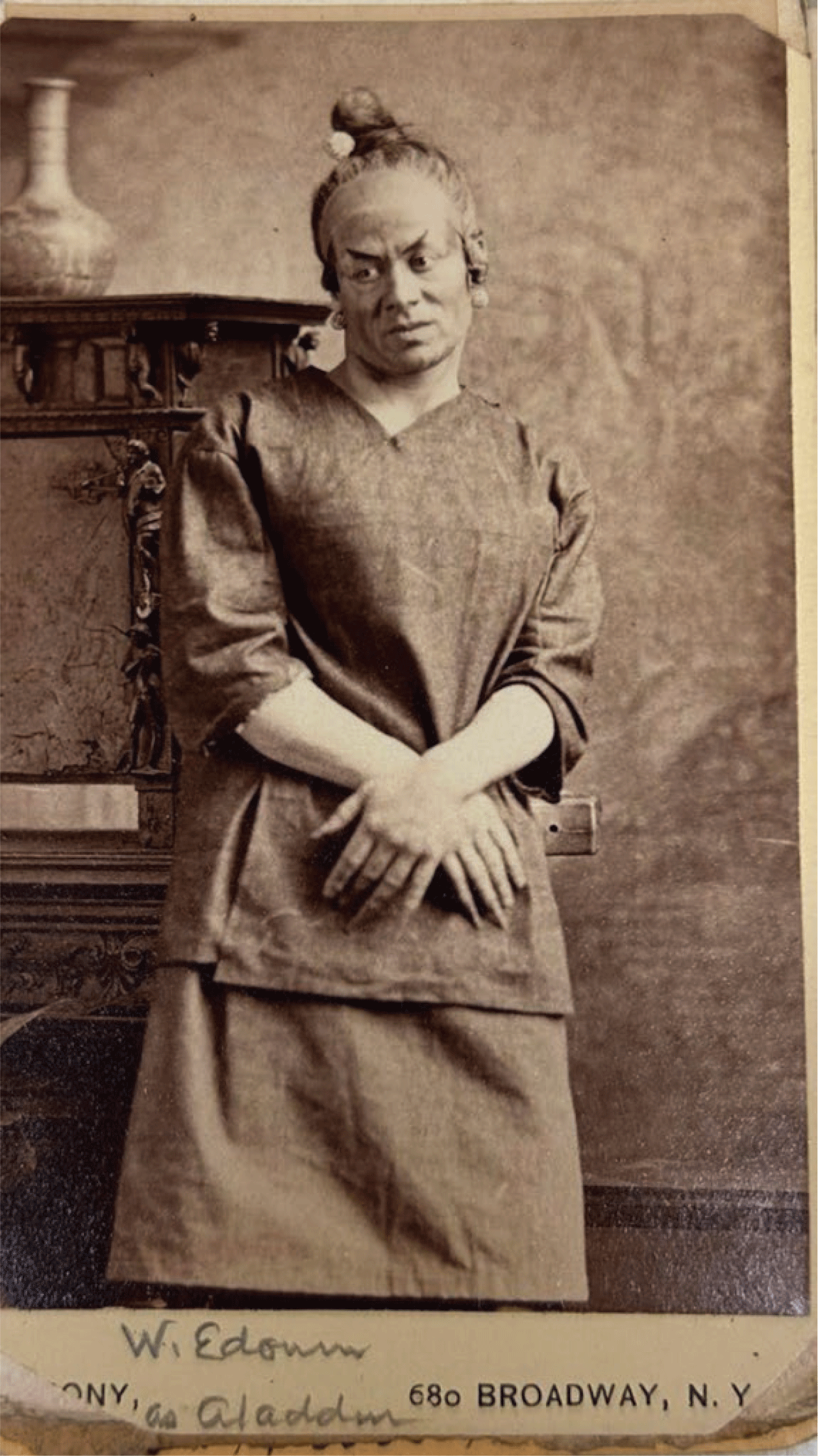
Willie Edouin as Widow Twankey. (TCS 18 Box 5. Houghton Library, Harvard University)

As this review demonstrates, not only was the “heathen Chinee” a new inductee into the pantheon of British stage characters but also such roles could in turn inform and influence blackface performances—including ones that were ostensibly not derived from blackface minstrelsy. Here, the dense histories intertwining the “heathen Chinee” with blackface minstrelsy both justify Edouin’s blackface performance as not minstrelsy while simultaneously perpetuating the minstrel form, which has had a lasting ramification in the continuation of yellowface performances in contemporary British—and US—theatre. To wit, Edouin would go on to play Aladdin’s mother Widow Twankey in 1888 after his stint as Man Friday. The Widow Twankey character that Edouin performed is the same one that Dongshin Chang encountered in London’s pantomimes; it continues to be performed to this day, often by men, demonstrating that the afterlife of the “heathen Chinee” is peculiar indeed, and that the legacy of blackface minstrelsy lives on in unlikely disguises. And where that legacy lives on, so too survive traces of transatlantic racial slavery and the transimperial cultures that have long buttressed it in literature, theatre, and entertainment.