A collection of out-of-copyright and rare books from the Cambridge University Library and other world-class institutions that have been digitally scanned, made available online, and reprinted in paperback.
To save content items to your account,
please confirm that you agree to abide by our usage policies.
If this is the first time you use this feature, you will be asked to authorise Cambridge Core to connect with your account.
Find out more about saving content to .
To save content items to your Kindle, first ensure no-reply@cambridge.org
is added to your Approved Personal Document E-mail List under your Personal Document Settings
on the Manage Your Content and Devices page of your Amazon account. Then enter the ‘name’ part
of your Kindle email address below.
Find out more about saving to your Kindle.
Note you can select to save to either the @free.kindle.com or @kindle.com variations.
‘@free.kindle.com’ emails are free but can only be saved to your device when it is connected to wi-fi.
‘@kindle.com’ emails can be delivered even when you are not connected to wi-fi, but note that service fees apply.
This two-volume work, originally published in 1705 and now reissued in John Nichols' edition of 1818, was one of the earliest examples of autobiographical writing in English. John Dunton (1659–1732), a highly eccentric bookseller and publisher, was also responsible for one of the first periodicals in London, the Athenian Gazette, which invited its readers to submit questions on any topic, to be answered by the Athenian Society, a group of learned men (in fact, Dunton himself and some cronies). However, he was not a practical businessman, and the death of his wife and his own illness led to poverty, and to hack-work for others. The Life and Errors was followed by pamphlets attacking those whom he blamed for his misfortunes. The work gives a fascinating picture of authors and the book trade in Restoration London. Volume 2 contains selections by Nichols from Dunton's works.
This two-volume work on the life and activities of the printer William Caxton, a vital source for bibliographers, was written by another printer, William Blades, and published in 1861–3. Blades (1824–90), apprenticed into the family firm, developed a great interest in the history of his trade, collecting an extensive library of antiquarian books, and becoming an expert on early typefaces. He brings to his study of Caxton (which follows in the wake of works on incunabula by Ames, Herbert and Dibdin) his own practical experience of the craft of printing, largely unchanged, except for the addition of machine power, since Caxton's day. He examined more than 450 Caxton printings, in Britain, France and the Low Countries, while preparing the work. Volume 1 deals with Caxton's life and the background, in England and Europe, to his innovatory work. Transcriptions of contemporary documents are also supplied.
After training as an apothecary and surgeon, Jonathan Pereira (1804–53) taught materia medica for many years. His lectures at the medical school in London's Aldersgate Street were highly successful and formed the basis for the first edition of his major encyclopaedic work on medicinal substances. A pioneering text in the field of pharmacology, Pereira's work, which he subsequently updated in further editions, provided pharmacists and medical professionals with a more rigorous scientific understanding of the drugs and remedies they prescribed. After Pereira's death, medical jurist Alfred Swaine Taylor (1806–80) and physician George Owen Rees (1813–89) prepared this revised and expanded fourth edition, interspersed with instructive woodcuts. Volume 2 is divided into two parts. Part 2 (1857) contains new articles, additional illustrations and a separate index. It concludes the analysis of organic compounds, both vegetable and animal.
Enhanced by several attractive engravings, this work, first published in 1881, illuminates Arctic exploration in the region of the Novaya Zemlya archipelago, north of the Russian mainland. Naval officer Albert Hastings Markham (1841–1918) summarises previous discoveries and voyages made in the region by various navigators from England, Russia, Norway and elsewhere. He goes on to give an account of his 1879 voyage aboard the Norwegian cutter Isbjörn, offering details of Arctic flora and fauna, topographical and oceanographic features, and navigational difficulties presented by ice. For those interested in the scientific aspects of the expedition, the appendices contain notes and lists, prepared by experts, drawing on the various botanical and zoological specimens that were collected. Also reissued in this series are Markham's A Whaling Cruise to Baffin's Bay (1874), The Great Frozen Sea (1878) and Northward Ho! (1879).
The most influential actor of his age, David Garrick (1717–79) shaped the London stage for over three decades as theatre manager at Drury Lane. He popularised a more natural style of acting, and did much to make Shakespeare the most revered English playwright. First published in 1780 and reissued here in the second edition of that year, this two-volume biography was written by Thomas Davies (c.1712–85). Samuel Johnson, a friend of the Garrick family, notably provided Davies with anecdotes and information on Garrick's early life. The work does not dwell on gossip or private life; it offers instead an informed portrait of the stage in Garrick's time. Davies had inhabited this world as a much less successful actor himself, before becoming a bookseller. His work is therefore a direct and valuable witness to theatrical London in the eighteenth century. The first volume covers the years 1717–63.
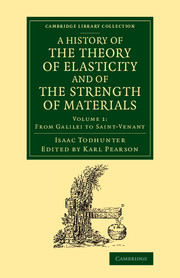
A distinguished mathematician and notable university teacher, Isaac Todhunter (1820–84) became known for the successful textbooks he produced as well as for a work ethic that was extraordinary, even by Victorian standards. A scholar who read all the major European languages, Todhunter was an open-minded man who admired George Boole and helped introduce the moral science examination at Cambridge. His many gifts enabled him to produce the histories of mathematical subjects which form his lasting memorial. First published between 1886 and 1893, the present work was the last of these. Edited and completed after Todhunter's death by Karl Pearson (1857–1936), another extraordinary man who pioneered modern statistics, these volumes trace the mathematical understanding of elasticity from the seventeenth to the late nineteenth century. Volume 1 (1886) begins with Galileo Galilei and extends to the researches of Saint-Venant up to 1850.
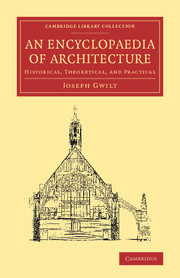
An architect like his father before him, Joseph Gwilt (1784–1863) is best remembered for his published work. His most celebrated achievement, reissued here in its first edition of 1842, was this hugely popular resource, which went through several further editions. The work draws extensively on French sources, although its success owes much to its accessibility and organisation into three thorough sections. The first looks at the development of architecture, using examples from various countries and regions, with a particular focus on Britain. Architectural theory is then explored with reference to construction, building materials and detailed illustrations. Lastly, Gwilt turns to praxis, looking at rules and styles of architecture and how these have been implemented in public and private buildings. Over 1,000 wood engravings, based on drawings by the author's son, accompany the text. The Architecture of Marcus Vitruvius Pollio (1826), Gwilt's English translation, is also reissued in this series.
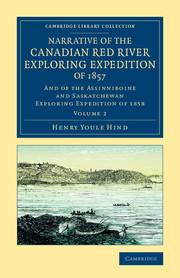
Born in Nottingham, Henry Youle Hind (1823–1908) moved to Canada in 1846. He joined the newly formed Canadian Institute in 1849 and later taught chemistry and geology at Trinity College in Toronto. In 1857–8, he made a range of observations during two expeditions to investigate underexplored areas of Canada and their agricultural and mineral potential to support future settlement. Illustrated with a number of plates based on photographs, this two-volume work first appeared in 1860. Intended for a broad readership, the narrative is regarded as a classic of nineteenth-century exploration literature, noted especially for its descriptive use of language and eye for detail. Volume 2 contains the concluding chapters on the 1858 expedition through parts of the Assiniboine, Saskatchewan and other valleys. Following the expedition narrative, Hind considers the lives and culture of the region's indigenous people before closing the volume with geological and climatic observations.
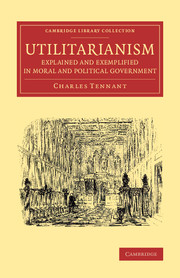
A founder in 1830 of the National Colonization Society, Charles Tennant (1796–1873) advocated government support for emigration to Britain's colonies as a means of alleviating poverty at home and boosting the workforce overseas. Briefly representing St Albans in Parliament, he later wrote treatises on contemporary political and financial questions, notably arguing for the abolition of income tax in The People's Blue Book (1857). Also published anonymously, the present work, which appeared in 1864, offers a critique of John Stuart Mill's Utilitarianism (1863). Tennant argues that happiness does not consist in utility, but rather in conformity to divine will as described by the Christian faith. Nevertheless, Tennant says, we ought to promote utility, as this is likely to be conducive to happiness. He then applies this view in detail to contemporary problems of government, domestic policy, taxation, colonies, dependencies, and foreign policy.
Richard Hakluyt (1552?–1616) was fascinated from his earliest years by stories of strange lands and voyages of exploration. A priest by profession, he was also an indefatigable editor and translator of geographical accounts, and a propagandist for English expeditions to claim new lands, especially in the Americas. His most famous work was first published in 1589, and expanded in 1598–1600: reissued here is the twelve-volume edition prepared by the Scottish firm of James MacLehose and Sons and first published between 1903 and 1905, which included introductory essays and notes. Hakluyt's subjects range from transcriptions of personal accounts and 'ruttiers' (descriptive charts of voyages) to patriotic attacks against rival nations (especially Spain). Volume 6 contains voyages made 'to the South and South-east quarters', including Syria, India, Japan and the East Indies.
In the mid-nineteenth century, British Arctic exploration was focused on the search for the missing expedition of Sir John Franklin. Physician and geologist Peter Cormack Sutherland (1822–1900) served as surgeon on William Penny's 1850–1 search expedition, which was instructed to concentrate on Jones Sound, Wellington Channel and Barrow Strait in the Canadian Arctic. Sutherland's illustrated eyewitness account, first published in two volumes in 1852, tells of appalling weather conditions, notes the hazards of navigating icy seas, describes the wildlife and geology of the region, and offers observations on the Inuit. Sutherland also recounts the poignant discovery of Franklin's winter quarters at Beechey Island and the graves of several of his crew. Franklin's fate, however, was yet to be discovered. Volume 2 contains insightful details relating to sledging journeys and crew diet. The volume concludes with the return voyage to Britain.