A collection of out-of-copyright and rare books from the Cambridge University Library and other world-class institutions that have been digitally scanned, made available online, and reprinted in paperback.
To save content items to your account,
please confirm that you agree to abide by our usage policies.
If this is the first time you use this feature, you will be asked to authorise Cambridge Core to connect with your account.
Find out more about saving content to .
To save content items to your Kindle, first ensure no-reply@cambridge.org
is added to your Approved Personal Document E-mail List under your Personal Document Settings
on the Manage Your Content and Devices page of your Amazon account. Then enter the ‘name’ part
of your Kindle email address below.
Find out more about saving to your Kindle.
Note you can select to save to either the @free.kindle.com or @kindle.com variations.
‘@free.kindle.com’ emails are free but can only be saved to your device when it is connected to wi-fi.
‘@kindle.com’ emails can be delivered even when you are not connected to wi-fi, but note that service fees apply.
Written by his friend, the physician John Baron (1786–1851), this laudatory biography of the 'father of immunology' did much to enhance the reputation of Edward Jenner (1749–1823) upon its publication in two volumes between 1827 and 1838. The work covers Jenner's personal and professional life both before and after his development of the vaccine for smallpox, as well as touching on the vaccine's reception and use around the world. Thoroughly explaining the history and facts of vaccination, Baron established himself as an authority on the subject. Although criticised by some for its unquestioning praise of Jenner's genius, the work is valuable for its use of primary sources, drawing heavily on correspondence and personal notes, excerpts of which appear throughout the text. Volume 2, published in 1838, covers Jenner's later life and the global reception of vaccination. The appendix lists the various honours bestowed upon him.
This 1898 English translation of a popular 1895 Norwegian work provides a valuable first-hand account of Arctic exploration in Greenland. Elvind Astrup (1871–95) took part in the expeditions led by the American explorer Robert Peary (1856–1920) between 1891 and 1894. Another of Astrup's shipmates during this time was Frederick Cook (1865–1940), who would later claim to be the first man to have reached the North Pole. Astrup gives here a short narrative of the expeditions, yet the real appeal of his work lies in its vivid descriptions of life on the ice - not merely that of the explorers, but crucially that of the Inuit, whose survival skills and techniques were later to prove invaluable during Peary's own drive towards the Pole. Numerous illustrations are spread throughout the text, based on sketches and photographs taken during the expeditions.
A friend of Sir Joseph Banks, and with scientific interests of his own, the naval officer Constantine John Phipps (1744–92) was appointed by the Admiralty in 1773 to command an Arctic expedition in search of a passage to the Pacific. Among the crew was a young Horatio Nelson and a freed slave, Olaudah Equiano, who became the first African to visit the Arctic. Although unsuccessful in its primary aim, the voyage is noteworthy for Phipps' description of the polar bear as a distinct species, and for being a naval voyage on which research was deemed as crucial as exploration. Following the publication of this account in 1774, the Gentleman's Magazine commented that 'there has not appeared a voyage in any language so replete with nautical information, nor in which the mariner and philosopher can find such liberal entertainment'. Illustrated throughout, the work includes a substantial appendix containing the scientific data.
Critic, poet and essayist Friedrich von Schlegel (1772–1829) was a leading figure of German Romanticism. This 1849 collection of his shorter works in English translation contains his key insights into literary criticism and art theory. While his early writings had championed classical forms and rejected modern styles, he went on to develop distinctly Romantic aesthetics and ethics. His 1794 treatise 'On the Limits of the Beautiful' demonstrates this philosophical transition in its effort to harmonise the elements of beauty: 'the richness of nature, the purity of love, and the symmetry of art'. Schlegel's other writings here apply his developing Romantic aesthetic to Christian art, Gothic architecture, and medieval poetry. The collection also includes the English translation of his seminal work on comparative grammar, Ueber die Sprache und Weisheit der Indier (1808), which is also reissued in this series in the original German.
After training as an apothecary and surgeon, Jonathan Pereira (1804–53) taught materia medica for many years. His lectures at the medical school in London's Aldersgate Street were highly successful and formed the basis for the first edition of his major encyclopaedic work on medicinal substances. A pioneering text in the field of pharmacology, Pereira's work, which he subsequently updated in further editions, provided pharmacists and medical professionals with a more rigorous scientific understanding of the drugs and remedies they prescribed. After Pereira's death, medical jurist Alfred Swaine Taylor (1806–80) and physician George Owen Rees (1813–89) prepared this revised and expanded fourth edition, interspersed with instructive woodcuts. Volume 2 is divided into two parts. Part 1 (1855) continues with articles on special pharmacology, moving on from inorganic compounds to discuss the medicinal properties of organic compounds.
A pioneering Egyptologist, Sir William Matthew Flinders Petrie (1853–1942) excavated over fifty sites and trained a generation of archaeologists. This reissue brings together two of the well-illustrated excavation reports that he prepared with collaborators. The first, originally published in 1905, documents his work at Ehnasya (or Herakleopolis Magna), ranging in its coverage from the twelfth-dynasty temple to the houses of the Roman period. The text includes material by C. T. Currelly (1876–1957) on the various cemeteries. The second report, from 1912, records the findings from a number of sites. Petrie discusses the labyrinth located in the Faiyum; Gerald Wainwright (1879–1964) notes the discovery at Gerzeh of early examples of iron and ceramic artefacts; and the cemeteries and pyramids of Mazghuna are examined by Ernest Mackay (1880–1943). Petrie wrote prolifically throughout his long career, and a great many of his other publications are also reissued in this series.
The Church of England clergyman Henry Lansdell (1841–1919) was an energetic traveller, both during his own leisure time and on behalf of the Irish Church Missions. He made many visits to Russia and central Asia, distributing bibles and tracts in the native languages of the many peoples he encountered, and focusing his attention especially on hospitals and prisons. He published this two-volume account in 1882, and it proved extremely popular (this second edition being prepared before the first was published), but attracted some criticism for its favourable treatment of the Russian government. The anarchist Prince Peter Kropotkin was especially indignant at the accounts of Russian prisons: he alleged that Lansdell was either a dupe of propaganda or was deliberately distorting what he had seen. Volume 2 continues Lansdell's account of his travels, both to prison colonies and mines, and among the native peoples of the Russian Far East.
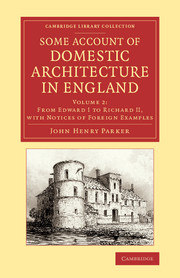
The Oxford bookseller and publisher John Henry Parker (1806–84), a supporter of the Tractarian movement and a friend of Cardinal Newman, was also a historian of architecture, whose two-volume Glossary of Terms Used in Grecian, Roman, Italian, and Gothic Architecture is also reissued in this series. In 1851, he published a volume on English domestic architecture from the Norman Conquest to 1300 by the antiquary Thomas Hudson Turner (1815–52), and on Turner's death he completed the second volume, on the fourteenth century, himself. Both volumes are highly illustrated with line drawings and plans. Volume 2 follows a similar plan, describing the rooms (such as halls, kitchens and chambers) common to domestic buildings, of whatever size, in the fourteenth century, and discussing their individual features and construction. The coverage of surviving buildings is organised by county, and there is a section on comparable buildings in France.
Originally published in 1853 and reissued here in the revised and enlarged third edition of 1859, this collection of verse quotations ranges across a broad spectrum of texts and authors. While modern scholarship has revealed the work's compiler to be Isabella Rushton Preston, very little beyond her name is known about her. Beginning with the Book of Genesis and other scriptural selections, the collection moves through Shakespeare, Milton, Dryden, Pope and many more. It also devotes space to the more contemporaneous poetry of Romantics such as Byron, Wordsworth and Coleridge. The choices of eighteenth- and nineteenth-century poetry in particular offer modern readers an insight into the literary tastes of both the compiler and the society she inhabited. The brief preface expresses the hope that the work will prove 'useful and amusing' to readers who may already know a quotation but cannot name its source. A thorough index is also provided.
Hermann Osthoff (1847–1909) and Karl Brugmann (1849–1919) were central figures in the circle of German scholars who rejected a doctrinal approach to the study of linguistics. They came to be known as the Neogrammarian school. At the core of their work was the theory that European languages, together with a subset of languages found in central and southern Asia, have a common origin in a single prehistoric language. They called this ancestor Indo-Germanic (known today as Indo-European) and claimed that its descendants are all related to one another by varying degrees of closeness. This six-volume elaboration of this thesis was published between 1878 and 1910. Volume 6 (1910) contains a number of essays, including one on the common roots of the word 'light' in Greek and Latin, along with further etymological and morphological analyses.
A physician and medical reformer enthused by the scientific and cultural progress of the Enlightenment as it took hold in Britain, Thomas Percival (1740–1804) wrote on many topics, including public health and demography. His influential Medical Ethics (also reissued in this series) is considered the first modern formulation. This one-volume reissue brings together two volumes of his essays on a variety of medical subjects, published in a revised second edition of 1772 and a follow-up collection of 1773. Many of the essays reflect his concern for public health, particularly for the citizens of Manchester. The appendix to the first volume includes two essays that were previously unpublished. Several of the pieces record medical oddities encountered by Percival, and others document his observations on the possible medicinal applications of certain plants, including coffee. His four-volume Works (1807), containing additional essays that appeared after 1773, is also reissued in this series.
The traveller and antiquary Henry Salt (1780–1827) hoped to become a portrait painter, but recognised his own limitations, and instead entered the employment of Viscount Valentia, embarking with him on an eastern tour in 1802. In 1805, Valentia sent him on a mission to improve relations with the rulers of Abyssinia. After a second expedition, this time on behalf of the British government, in which he made observations and collections of the local flora and fauna, he was appointed consul-general to Egypt, and in his spare time carried out excavations at Thebes and Abu Simbel. This two-volume work was published in 1834 by Salt's close friend, the painter J. J. Halls (1776–1853). Volume 2 describes Salt's later career in Egypt, as a diplomat and especially as a pioneering archaeologist, as well as his negotiations over the future of his own spectacular collection of Egyptian artefacts.
The Oxford bookseller and publisher John Henry Parker (1806–84), a supporter of the Tractarian movement and a friend of Cardinal Newman, was also a historian of architecture, and first published this glossary in 1836. Reissued here is the enlarged third edition of 1840. The work is ordered alphabetically, and illustrated with 700 woodcuts by various artists. As stated in the first edition's preface, the book 'lays no claim to originality, its sole object being utility'. By 1837, 'the rapid sale of the first edition of this work clearly shews that something of the kind was required'. The third edition was followed in 1841 by a companion volume which contained 400 further examples and a chronological table: the two books offered a useful guide for those travellers and others who were taking a keen interest in the built environment. The first volume contains explanations of terms from 'abacus' to 'zotheca' and 105 plates with notes.
Containing a Particular Account of the Icebergs and Other Phenomena which Present Themselves in those Regions; Also, a Description of the Esquimeaux and North American Indians
Thomas M'Keevor served as the physician for the second group of Selkirk settlers that set out in 1812 for the Red River Colony in Canada. This short account of what he witnessed, particularly the crossing of Hudson Bay, appeared in 1819. Greatly interested in icebergs, M'Keevor discusses these 'sea mountains' in detail. He also describes the Inuit peoples encountered, giving a short glossary of Inuit words. Presenting a vivid account of the scene, he was clearly moved by seeing a polar bear protecting her cubs from a hunting party sent out from the ship. Also published in this volume is a brief account in English of the 1806 voyage of the Sirène by the French naval officer Fréminville. Initially tasked with attacking British whalers off Spitsbergen, the frigate came close to the coast of Greenland, yet most of the time on land was spent in Iceland, where observations were made of the Icelandic people, fauna and geology.
This two-volume account of the life and friendships of the publisher John Murray (1778–1843), told largely through his voluminous correspondence, was published in 1891 by Samuel Smiles (1812–1904), whose Lives of the Engineers, Self-Help, and other works are also reissued in the Cambridge Library Collection. Murray was only fifteen when his father, the founder of the famous firm, died, but after a period of apprenticeship he took sole control of the business, becoming the friend as well as the publisher of a range of the most important writers of the first half of the nineteenth century, in both literature and science. Perhaps his most famous author was Lord Byron, whose memoir of his own life, considered unpublishable, was burned in the fireplace at Murray's office in Albemarle Street, London. Volume 2 describes innovations including the famous travel guides, and ends with an assessment of Murray's publishing career.
Professor of natural philosophy for the Royal Institution between 1853 and 1887, the physicist John Tyndall (1820–93) passionately sought to share scientific understanding with the Victorian public. Reissued here is the collected research he contributed to the Philosophical Transactions of the Royal Society and other journals. Published in 1872, it complements Tyndall's Heat Considered as a Mode of Motion (1863), which is also reissued in this series. Here each memoir is preceded by a short summary, explaining what he discovered and his reasons for embarking on the investigations in question. Accompanying the detailed descriptions of experimental methods are illustrations of the scientific apparatus used. Tyndall also shows how his work built upon previous research, acknowledging the insights of distinguished scientists such as William Herschel and Macedonio Melloni. In particular, he discusses at length his academic debates with Heinrich Gustav Magnus.
Following distinguished naval service during the Napoleonic Wars, Edward Chappell (1792–1861) took part in two voyages patrolling British fisheries in North America. The second of these, in 1814, is recounted in this journal, first published in 1817. Illustrated with several engravings, Chappell's narrative dwells in particular upon the Inuit, who were little understood by Europeans at the time. Knowing only a few Inuit words, Chappell traded with them and was admitted to their homes. Though somewhat superficial and patronising, his descriptions revised previous accounts and brought new information to English readers. The rest of the journal brims with evocative anecdotes from the journey - a polar bear sighting, a thunderstorm on an ice-ridden sea, a meeting with a renowned Native American chieftain. The appendices provide such additional information as navigational data, details of Inuit dress, and a short vocabulary of the Cree language.
French astronomer Camille Flammarion (1842–1925) called the study of the heavens 'the science which concerns us most'. He believed that learning 'what place we occupy in the infinite' could delight and instruct, and might even promote an end to war and strife. Flammarion dedicated the present work to François Arago (1786–1853), author of earlier work on popular astronomy. Since Arago's time, the capabilities of telescopes and other instruments had vastly improved, advancing understanding in areas such as the composition of stars. Flammarion sought to bring this new knowledge to the public in a charming yet 'scrupulously exact' style. His highly illustrated introduction to astronomy succeeded in reaching a wide readership, selling over 100,000 French copies before this English translation appeared in 1894. The 1881 French version and Flammarion's work on the origins of the Earth, Le Monde avant la création de l'homme (1886), are also reissued in this series.
In 1865, the Swedish geologist Carl Wilhelm Paijkull (1836–69) made a voyage from Copenhagen to Iceland, a country that was still little understood by the rest of Europe. In the course of a trip that had a chiefly scientific purpose, Paijkull noted not only the geological features of the island, but also many salient aspects of Icelandic culture in a detailed yet readable style. The book features a number of striking engravings of natural features, including the volcano Hekla, as well as depictions of Icelanders engaging in activities such as drying fish or crossing a river. Paijkull ranges widely in his narrative, commenting on the Icelandic fondness for dogs, historical and contemporary friction with Denmark, and the island's economic fortunes. His perceptive account was first published in Swedish in 1866 and is reissued here in the English translation that appeared in 1868.
Following his stint as the naturalist aboard the Endeavour on James Cook's pioneering voyage, Sir Joseph Banks (1743–1820) became a pre-eminent member of the scientific community in London. President of the Royal Society from 1778, and a friend and adviser to George III, Banks significantly strengthened the bonds between the practitioners and patrons of science. Between 1796 and 1800, the Swedish botanist and librarian Jonas Dryander (1748–1810) published this five-volume work recording the contents of Banks' extensive library. The catalogue was praised by many, including the distinguished botanist Sir James Edward Smith, who wrote that 'a work so ingenious in design and so perfect in execution can scarcely be produced in any science'. Volume 4 (1799) lists books pertaining to geology and mineralogy, including works on the medical and economic applications of minerals and metals.