A collection of out-of-copyright and rare books from the Cambridge University Library and other world-class institutions that have been digitally scanned, made available online, and reprinted in paperback.
To save content items to your account,
please confirm that you agree to abide by our usage policies.
If this is the first time you use this feature, you will be asked to authorise Cambridge Core to connect with your account.
Find out more about saving content to .
To save content items to your Kindle, first ensure no-reply@cambridge.org
is added to your Approved Personal Document E-mail List under your Personal Document Settings
on the Manage Your Content and Devices page of your Amazon account. Then enter the ‘name’ part
of your Kindle email address below.
Find out more about saving to your Kindle.
Note you can select to save to either the @free.kindle.com or @kindle.com variations.
‘@free.kindle.com’ emails are free but can only be saved to your device when it is connected to wi-fi.
‘@kindle.com’ emails can be delivered even when you are not connected to wi-fi, but note that service fees apply.
Richard Hakluyt (1552?–1616) was fascinated from his earliest years by stories of strange lands and voyages of exploration. A priest by profession, he was also an indefatigable editor and translator of geographical accounts, and a propagandist for English expeditions to claim new lands, especially in the Americas. His most famous work was first published in 1589, and expanded in 1598–1600: reissued here is the twelve-volume edition prepared by the Scottish firm of James MacLehose and Sons and first published between 1903 and 1905, which included introductory essays and notes. Hakluyt's subjects range from transcriptions of personal accounts and 'ruttiers' (descriptive charts of voyages) to patriotic attacks against rival nations (especially Spain). Volume 7 contains accounts of journeys to the south and south-east (including the legendary voyage of the Welsh prince Madoc), and also gives reports of voyages by Frobisher and John Davis in search of the North-West Passage.
Ranging in coverage from humble cottages to grand villas, this encyclopaedia was compiled by the Scottish landscape gardener John Claudius Loudon (1783–1843). Its ambition, as stated in the introduction, was 'to improve the dwellings of the great mass of society'. Hundreds of types of rural abode are delineated here by Loudon and his contributors, and the text is greatly enhanced by more than 2,000 illustrations. Later sections examine the subject of fixtures and furnishings - from cornices to carpets - and explain which types were considered appropriate for a particular style of house. Space is also devoted to the principles of architectural criticism. For historians and lovers of architecture and interior design, this substantial resource, published in 1833, sheds light on the fashions and theories of the early nineteenth century. Loudon's First Additional Supplement to the Encyclopaedia of Cottage, Farm, and Villa Architecture and Furniture (1842) is also reissued in this series.
The Danish geologist and geographer Hinrich Rink (1819–93) amassed decades of experience in exploring Greenland, becoming well versed in the language and customs of the Inuit. The present work is a condensed version of his investigations into indigenous culture, first published in two volumes in 1866 and 1871. Rink revised and translated the work from Danish into English for this 1875 publication, and the text was emended by the Scottish scientist and explorer Robert Brown (1842–95). In the book's first part, Rink describes succinctly the Inuit mode of life in Greenland. The second part, which is significantly longer, recounts the legends and folk tales that Rink had recorded on his travels. The book also includes a number of illustrations drawn and engraved by the Inuit people themselves. This work will appeal to those interested in the history of Inuit culture and nineteenth-century ethnography.
Nathaniel Pearce (1779–1820) was, according to J. J. Halls, who edited and published his autobiographical writings in 1831, 'one of those remarkable and adventurous beings, whom Nature … seems to take delight in creating'. Having run away to sea twice, deserted from the navy, accidentally killed a man, and briefly converted to Islam, he came into his own as a guide and factotum to British travellers in Egypt. He accompanied Henry Salt's 1805 mission to Abyssinia, where he married a local girl and served the ruler of Tigré until the latter's death in 1816. Pearce's humorous account of his life is particularly interesting in the details it gives of the land and people of Ethiopia, then little known by Europeans. In Volume 2, the situation in Abyssinia becomes dangerous and Pearce decides to escape down the Nile. The journal ends abruptly in 1819, a year before his death.
First published in 1874 and reissued here in its second edition of 1879, this substantial work provides information on the vegetable material medica used by Victorian pharmacists, principally in Britain but also in India. Arranging the entries according to the type of plant from which each drug is derived, Daniel Hanbury (1825–75) and Friedrich August Flückiger (1828–94) give a description of each drug as well as covering its botanical origin and history, including its first medicinal application. They also discuss chemical composition, referring to the investigations of other scientists as well as their own, and comment on microscopic structure. Intending to create a broad reference work rather than an encyclopaedia, the authors chose not to focus on the therapeutic applications of the drugs. In many instances, however, they give some information on how the plant products are used. The appendix provides short biographical and bibliographical notes.
First published in 1868, soon after the death of Michael Faraday (1791–1867), this short work assesses the discoveries made by a humble bookbinder who became one of the foremost scientific investigators of the nineteenth century. Eminently qualified, John Tyndall (1820–93), who received Faraday's support in taking up the professorship of natural philosophy at the Royal Institution in 1853, gives an informed appraisal of a remarkable scientific career. The protégé of Sir Humphry Davy, Faraday went on to carry out pioneering work in the fields of electromagnetism, diamagnetism and electrolysis. Tyndall focuses here on Faraday's research, describing his influences and how he approached his investigations, although insights into his character are also incorporated: 'Underneath his sweetness and gentleness was the heat of a volcano.' Also reissued in this series are The Life and Letters of Faraday (1870), compiled by Henry Bence Jones, and John Hall Gladstone's Michael Faraday (1872).
Although devoted to his parish, Leonard Jenyns (1800–93) combined his clerical duties with keen research into the natural world around him. His numerous publications include A Manual of British Vertebrate Animals (1835) and Observations in Natural History (1846), both of which are reissued in this series. This 1858 work is based on nineteen years of meticulous observation of Cambridgeshire weather, including trends in atmospheric pressure and precipitation. Jenyns' careful recording of his surroundings supplies the raw data for the text and many informative tables. The geological position of Swaffam Bulbeck, where most of the observations were made, is briefly discussed along with other factors bearing upon the climate of Cambridgeshire more generally. Throwing light on how meteorological observation was conducted and interpreted, the work reflects a growing interest in the topic in Victorian Britain.
First published in 1870, this 'museum of literary odds and ends' was condensed from material in a manuscript that was thrice the size of the finished book. At the end of his life, Ebenezer Cobham Brewer (1810–97) substantially revised and updated the Dictionary in 1895 and it has appeared in new versions ever since. Reissued here in its first edition, the work reflects Brewer's distinct style and draws on a lifetime's reading. Elucidating the etymology of some 20,000 unusual and everyday words and phrases, the collection touches on diverse subjects ranging from history and literature to mythology and magic. Brewer's charming preface describes the book as an 'alms-basket of words' and promises to examine terms such as 'killed with kindness' and 'kettle of fish'. Readers will be enlightened as to the original meaning of familiar and unfamiliar phrases, many of which have fallen out of use yet testify to the richness of an evolving language.
Later known as Lady Eastlake, the writer Elizabeth Rigby (1809–93) travelled widely in her early years, and subsequently moved in the highest literary and artistic circles. After an illness in 1827 she was taken abroad to recover, and her encounters with European art led to her writing career. In 1849, she married the painter Charles Eastlake, who became the director of the National Gallery and president of the Royal Academy. Continuing to write, especially for the Quarterly Magazine, on literature and art, she spent part of each year touring galleries and private collections across Europe. This engaging two-volume work of 1895, edited by her nephew and full of shrewd judgements on art and on people, is compiled from her journals and letters. Volume 1 describes Eastlake's early life: the extracts from her journals end in 1854 with her impressions of the reopening of the Crystal Palace at Sydenham.
A Scottish doctor and botanist, George Watt (1851–1930) had studied the flora of India for more than a decade before he took on the task of compiling this monumental work. Assisted by numerous contributors, he set about organising vast amounts of information on India's commercial plants and produce, including scientific and vernacular names, properties, domestic and medical uses, trade statistics, and published sources. Watt hoped that the dictionary, 'though not a strictly scientific publication', would be found 'sufficiently accurate in its scientific details for all practical and commercial purposes'. First published in six volumes between 1889 and 1893, with an index volume completed in 1896, the whole work is now reissued in nine separate parts. Volume 3 (1890) contains entries from Dacrydium (a genus of coniferous trees) to Gordonia obtusa (a species of evergreen tree).
Richard Hakluyt (1552?–1616) was fascinated from his earliest years by stories of strange lands and voyages of exploration. A priest by profession, he was also an indefatigable editor and translator of geographical accounts, and a propagandist for English expeditions to claim new lands, especially in the Americas. His most famous work was first published in 1589, and expanded in 1598–1600: reissued here is the twelve-volume edition prepared by the Scottish firm of James MacLehose and Sons and first published between 1903 and 1905, which included introductory essays and notes. Hakluyt's subjects range from transcriptions of personal accounts and 'ruttiers' (descriptive charts of voyages) to patriotic attacks against rival nations (especially Spain). Volume 3 contains accounts of travels to Russia and Persia, and the activities of the Muscovy Company, especially the celebrated merchant and traveller Anthony Jenkinson, who was entertained at the court of Ivan the Terrible in 1558.
An American inventor and entrepreneur, Taliaferro Preston Shaffner (1818–81) collaborated with the Rev. W. Owen on this 'guided tour' of London's 1862 International Exhibition, showcasing Victorian achievements in technology and the arts. Described here are exhibits, originating from Britain, her empire and beyond, which include early washing machines and lawnmowers, as well as grand ideas for metropolitan drainage systems and a Channel Tunnel. The arts are also well covered, with descriptions of the latest fabrics, wallpapers, musical instruments, ceramics and photography. The authors also give background details of how the International Exhibition built upon the success of the Great Exhibition of 1851. Illustrated with sixty full-page steel engravings, this is a highly detailed guide to a very modern event. Also relating to the exhibition, Edward McDermott's Popular Guide and both the official and illustrated catalogues of the industrial department have been reissued in this series.
Prior to his disappearance in the Arctic during an airborne rescue mission, the Norwegian explorer Roald Amundsen (1872–1928) had reflected in writing on his extraordinary career. First published in 1927 and reissued here in the English translation of that year, his autobiography discusses in straightforward style the numerous difficulties of his many expeditions, ranging from problems of finance and planning through to dealing with life-threatening danger and inevitable controversy. Generously acknowledging an 'old gentleman in Grimsby' for providing materials that helped him plan the first navigation of the North-West Passage, Amundsen credits painstaking preparation as the cornerstone of his success, especially in the conquest of the South Pole. His fuller accounts of these two expeditions are also reissued in the Cambridge Library Collection. Frank and focused like its author, the present work will reveal to readers the outlook and approach of a remarkable figure in the history of polar exploration.
This practical guide was first published in 1776: in this reissue of the two-volume 1777 second edition, the two volumes have been bound in one book. John Kennedy (d.1790) was the gardener to Sir Thomas Gascoigne, the owner of Parlington Hall in Yorkshire, and his book is addressed to landowners and their head gardeners. His concern is with 'the planting of poor wastes, moorlands, and apparent mountains', as well as with hothouse plants such as pineapples and vines, and delicacies including asparagus and cultivated mushrooms. At the other end of the scale, he also provides sections on field-cabbages, carrots and turnips as feed for cattle. In each of these areas, he gives detailed descriptions of the preparation of the ground, the tools needed, propagation techniques, and the subsequent management of pests and diseases. This is a fascinating treatise on the gardening skills needed on a grand eighteenth-century agricultural estate.
Richard Hakluyt (1552?–1616) was fascinated from his earliest years by stories of strange lands and voyages of exploration. A priest by profession, he was also an indefatigable editor and translator of geographical accounts, and a propagandist for English expeditions to claim new lands, especially in the Americas. His most famous work was first published in 1589, and expanded in 1598–1600: reissued here is the twelve-volume edition prepared by the Scottish firm of James MacLehose and Sons and first published between 1903 and 1905, which included introductory essays and notes. Hakluyt's subjects range from transcriptions of personal accounts and 'ruttiers' (descriptive charts of voyages) to patriotic attacks against rival nations (especially Spain). Volume 5 contains accounts of voyages to the Mediterranean and the Levant, including a history of the great siege of Rhodes in 1522 by the troops of Suleiman the Magnificent.
The author and clergyman William Coxe (1748–1828), noted for his travel works, was the stepson of Handel's amanuensis, German-born John Christopher Smith (1712–95). First published in 1799, the present work is a valuable source of first-hand information about two men at the heart of eighteenth-century English music: George Frideric Handel (1685–1759), whose inventive and sensitive melodic genius and exuberant brilliance in depicting the spectacular are best displayed in his Messiah and Zadok the Priest, and Smith, a composer of attractive and fashionable music, who settled in London in 1720, took lessons with Handel and later supported the great composer as his eyesight failed. Smith was also organist at the Foundling Hospital until 1770. This publication, profits from which were intended to support Smith's family, draws on the works of John Hawkins and Charles Burney, and on anecdotes claimed to be 'derived from unquestionable authority'.
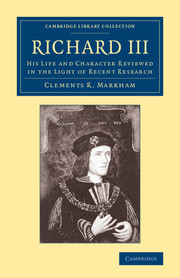
First published in 1906, this work was one of the first and most important Ricardian apologias for a general readership. A distinguished geographer, whose long career had involved voyaging to the Arctic in search of Sir John Franklin, as well as travels in Peru and India, Sir Clements Markham (1830–1916) had played a crucial role in launching Scott's first expedition to Antarctica in 1901. Markham also had a long-standing interest in the reputation of England's last Plantagenet king. The first part of this book presents the life of Richard, while the second half is devoted to a thorough examination of the charges laid against the monarch by the Tudors and later historians. Markham seeks to expose these charges as unfair and unfounded. The work also includes genealogical tables and a map of the Battle of Bosworth Field.
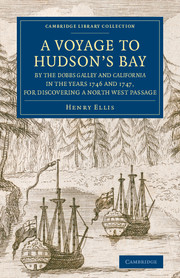
After running away to sea in 1741, Henry Ellis (1721–1806) joined a privately funded expedition with the purpose of discovering the North-West Passage, a possible trade route to the East Indies. While the expedition returned to England unsuccessful in 1747, having been thwarted by hazardous ice, Ellis believed that the route was still likely to exist. The party had travelled further north than any previous expedition, and Ellis's account, first published in 1748, generated great interest. The book includes a brief history of other attempts to find the passage, a map of Hudson Bay, several engravings of the fauna encountered, and observations of the natural history of the area. With his reputation increased by the book's publication, Ellis became a fellow of the Royal Society in 1749. He was later involved in the slave trade in Africa and colonial governance in North America.
An exceptional child prodigy at the keyboard, the organist and composer William Crotch (1775–1847) attracted the attention of both George III and Charles Burney, going on to become one of the most eminent musical figures of his day. Following a period of study in Cambridge, at the age of fifteen he was appointed organist at Christ Church, Oxford. At twenty-one he assumed the university's chair of music, a post he retained until his death. The first principal of the Royal Academy of Music between 1822 and 1832, Crotch is remembered today for his oratorio Palestine. The present work, which first appeared in 1831, made his expertise available to a wider audience. Based on popular lectures given in Oxford and London, the book includes a penetrating assessment of contemporary musical taste and a list of Crotch's sheet music. His Elements of Musical Composition (1812) is also reissued in this series.
From its beginnings in Babylonian and Egyptian theories, through its flowering into revolutionary ideas such as heliocentricity, astronomy proved a source of constant fascination for the philosophers of antiquity. In ancient Greece, the earliest written evidence of astronomical knowledge appeared in the poems of Homer and Hesiod. In the present work, first published in 1932, Sir Thomas Little Heath (1861–1940) collects some of the most notable essays and discussions of astronomical theory by Greek astronomers and mathematicians, presenting them in English translation for the modern reader. With chronological coverage, Heath's book features a thorough introduction, a doxography of what ancient authors said about the earliest theorists and longer excerpts exploring fundamental ideas. Among the pieces are extracts from Plato's Republic and Ptolemy's work on the impossibility of a moving Earth, alongside material from Aristotle, Euclid, Strabo, Plutarch and others.