A collection of out-of-copyright and rare books from the Cambridge University Library and other world-class institutions that have been digitally scanned, made available online, and reprinted in paperback.
To save content items to your account,
please confirm that you agree to abide by our usage policies.
If this is the first time you use this feature, you will be asked to authorise Cambridge Core to connect with your account.
Find out more about saving content to .
To save content items to your Kindle, first ensure no-reply@cambridge.org
is added to your Approved Personal Document E-mail List under your Personal Document Settings
on the Manage Your Content and Devices page of your Amazon account. Then enter the ‘name’ part
of your Kindle email address below.
Find out more about saving to your Kindle.
Note you can select to save to either the @free.kindle.com or @kindle.com variations.
‘@free.kindle.com’ emails are free but can only be saved to your device when it is connected to wi-fi.
‘@kindle.com’ emails can be delivered even when you are not connected to wi-fi, but note that service fees apply.
An Austrian Dominican priest, Heinrich Denifle (1844–1905) carried out painstaking research in the archives of the Vatican and in libraries throughout Europe, resulting in several major publications on medieval history and theology. In 1887 he was appointed to edit the medieval records of the University of Paris, with the assistance of the palaeographer Emile Chatelaine (1851–1933). Paris was the centre of theological learning in Europe in the Middle Ages, and the records here contain important information regarding the university's organisation, teachers, students, relations with popes and kings, religious orders, and intellectual controversies. The four volumes published between 1889 and 1897 contain the texts of some 2,700 records, with references to many more in the notes. Volume 2 (1891) contains material covering 1286–1350, when the university was growing both in size and influence internationally.
Sir Henry Alexander Wickham (1846–1928) is remembered for his role in bringing the seeds of the rubber tree in 1876 from Brazil to the Royal Botanic Gardens at Kew, where seedlings were successfully cultivated and then sent to Asia for the establishment of commercial plantations. Wickham later styled his actions in collecting some 70,000 seeds as a tale of botanical smuggling, though at the time such action was not illegal. Skilled as a self-publicist, he enjoyed the great acclaim of the rubber industry as it burgeoned in British colonies abroad. This account, first published in 1872, is of Wickham's earlier travels in South America. The first part of the work traces his journey by river into the continent, recording his observations on rubber cultivation in Brazil. The second part describes his time among the indigenous peoples who lived on the Caribbean coast of Central America.
This innovative aid to the study of Italian was published in 1867 by Maria Francesca Rossetti (1827–76), the older sister of Dante Gabriel, William Michael and Christina. A scholar and teacher of Italian, she was later to publish A Shadow of Dante, a guide to the Divine Comedy, also reissued in the Cambridge Library Collection. Her purpose here, as she explains in her preface, is to demonstrate idiomatic Italian usage by providing short passages translated very literally into English, so that the 'unnatural' English phraseology demonstrates the correct Italian construction. The passages are to be translated back into Italian, with the help of some supplied vocabulary and an opening chapter which elucidates some of the more difficult aspects of Italian grammar, often by comparing Italian with French usage. The technique had long been used for Latin and Greek prose composition, but was innovatory for modern languages.
By 1820, the explorer William Parry had managed to traverse half of the North-West Passage. For his second attempt in 1821–3, he was accompanied by George Francis Lyon (1795–1832), who captained HMS Hecla. Parry and Lyon ultimately failed to get beyond Fury and Hecla Strait - named for the expedition's ships - because of heavy ice. This, together with the onset of scurvy, brought about their return to England. First published in 1824, Lyon's journal provides details of the region's natural history and its ice conditions as well as some of the most perceptive early commentary on the Inuit of Baffin Island and Melville Peninsula. Lyon struck up a rapport with these people, even allowing them to tattoo him. Living among the Inuit, Lyon observed their customs, their clothing, their diet, and their hunting activities. Several engravings of the author's sketches enhance the value of the work.
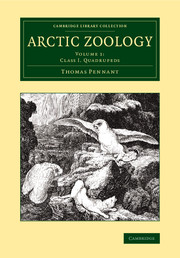
In the 'Advertisement' to this 1784 two-volume work, Thomas Pennant (1726–98), zoologist and traveller, explains that his original intention was to record the zoology of North America 'when the empire of Great Britain was entire'. After the War of Independence, he changed his focus to the zoology (and people, archaeology and geology) of the Arctic regions of America, Europe and Siberia. The content of the volumes, one of the earliest works of systematic zoology published in Britain, is based on the writings of earlier zoologists, information obtained by Pennant from his scientific correspondents all over Europe and America, and his studies in private museums and collections. It is embellished with engravings of animals, birds, landscapes and artefacts. Volume 1 begins with an account of the various Arctic habitats, and describes the quadrupeds of these regions. Other works by Thomas Pennant are also reissued in the Cambridge Library Collection.
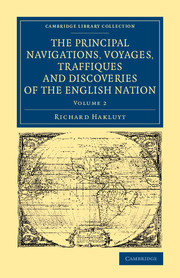
Richard Hakluyt (1552?–1616) was fascinated from his earliest years by stories of strange lands and voyages of exploration. A priest by profession, he was also an indefatigable editor and translator of geographical accounts, and a propagandist for English expeditions to claim new lands, especially in the Americas. His most famous work was first published in 1589, and expanded in 1598–1600: reissued here is the twelve-volume edition prepared by the Scottish firm of James MacLehose and Sons and first published between 1903 and 1905, which included introductory essays and notes. Hakluyt's subjects range from transcriptions of personal accounts and 'ruttiers' (descriptive charts of voyages) to patriotic attacks against rival nations (especially Spain). Volume 2 contains accounts of voyages to the north and north-east, including historical information about Prussia and the Hanseatic towns, and their trade and diplomatic relations with England, in the late medieval period.
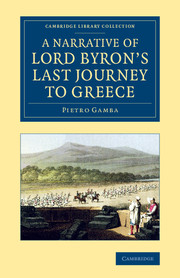
Count Pietro Gamba (1801–27) was the brother of Teresa Guiccioli, Lord Byron's mistress, and a member of the Italian revolutionaries known as the Carbonari. He accompanied Byron on his mission to Greece in 1823, and was described by the poet as 'one of the most amiable, brave, and excellent young men' he had ever encountered, 'with a thirst for knowledge, and a disinterestedness rarely to be met with'. This account of the mission, and of Byron's death and the subsequent controversies over its cause and the disposal of the body, was published in 1825, and dedicated to Byron's close friend, John Cam Hobhouse. It was based on Gamba's diary, 'containing a minute account of all the events of the day … My only object is to give a simple narrative of what Lord Byron did in Greece'. Gamba died of typhoid in 1827, still working for Greek independence.
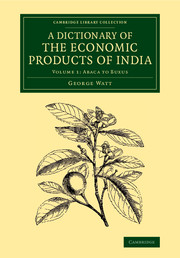
A Scottish doctor and botanist, George Watt (1851–1930) had studied the flora of India for more than a decade before he took on the task of compiling this monumental work. Assisted by numerous contributors, he set about organising vast amounts of information on India's commercial plants and produce, including scientific and vernacular names, properties, domestic and medical uses, trade statistics, and published sources. Watt hoped that the dictionary, 'though not a strictly scientific publication', would be found 'sufficiently accurate in its scientific details for all practical and commercial purposes'. First published in six volumes between 1889 and 1893, with an index volume completed in 1896, the whole work is now reissued in nine separate parts. Volume 1 (1889) opens with the prefatory matter, along with lists of works consulted, contributors and abbreviations. It contains entries from Abaca (a name in the Philippines for Manila hemp) to Buxus (a genus of evergreen shrubs).
In his autobiography, Charles Darwin wrote of his time at Cambridge: 'I attempted mathematics … but I got on very slowly. The work was repugnant to me, chiefly from my not being able to see any meaning in the early steps in algebra. This impatience was very foolish, and in after years I have deeply regretted that I did not proceed far enough at least to understand something of the great leading principles of mathematics, for men thus endowed seem to have an extra sense.' First published in 1795 and reissued here in its 1815 sixth edition, The Elements of Algebra by James Wood (1760–1839) was one of the standard Cambridge texts for decades, so its presence in Darwin's library aboard the Beagle is readily understandable. Then, as now, Cambridge had a high opinion of itself as a mathematical university. The contents of Wood's book give an interesting glimpse of the standards expected of the less able students.
After training as an apothecary and surgeon, Jonathan Pereira (1804–53) taught materia medica for many years. His lectures at the medical school in London's Aldersgate Street were highly successful and formed the basis for the first edition of his major encyclopaedic work on medicinal substances. A pioneering text in the field of pharmacology, Pereira's work, which he subsequently updated in further editions, provided pharmacists and medical professionals with a more rigorous scientific understanding of the drugs and remedies they prescribed. After Pereira's death, medical jurist Alfred Swaine Taylor (1806–80) and physician George Owen Rees (1813–89) prepared this revised and expanded fourth edition, interspersed with instructive woodcuts. Volume 1 (1854) includes discussion of 'physical remedies' such as heat, cold and electricity, and 'hygienic remedies' of diet, exercise and climate. It then focuses on general pharmacological practice and specific drugs, describing the medicinal properties of inorganic compounds.
This work, first published in 1853, grew from a paper describing the crossing of two Roman roads at Cambridge, and the small Roman fort at Grantchester. However, other Roman sites were added to the investigation, and the book came to encompass all the Roman and other ancient roads of Cambridgeshire, as well as the locations where Roman coins and other remains had been found. The author, Charles Cardale Babington (1808–95), is best remembered as the pupil and assistant of John Stevens Henslow and as his successor in the chair of botany at Cambridge. However, Babington was also keenly interested in archaeology, and this fascinating work of local history is the first substantial account of Roman Cambridgeshire, describing not only the courses of the various roads but also finds such as the Roman villa at Comberton, the Roman cemetery at Trumpington, and large numbers of individual coins and other artefacts.
The Oxford bookseller and publisher John Henry Parker (1806–84), a supporter of the Tractarian movement and a friend of Cardinal Newman, was also a historian of architecture, whose two-volume Glossary of Terms Used in Grecian, Roman, Italian, and Gothic Architecture is also reissued in this series. In 1851, he published a volume on English domestic architecture from the Norman Conquest to 1300 by the antiquary Thomas Hudson Turner (1815–52), and on Turner's death he completed the second volume, on the fourteenth century, himself. Both volumes are highly illustrated with line drawings and plans. Volume 1, after an introductory chapter about pre-Conquest buildings, discusses architectural plans, features, building materials and techniques of the twelfth and thirteenth centuries, and gives examples of surviving buildings, from grand to modest, all over England, as well as reproducing documents throwing light on the painting and decoration of medieval buildings.
Richard Hakluyt (1552?–1616) was fascinated from his earliest years by stories of strange lands and voyages of exploration. A priest by profession, he was also an indefatigable editor and translator of geographical accounts, and a propagandist for English expeditions to claim new lands, especially in the Americas. His most famous work was first published in 1589, and expanded in 1598–1600: reissued here is the twelve-volume edition prepared by the Scottish firm of James MacLehose and Sons and first published between 1903 and 1905, which included introductory essays and notes. Hakluyt's subjects range from transcriptions of personal accounts and 'ruttiers' (descriptive charts of voyages) to patriotic attacks against rival nations (especially Spain). Volume 10 contains material relevant to the voyages 'for the discovery of the large, rich, and beautifull Empire of Guiana' as well as voyages to the Caribbean and other parts of South America.
Richard Hakluyt (1552?–1616) was fascinated from his earliest years by stories of strange lands and voyages of exploration. A priest by profession, he was also an indefatigable editor and translator of geographical accounts, and a propagandist for English expeditions to claim new lands, especially in the Americas. His most famous work was first published in 1589, and expanded in 1598–1600: reissued here is the twelve-volume edition prepared by the Scottish firm of James MacLehose and Sons and first published between 1903 and 1905, which included introductory essays and notes. Hakluyt's subjects range from transcriptions of personal accounts and 'ruttiers' (descriptive charts of voyages) to patriotic attacks against rival nations (especially Spain). Volume 11 contains accounts of Brazil, the Straits of Magellan, the South Seas, and circumnavigations, and includes a letter written by Queen Elizabeth to the emperor of China.
The Oxford bookseller and publisher John Henry Parker (1806–84), a supporter of the Tractarian movement and a friend of Cardinal Newman, was also a historian of architecture, and first published this glossary in 1836. Reissued here is the enlarged third edition of 1840. The work is ordered alphabetically, and illustrated with 700 woodcuts by various artists. As stated in the first edition's preface, the book 'lays no claim to originality, its sole object being utility'. By 1837, 'the rapid sale of the first edition of this work clearly shews that something of the kind was required'. The third edition was followed in 1841 by a companion volume: the two books offered a useful guide for those travellers and others who were taking a keen interest in the built environment. The companion volume contains further line drawings and plates, an index to the plates in both volumes, and a chronology of the architectural developments and individual buildings being discussed.
First published in 1874, this illustrated work by Albert Hastings Markham (1841–1918) recounts his experiences aboard the Dundee steam whaler Arctic. Markham also gives an account of the rescue of the crew of the American vessel Polaris, crushed by ice in 1872 during its attempt to reach the North Pole. The work is enhanced by details of meetings with Inuit, encounters with polar wildlife, oceanographic observations, and meteorological events. Appropriately, fellow naval officer and explorer Sherard Osborn (1822–75) wrote the introduction: he had a long interest in Arctic exploration, advocated the benefits of using steam ships in icy waters, and encouraged Markham to embark on the whaling cruise. The appendices include a 'list of birds shot', as well as data on botanical and geological specimens. Also reissued in this series are Markham's The Great Frozen Sea (1878), Northward Ho! (1879) and A Polar Reconnaissance (1881).
In the 'Advertisement' to this 1784 two-volume work, Thomas Pennant (1726–98), zoologist and traveller, explains that his original intention was to record the zoology of North America 'when the empire of Great Britain was entire'. After the War of Independence, he changed his focus to the zoology (and people, archaeology and geology) of the Arctic regions of America, Europe and Siberia. The content of the volumes, one of the earliest works of systematic zoology published in Britain, is based on the writings of earlier zoologists, information obtained by Pennant from his scientific correspondents all over Europe and America, and his studies in private museums and collections. It is embellished with engravings of animals, birds, landscapes and artefacts. Volume 2 deals with land and water birds, including some, such as the passenger pigeon, which are now extinct. Other works by Thomas Pennant are also reissued in the Cambridge Library Collection.
By the late nineteenth century, charges imposed on Manchester companies for the use of Liverpool's docks and the connecting railway had created an atmosphere of resentment within the business community. The Manchester Ship Canal was to play a major part in the city's regeneration following the depression of the 1870s, but it took a lengthy battle for the scheme to gain the backing of Parliament and for construction to begin in 1887. In this two-volume work of 1907, Sir Bosdin Leech (1836–1912) traces the canal's conception, planning and construction. Volume 1 discusses the historical and economic factors that led to the creation of the waterway, as well as the bitter political fight to make it a reality. The work includes a large amount of illustrative content, enhancing the light shed on the landscape and notable personalities of Manchester at that time.
On the death of Edward Gibbon (1737–94), his unpublished papers were left to his friend John Baker Holroyd, first earl of Sheffield, who published them in two volumes in 1796. Volume 2 contains abstracts from Gibbon's reading, with his reflections on what he read, and extracts from his journal (sometimes in French, with a parallel translation), short pieces on various aspects of Roman history, an outline of his planned history of the world from the ninth to the end of the fifteenth century, literary criticism, a history of the House of Brunswick (ancestors of the Hanoverian British royal family), and a riposte to a criticism of his own great work, The History of the Decline and Fall of the Roman Empire, which is also reissued (in the 1896–1900 edition by J. B. Bury) in the Cambridge Library Collection.
Written by his friend, the physician John Baron (1786–1851), this laudatory biography of the 'father of immunology' did much to enhance the reputation of Edward Jenner (1749–1823) upon its publication in two volumes between 1827 and 1838. The work covers Jenner's personal and professional life both before and after his development of the vaccine for smallpox, as well as touching on the vaccine's reception and use around the world. Thoroughly explaining the history and facts of vaccination, Baron established himself as an authority on the subject. Although criticised by some for its unquestioning praise of Jenner's genius, the work is valuable for its use of primary sources, drawing heavily on correspondence and personal notes, excerpts of which appear throughout the text. Volume 1, published in 1827, focuses on Jenner's early life and the history and science of vaccination.