A collection of out-of-copyright and rare books from the Cambridge University Library and other world-class institutions that have been digitally scanned, made available online, and reprinted in paperback.
To save content items to your account,
please confirm that you agree to abide by our usage policies.
If this is the first time you use this feature, you will be asked to authorise Cambridge Core to connect with your account.
Find out more about saving content to .
To save content items to your Kindle, first ensure no-reply@cambridge.org
is added to your Approved Personal Document E-mail List under your Personal Document Settings
on the Manage Your Content and Devices page of your Amazon account. Then enter the ‘name’ part
of your Kindle email address below.
Find out more about saving to your Kindle.
Note you can select to save to either the @free.kindle.com or @kindle.com variations.
‘@free.kindle.com’ emails are free but can only be saved to your device when it is connected to wi-fi.
‘@kindle.com’ emails can be delivered even when you are not connected to wi-fi, but note that service fees apply.
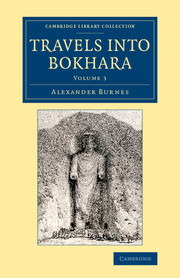
Being the Account of a Journey from India to Cabool, Tartary and Persia; Also, Narrative of a Voyage on the Indus, from the Sea to Lahore, with Presents from the King of Great Britain
Aged sixteen, Alexander Burnes (1805–41) took up a post in the Bombay army, and speedily learned both Hindustani and Persian. His skills led him to political work, and he himself proposed a covert expedition to Bukhara, to survey the country, but also to observe the expansionist activities of the Russians in central Asia. In 1832, he set off, with an army doctor, and two Indians as surveyor and secretary. They travelled in local dress and adopted whatever personas a situation required. Having reached Bukhara, they continued overland to the Caspian Sea, and then to Tehran, returning to Bombay by sea in 1833. This three-volume account of his adventures, published in 1834, was an instant bestseller. Volume 3 is an account of Burnes' earlier diplomatic mission up the Indus to Lahore in 1831. He continued his diplomatic activities in Afghanistan, but was murdered there by a mob in 1841.
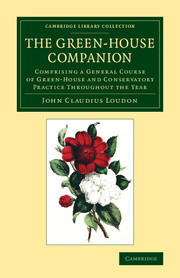
The Scottish landscape gardener and prolific horticultural writer John Claudius Loudon (1783–1843) published this manual on the practice of greenhouse or conservatory gardening in 1824. In his preface he remarks on the rise of greenhouses, which have 'now become an appendage to every villa, and to many town residences'. The work is directed at professional gardeners (and their employers) who may not have the requisite knowledge and skills to make the best use of this exciting new space. The first part of the work describes the practicalities of siting and constructing the greenhouse, how it should be heated, with what plants it should be stocked and how these should be cultivated. The second part consists of a catalogue of 'all the green-house and frame plants hitherto in cultivation'. Still valuable, this substantial guide offers modern readers a record of the plants that were then available to the enthusiast.
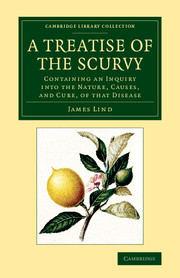
Born in Edinburgh, with family connections to the local medical profession, James Lind (1716–94) went on to spend nine years at sea as a surgeon for the Royal Navy. His service made him familiar with one of the most common and debilitating ailments of the eighteenth century. Scurvy posed a particular problem for Britain, an island nation seeking to assert itself overseas through its navy. The symptoms of the disease had been recognised for centuries, but the causes remained elusive. First published in 1753, Lind's treatise explores the topic thoroughly, weighing the evidence and presenting a theory of the disease's aetiology, suggesting methods of prevention and treatment, and also discussing previous work on the subject, including ancient texts. Lind provided the groundwork for later investigations, his research lending support to the later practice of including the juice of citrus fruit in a sailor's diet, even though vitamin deficiency was not yet understood.
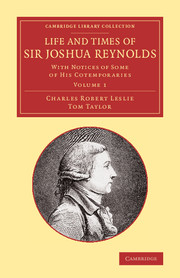
This two-volume life of Sir Joshua Reynolds (1723–92) was begun by the Royal Academician Charles Leslie (1794–1859), who had previously published a life of John Constable, also reissued in this series. On Leslie's death, the journalist and dramatist Tom Taylor (1817–80) completed the work, published in 1865. Leslie's motive was that he felt that Reynolds had been unfairly treated by an earlier biography. He aimed to show that Reynolds was 'the genial centre of a most various and brilliant society, as well as the transmitter of its chief figures to our time by his potent art'. One of the greatest artists of the eighteenth century, especially famous for his portraits, Reynolds was also instrumental in founding the Royal Academy, and was its first president. Volume 1 covers his early life and his progress as an artist until his fiftieth year.
Successful long-distance navigation depends on knowing latitude and longitude, and the determination of longitude depends on knowing the exact time at some fixed point on the earth's surface. Since Newton it had been hoped that a method based on accurate prediction of the moon's orbit would give such a time. Building on the work of Euler, Thomas Mayer and others, the astronomer and mathematician Nevil Maskelyne (1732–1811) was able to devise such a method and yearly publication of the Nautical Almanac and Astronomical Ephemeris placed it in the hands of every ship's captain. First published in 1767 and reissued here in the revised third edition of 1802, the present work provided the necessary tables and instructions. The development of rugged and accurate chronometers eventually displaced Maskelyne's method, but navigators continued to make use of it for many decades. This edition of the tables notably formed part of the library of the Beagle on Darwin's famous voyage.
In this 1782 travelogue, naturalist Thomas Pennant (1726–98) immortalised the local history, churches, homes and antiquities he encountered on his yearly trip to London. In The Literary Life of the Late Thomas Pennant, Esq. (1793), also reissued in this series, Pennant writes that he often stayed several days or more in each village to learn about its history. He hoped to rid the route of the 'calumny' of 'dulness', and although he was more interested in antiquities than contemporary innovations, he describes the impact of some developments such as a new canal system. In addition to describing places and artefacts which have since been altered or lost, Pennant's writing unconsciously reveals the workings of his thorough mind, with its seemingly tireless capacity for observation. Featuring twenty-two engravings, this book contains a full account of Pennant's 1780 journey, as well as the description of an alternative route beginning in Northamptonshire.
This classic work in the literature of poverty was published in 1890 by William Booth (1829–1912), the founder of the Salvation Army. It was in fact mostly written by the crusading journalist W. T. Stead (referred to as an anonymous 'friend of the poor' in Booth's preface), but the practical ideas for relieving the poverty and squalor of late Victorian British cities are all Booth's own. Reworking the cliché of 'Darkest Africa', in the first part he describes the 'submerged tenth' of Darkest England - destitute and/or criminal - and goes on to suggest the way to 'Deliverance', which includes better housing, education and training for work, and the sending of the urban poor to 'colonies', both overseas and in the British countryside. These proposals had their critics, but drew wide attention to an appalling aspect of urban life of which the prosperous classes were barely aware.
The classical scholar J. P. Mahaffy (1839–1919) is known equally for his work on Greek texts and Egyptian papyri (his edition of The Flinders Petrie Papyri is reissued in the Cambridge Library Collection). He graduated from Trinity College, Dublin and spent the rest of his working life there, as a fellow, and ultimately as provost from 1914 until his death. In this 1874 work, Mahaffy attempts to penetrate what he describes as the 'subjective side … the feelings of the Greeks in their temples and their assemblies, in their homes, and their wanderings'. He considers the methodology to be used in interrogating works of literature for this sort of sociological, or even psychological, research, and examines the written evidence from Homer to Menander, focusing, almost inevitably, on Athens. This is an early and pioneering work in an area of study which has become increasingly significant over the last century.
In the mid-nineteenth century, British Arctic exploration was focused on the search for the missing expedition of Sir John Franklin. Physician and geologist Peter Cormack Sutherland (1822–1900) served as surgeon on William Penny's 1850–1 search expedition, which was instructed to concentrate on Jones Sound, Wellington Channel and Barrow Strait in the Canadian Arctic. Sutherland's illustrated eyewitness account, first published in two volumes in 1852, tells of appalling weather conditions, notes the hazards of navigating icy seas, describes the wildlife and geology of the region, and offers observations on the Inuit. Sutherland also recounts the poignant discovery of Franklin's winter quarters at Beechey Island and the graves of several of his crew. Franklin's fate, however, was yet to be discovered. Volume 1 covers the journey from Aberdeen as far as Barrow Strait. Sutherland's records here the many perils of the Arctic winter.
Originally published in 1879, this illustrated work by Albert Hastings Markham (1841–1918) opens with accounts of Arctic exploration from the sixth to the nineteenth centuries, including the expeditions led by Constantine John Phipps (1744–92), William Edward Parry (1790–1855) and George Nares (1831–1915). The journal of Thomas Floyd (c.1754–78), who served as midshipman under Phipps in 1773, comprises the most significant part of the work. Outlining the difficulties faced by an eighteenth-century expedition, ranging from encounters with wildlife to adverse weather conditions, Floyd's narrative is notable also for its inclusion of some early episodes in the career of Horatio Nelson, also a midshipman on the voyage. More than a dozen engravings enhance the work. Other publications by Markham, including A Whaling Cruise to Baffin's Bay (1874) and The Great Frozen Sea (1878), are also reissued in this series.
With a fondness for classical antiquities and neoclassical design, the connoisseur Thomas Hope (1769–1831) sought to influence Georgian taste by promoting informed interior decoration, displaying his own considerable art collection, and writing with insight on aesthetic topics. This two-volume work, originally published posthumously in 1835, traces the evolution of Western architecture since antiquity. Hope was a keen traveller, and the examples he cites are drawn from buildings that he studied on journeys through Europe and beyond, notably in those countries bordering the Mediterranean. Volume 2 contains the precise line drawings that accompanied the first edition, showcasing many western European and ecclesiastical buildings and details. The work's analytical index, which appeared in 1836, is illustrated with wood engravings of features mentioned in the text and has been incorporated in this reissue.
Born in Nottingham, Henry Youle Hind (1823–1908) moved to Canada in 1846. He joined the newly formed Canadian Institute in 1849 and later taught chemistry and geology at Trinity College in Toronto. In 1857–8, he made a range of observations during two expeditions to investigate underexplored areas of Canada and their agricultural and mineral potential to support future settlement. Illustrated with a number of plates based on photographs, this two-volume work first appeared in 1860. Intended for a broad readership, the narrative is regarded as a classic of nineteenth-century exploration literature, noted especially for its descriptive use of language and eye for detail. Volume 1 covers the entire Red River expedition of 1857 and the first part of the 1858 expedition through parts of the Assiniboine, Saskatchewan and other valleys.
The leading antiquary of his day, Richard Gough (1735–1809) promoted the history of the British Isles, particularly the Anglo-Saxon period, rather than pursuing the classical interests of contemporaries who had made the Grand Tour. Gough travelled extensively over the years, sketching and taking detailed notes on what he observed. He believed that the Society of Antiquaries, of which he was director from 1771 to 1797, should preserve the nation's heritage without catering to fashion or the interests of dilettantes. He published this major work anonymously in 1768, and it found a receptive readership. The book is in effect a gazetteer of published and unpublished materials for the local history and topography of the whole of Great Britain and Ireland, discussing public records, printed books, manuscripts, maps, and other sources relating to the antiquities of each county.
Little is known of the early life of the French chef Louis Eustache Ude (d.1846). He claims in this work, first published in 1813 and reissued here in its 1827 eighth edition, to have had 'upwards of forty years practice and assiduous application to the study of his profession'. The book describes him as 'ci-devant cook to Louis XVI', but the greater part of his career was spent in England. His first English employer, the earl of Sefton, paid him the considerable sum of 300 guineas a year. After twenty years, Ude moved on, to the United Services Club and then to the duke of York's household, though he was most famous for his cooking at a notorious gambling club, Crockford's, between 1828 and 1838. Ude attempts to convey to professional English cooks 'a knowledge of the science of French cookery', which he naturally regards as superior to all others.
Sir James Fitzjames Stephen (1829–94) published this three-volume account of the English criminal law's historical development in 1883, four years after his appointment as a judge of the High Court. It is a revision and expansion of the second chapter in Stephen's 1863 General View (also reissued in this series). At first sight, it is ironic that the author of this classic of legal historical scholarship was himself a Benthamite who favoured and promoted the codification of the common law and worked on codes of criminal law and procedure for India and for England. Volume 3 covers the history of the criminal offences not covered in Volume 2 (murder and other offences against the person; theft and other property offences; and offences relating to trade and labour) and also covers the development of Indian criminal law and the main features of the Indian Penal Code of 1860 and Code of Criminal Procedure of 1882.
Following his stint as the naturalist aboard the Endeavour on James Cook's pioneering voyage, Sir Joseph Banks (1743–1820) became a pre-eminent member of the scientific community in London. President of the Royal Society from 1778, and a friend and adviser to George III, Banks significantly strengthened the bonds between the practitioners and patrons of science. Between 1796 and 1800, the Swedish botanist and librarian Jonas Dryander (1748–1810) published this five-volume work recording the contents of Banks' extensive library. The catalogue was praised by many, including the distinguished botanist Sir James Edward Smith, who wrote that 'a work so ingenious in design and so perfect in execution can scarcely be produced in any science'. Volume 3 (1797) lists Banks' collection of books on botanical subjects, including works on the medical and economic applications of various plants.
The dialect of ancient Greek in which the Homeric epics the Iliad and the Odyssey were composed and later written down is sufficiently different from classical Attic Greek that it has always proven a stumbling block for students. Perceiving the need for a concise dictionary of Homeric Greek forms, German scholar Georg Autenrieth (1833–1900) compiled this now famous work, first published in 1873 and translated into English by Robert P. Keep (1844–1904) in 1877. Keep, who taught Greek at Yale University and various New England colleges, recognised from his own experience that Autenrieth's book would enable students to proceed faster and further in their studies of Homer than could ever be the case using a conventional dictionary, where dialect forms received a relatively cursory treatment at the end of each entry. The worldwide success of the work, reissued here in its first English edition, has justified this belief.
The Resolute was a merchant ship purchased by the Royal Navy for service in the search for the lost expedition of Sir John Franklin. Its first voyage to the Canadian Arctic, which took place between 1850 and 1851, proved fruitless, so a second, larger expedition was launched in 1852. Again the Resolute could find no trace of Franklin, and the crew came close to perishing themselves. With their ship trapped in ice, they endured the freezing temperatures and a harrowing trek to Beechey Island to survive. Published in 1857, the present work is the journal of George Frederick McDougall (c.1825–71), who served as master aboard the Resolute. The book features numerous woodcuts and plates, as well as an account of the ship's salvage by an American vessel. Notably, a desk made from the ship's timbers has been used by a number of American presidents in the White House.
Being an Account of Various Observations Made during the Voyage of HMS Challenger round the World, in the Years 1872–1876, Under the Commands of Capt. Sir G. S. Nares, and Capt. F. T. Thomson
The Challenger Expedition of 1872–6 was conceived to examine the deep sea floor worldwide and disprove the theory of a 'dead zone' in the oceans below a certain depth. Using a modified Royal Navy ship, the expedition sailed nearly 70,000 nautical miles across the globe, collecting oceanographic data and marine specimens, and laying the foundations for the science of oceanography by later publishing fifty volumes of reports. The naturalist Henry Moseley (1844–91) recounts the voyage in this 1879 work, covering visits to many remote islands and the taking of samples at hundreds of locations. The voyage's achievements included the collection of over 4,000 new marine species and the discovery of the world's deepest ocean trench (Challenger Deep). Moseley's observations on native peoples also proved important as traditional cultures were changing rapidly at the time. Illustrated with numerous woodcuts, this narrative illuminates an adventure of great scientific significance.
This well-illustrated account of polar exploration was originally published in Norway in 1903, and in this two-volume English translation in 1904. It tells the story of the four years spent by Otto Sverdrup (1854–1930) and his crew in surveying and charting the seas and coastlines of the Arctic. Sverdrup had qualified as a ship's master when he first met Fridtjof Nansen, whose Greenland expedition of 1888 he accompanied. He advised on the construction of Nansen's wooden ship, the Fram, and became its master in 1895. Both with Nansen and under his own leadership, he undertook many expeditions. In June 1898, he took the Fram and a crew including several scientists to Ellesmere Island in the Canadian Arctic, where they overwintered for four years. Volume 2 describes the remainder of the expedition's time on the ice, and also the results of the various scientific surveys made by the crew.