
To save content items to your account,
please confirm that you agree to abide by our usage policies.
If this is the first time you use this feature, you will be asked to authorise Cambridge Core to connect with your account.
Find out more about saving content to .
To save content items to your Kindle, first ensure no-reply@cambridge.org
is added to your Approved Personal Document E-mail List under your Personal Document Settings
on the Manage Your Content and Devices page of your Amazon account. Then enter the ‘name’ part
of your Kindle email address below.
Find out more about saving to your Kindle.
Note you can select to save to either the @free.kindle.com or @kindle.com variations.
‘@free.kindle.com’ emails are free but can only be saved to your device when it is connected to wi-fi.
‘@kindle.com’ emails can be delivered even when you are not connected to wi-fi, but note that service fees apply.
Anti-fascism is along with anti-militarism, one of the most successful campaigns with which the left in Britain has been associated. The key moments, such as the Battles of Olympia, Cable Street or Lewisham were events at which the activities of the left forced themselves into the news and through which whole generations of activists came into the movement. Seasoned anti-fascists viewed New Labour's victory at the 1997 general election with scepticism. Between 1997 and 2001, the British National Party (BNP) grew noticeably, albeit without achieving the electoral breakthroughs which were to follow later. Between 2001 and 2005, the BNP enjoyed sustained electoral success. In 2009, 2010 and until summer 2011, the United Against Fascism (UAF) and English Defence League (EDL) numbers were usually broadly even. In June 2009, a rival far-right organisation, the EDL, was founded, as a street-fighting Islamophobic group.
Aims: To examine current monitoring practices for valproate users within Mayo Mental Health Services and analyse the conditions for which it is prescribed.
Methods: Information on sodium valproate users was collected from clinical records using a data collection tool specifically developed to capture indicative parameters.
Results: Data was collected from 6 community clinics and 4 inpatient units with a total of 69 patients on sodium valproate treatment within the service. Licensed indication was accounted for in 24.6% of patients with 63.8% prescribed valproate for unlicensed use and 11.6% for unknown indication. Amongst the prescribed users 33.3% were male and 66.7% were female with 27.5% of participants being under 55 years old and 72.5% over 55 years old. Out of 39 females using valproate 20.5% were on effective contraceptives and 79.5% were not using any. Regarding the annual physical health check, all participants in the approved inpatient units were compliant as it was part of the inpatient care requirement. 54.5% of patients in the community clinic on valproate had annual physical health reviews and 45.5% were not compliant.
Conclusion: Our examination of Mayo Mental Health Service shows that most valproate use was for unlicensed indications with the majority of the users being female, most of whom were over 55 years of age. This reflects the high percentage of non-effective contraceptive users. There is also inadequate physical health monitoring for patients in the community.
Objectives: Leveraging the non-monolithic structure of Latin America, which represents a large variability in social determinants of health (SDoH) and high levels of genetic admixture, we aim to evaluate the relative contributions of SDoH and genetic ancestry in predicting dementia risk in Latin American populations
Methods: Community-dwelling participants aged 65 and older (N = 3808) from Cuba, Dominican Republic, Mexico, and Peru completed the 10/66 protocol assessments. Dementia was diagnosed using the cross-culturally validated 10/66 algorithm. The primary outcome measured was the risk of developing dementia. Multivariate linear regression models adjusted for SDoH were used in the main analysis.
Results: We observed extensive three-way (African/European/Native American) genetic ancestry variation between countries. Individuals with higher proportions of Native American (>70%) and African American (>70%) ancestry were more likely to exhibit factors contributing to worse SDoH, such as lower educational levels (p <0.001), lower SES (p < 0.001), and higher frequency of vascular risk factors (p < 0.001). In unadjusted analysis, American individuals with predominant African ancestry exhibited a higher dementia frequency (p = 0.03) and both Native and African ancestry predominant groups showed lower cognitive performance relative to those with higher European ancestry (p < 0.001). However, after adjusting for measures of SDoH, there was no association between ancestry proportion and dementia probability, and ancestry proportions no longer significantly accounted for the variance in cognitive performance (African predominant p = 0.31 [–0.19, 0.59] and Native predominant p = 0.74 [–0.24, 0.33]).
Conclusions: The findings suggest that social and environmental factors play a more crucial role than genetic ancestry in predicting dementia risk in Latin American populations. This underscores the need for public health strategies and policies that address these social determinants to reduce dementia risk in these communities effectively.
How does the horse help us rethink the empire developing in the Iberian world? Horse riding and horse breeding comprised important elements of Spanish governance in Iberia and underwent a dynamic process of transfer, adaptation, and change in the Americas. The framework of ferality illustrates the limits of domestication in diverse colonial environments, where the horse was not only an extension of empire but also a challenge to it. Recovering the full spectrum of human-equine relations confirms the horse’s relevance to this period of change.
Returning to the Iberian Peninsula, this chapter considers how colonial experiences influenced early modern views of horse breeding. King Philip II’s survey of horse breeding in Spain and his efforts to develop a new royal “race” (raza) of horses provide two valuable case studies of contemporary debates about improving horse breeds. Knowledge and expertise gained from active horse breeding often contradicted ideal values of lineage or blood purity. These cases acknowledge limits to the control implied in selectively breeding domesticated animals and demonstrate an early modern understanding of the contructedness of horse breeds. In a larger sense, these findings offer a nuanced reading of how raza and casta in animal husbandry relate to histories of racial terminology and classifications of difference in the Spanish empire.
The iconic image of the knight on horseback represents just one facet of the horse’s imprint on legal, political, and social systems developing in medieval Iberian society. This chapter argues that historical and bodily relations with horses shaped the negotiation of social status and the administration of territory during the dynamic periods of peace, conflict, and negotiation among Iberian kingdoms in the tenth to fifteenth centuries. Defining the set of practices, ideals, and institutional hierarchies making up an Iberian "culture of the horse” brings to light a fundamental tension in which the horse served as both an agent of control and a means to disrupt power relations.
The introduction provides an overview of current theoretical concepts in animal and environmental studies for examining historical equine-human relations and previews the book chapters. The author argues that the embodied experiences of historical horses created real-world entanglements with the political and social structures that aimed to define or control them. This animal imprint, made visible in governance structures, was one way that animals participated in early modern social relations and imperial ecologies, and also gave rise to numerous possibilities for feral or counter-intentional responses within an expanding early modern empire.
As the Spanish empire expanded, the growing abundance of horses elevated an underlying tension between two colonial goals: to populate land with horses bred in new settlements, and to control land in new settlements by regulating the movement, reproduction, and possession of horses in them. The horse population increased due to both evolutionary environmental affinities and the use of traditional husbandry methods, such as loose herd management and protection of the commons, which had some unintended consequences. The responses of Spanish and Indigenous actors to these changes presented opportunities to negotiate the perception of and exercise of Spanish imperial power in a new equine political ecology.
Although Spanish colonizers expected horses to enforce social order, new environments for breeding and keeping horses and colonial interdependence on Indigenous populations also subverted these expectations. Licenses to ride horses offers a widespread example of this new political ecology. Across New Spain and Peru, Indigenous allies gained access to horses according to Spanish customs that rewarded military service to the crown, cases that emphasize the powerful imprint of the horse in Spanish governance. More broadly, the development of Indigenous equestrianisms both within and outside of Spanish spheres of influence demonstrate the complex boundary work involved in navigating a new interspecies landscape and producing new forms of knowledge.
Colonial horse breeding regulations attempted to manage and classify equine difference, but conceded to the numerous challenges in establishing desired physical traits. Likewise, emerging feral horse herds challenged narratives of Spanish domination over colonial environments. Importantly, these feral horses were a direct product of Spanish husbandry methods that used both controlled and uncontrolled breeding. In this sense, both the free-ranging horses and selectively bred colonial horses illustrated the limits of domestication in their diverging from human efforts to intervene and control them.
Horses represented an expensive and logistically challenging aspect of early expeditions, as they had to be brought by boat and then bred in colonial settlements to aid in expansion. This scarcity only elevated the cultural and political significance of horses, evident in the narratives of early Spanish or Indigenous chroniclers and also in strategic efforts to breed horses in colonial settlements, despite the challenging and varied new environments. Beyond the military lore of conquest, horses literally and materially served as the measure for establishing social status, access to political office, and territorial control by colonial representatives, shaping the structure and strategy of colonial expansion in powerful ways.
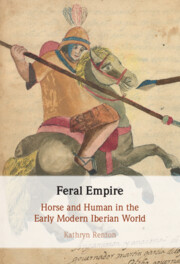
By tracing the dramatic spread of horses throughout the Americas, Feral Empire explores how horses shaped society and politics during the first century of Spanish conquest and colonization. It defines a culture of the horse in medieval and early modern Spain which, when introduced to the New World, left its imprint in colonial hierarchies and power structures. Horse populations, growing rapidly through intentional and uncontrolled breeding, served as engines of both social exclusion and mobility across the Iberian World. This growth undermined colonial ideals of domestication, purity, and breed in Spain's expanding empire. Drawing on extensive research across Latin America and Spain, Kathryn Renton offers an intimate look at animals and their role in the formation of empires. Iberian colonialism in the Americas cannot be explained without understanding human-equine relationships and the centrality of colonialism to human-equine relationships in the early modern world. This title is part of the Flip it Open Program and may also be available Open Access. Check our website Cambridge Core for details.
The regeneration niche defines the specific environmental requirements of the early phases of a plant's life cycle. It is critical for the long-term persistence of plant populations, particularly for obligate seeders that are highly vulnerable to stochastic events in fire-prone ecosystems. Here, we assessed germination characteristics and the relationship between population structure, soil seed bank density and fire response in Stachystemon vinosus (Euphorbiaceae), a rare endemic shrub from Western Australia, from burnt and long unburnt habitats. Many plants in long unburnt habitat were similar in size to those in recently burnt habitat. Soil seed bank density was related to plant abundance and fire history with density lower in burnt than unburnt sites. Thus, inter-fire recruitment may play a critical role in the requirements of the study species. To assess the dormancy status and germination requirements we used a ‘move-along’ experiment with temperatures from six seasonal phases of the year. Seeds were incubated under light and dark conditions, with and without smoked water, and with and without dry after-ripening. Germination was most effective when seeds were treated with smoked water and incubated in the dark at temperatures resembling autumn/winter conditions. After-ripening increased germination in light and dark incubated seeds in the absence of smoked water but was unnecessary for optimal germination in smoked water treated seeds. Irrespective of treatment, seeds showed a requirement for cooler temperatures for germination. These results suggest that rising temperatures and changes in fire regime associated with global warming may alter future germination responses of Stachystemon vinosus.
