To save content items to your account,
please confirm that you agree to abide by our usage policies.
If this is the first time you use this feature, you will be asked to authorise Cambridge Core to connect with your account.
Find out more about saving content to .
To save content items to your Kindle, first ensure no-reply@cambridge.org
is added to your Approved Personal Document E-mail List under your Personal Document Settings
on the Manage Your Content and Devices page of your Amazon account. Then enter the ‘name’ part
of your Kindle email address below.
Find out more about saving to your Kindle.
Note you can select to save to either the @free.kindle.com or @kindle.com variations.
‘@free.kindle.com’ emails are free but can only be saved to your device when it is connected to wi-fi.
‘@kindle.com’ emails can be delivered even when you are not connected to wi-fi, but note that service fees apply.
This volume is dedicated to Paul Erdos, who profoundly influenced mathematics in the twentieth century, with over 1200 papers in number theory, complex analysis, probability theory, geometry, interpretation theory, algebra set theory and combinatorics. One of Erdos' hallmarks was the host of stimulating problems and conjectures, to many of which he attached monetary prices, in accordance with their notoriety. A feature of this volume is a collection of some 50 outstanding unsolved problems, together with their 'value'! Eminent mathematicians from around the world have contributed articles to this volume that reflect the diversity of Erdos' interests, and it will be a fund of insight for number theorists, combinatorialists, set theorists and analysts.
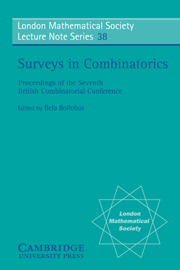
Combinatorics is an active field of mathematical study and the British Combinatorial Conference, held biennially, aims to survey the most important developments by inviting distinguished mathematicians to lecture at the meeting. The contributions of the principal lecturers at the Seventh Conference, held in Cambridge, are published here and the topics reflect the breadth of the subject. Each author has written a broadly conceived survey, not limited to his own work, but intended for wide readership. Important aspects of the subject are emphasized so that non-specialists will find them understandable. Topics covered include graph theory, matroids, combinatorial set theory, projective geometry and combinatorial group theory. All those researching into any aspect of Combinatorics and its applications will find much in these articles of use and interest.
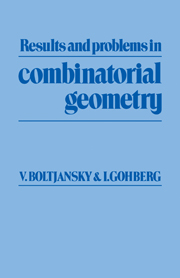
In this short book, the authors discuss three types of problems from combinatorial geometry: Borsuk's partition problem, covering convex bodies by smaller homothetic bodies, and the illumination problem. They show how closely related these problems are to each other. The presentation is elementary, with no more than high-school mathematics and an interest in geometry required to follow the arguments. Most of the discussion is restricted to two- and three-dimensional Euclidean space, though sometimes more general results and problems are given. Thus even the mathematically unsophisticated reader can grasp some of the results of a branch of twentieth-century mathematics that has applications in such disciplines as mathematical programming, operations research and theoretical computer science. At the end of the book the authors have collected together a set of unsolved and partially solved problems that a sixth-form student should be able to understand and even attempt to solve.
Recently, Bollobás, Janson and Riordan introduced a very general family of random graph models, producing inhomogeneous random graphs with Θ(n) edges. Roughly speaking, there is one model for each kernel, i.e. each symmetric measurable function from [0, 1]2 to the non-negative reals, although the details are much more complicated, to ensure the exact inclusion of many of the recent models for large-scale real-world networks.
A different connection between kernels and random graphs arises in the recent work of Borgs, Chayes, Lovász, Sós, Szegedy and Vesztergombi. They introduced several natural metrics on dense graphs (graphs with n vertices and Θ(n2) edges), showed that these metrics are equivalent, and gave a description of the completion of the space of all graphs with respect to any of these metrics in terms of graphons, which are essentially bounded kernels. One of the most appealing aspects of this work is the message that sequences of inhomogeneous quasi-random graphs are in a sense completely general: any sequence of dense graphs contains such a subsequence. Alternatively, their results show that certain natural models of dense inhomogeneous random graphs (one for each graphon) cover the space of dense graphs: there is one model for each point of the completion, producing graphs that converge to this point.
We give an algorithm that, with high probability, recovers a planted $k$-partition in a random graph, where edges within vertex classes occur with probability $p$ and edges between vertex classes occur with probability $r\ge p+c\sqrt{p\log n/n}$. The algorithm can handle vertex classes of different sizes and, for fixed $k$, runs in linear time. We also give variants of the algorithm for partitioning matrices and hypergraphs.
The classical canonical Ramsey theorem of Erdős and Rado states that, for any integer q [ges ] 1, any edge colouring of a large enough complete graph contains one of three canonically coloured complete subgraphs of order q. Of these canonical subgraphs, one is coloured monochromatically while each of the other two has its edge set coloured with many different colours. The paper presents a condition on colourings that, roughly speaking, requires them to make effective use of many colours (‘essential infiniteness’); this condition is then shown to imply that the colourings in question must contain large refinements of one of two ‘unavoidable’ colourings that are rich in colours. As it turns out, one of these unavoidable colourings is one of the canonical colourings of Erdős and Rado, and the other is a ‘bipartite variant’ of this colouring.
By
B. Bollobás, Department of Pure Mathematics and Mathematical Statistics, University of Cambridge, 16 Mill Lane, Cambridge CB2 1SB, England,
Y. Kohayakawa, Instituto de Matemática e Estatística, Universidade de Sāo Paulo, Caixa Postal 20570, 01452–990 São Paulo, SP, Brazil
By
B. Bollobás, Department of Pure Mathematics and Mathematical Statistics, University of Cambridge, 16 Mill Lane, Cambridge CB2 1SB, England,
S. Janson, Department of Mathematics, Uppsala University, PO Box 480, S-751 06 Uppsala, Sweden
There are many elegant results in the theory of convex bodies that may be fully understood by high school students, and at the same time be of interest to expert mathematicians. The aim of this book is to present some of these results. We shall discuss combinatorial problems of the theory of convex bodies, mainly connected with the partition of a set into smaller parts.
The theorems and problems in the book are fairly recent: the oldest of them is just over thirty years old, and many of the theorems are still in their infancy. They were published in professional mathematical journals during the last five years.
We consider the main part of the book to be suitable for high school students interested in mathematics. The material indicated as complicated may be skipped by them. The most straightforward sections concern plane sets: §§1–3, 7–10, 12–14. The remaining sections relate to spatial (and even n-dimensional) sets. For the keen and well-prepared reader, at the end of the book will be found notes, as well as a list of journals, papers and books. References to the notes are given in round brackets (). and references to the bibliography in square brackets []. In several places, especially in the notes, the discussion is at the level of scientific papers. We did not consider it inappropriate to include such material in a non-specialized book.