To save content items to your account,
please confirm that you agree to abide by our usage policies.
If this is the first time you use this feature, you will be asked to authorise Cambridge Core to connect with your account.
Find out more about saving content to .
To save content items to your Kindle, first ensure no-reply@cambridge.org
is added to your Approved Personal Document E-mail List under your Personal Document Settings
on the Manage Your Content and Devices page of your Amazon account. Then enter the ‘name’ part
of your Kindle email address below.
Find out more about saving to your Kindle.
Note you can select to save to either the @free.kindle.com or @kindle.com variations.
‘@free.kindle.com’ emails are free but can only be saved to your device when it is connected to wi-fi.
‘@kindle.com’ emails can be delivered even when you are not connected to wi-fi, but note that service fees apply.
This essay traces the emergence of Anthropocene fantasy through an analysis of three multivolume series—George R. R. Martin's A Song of Ice and Fire, Robin Hobb's Realm of the Elderlings, and N. K. Jemisin's The Broken Earth. Each of these series repurposes the conventions of epic fantasy to analyze the ideological underpinnings of anthropogenic crisis. Among the most important tropes revised are fantasy infrastructures, which, in Anthropocene fantasy, frequently manifest a problematic division between the human and the nonhuman. Consequently, characters’ responses to these infrastructures often reflect these novels’ ecological politics. The surrender of agency associated with the abandonment of ancient infrastructures further indicates Anthropocene fantasy's interest in reimagining the individualistic mode of human agency that drives so many novel plotlines, fantasy and realist alike. Anthropocene fantasy's revision of its own problematic genre infrastructures thus has implications not only for the epic fantasy but for the novel form more broadly.
“American Empire” explores how the interplay between imperialism and race shaped early American politics, literature, and culture. Through a series of close readings of works by Phillis Wheatley, J. Hector St. John de Crèvecœur, William Apess, and James Fenimore Cooper, the essay shows how early American writers wrestled with the continuities and discontinuities between some of the most important concepts that shaped the young republic, in particular the tensions between democracy, empire, freedom, slavery, and race. These internal contradictions between the ideals espoused in political documents such as the Declaration of Independence, the US Constitution, and The Federalist, and the policies of racial exploitation and dispossession that drove the nation’s expansionist economic agenda, would come to shape the most important literary works of the day. Writers like Wheatley, Crèvecœur, Apess, and Cooper would seek to make sense of those contradictions in their writings, a legacy that would carry on through the nineteenth century and into the current moment.
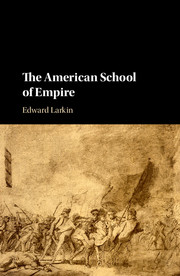
Early American artists and political thinkers wrestled with the challenges of forming a cohesive, if not coherent, culture and political structure to organize the young republic and its diverse peoples. The American School of Empire shows how this American idea of empire emerged through a dialogue with British forms of empire, becoming foundational to how the US organized its government and providing early Americans with the framework for thinking about the relations between states and the disparate peoples and cultures that defined them. Edward Larkin places special emphasis on the forms of the novel and history painting, which were crucial vehicles for the articulation of the American vision of empire in the late eighteenth and early nineteenth centuries.
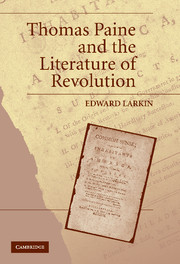
Although the impact of works such as Common Sense and The Rights of Man has led historians to study Thomas Paine's role in the American Revolution and political scientists to evaluate his contributions to political theory, scholars have tacitly agreed not to treat him as a literary figure. This book not only redresses this omission, but also demonstrates that Paine's literary sensibility is particularly evident in the very texts that confirmed his importance as a theorist. And yet, because of this association with the 'masses', Paine is often dismissed as a mere propagandist. Thomas Paine and the Literature of Revolution recovers Paine as a transatlantic popular intellectual who would translate the major political theories of the eighteenth century into a language that was accessible and appealing to ordinary citizens on both sides of the Atlantic.
It can be easy to forget that the American Revolution included a long and difficult armed conflict. Scholars of the period, in both historical and literary studies, have focused almost entirely on the ideas that drove the American colonists to resist British imperial rule and underpinned the new form of government they adopted in that process, the so-called experiment in democracy. The contrast to the historical memory of the American Civil War is instructive. The symbols and images of the Civil War are for the most part specifically related to the bloodshed of war: battlefields such as Gettysburg and Petersburg and events such as the burning of Atlanta and Richmond have become the enduring emblems of the conflict that divided the states. Although battlefields are not entirely absent from the memorializing of the Revolution, the national imagination has been captured more by political sites such as Independence Hall, Mount Vernon, Monticello, and documents such as the Declaration of Independence, the United States Constitution, and the Bill of Rights. Moreover, images such as the signing of the Declaration of Independence (disseminated widely as a popular engraving), the Liberty Bell, and the Boston Tea Party focus attention on the political motivations for independence and push the war into the background, as if the war were incidental to the Revolution and not essential to its success. War, in other words, remains at the center of the cultural memory of the Civil War, whereas it has been pushed to the margins of the story of the American Revolution.
ALOYSIUS VON G*** WAS THE ENNOBLED SON of a burgher in the service of the Prince of ***; early on, the seeds of his felicitous genius were encouraged by a liberal education. Young, but armed with a broad range of knowledge, he entered the military service of the Prince, who could not long remain unaware of the young man's great talents and even greater aspirations. G*** was in the full bloom of his youth, as was the Prince; G*** was quick and enterprising, and the similarly endowed Prince deeply admired such traits. With his prolific wit and comprehensive knowledge, G*** was able to inspire those around him; through his invariable good cheer he delighted the circles in which he moved; he brought zest and life to every situation that arose. The Prince had an eye for just these virtues, which he himself possessed to a great extent. Everything that G*** undertook, even his lighter pursuits, had a touch of grandeur; obstacles did not deter him, and failure could not shake his perseverance. The value of these virtues was heightened by a pleasing stature; the picture of his good health and his Herculean strength were ennobled by the expressive playfulness of his active mind. His countenance, his gait, and his being exuded an innate, natural majesty, which was tempered by a noble modesty. If the Prince was enchanted by his young companion's intellect, G***'s winning appearance appealed even more irresistibly to his sensual nature.