To save content items to your account,
please confirm that you agree to abide by our usage policies.
If this is the first time you use this feature, you will be asked to authorise Cambridge Core to connect with your account.
Find out more about saving content to .
To save content items to your Kindle, first ensure no-reply@cambridge.org
is added to your Approved Personal Document E-mail List under your Personal Document Settings
on the Manage Your Content and Devices page of your Amazon account. Then enter the ‘name’ part
of your Kindle email address below.
Find out more about saving to your Kindle.
Note you can select to save to either the @free.kindle.com or @kindle.com variations.
‘@free.kindle.com’ emails are free but can only be saved to your device when it is connected to wi-fi.
‘@kindle.com’ emails can be delivered even when you are not connected to wi-fi, but note that service fees apply.
Comparing the use of masks and other face coverings in the “mystery plays” of medieval England and taʿziyeh-khani, the Shiʿi form of devotional drama, reveals similar anxieties and impulses surrounding representation of the holy. In performance, what can or must not be shown of divinity? Is the (new) 21st-century inclination toward veiling the faces of holy characters in the taʿziyeh restrictive or an analogue display of divine resplendence? Comparison with the Christian medieval tradition affords a nuanced understanding.
Newest research into drama and performance from the Middle Ages and the Tudor period.
Medieval English Theatre is the premier journal in early theatre studies. Its name belies its wide range of interest: it publishes articles on theatre and pageantry from across the British Isles up to the opening of the London playhouses and the suppression of the civic religious plays, and also includes contributions on European and Latin drama, together with analyses of modern survivals or equivalents, and of research productions of medieval plays.
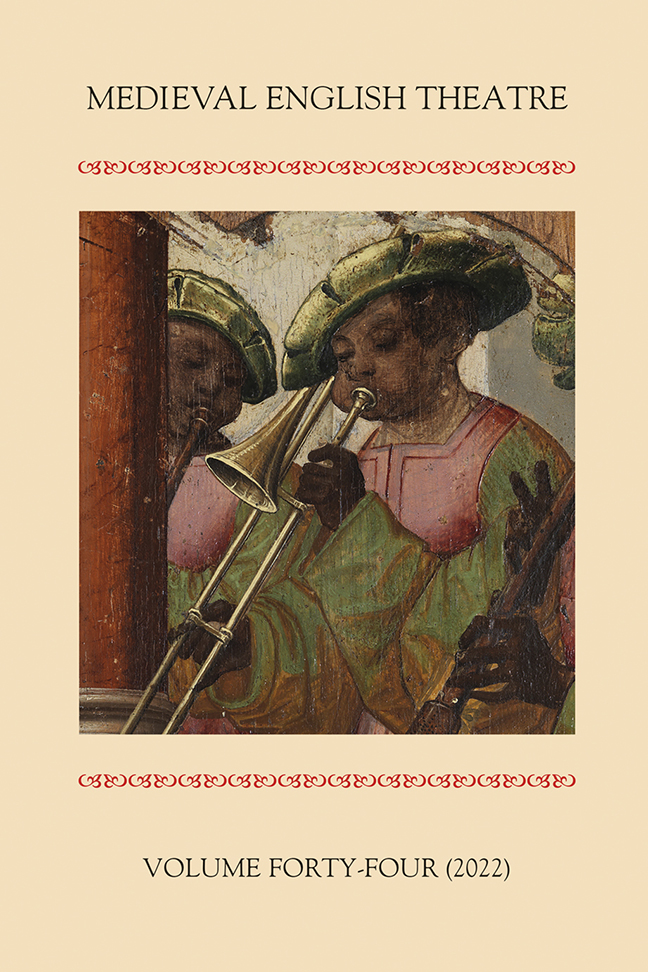
This volume is testament to the lively range of current research across the field of medieval theatre. It investigates different traditions of performance, through a variety of theatrical, theological, and material approaches. It opens with an analysis of a fascinating Dutch rhetoricians play-text, revealing how its engagingly disruptive female character, "Everyday Chitchat", proves central to a serious discussion of censorship - in a play which was itself censored. Although no play-text survives from medieval Beverley, the next contribution shows how local records of its Corpus Christi plays offer rich details of a range of pageants and organisation not dissimilar from its more famous neighbour, York. The two following articles investigate theological issues. A nuanced re-reading of The Treatise of Miracles Playing considers how priestly involvement in performance raised anxieties about the role and authority of priests, including at the Mass. Attitudes to "dread", revealed through the taxonomies of fear developed by medieval theologians, then illuminate the didactic role of fear, engendered in the protagonists and audiences of the Macro morality plays. The volume closes with the second part of an investigation into "John Blanke's Hat". Following the first part's demonstration, in the previous volume of METh, that the Black trumpeter's headgear was not a marker of his faith, this uncovers the true identity of the hat, asking how far it can offer evidence for his history. The present volume thus throws new light on familiar texts and questions, offering important contributions to newly developing fields of study.
In April 2024 the Medieval English Theatre conference was held at the University of Newcastle, admirably hosted by James Cummings. The theme was ‘Dramatic Margins’, and the papers covered a stimulating range of topics while exhibiting characteristic METh interest in manuscripts, historical records, and drama in performance. Papers invited us to consider how attention to margins, of various kinds, could illuminate questions about how to define ‘drama’, ‘performance’, and ‘theatre’ – questions which are theoretical but which are also made practical in the activities of collecting records of ‘early drama’ or taking words from page to ‘stage’.
Charlotte Steenbrugge discussed the play-frame of the Dutch Tspel van dOnghelycke Munte (‘The Play of the Fluctuating Currency’), with its creatively disruptive female character, Everyday Chitchat. Sarah Grandage, with Dana Key on Zoom, described a project on the use of marginal playing spaces in modern performance, in which students from the University of Nottingham presented performances of Joseph's Trouble and the Nativity among the medieval alabasters in the Nottingham Castle museum. Pamela King, joined on Zoom by David Parkinson, presented his new edition of Henry Adamson's The Muses Threnodie, a delightfully humorous Scottish seventeenth-century text which through argument and animated reading they persuasively demonstrated should be considered as para-drama. Eleanor Rycroft and Clare Wright led a lively and stimulating panel discussion of the term ‘Pre-Dramatic Theatre’, drawing on their current project with Greg Walker to explore the uses and limitations of terminology in current theatre studies.