To save content items to your account,
please confirm that you agree to abide by our usage policies.
If this is the first time you use this feature, you will be asked to authorise Cambridge Core to connect with your account.
Find out more about saving content to .
To save content items to your Kindle, first ensure no-reply@cambridge.org
is added to your Approved Personal Document E-mail List under your Personal Document Settings
on the Manage Your Content and Devices page of your Amazon account. Then enter the ‘name’ part
of your Kindle email address below.
Find out more about saving to your Kindle.
Note you can select to save to either the @free.kindle.com or @kindle.com variations.
‘@free.kindle.com’ emails are free but can only be saved to your device when it is connected to wi-fi.
‘@kindle.com’ emails can be delivered even when you are not connected to wi-fi, but note that service fees apply.
Large-scale quality improvement programmes (QIPs) have diverse factors that may influence their success and can undergo rapid changes throughout their lifecycle. The COllaboratioN on QUality improvement initiative for achieving Excellence in STandards of COPD care (CONQUEST) programme has recently been implemented in primary care practices in the UK. The CONQUEST programme aims to identify patients with already diagnosed and undiagnosed COPD at high risk of COPD-related adverse outcomes and optimize their management. CONQUEST has been successful in identifying COPD patients who may represent an outsized opportunity to improve patient outcomes and healthcare utilization, whilst focusing on relatively few patients per primary care practice. This paper reviews the steps involved in implementing CONQUEST in the UK, focussing on the challenges encountered, the solutions used to overcome these challenges barriers, and the lessons learned for the implementation of QIPs more widely. Key lessons from this process include that QIPs need to be designed with the flexibility to adapt to multiple and different local contexts, that early monitoring of data across the lifecycle of a QIP allows efficient detection of issues and troubleshooting, and that planning for allocation of limited resources to a QIP is essential for real-world implementation. The problems and solutions described here are applicable to QIPs in a wide variety of high-risk diseases and different healthcare settings.
The psychological consequences of hospital admission for COVID-19, such as post-traumatic stress disorder (PTSD), are under-researched.
Aims
To describe the prevalence of, and risk factors for, psychological trauma symptoms in COVID-19 patients discharged from hospital.
Method
We used data from the Post-Hospitalisation COVID-19 (PHOSP-COVID) study of adults discharged from UK hospitals after COVID-19. Psychological trauma was assessed using the Posttraumatic Stress Disorder Checklist for DSM-5 (PCL-5) 5 and 12 months after discharge. We used log binomial regression to identify risk factors for probable PTSD.
Results
We describe 1565 study participants discharged from hospital between February 2020 and March 2021 following an admission for COVID-19. Most were male (61.3%), White (77.4%) and from more deprived areas (62%). Of these, 15% had probable PTSD (PCL-5 ≥34) at 5 months which was associated with being 18 to 50 years old (risk ratio: 3.0 (2.1– 4.3), p < 0.001), lower income (e.g. <£19,001, risk ratio 2.1, 95% CI: 1.5 – 2.8, p < 0.001), longer admission and a history of depression or anxiety. Out of 236, 136 (57.6%) with probable PTSD at 5 months still had probable PTSD at 12 months. Persistence was associated with intensive care unit (ICU) admission (risk ratio 1.3, 95% CI 1.1–1.6, p < 0.001) and higher anxiety and PCL-5 scores at 5 months.
Conclusions
Probable PTSD was common 5 months after admission for COVID-19 and was associated with lower socioeconomic status, longer admission and previous depression or anxiety. Over half remained symptomatic at 12 months, associated with ICU admission and higher 5-month PCL-5 scores.
The melting of ice shelves into the ocean plays a major role, and is a key source of uncertainty, in sea level rise projections. Under-ice shelves, meltwater moves upslope, setting up a stratified shear flow with the warmer, but critically saltier, ocean beneath, regulating the transfer of heat between ice and the ambient ocean. Such features are incredibly difficult to access in situ, and so most research has focussed on the use of numerical modelling, laboratory experiments and analytical models to understand these processes, each with their own trade-offs. Here, novel numerical simulations of the Navier–Stokes equations approximate this flow for a tilted domain forced with fixed densities at the upper and lower boundaries to induce such a buoyant boundary shear current. These simulations and accompanying linear stability analysis (LSA) reveal that the shear flows under-ice shelves form a unique mixed-mode shear instability. This instability consists of paired Kelvin Helmholtz and Holmboe instabilities, highly effective at mixing the water column, and due to the restoring effect of the boundary forcing, results in a cyclical instability. The flow criticality is found to be well predicted by LSA, and dependent on diagnostic flow Reynolds and bulk Richardson numbers, whilst the local gradient Richardson number is not a useful indicator of instability in this problem. Based on these results, it is unclear how well this unusual route to turbulent mixing is represented in current models, highlighting the need for further investigation into turbulent heat transfer and ice-shelf melting.
Resource-rational contractualism explains human moral reasoning as efficient heuristics approximating idealized bargaining processes. Levine et al. compellingly model pairwise and small-group moral cognition, but overlook how institutions serve as computational shortcuts – pre-computed agreements that eliminate repeated negotiation. These cached computations can become rigid over time, driving new opportunities for flexible negotiation.
Since the late 1980s, Northern Ireland has seen a radical electoral shift away from the historically dominant parties in the Catholic and Protestant blocs – the Social Democratic and Labour Party (SDLP) and Ulster Unionist Party (UUP), respectively – towards the traditionally more ‘extreme’ parties – Sinn Fein and the Democratic Unionist Party (DUP). This change in aggregate support has been accompanied by increasing differences between generations as older cohorts of UUP and SDLP supporters have been replaced by newer cohorts of DUP and Sinn Fein partisans. This is not a result of increased polarisation in values and attitudes (whether overtly political or simply communal intolerance) among younger cohorts who are, if anything, slightly more moderate than their forbears. Rather, this results from the changing political context in which new generations have been socialised – in particular the expanded choice sets facing voters as they have reached voting age. This in turn has positive implications for the consolidation of devolved democratic governance.
External auditory exostosis (surfer’s ear) is a progressive condition of benign hyperostotic overgrowths of the external auditory canal, secondary to repetitive cold-water exposure, in which symptoms correlate to degree of exostosis. Surgical intervention is the only available treatment, most commonly using the osteotome or microdrill, but these carry a risk of sensorineural hearing loss, post-operative stenosis, temporomandibular dysfunction and tympanic membrane perforation.
Methods
We describe in detail the Swansea technique, an innovative method of canaloplasty with endoscopic underwater excision of exostoses using a piezoelectric saw and continuous irrigation with 1:1,000,000 adrenaline, with the results from our first 34 procedures.
Results
The inherent properties of the piezoelectric saw reduce the risk of overall complications when compared with traditional methods, whilst the surgical set-up is cost-equivocal and easily implemented in departments with endoscopic capabilities.
Conclusion
The piezoelectric saw is a promising novel technique for the treatment of external auditory exostosis.
We surveyed physicians and patients to create a novel Desirability of outcome ranking (DOOR) for non-severe community-acquired pneumonia (CAP). Patients generally ranked uncomfortable but non-life-threatening symptoms as less desirable, while physicians focused on traditional medical outcomes. When developing DOORs, both patient and clinician perspectives should be considered.
The phylogenetic relationships among arthropods remain contentious because morphological studies face challenges in resolving certain branches. Particularly difficult are relationships within and between the stem arthropods, owing largely to too few well-preserved fossil representatives. Additional fossil evidence, particularly from exceptional deposits like the Silurian Waukesha Lagerstätte in Wisconsin, helps to bolster our views on the evolutionary history of arthropods by providing well-preserved examples of novel taxa that could fit between early diverging stem-arthropod clades and modern euarthropods, thus building possible bridges between the two. Formed in karstification-induced troughs of the Manistique Formation paleoslope, the Waukesha Lagerstätte preserves a unique biota of organisms from the Telychian Age, mostly through secondary precipitation of francolite. Perhaps most well known from this deposit are the many peculiar and enigmatic arthropod taxa that could help resolve early arthropod cladistic relationships. We add to the growing body of work on the diversity, phylogeny, and taxonomic descriptions of the Waukesha biota by detailing a previously unnamed bivalved arthropod, informally called ‘the butterfly animal’ in past literature—which we here designate as Papiliomaris kluessendorfae n. gen. n. sp. We also conducted a Bayesian phylogenetic analysis that placed several recently described Waukesha taxa as basal members of the ‘Mandibulate’ clade within the Euarthropoda.
We report the introduction of Juxtacribrilina mutabilis, a nonindigenous marine encrusting bryozoan, to eastern Canada. Previously reported as a nonindigenous species (NIS) in Europe and Maine, USA, this species is of potential ecological concern due to its propensity to foul eelgrass (Zostera marina), an ecologically important habitat-forming coastal species. By compiling prior unpublished records, re-evaluating existing specimens, and collecting new records of J. mutabilis, we discovered that the species has a widespread distribution in eastern Canada. Specimen reclassification efforts in our study indicate that J. mutabilis has been present in eastern Canada since at least 2013, but the species largely escaped notice until 2024, likely due to its similarity to other encrusting bryozoan species and other factors inhibiting its detection. In light of the distributional and genetic data collected in this study, we reconstruct the possible invasion history of J. mutabilis in eastern Canada, including potential introduction mechanisms, timing, and source regions. We also discuss the ecology of J. mutabilis in eastern Canada, evaluating the factors influencing the morphology of the bryozoan, assessing its potential to detrimentally impact its eelgrass substrate, and estimating its environmental niche. Further research into the distribution, ecology, and potential impacts of J. mutabilis in eastern Canada is recommended. This case study highlights the importance of diversity in the habitats surveyed and methods used when monitoring for marine NIS, the need for horizon scanning to raise awareness of potential NIS, and the advantages of multi-party collaboration and citizen science for early detection of such species.
Nursing homes residents have a high prevalence of multidrug-resistant organism (MDRO) colonization. Recent trials demonstrated that decolonizing residents reduces infection. However, decolonization’s impact on environmental MDRO contamination is not well understood.
Methods:
We performed a 9-month pilot (3-month baseline, 3-month phase-in and 3-month intervention) in 3 nursing homes implementing routine chlorhexidine bathing/showering and nasal iodophor. We repeatedly tested for colonization via skin and nasal swabs for methicillin-resistant Staphylococcus aureus (MRSA), vancomycin-resistant Enterococcus (VRE), extended-spectrum beta-lactamase producers (ESBLs), and carbapenem-resistant Enterobacterales (CRE). We also swabbed high-touch surfaces in rooms of MDRO carriers for MDRO fomite contamination.
Results:
Decolonization decreased the odds of MDRO colonization in nursing home residents by 55% (OR 0.45, P < 0.001, raw reduction from 46% (411/900) to intervention: 29% (262/900); colonization with MRSA, VRE, and ESBL all significantly decreased (P < 0.001). Among residents who remained colonized with any MDRO, 288/330 (87%) of high-touch bedroom objects were colonized with ≥1 MDRO. In a multivariable analysis, MDRO fomite contamination in rooms of MDRO carriers was associated with antibiotic use (OR = 1.54 [95% CI: 1.19–1.98], wound presence (OR = 1.34 (95% CI: 1.02–1.77), and specific fomites such as bedside table/bedrails (OR = 12.7 (95% CI: 9.37–17.25), but not the intervention period (OR = 1.02 [0.81–1.27]).
Conclusion:
Routine chlorhexidine bathing and nasal iodophor significantly reduced MDRO body colonization among nursing home residents. However, in rooms of residents who remained MDRO carriers, environmental contamination was unchanged during the decolonization intervention. Efforts to ensure fomite surface clearance in rooms of MDRO carriers may be key to reducing environmental MDRO spread.
Patients with posttraumatic stress disorder (PTSD) exhibit smaller regional brain volumes in commonly reported regions including the amygdala and hippocampus, regions associated with fear and memory processing. In the current study, we have conducted a voxel-based morphometry (VBM) meta-analysis using whole-brain statistical maps with neuroimaging data from the ENIGMA-PGC PTSD working group.
Methods
T1-weighted structural neuroimaging scans from 36 cohorts (PTSD n = 1309; controls n = 2198) were processed using a standardized VBM pipeline (ENIGMA-VBM tool). We meta-analyzed the resulting statistical maps for voxel-wise differences in gray matter (GM) and white matter (WM) volumes between PTSD patients and controls, performed subgroup analyses considering the trauma exposure of the controls, and examined associations between regional brain volumes and clinical variables including PTSD (CAPS-4/5, PCL-5) and depression severity (BDI-II, PHQ-9).
Results
PTSD patients exhibited smaller GM volumes across the frontal and temporal lobes, and cerebellum, with the most significant effect in the left cerebellum (Hedges’ g = 0.22, pcorrected = .001), and smaller cerebellar WM volume (peak Hedges’ g = 0.14, pcorrected = .008). We observed similar regional differences when comparing patients to trauma-exposed controls, suggesting these structural abnormalities may be specific to PTSD. Regression analyses revealed PTSD severity was negatively associated with GM volumes within the cerebellum (pcorrected = .003), while depression severity was negatively associated with GM volumes within the cerebellum and superior frontal gyrus in patients (pcorrected = .001).
Conclusions
PTSD patients exhibited widespread, regional differences in brain volumes where greater regional deficits appeared to reflect more severe symptoms. Our findings add to the growing literature implicating the cerebellum in PTSD psychopathology.
To understand the scenarios where health care worker (HCW) masking is most impactful for preventing nosocomial transmission.
Methods:
A mathematical agent-based model of nosocomial spread with masking interventions. Masking adherence, community prevalence, disease transmissibility, masking effectiveness, and proportion of breakroom (unmasked) interactions were varied. The main outcome measure is the total number of nosocomial infections in patients and HCW populations over a simulated three-month period.
Results:
HCW masking around patients and universal HCW masking reduces median patient nosocomial infections by 15% and 18%, respectively. HCW-HCW interactions are the dominant source of HCW infections and universal HCW masking reduces HCW nosocomial infections by 55%. Increasing adherence shows a roughly linear reduction in infections. Even in scenarios where a high proportion of interactions are unmasked “breakroom” interactions, masking is still an effective tool assuming adherence is high outside of these areas. The optimal scenarios where masking is most impactful are those where community prevalence is at a medium level (around 2%) and transmissibility is high.
Conclusions:
Masking by HCWs is an effective way to reduce nosocomial transmission at all levels of mask effectiveness and adherence. Increases in adherence to a masking policy can provide a small but important impact. Universal HCW masking policies are most impactful should policymakers wish to target HCW infections. The more transmissible a variant in circulation is, the more impactful HCW masking is for reducing infections. Policymakers should consider implementing masking at the point when community prevalence is optimum for maximum impact.
The marketing of foods and non-alcoholic beverages (hereafter: food) high in fat, salt and/or sugar (HFSS) is implicated in the development of poor dietary habits, overweight and obesity. Digital media, including video game live streaming platforms (VGLSP), are an increasingly prominent source of food marketing exposure, particularly for young people. This study aimed to experimentally examine the impact of food marketing via VGLSP on eating behaviour in young people.
Design:
A between-subjects randomised controlled trial design was used to explore the impact of exposure to HFSS food marketing in a video game live stream (a static food banner advert present throughout the footage) on immediate consumption of the marketed snack and an ‘alternative brand’ of the same snack in a sample of adolescents (n 91, Mage = 17·8, 69 % female). Relationships with food-advertising-related attentional bias and inhibitory control in relation to branded food cues were also examined.
Setting:
University Psychology laboratory.
Results:
Exposure to HFSS food marketing, compared with non-food marketing, did not significantly impact immediate marketing or overall snack intake. Additionally, no significant effects for attentional bias or inhibitory control were found. However, although the overall model was non-significant, greater weekly use of VGLSP was significantly associated with greater marketed snack intake.
Conclusions:
Findings suggest that while acute exposure to food marketing in VGLSP did not impact snack intake, perhaps more sustained exposure is impactful. Further exploration of this effect is needed, as well as studies investigating the potential impacts of other food marketing formats within VGLSP.
We present the Evolutionary Map of the Universe (EMU) survey conducted with the Australian Square Kilometre Array Pathfinder (ASKAP). EMU aims to deliver the touchstone radio atlas of the southern hemisphere. We introduce EMU and review its science drivers and key science goals, updated and tailored to the current ASKAP five-year survey plan. The development of the survey strategy and planned sky coverage is presented, along with the operational aspects of the survey and associated data analysis, together with a selection of diagnostics demonstrating the imaging quality and data characteristics. We give a general description of the value-added data pipeline and data products before concluding with a discussion of links to other surveys and projects and an outline of EMU’s legacy value.
We describe Swauka ypresiana n. gen. n. sp., the second fossil gossamerwing damselfly (Odonata, Zygoptera, Epallagidae, Epallaginae) and its oldest occurrence. It is the first fossil insect reported from the Swauk Formation of central Washington State, U.S.A. It was recovered from the “Sandstone facies of Swauk Pass,” a fluvial unit, immediately below the Silver Pass Volcanic Member of the Swauk Formation, which has a U–Pb zircon CA-ID-TIMS age of 51.364 ± 0.029 Ma. The host deposits probably represent mud-dominated floodplain lake or oxbow lake environments.
Young stellar objects (YSOs) are protostars that exhibit bipolar outflows fed by accretion disks. Theories of the transition between disk and outflow often involve a complex magnetic field structure thought to be created by the disk coiling field lines at the jet base; however, due to limited resolution, these theories cannot be confirmed with observation and thus may benefit from laboratory astrophysics studies. We create a dynamically similar laboratory system by driving a $\sim$1 MA current pulse with a 200 ns rise through a $\approx$2 mm-tall Al cylindrical wire array mounted to a three-dimensional (3-D)-printed, stainless steel scaffolding. This system creates a plasma that converges on the centre axis and ejects cm-scale bipolar outflows. Depending on the chosen 3-D-printed load path, the system may be designed to push the ablated plasma flow radially inwards or off-axis to make rotation. In this paper, we present results from the simplest iteration of the load which generates radially converging streams that launch non-rotating jets. The temperature, velocity and density of the radial inflows and axial outflows are characterized using interferometry, gated optical and ultraviolet imaging, and Thomson scattering diagnostics. We show that experimental measurements of the Reynolds number and sonic Mach number in three different stages of the experiment scale favourably to the observed properties of YSO jets with $Re\sim 10^5\unicode{x2013}10^9$ and $M\sim 1\unicode{x2013}10$, while our magnetic Reynolds number of $Re_M\sim 1\unicode{x2013}15$ indicates that the magnetic field diffuses out of our plasma over multiple hydrodynamical time scales. We compare our results with 3-D numerical simulations in the PERSEUS extended magnetohydrodynamics code.

Background: Most individuals with dementia in the UK die in care homes. 70% of these are residential, relying on external healthcare professionals to manage the complex needs. eHealth can help facilitate the delivery of holistic care in care homes, yet adoption has traditionally been faced with resistance. Innovative approaches employing Methods from implementation science are required to promote the uptake of eHealth in care homes.
Aim: To evaluate the feasibility of a theoretically-informed co-designed implementation plan for an eHealth intervention to support holistic assessment and decision making for people with dementia in care homes and their family carers, and to identify opportunities to strengthen it.
Methods: An embedded mixed-Methods study conducted in two residential care homes. Qualitative data comprised non-participant observations of the intervention in use, focus groups and semi-structured interviews with care home staff. Data was analysed using a codebook thematic analysis underpinned by the Normalistion Process Theory. Quantitative data included app usage data and two implementation measures, analysed using descriptive statistics. Patient and public involvement informed development and conduct of the study.
Results: 20 care home staff across two care homes used the intervention with 26 residents. Whilst there was some evidence of adoption, reach within the care home and feasibility of its implementation, usage data indicated that the intervention was largely not utilised as intended. Whilst there was sufficient coherence around the intervention, staff faced barriers related to collective action including workload and incompatibility with practice. Reflexive monitoring was therefore low as individuals could not appraise its impact, which compromised staff cognitive participation. Revisions to the plan related to strategies to provide further staff support, including encouraging family involvement and a more tailored approach to training.
Conclusions: Evaluating feasibility of the implementation plan of the intervention was a vital step in its development. Rapid evaluation and iterative response to barriers to use informed learning and allowed for real- time adjustments to implementation strategies, and a set of updated recommendations for use. Further collaboration on the revised strategies with people living with dementia and their family carers is required.
In response to the COVID-19 pandemic, we rapidly implemented a plasma coordination center, within two months, to support transfusion for two outpatient randomized controlled trials. The center design was based on an investigational drug services model and a Food and Drug Administration-compliant database to manage blood product inventory and trial safety.
Methods:
A core investigational team adapted a cloud-based platform to randomize patient assignments and track inventory distribution of control plasma and high-titer COVID-19 convalescent plasma of different blood groups from 29 donor collection centers directly to blood banks serving 26 transfusion sites.
Results:
We performed 1,351 transfusions in 16 months. The transparency of the digital inventory at each site was critical to facilitate qualification, randomization, and overnight shipments of blood group-compatible plasma for transfusions into trial participants. While inventory challenges were heightened with COVID-19 convalescent plasma, the cloud-based system, and the flexible approach of the plasma coordination center staff across the blood bank network enabled decentralized procurement and distribution of investigational products to maintain inventory thresholds and overcome local supply chain restraints at the sites.
Conclusion:
The rapid creation of a plasma coordination center for outpatient transfusions is infrequent in the academic setting. Distributing more than 3,100 plasma units to blood banks charged with managing investigational inventory across the U.S. in a decentralized manner posed operational and regulatory challenges while providing opportunities for the plasma coordination center to contribute to research of global importance. This program can serve as a template in subsequent public health emergencies.
Background: Carbapenem-resistant Acinetobacter baumannii (CRAB) and Pseudomonas aeruginosa (CRPA) are drug-resistant pathogens causing high mortality rates with limited treatment options. Understanding the incidence of these organisms and laboratory knowledge of testing protocols is important for controlling their spread in healthcare settings. This project assessed how often Veterans Affairs (VA) healthcare facilities identify CRAB and CRPA and testing practices used. Method: An electronic survey was distributed to 126 VA acute care facilities September-October 2023. The survey focused on CRAB and CRPA incidence, testing and identification, and availability of testing resources. Responses were analyzed by complexity of patients treated at VA facilities (High, Medium, Low) using Fisher’s exact tests. Result: 77 (61.1%) facilities responded, most in urban settings (85.4%). Most respondents were lead or supervisory laboratory technologists (84.2%) from high complexity facilities (69.0%). Few facilities detected CRAB ≥ once/month (4.4%), with most reporting that they have not seen CRAB at their facility (55.0%). CRPA was detected more frequently: 19% of facilities with isolates ≥ once/month, 29.2% a few times per year, and 26.9% reporting had not seen the organism. No differences in CRAB or CRPA incidence was found by facility complexity. Nearly all facilities, regardless of complexity, utilize the recommended methods of MIC or disk diffusion to identify CRAB or CRPA (91.9%) with remaining facilities reporting that testing is done off-site (7.8%). More high complexity facilities perform on-site testing compared to low complexity facilities (32.0% vs 2.7%, p=0.04). 83% of laboratories test for Carbapenemase production, with one-fourth using off-site reference labs. One-fourth of facilities perform additional antibiotic susceptibility testing for CRAB and CRPA isolates, most of which test for susceptibility to combination antibiotics; no differences between complexities were found. Agreement that sufficient laboratory and equipment resources were available was higher in high complexity than in medium complexity facilities (70.7% vs 33.3%, p=0.01), but not low complexity facilities (43.8%). Conclusion: Having timely and accurate testing protocols for CRAB and CRPA are important to quickly control spread and reduce associated mortality. This study shows that most VA protocols follow recommended testing and identification guidelines. Interestingly, there was no difference in CRAB or CRPA incidence for facilities providing higher vs lower complexity of care. While high and low complexity facilities generally reported sufficient resources for CRAB and CRPA evaluation, some medium-complexity labs, who may feel more compelled than low-complexity labs to bring testing in house, reported that additional resources would be required.
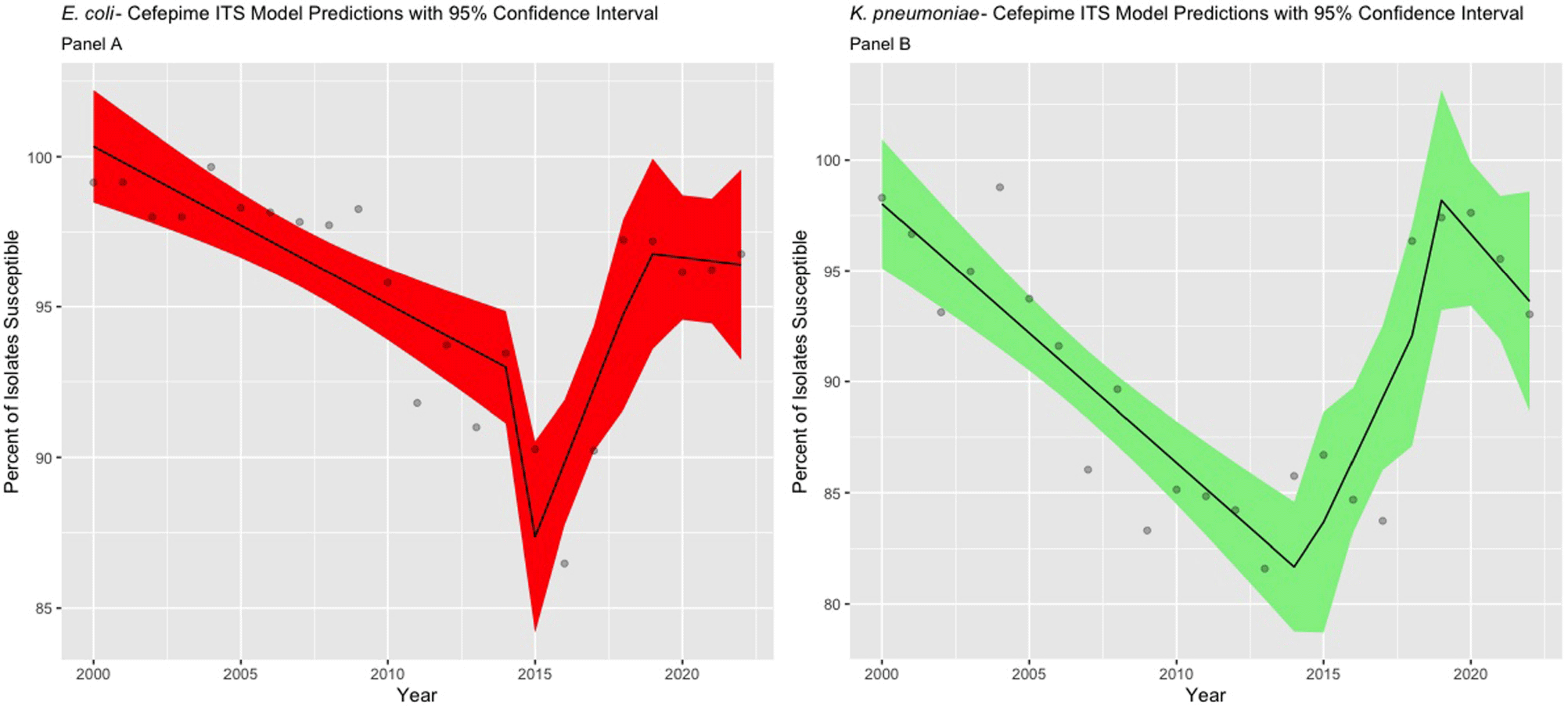
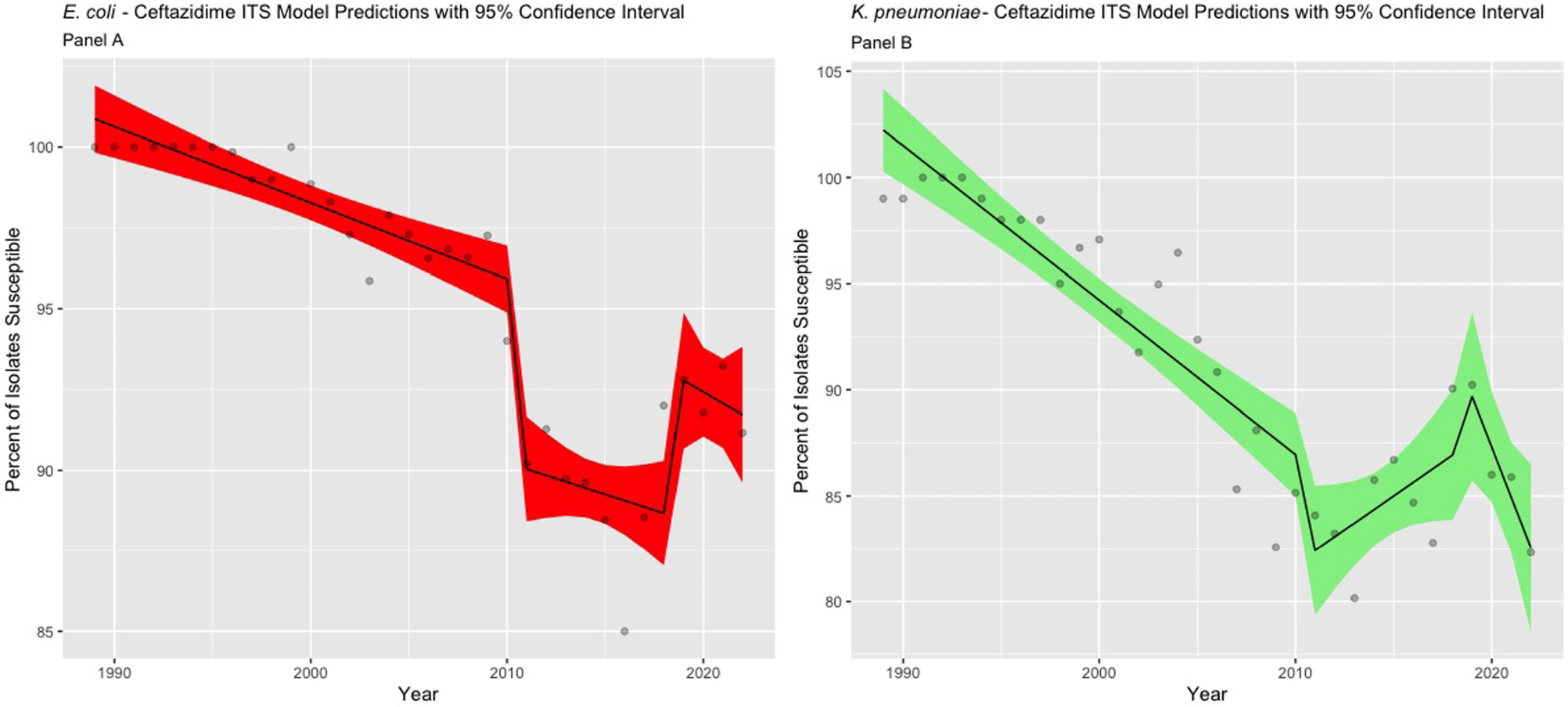
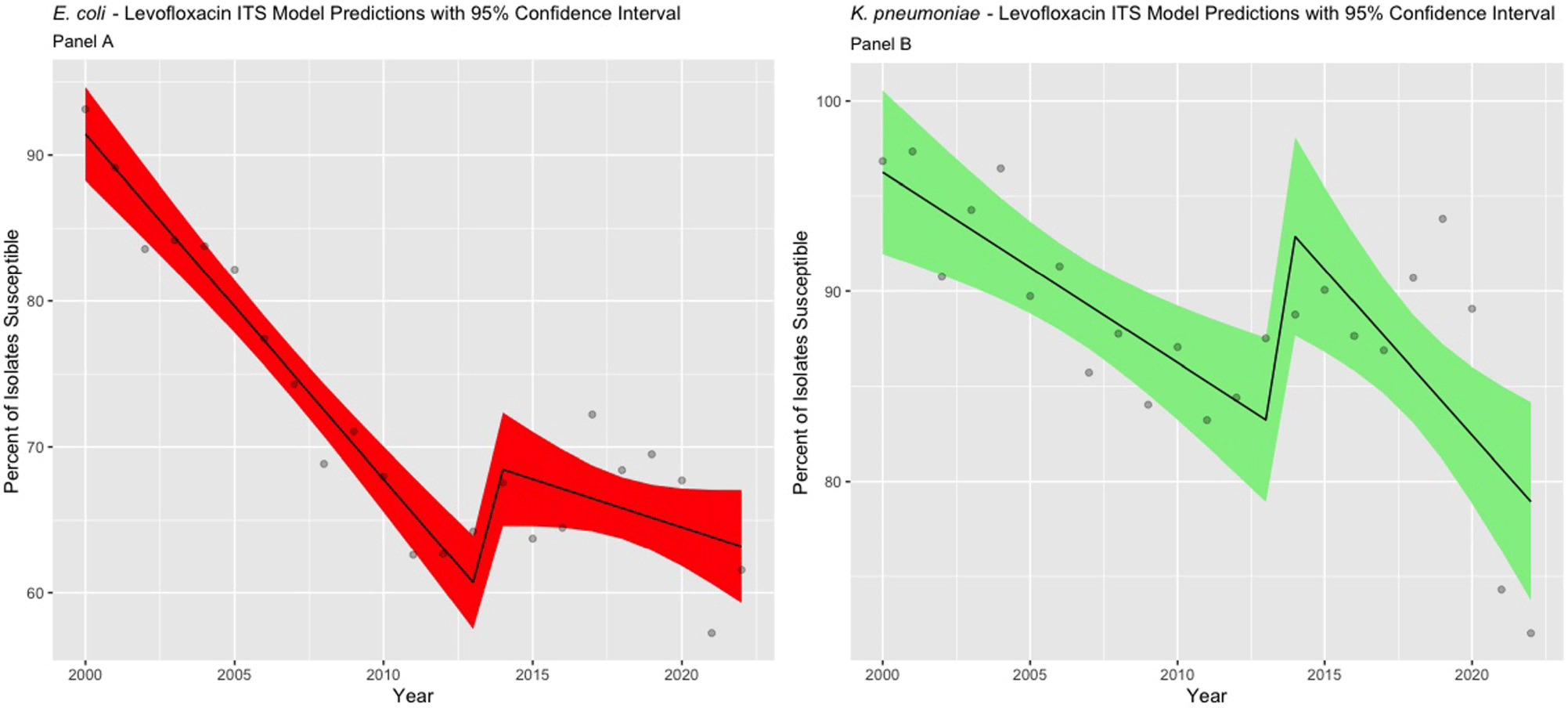
Background: The Clinical & Laboratory Standards Institute (CLSI) recommends use of annual antibiograms to help guide empiric antibiotic therapy. Because CLSI periodically updates minimum inhibitory concentration (MIC) breakpoints, we assessed the impact of these updates on longitudinal trends in antibiotic susceptibility rates for Escherichia coli and Klebsiella pneumoniae at a single academic medical center in Atlanta, GA. Methods: Susceptibilities for cefepime, ceftazidime, and levofloxacin in E. coli and K. pneumoniae were extracted from hospital antibiograms from 1988 to 2022. Starting in 1995, intensive care units (ICUs) and wards had separate annual antibiograms, which we combined using weighted averages to create annual overall hospital antibiograms. After summarizing the frequency of isolates tested and susceptibilities using medians and interquartile ranges (IQR), we conducted an interrupted time series analysis using linear segmented regression models, to evaluate the level changes and trends in susceptibility, before and after CLSI MIC breakpoints were updated for ceftazidime (2010 and 2017), cefepime (2014 and 2017), and levofloxacin (2013). Results: Among 21,214 E. coli, there was a median of 291 [IQR: 104, 555] isolates tested annually. Similarly, among 8,686 K. pneumoniae isolates, the median was 125 per year (IQR: 76, 178). Prior to the MIC breakpoint changes, baseline susceptibility trends of both organisms to all 3 antibiotics significantly declined at a rate between 0.2% to 2.4% per year (Table 1). For cefepime (Figure 1), susceptibility decreased annually during 1988 – 2013 for both E. coli (-0.5%) and K. pneumoniae (-1.2%). There were no significant level changes but there were trend changes after 2018, for E. coli (+2.1%) and K. pneumoniae (– 5.5%). For ceftazidime (Figure 2), significant level changes occurred after 2010 for both organisms (E. coli: -5.7%; K. pneumoniae: -5.2%). For levofloxacin (Figure 3), the breakpoint update in 2013 lead to significant level change in susceptibility (E. coli: +8.4%; K. pneumoniae: +11.4%). Conclusion: Overall, we observed a consistent decrease in antibiotic susceptibility in E. coli and K. pneumoniae over three decades, with immediate increases in the level change of susceptibility when MIC breakpoints were changed, followed by a decreasing trend. These findings highlight the importance of longitudinal surveillance and MIC breakpoint changes to inform antimicrobial stewardship strategies.