Refine search
Actions for selected content:
25 results
Bibliography
-
- Book:
- Women and Colonial Law
- Published online:
- 28 February 2025
- Print publication:
- 10 April 2025, pp 249-276
-
- Chapter
-
- You have access
- Open access
- Export citation
6 - Votes, Reserved Seats and Women’s Participation
-
- Book:
- Women and Colonial Law
- Published online:
- 28 February 2025
- Print publication:
- 10 April 2025, pp 132-154
-
- Chapter
-
- You have access
- Open access
- Export citation
Dedication
-
- Book:
- Women and Colonial Law
- Published online:
- 28 February 2025
- Print publication:
- 10 April 2025, pp vii-viii
-
- Chapter
-
- You have access
- Open access
- Export citation
Frontmatter
-
- Book:
- Women and Colonial Law
- Published online:
- 28 February 2025
- Print publication:
- 10 April 2025, pp i-vi
-
- Chapter
-
- You have access
- Open access
- Export citation
Acknowledgements
-
- Book:
- Women and Colonial Law
- Published online:
- 28 February 2025
- Print publication:
- 10 April 2025, pp xv-xvi
-
- Chapter
-
- You have access
- Open access
- Export citation
4 - Female Childhood in Focus
-
- Book:
- Women and Colonial Law
- Published online:
- 28 February 2025
- Print publication:
- 10 April 2025, pp 74-95
-
- Chapter
-
- You have access
- Open access
- Export citation
1 - Introduction: Women and Colonial Law—A Feminist Social History
-
- Book:
- Women and Colonial Law
- Published online:
- 28 February 2025
- Print publication:
- 10 April 2025, pp 1-21
-
- Chapter
-
- You have access
- Open access
- Export citation
3 - The Widow and Her Rights Redefined
-
- Book:
- Women and Colonial Law
- Published online:
- 28 February 2025
- Print publication:
- 10 April 2025, pp 48-73
-
- Chapter
-
- You have access
- Open access
- Export citation
5 - Labour Legislation and the Woman Worker
-
- Book:
- Women and Colonial Law
- Published online:
- 28 February 2025
- Print publication:
- 10 April 2025, pp 96-131
-
- Chapter
-
- You have access
- Open access
- Export citation
8 - Personal Laws under Colonial Rule
-
- Book:
- Women and Colonial Law
- Published online:
- 28 February 2025
- Print publication:
- 10 April 2025, pp 187-219
-
- Chapter
-
- You have access
- Open access
- Export citation
9 - Towards a Uniform Civil Code—and Beyond
-
- Book:
- Women and Colonial Law
- Published online:
- 28 February 2025
- Print publication:
- 10 April 2025, pp 220-244
-
- Chapter
-
- You have access
- Open access
- Export citation
Preface
-
- Book:
- Women and Colonial Law
- Published online:
- 28 February 2025
- Print publication:
- 10 April 2025, pp xi-xiv
-
- Chapter
-
- You have access
- Open access
- Export citation
7 - Family Forms, Sexualities and Reconstituted Patriarchies
-
- Book:
- Women and Colonial Law
- Published online:
- 28 February 2025
- Print publication:
- 10 April 2025, pp 155-186
-
- Chapter
-
- You have access
- Open access
- Export citation
Index
-
- Book:
- Women and Colonial Law
- Published online:
- 28 February 2025
- Print publication:
- 10 April 2025, pp 277-296
-
- Chapter
-
- You have access
- Open access
- Export citation
Afterword: The Law, Women and an Argument about the Past
-
- Book:
- Women and Colonial Law
- Published online:
- 28 February 2025
- Print publication:
- 10 April 2025, pp 245-248
-
- Chapter
-
- You have access
- Open access
- Export citation
2 - The Foundations of Modern Legal Structures in India
-
- Book:
- Women and Colonial Law
- Published online:
- 28 February 2025
- Print publication:
- 10 April 2025, pp 22-47
-
- Chapter
-
- You have access
- Open access
- Export citation
Contents
-
- Book:
- Women and Colonial Law
- Published online:
- 28 February 2025
- Print publication:
- 10 April 2025, pp ix-x
-
- Chapter
-
- You have access
- Open access
- Export citation
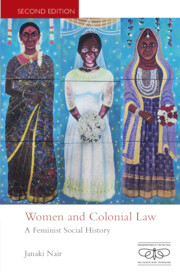
Women and Colonial Law
- A Feminist Social History
-
- Published online:
- 28 February 2025
- Print publication:
- 10 April 2025
-
- Book
-
- You have access
- Open access
- Export citation
‘Monarchical modern’: the making of Mysore city, 1880–1940
-
- Journal:
- Urban History / Volume 51 / Issue 1 / February 2024
- Published online by Cambridge University Press:
- 22 November 2022, pp. 61-87
-
- Article
- Export citation
An Inheritance of Loss: The king's debt, women's wills, and public charity in princely Mysore
-
- Journal:
- Modern Asian Studies / Volume 55 / Issue 2 / March 2021
- Published online by Cambridge University Press:
- 15 May 2020, pp. 429-467
-
- Article
- Export citation
