To save content items to your account,
please confirm that you agree to abide by our usage policies.
If this is the first time you use this feature, you will be asked to authorise Cambridge Core to connect with your account.
Find out more about saving content to .
To save content items to your Kindle, first ensure no-reply@cambridge.org
is added to your Approved Personal Document E-mail List under your Personal Document Settings
on the Manage Your Content and Devices page of your Amazon account. Then enter the ‘name’ part
of your Kindle email address below.
Find out more about saving to your Kindle.
Note you can select to save to either the @free.kindle.com or @kindle.com variations.
‘@free.kindle.com’ emails are free but can only be saved to your device when it is connected to wi-fi.
‘@kindle.com’ emails can be delivered even when you are not connected to wi-fi, but note that service fees apply.
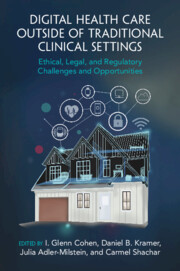
Health care delivery is shifting away from the clinic and into the home. Even prior to the COVID-19 pandemic, the use of telehealth, wearable sensors, ambient surveillance, and other products was on the rise. In the coming years, patients will increasingly interact with digital products at every stage of their care, such as using wearable sensors to monitor changes in temperature or blood pressure, conducting self-directed testing before virtually meeting with a physician for a diagnosis, and using smart pills to document their adherence to prescribed treatments. This volume reflects on the explosion of at-home digital health care and explores the ethical, legal, regulatory, and reimbursement impacts of this shift away from the twentieth-century focus on clinics and hospitals toward a more modern health care model. This title is also available as Open Access on Cambridge Core.
Health care delivery is shifting away from the clinic and into the home. Even prior to the COVID-19 pandemic, the use of telehealth, wearable sensors, ambient surveillance, and other products was on the rise. In the coming years, patients will increasingly interact with digital products at every stage of their care, such as using wearable sensors to monitor changes in temperature or blood pressure, conducting self-directed testing before virtually meeting with a physician for a diagnosis, and using smart pills to document their adherence to prescribed treatments. This volume reflects on the explosion of at-home digital health care and explores the ethical, legal, regulatory, and reimbursement impacts of this shift away from the 20th-century focus on clinics and hospitals towards a more modern health care model. This title is also available as Open Access on Cambridge Core.
OBJECTIVES/GOALS: The objective of this study is to examine the associated changes in the EHR use patterns after the widespread implementation of telehealth in the ambulatory care setting after the COVID pandemic. METHODS/STUDY POPULATION: The study sample will be all attending ambulatory care physicians at UCSF Health. Signal measures captured by Epic Systems are markers of EHR use pattern that characterize EHR use at the individual provider level in terms of time spent performing certain activities, time spent at particular times of the day, and the number of EHR tools being used. We will use the Single Interrupted Time Series framework to analyze the changes in Signal measures that occur after the widespread implementation of telehealth with pre-telehealth time period defined as Jan 2018 – Feb 2020 and post-telehealth time period defined as March 2020 – present. RESULTS/ANTICIPATED RESULTS: The outcomes of this study will reveal how the increased use of telehealth following the COVID pandemic has changed the way providers utilize various functions within EHR (e.g. time in EHR at particular time of day, documentation, medication and non-medication orders, chart review, etc). These results can, in turn, inform us potential impacts of increased telehealth use on physician burnout given that a number of markers of EHR use pattern (i.e. Signal measures) in previous studies have been associated with burnout. In addition, a stratified version of Interrupted Time Series by specialty and clinical work volume may inform us how different subgroups of providers exhibit varying EHR use patterns in response to the increased use of telehealth. DISCUSSION/SIGNIFICANCE: The use of telehealth will likely remain a strong presence in health care delivery in the post-COVID era. This study can serve as a baseline study on the influence of telehealth on EHR use. Future studies may focus on potential targeted interventions to best support the usage of telehealth.
Recommend this
Email your librarian or administrator to recommend adding this to your organisation's collection.